Mohamed Ali Mosque: Albanian History in the Heart of Cairo
Mohamed Ali was Albanian, spoke no Arabic when he seized Egypt, and built a mosque in the Ottoman style his Ottoman overlords had perfected. Cairo's skyline has never recovered.

Quick Facts
- Best time to visit
- October to April, arriving at 8am on weekday mornings for the lightest crowds and best interior light
- Entrance fee
- EGP 450 (approx $9 USD) for the full Citadel complex, students EGP 225 with valid ID
- Opening hours
- Daily 8am to 5pm. Avoid midday on Fridays during prayer times.
- How to get there
- Uber from Downtown Cairo: EGP 40 to 70. Microbus from Ataba Square: EGP 5. Metro Line 1 to Mar Girgis then microbus or 15-minute walk.
- Time needed
- 2 to 3 hours for the mosque and Citadel complex alone. Half-day if combining with Sultan Hassan and Al-Rifa'i mosques.
- Cost range
- Budget EGP 500 to 700 including transport and entry. Add EGP 150 to 250 for a private guide.
Quick Facts
Best time to visit: October to April, early morning on weekdays Entrance fee: Included in the Citadel complex ticket: EGP 450 (approx $9 USD), students EGP 225. Foreign tourists pay more; keep your student ID if relevant. Opening hours: Daily 8am to 5pm. The mosque itself closes briefly during Friday prayers; plan around midday on Fridays. How to get there: Cairo Metro Line 1 to Mar Girgis, then a microbus or Uber to the Citadel gate (Bab al-Gabal). Uber from Downtown Cairo runs EGP 40 to 70. A microbus from Ataba Square costs EGP 5 and drops you at the base of the hill. Taxis from Zamalek are roughly EGP 80 to 120 depending on traffic. Time needed: 2 to 3 hours for the Citadel complex, 45 minutes minimum inside the mosque alone. Cost range: Budget EGP 500 to 700 including transport and entry. Add EGP 100 to 150 if you hire an on-site guide, which is worth doing.
---
Mohamed Ali Pasha, the man whose mosque dominates Cairo's skyline from every angle in the city, never intended to become the founder of modern Egypt. He was born in Kavala, in what is now northern Greece, probably in 1769, the son of an Albanian tobacco merchant. His mother tongue was Albanian. He spoke Ottoman Turkish as a second language. He arrived in Egypt in 1801 as a junior officer in an Ottoman military expedition to expel Napoleon's forces. Fourteen years later, after a campaign of extraordinary ruthlessness and political cunning, he ruled the country. He never became fluent in Arabic.
This is the man whose silhouette Cairo identifies with. Understanding that paradox is the whole point of going to the Citadel.
Why This Place Matters
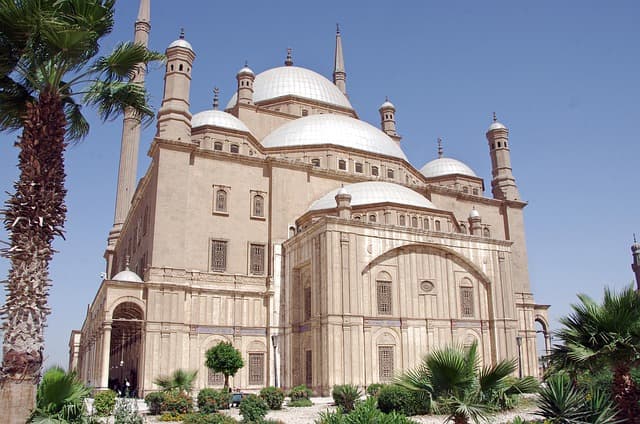
The Citadel of Saladin has been the seat of Egyptian power for longer than most European nations have existed. Salah al-Din al-Ayyubi began construction in 1176 using stone quarried from the smaller Giza pyramids, a fact the tourist brochures tend to omit. For seven centuries after that, every ruler of Egypt governed from this hill. The Mamluks expanded it. The Ottomans modified it. Napoleon's forces looted it. And then Mohamed Ali rebuilt it almost entirely in his own image, tearing down Mamluk structures to construct the mosque that bears his name.
The mosque was designed by a Greek-Armenian architect named Yusuf Bushnak and modeled closely on the Sultan Ahmed Mosque in Istanbul, the so-called Blue Mosque, completed in 1616. This is not a coincidence of aesthetic preference. It was a political statement. Mohamed Ali was technically a vassal of the Ottoman Sultan, and by building in the Ottoman imperial style, he was simultaneously paying tribute to and competing with Constantinople. He wanted a building that would announce Cairo as the capital of a power to be reckoned with, not a provincial backwater.
Construction began in 1830 and was not completed until 1857, fourteen years after Mohamed Ali died and under his successors. He is buried inside, in a white marble tomb near the entrance on the right. It is modest in a way that surprises most visitors, given the scale of everything else.
What You Will Actually See: The Architecture
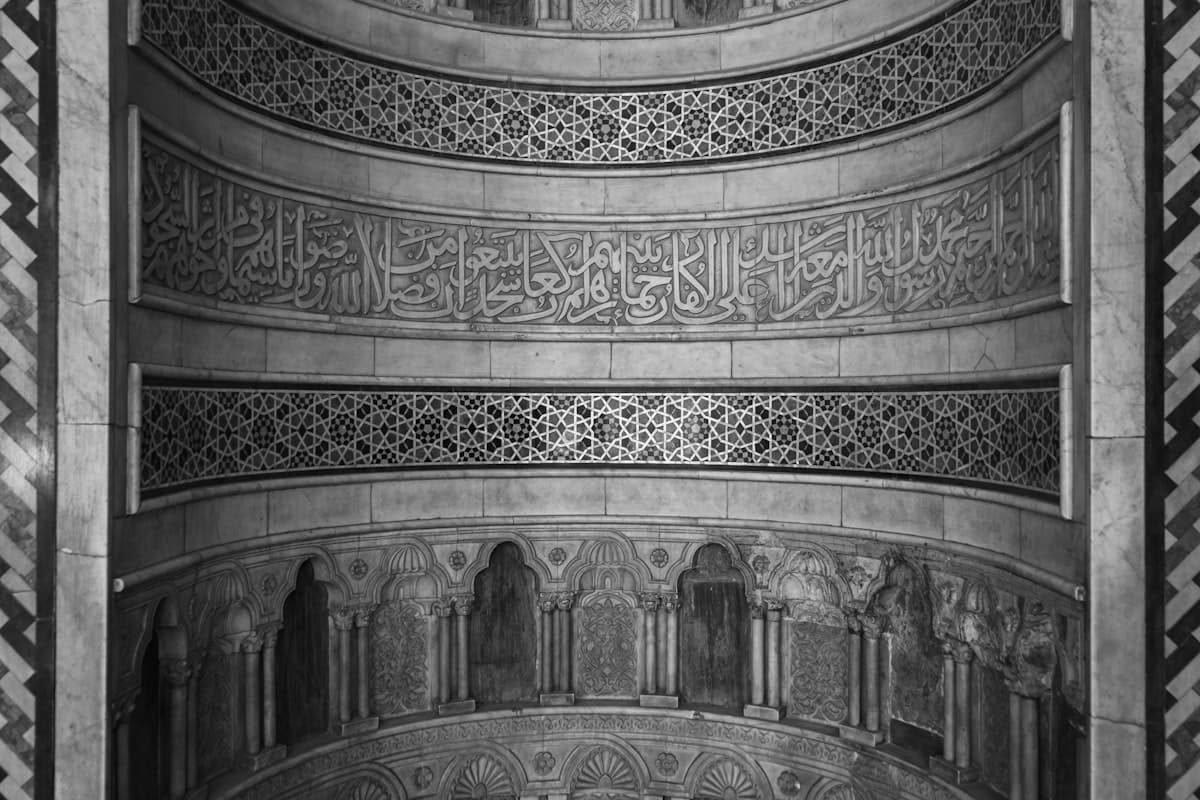
The mosque's two minarets are 82 meters tall. They are pencil-thin in the Ottoman style, quite unlike the shorter, stockier minarets of earlier Cairene mosques, which tells you immediately that you are standing inside a deliberate break from local tradition. Inside, the central dome reaches 52 meters at its peak. The interior is covered in alabaster from Luxor up to the height of the windows, which is where the mosque gets its less-used name: the Alabaster Mosque. The stone catches light differently at different hours. At 9am in winter, when the sun comes through the eastern windows at a low angle, the walls turn the color of old bone and warm amber simultaneously. Come then if you can.
In the courtyard stands a clock tower that has never worked. It was a diplomatic gift from King Louis-Philippe of France in 1846, exchanged for the obelisk from Luxor Temple that now stands in the Place de la Concorde in Paris. The French sent a clock that arrived broken and was never repaired. The Egyptians sent a 3,200-year-old obelisk carved under Ramesses II. France has the better end of that trade, and Egyptians will tell you so.
The Human Story Behind Mohamed Ali's Rise
The Albanian history Egypt and Mohamed Ali are linked through a single act of calculated violence that changed everything. On March 1, 1811, Mohamed Ali invited 470 Mamluk leaders to the Citadel for a celebration honoring his son's appointment to command a military campaign. As the procession moved through the narrow passage known as the Gate of the Azab, the gates were sealed and his soldiers opened fire from the walls above. Every Mamluk was killed. The Mamluks had ruled Egypt for 267 years. Mohamed Ali ended their power in an afternoon.
This event matters for understanding the mosque you are standing in. He built it on a Citadel cleared of Mamluk structures, in a style that owed nothing to Mamluk Egypt, funded by an economy he reorganized from the ground up by abolishing tax farming, nationalizing land, and forcing Egyptian peasants into cotton monoculture to supply European textile mills. His modernization project was genuine and brutal in equal measure. The cotton economy he built made Egypt extraordinarily profitable and laid the groundwork for the Suez Canal debt crisis seventy years later that would result in British occupation.
His descendants ruled Egypt until 1952, when Naguib and then Nasser ended the monarchy. His great-great-grandson Farouk was the last king. The family line from an Albanian tobacco merchant's son to a deposed king spans 150 years and the entire arc of modern Egyptian history.
What Most Visitors Walk Past
To the left as you enter the mosque's outer courtyard, there are the remains of the Al-Nasir Muhammad Mosque, built by the Mamluk Sultan Al-Nasir Muhammad between 1318 and 1335. Mohamed Ali demolished most of it. What remains is a single Gothic doorway, taken from a Crusader church in Acre after the Mamluk conquest of that city in 1291. It is one of the only pieces of Crusader architecture in Egypt and almost no one stops to look at it. The doorway predates the mosque around it by five centuries and arrived in Cairo as war spoils. Run your hand along the stone if you want to touch something that was carved in a Crusader port city and has been standing on this hill for 700 years.
Also worth finding: the Military Museum inside the Citadel complex, housed in what was Mohamed Ali's Harem Palace. It contains his personal belongings, his military uniforms, and a remarkably candid account of his Albanian origins. The displays are in Arabic and English. Budget 30 minutes.
The Connections
The Citadel sits on the Muqattam escarpment above medieval Islamic Cairo, and the view from its ramparts is the best free lesson in Cairo's layered geography you will find. Directly below you is the City of the Dead, the vast necropolis where Cairo's living and dead have coexisted since the Fatimid period. To the northwest you can see the minarets of Ibn Tulun, built in 879 by an Abbasid governor of Turkic origin who modeled his mosque on the great mosque of Samarra in Iraq. Behind you, if you turn south, the Muqattam hills were the source of limestone for the Giza pyramid casing stones.
The Albanian history Egypt connection does not end with Mohamed Ali. His military recruits included Albanians, Sudanese, and eventually a deliberately French-trained Egyptian officer class. The French advisors he brought in to train his army were the intellectual descendants of Napoleon's expedition, and their presence in Egypt through the 1820s and 1830s helped transmit European scientific and medical knowledge into the Arab world. The School of Medicine Mohamed Ali founded in Cairo in 1827 was the first modern medical school in the Arab world. Its first director was a French doctor named Antoine Barthélemy Clot, known in Cairo as Clot Bey. The institution he built became today's Kasr Al-Ainy Hospital, still Cairo's largest public hospital.
The Ottoman style of the mosque connects physically to the rest of Islamic Cairo. Walk downhill from the Citadel through the Bab Zuwayla gate into the Fatimid city, and you pass through 900 years of Islamic architecture in 20 minutes: Fatimid, Ayyubid, Mamluk, Ottoman, and the occasional colonial-era intrusion. Mohamed Ali's mosque sits at the end of that sequence, not the beginning.
Common Mistakes
Buying a ticket only for the mosque. There is no separate ticket for the mosque. Your EGP 450 covers the entire Citadel complex, including the National Military Museum, the Police Museum, the Al-Gawhara Palace Museum, and the remains of earlier Mamluk structures. Most visitors pay the full price and see 20 percent of what is available. Spend the whole morning.
Visiting at midday in summer. The mosque courtyard is entirely exposed stone and marble with no shade. In July and August, the surface temperature in that courtyard exceeds 50°C. The alabaster interior of the mosque stays cooler, but getting there from the gate in summer heat is genuinely unpleasant. October to April, before 10am, is the correct answer.
Taking the tour bus package that combines this with Khan el-Khalili. These packages give you 45 minutes at the Citadel, which is not enough time to get through the mosque and the courtyard properly. The Khan el-Khalili portion of these tours deposits you in the most tourist-facing section of the bazaar for 30 minutes. Skip the packaged tour entirely. Hire a private guide for the Citadel alone (roughly EGP 150 to 250 for two hours) or go independently.
The sound and light show. It costs EGP 350, runs twice a week, and tells you nothing about Mohamed Ali or the Citadel's actual history that you will not learn from spending 20 minutes with a good guide or this article. The colored lighting is not illuminating in any sense. Skip it.
Ignoring the Al-Nasir Muhammad remains. The Crusader doorway described above is the kind of specific historical artifact that changes how you understand a place. It takes three minutes. Do not walk past it.
Leaving without looking back at the city. The rampart view north and west over Cairo is one of the genuinely useful panoramic views in the city, because Cairo has very few elevated vantage points. From here you can orient yourself spatially: the Nile, the pyramids on the horizon on clear days, the minarets of Ibn Tulun, the dome of the Sultan Hassan Mosque directly below. Spend ten minutes doing this before you leave.
Dressing without thinking about it. The mosque requires covered shoulders and knees for everyone, and women will be asked to cover their hair. There are coverings available to borrow at the entrance, but they are thin and uncomfortable. Bring your own scarf and loose trousers. You will also remove your shoes; the floor is cold marble in winter and warm stone in summer, and plastic bags are sometimes offered. Bring clean socks.
Practical Tips
The best days to visit are Sunday through Thursday, arriving at 8am when the gates open. Friday mornings before noon are very crowded for the prayer, and Saturday afternoons attract significant domestic tourism. Weekday mornings in winter are the quietest combination.
There is no reliable Wi-Fi inside the complex. Download an offline map and any reference material before you arrive. The official ticketing window is at Bab al-Gabal, the main lower gate. Do not pay anyone outside this gate for entry; they are not official.
The on-site guides who approach you at the entrance are of variable quality. If you want one, ask specifically about their knowledge of the Ottoman period and Mohamed Ali's Albanian origins. If they give you a coherent two-sentence answer, they know the site. If they pivot immediately to stories about curses and treasure, walk on.
From the Citadel, the Sultan Hassan Mosque and the Al-Rifa'i Mosque are a five-minute walk downhill and worth combining into the same morning. Sultan Hassan, built 1356 to 1363, is architecturally more sophisticated than what Mohamed Ali built 500 years later, which is either a commentary on the Mamluk achievement or the limits of Mohamed Ali's Ottoman borrowings, depending on your perspective. Both readings are defensible.
Frequently Asked Questions
The Weekly Dispatch
More on Egypt, every Friday.
Cultural depth and places most guides never mention.
No spam. Unsubscribe anytime.