Mohamed Ali Mosque: Albanian History That Remade Egypt
Mohamed Ali was an Albanian soldier who never learned Arabic. He founded a dynasty that ruled Egypt for 150 years. His mosque is built on the bones of a Mamluk palace.

Audio Guide: Mohamed Ali Mosque: Albanian History That Remade Egypt
Quick Facts
- Best time to visit
- October through March. Arrive before 9am to avoid tour groups. Summer visits are possible but the exposed plateau is brutal from 11am onward.
- Entrance fee
- EGP 450 (approx. $9 USD) for foreigners; EGP 100 Egyptian adults; EGP 50 Egyptian students. Covers the full Citadel compound including the mosque.
- Opening hours
- Daily 8am to 5pm. The mosque closes briefly for Friday prayers. Last entry to the Citadel is 4:30pm.
- How to get there
- Metro to Mar Girgis (Line 1, EGP 8) then microbus (EGP 3) or taxi. Uber or taxi from Downtown Cairo runs EGP 80 to 120. No direct metro stop at the Citadel.
- Time needed
- 2 hours minimum for mosque only. Half-day (3-4 hours) to include al-Nasir Muhammad Mosque and Military Museum. Full day if combining with Ibn Tulun and the Fatimid city.
- Cost range
- Budget: under EGP 600 including transport and entrance. Mid-range with licensed guide and lunch: EGP 1,500 to 2,000.
Quick Facts
Best time to visit: October through March, arriving before 9am to beat tour groups and catch the morning light through the mosque's alabaster windows.
Entrance fee: The Citadel complex costs EGP 450 (approx. $9 USD) for foreigners, EGP 100 for Egyptian adults, EGP 50 for Egyptian students. The Mohamed Ali Mosque is included in the Citadel ticket. A separate ticket is not required.
Opening hours: Daily 8am to 5pm. The mosque itself closes briefly during Friday prayers. Plan accordingly.
How to get there: A Cairo Metro ride to Mar Girgis station (Line 1, EGP 8) followed by a 20-minute walk or a short microbus ride (EGP 3) along Salah Salem Road. From Downtown Cairo, a taxi or Uber costs roughly EGP 80 to 120 depending on traffic. The Citadel is not walkable from most hotels without significant effort.
Time needed: Two hours minimum for the mosque and the Citadel's two main museums. A half-day if you intend to walk the full compound and visit the Military Museum and the Carriage Museum.
Cost range: Budget visitors can do the Citadel and mosque for under EGP 600 including transport. Mid-range, adding a guided tour and lunch at a nearby Cairene restaurant, runs EGP 1,500 to 2,000.
---
Why This Place Matters
![[The Citadel and the Mosque of Mohammed Ali, Cairo]](/_next/image?url=https%3A%2F%2Fpub-04554b4ed1074e4a91148d8c5d76943b.r2.dev%2Fimages%2Fmohamed-ali-mosque-albanian-history-that-remade-egypt%2F1.jpg&w=3840&q=75)
Mohamed Ali Pasha, the man whose name is on every other school, street, and public square in modern Egypt, was born in Kavala in 1769. Kavala is in present-day Greece, then part of the Ottoman Empire, and his mother tongue was Albanian. He arrived in Egypt in 1801 not as a conqueror but as a minor Ottoman officer commanding a regiment of Albanian soldiers sent to push out Napoleon's occupying forces. Within five years, through a combination of tactical brutality and political genius, he had made himself the undisputed ruler of the country. He never became fluent in Arabic. He died, mentally incapacitated, in 1849, after transforming Egypt from an Ottoman backwater into the most modern state in the Arab world.
The mosque he commissioned in 1830 sits at the highest point of the Citadel of Saladin, which itself was built between 1176 and 1183 by the Kurdish-born Saladin on a rocky spur of the Muqattam Hills. Mohamed Ali demolished three existing Mamluk mosques to clear the site. He then hired a Greek-Ottoman architect named Yusuf Boshnak, who drew inspiration directly from the Sultan Ahmed Mosque in Istanbul. The result is not an Egyptian building. It is an Ottoman building, built by an Albanian ruler, on a Mamluk fortress, on a Pharaonic limestone ridge, in the middle of Cairo. That sentence alone is the history of this country.
---
The Man Inside the Building
Most visitors photograph the twin minarets and the alabaster-clad exterior and move on. The alabaster itself deserves a pause: the lower half of the mosque's exterior walls are sheathed entirely in alabaster quarried from Beni Suef, roughly 120 kilometers south of Cairo. The technique of using alabaster for large-scale exterior cladding on a mosque was unprecedented in Egyptian Islamic architecture. Mohamed Ali was making a deliberate visual argument: this building would look like nothing that had come before it.
Inside, the central dome rises to 52 meters. Four semi-domes carry the weight outward toward the walls, a classic Ottoman structural solution that Mohamed Ali's architect borrowed wholesale from Istanbul. The French clock in the courtyard, an ornate nineteenth-century mechanism mounted on a square tower near the ablution fountain, was a gift from King Louis Philippe of France in 1845, given in exchange for the obelisk that now stands in the Place de la Concorde in Paris. Louis Philippe got the better deal. The clock has never worked properly.
Mohamed Ali's tomb is in the southern corner of the mosque, enclosed in a white marble screen. He is the only member of his dynasty buried here. His descendants, the khedives and kings who ruled Egypt until 1952, are buried elsewhere around Cairo. The dynasty he founded ended when his great-great-grandson King Farouk was deposed by Nasser's Free Officers and sailed into exile from Alexandria, a city Mohamed Ali had personally rebuilt.
---
What the Citadel Was Before Mohamed Ali Arrived
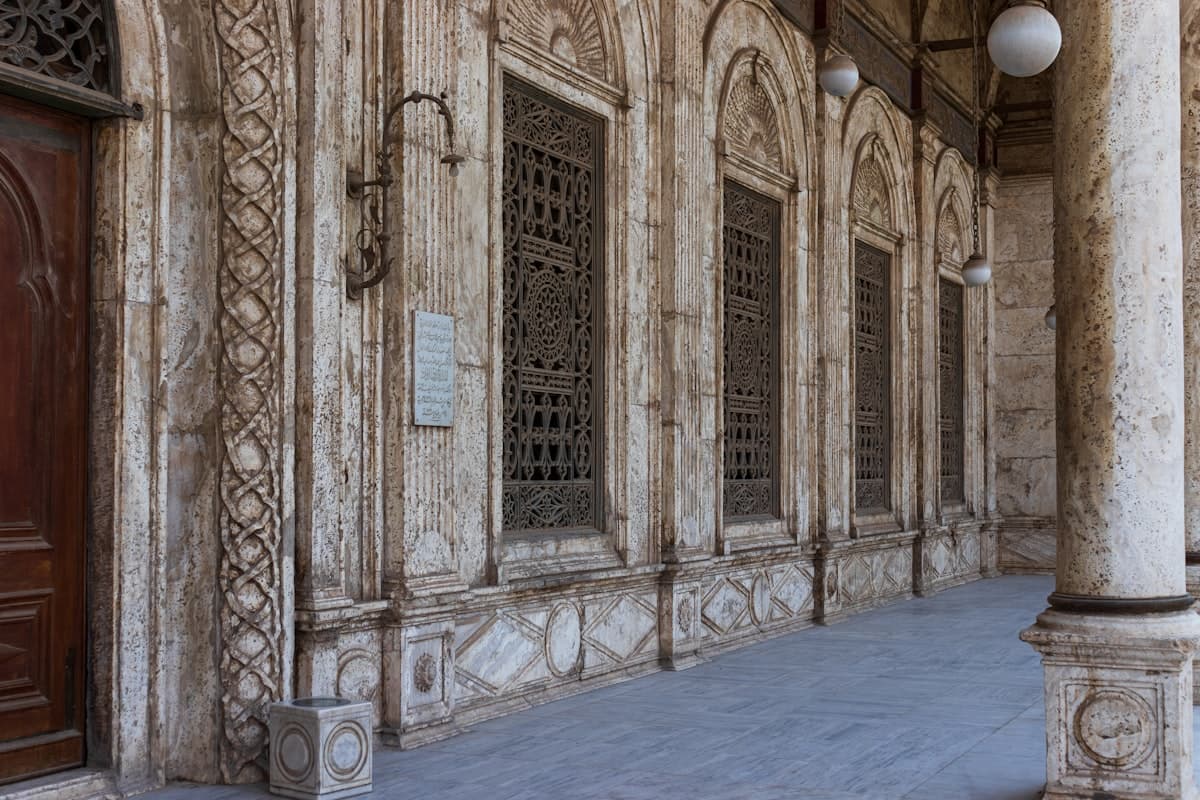
To understand what Mohamed Ali inherited and destroyed, you need to know what the Citadel was before him. Saladin began it in 1176 as a military headquarters and never lived to see it finished. The Mamluk sultans who came after him turned it into the seat of Islamic power in the eastern Mediterranean world for three centuries. At its height, the Citadel contained palaces, barracks, granaries, a hippodrome, and the Ablaq Palace, a striped black-and-white marble structure built by Sultan al-Nasir Muhammad in 1315 that contemporary accounts described as the most beautiful building in the Islamic world.
Mohamed Ali demolished most of it. The Ablaq Palace is gone. The great Mamluk congregational mosque that dominated the northern end of the compound was torn down to make room for the new mosque. What survives from the Mamluk period is the al-Nasir Muhammad Mosque, begun in 1318 and still standing in the northern enclosure of the Citadel, its Gothic-influenced portico a bizarre architectural echo of the Crusader-era buildings the Mamluks had looted for materials. The portico columns were actually taken from a church in Acre after the Mamluks expelled the Crusaders in 1291. Nobody on any tour group ever stops to explain this.
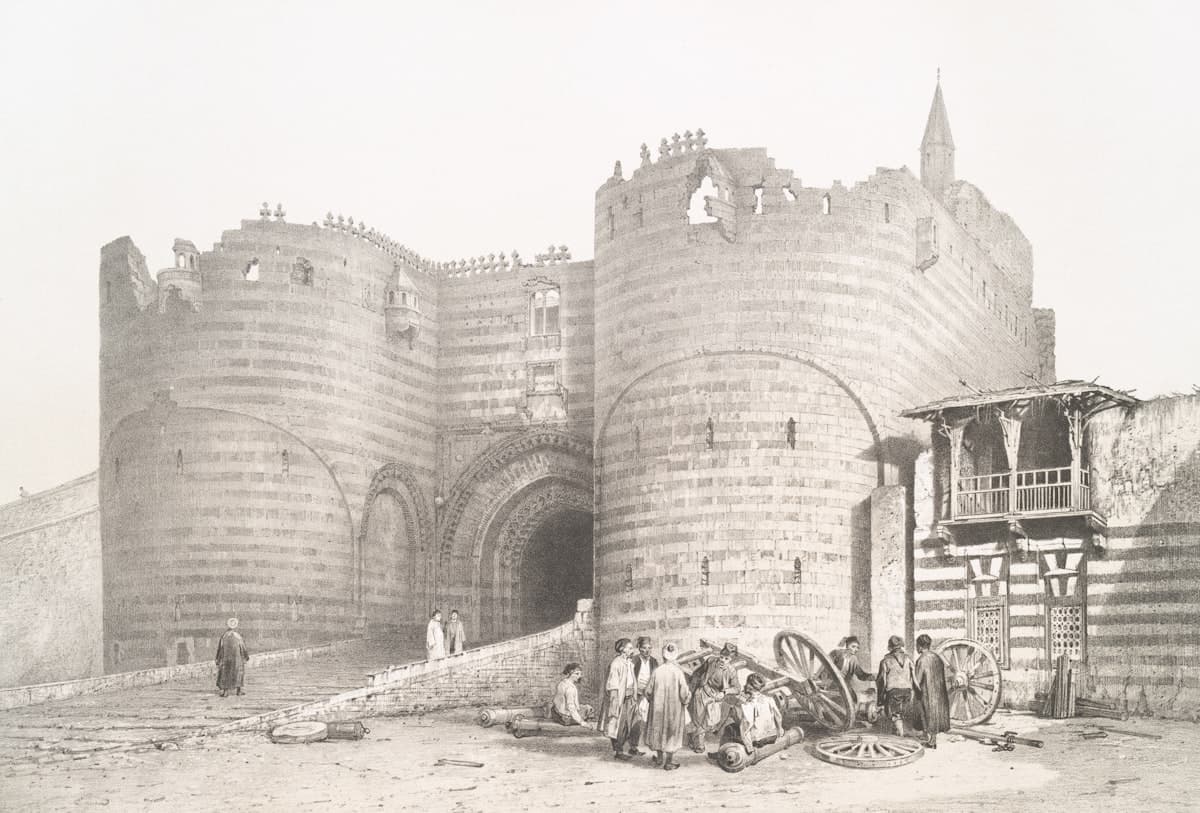
The Mamluks themselves require a word here because their story is essential to understanding why Mohamed Ali's rise was so violent. The Mamluks were slave soldiers, originally Turkic and Circassian men purchased as boys and trained as an elite military caste. They had ruled Egypt since 1250. By the time Mohamed Ali arrived in 1801, they were factionalized and weakened but still capable of violence. In 1811, Mohamed Ali invited the Mamluk leaders to a banquet at the Citadel to celebrate his son's appointment as commander of a military campaign. After the feast, as the Mamluk leaders rode in procession through the Bab al-Azab gate passage below the Citadel, Mohamed Ali's soldiers opened fire from the walls above. The number killed that day is disputed: most Egyptian historians put it at around 470 men. This event, known as the Massacre of the Citadel, effectively ended Mamluk power in Egypt after more than five centuries.
---
The Connections
The Citadel sits at the intersection of almost every layer of Cairo's history, and the Mohamed Ali Mosque is only the most visible layer.
Below the Citadel, in the neighborhood of Old Cairo, the Roman fortress of Babylon dates to the first century AD. The Coptic churches built inside its walls, including the Hanging Church (al-Muallaqah), sit directly on Roman towers. The street level of Roman Cairo is roughly nine meters below the current street level.
The Fatimid walls of Cairo, built between 1087 and 1092 by the Armenian general Badr al-Jamali, connect the Citadel area to the medieval city to the north. The street called Sharia al-Muizz, which runs through the heart of the Fatimid city, contains the highest concentration of medieval Islamic architecture anywhere in the world, a fact that is easy to miss because it looks like an ordinary Cairo street.
Mohamed Ali's own legacy extends south and east. His industrialization program in the 1820s and 1830s included Egypt's first modern textile factories, built in Upper Egypt and staffed in part by forced labor. His military campaigns in Sudan established Egyptian control over Khartoum and opened the Nile trade to Cairo merchants. The canal infrastructure he ordered dug in the Delta is the basis of the modern Egyptian irrigation system. He was, depending on your perspective, the father of modern Egypt or the man who mortgaged it to European creditors before it had any choice in the matter. Possibly both.
---
Common Mistakes
Visiting at midday in summer. The Citadel plateau is fully exposed to the sun with almost no shade. Between June and August, the stones absorb heat and radiate it back at you from below. The morning light is better for photography anyway.
Paying for a guide at the gate. Unofficial guides approach at the main entrance and offer tours for EGP 200 to 300. Most of them know the building's architectural features but nothing about Mohamed Ali's political history, Albanian origins, or the Mamluk context. Read this article instead, or hire a licensed guide through a reputable agency in advance for EGP 400 to 600 who can connect the dots.
Skipping the al-Nasir Muhammad Mosque. Almost every tour group walks past it to reach the Mohamed Ali Mosque. It is quieter, more intimate, and the stolen Crusader portico columns are one of the most interesting architectural details anywhere in Cairo. It takes twenty minutes and costs nothing beyond the Citadel ticket.
Spending money on the sound and light show at the Citadel. It costs EGP 400, runs for forty-five minutes, and covers less historical ground than this article. The night view of Cairo from the Citadel is worth having, but you can get it by standing at the terrace outside the Mohamed Ali Mosque for free after paying the entrance fee.
Entering without appropriate clothing. The mosque is an active place of worship. Shoulders and knees must be covered. Shoe removal is required. Women are not required to cover their hair, though scarves are available at the entrance. Bring your own if you prefer.
Treating the two museums as optional. The Military Museum is housed in the Harim Palace built by Mohamed Ali himself in 1827. The building is the thing. The exhibits are secondary. The Carriage Museum contains the gilded state carriages used by Mohamed Ali's descendants through the early twentieth century and gives you a direct visual sense of how the dynasty chose to present itself.
Conflating Mohamed Ali Pasha with Muhammad Ali the boxer. Not a mistake made by Egyptians, but by a surprising number of English-speaking visitors who arrive at the Citadel expecting something related to the Louisville-born heavyweight champion. The Egyptian ruler is spelled differently in transliteration and preceded the boxer by nearly two centuries.
---
Practical Tips
Arrive when the Citadel opens at 8am. By 10am, tour buses have emptied and the Mohamed Ali Mosque interior becomes genuinely crowded, with groups standing six people deep at the carved wooden screens around the tomb.
The views from the northern terrace of the Citadel, looking out over the City of the Dead and the minarets of the Fatimid city toward the pyramids at Giza on clear days, are the best elevated views of Cairo available without paying for a rooftop restaurant. In winter and early spring, visibility extends all the way to the pyramid plateau. In summer, haze reduces visibility significantly.
If you are combining the Citadel with a walk through the Mamluk city, the logical sequence is: Citadel in the morning, then walk or take a short taxi north to the Ibn Tulun Mosque (EGP 80 entrance, the oldest intact mosque in Cairo, built in 879), then continue into the Sharia al-Muizz area in the afternoon when the light is better and the street traders have fully opened. This is a full day.
Do not eat at the restaurants immediately outside the Citadel gates. They are overpriced and trade entirely on captive tourist traffic. Walk fifteen minutes north into the Sayyida Zeinab neighborhood for Cairene food at a third of the price.
Frequently Asked Questions
The Weekly Dispatch
More on Egypt, every Friday.
Cultural depth and places most guides never mention.
No spam. Unsubscribe anytime.