Mohamed Ali Pasha: Albanian Heritage and Power in Cairo
The man who modernized Egypt was born in a small Albanian port town, spoke no Arabic, and massacred his rivals at a banquet. His mosque still dominates Cairo's skyline.
Quick Facts
- Best time to visit
- October to March for tolerable temperatures on the hilltop. Arrive before 9am any day of the week to avoid tour groups. Avoid Friday midday when the mosque closes for prayers.
- Entrance fee
- EGP 450 (approx $9 USD) for the full Citadel complex. Students with valid ID pay EGP 225. Mohamed Ali Palace at Shubra: EGP 80 (approx $1.60 USD) separately.
- Opening hours
- Daily 8am to 5pm (October to April), 8am to 6pm (May to September). Closed briefly Friday midday for prayers.
- How to get there
- Metro to Sadat or Mar Girgis station, then taxi to Bab al-Gabal gate (EGP 30 to 50 from downtown). Bus 272 from Abdel Moneim Riyad terminal. Uber from downtown Cairo typically EGP 40 to 70 depending on traffic.
- Time needed
- 2 to 3 hours for the Citadel complex alone. Add 1.5 hours if combining with Sultan Hassan Mosque below. Full day if adding Shubra Palace and Ibn Tulun Mosque.
- Cost range
- Budget day EGP 600 to 900 combining Citadel, Sultan Hassan, and local lunch. Mid-range EGP 1,500 to 2,000 adding a licensed guide and the Shubra Palace.
Quick Facts
Best time to visit: October to March, when the Citadel's hilltop position doesn't cook you alive. Early morning visits before 9am give you the mosque nearly to yourself.
Entrance fee: EGP 450 (approx $9 USD) for the Citadel complex, which includes the Mosque of Mohamed Ali, the Military Museum, and the Carriage Museum. Students with valid ID pay EGP 225.
Opening hours: Daily 8am to 5pm (winter), 8am to 6pm (summer). The mosque itself closes briefly during Friday prayers.
How to get there: From Midan Tahrir, take the metro to Sadat station, then a taxi to the Citadel's Bab al-Gabal gate (around EGP 30 to 50 from downtown). The 272 bus runs from Abdel Moneim Riyad terminal. Do not let drivers take you to nearby alabaster shops first.
Time needed: 2 to 3 hours for the Citadel complex. Add an afternoon in the Mohamed Ali Palace at Shubra (a separate site, 30 minutes north by taxi) if you want the full picture of his Albanian-Egyptian world.
Cost range: Budget EGP 600 to 900 per day combining this with Islamic Cairo. Mid-range EGP 1,500 to 2,000 including a guide.
---
Why This Place Matters
Mohamed Ali Pasha arrived in Egypt in 1801 as a junior officer commanding a 300-man Albanian contingent sent by the Ottoman Empire to help expel Napoleon's army. He was born in 1769 in Kavala, a tobacco-trading port in what is now northern Greece, to a family of Albanian origin. He spoke Albanian and Ottoman Turkish. He learned Arabic only in middle age, and imperfectly. Within four years of landing in Egypt, he had outmaneuvered the British, neutralized the Ottomans, and eliminated the Mamluks, the military caste that had controlled Egypt since the 13th century. In 1805, the Egyptian ulema, the religious scholars, declared him governor. No Khedive, no general, no colonial power had come to that position through popular religious legitimacy before.
The Mohamed Ali Pasha Albanian heritage connection is not incidental to Egyptian history. It is central to it. The dynasty he founded, which ruled Egypt until 1952, was Albanian in origin, Turkish in language and court culture, and genuinely invested in making Egypt a modern state with an Egyptian identity. This contradiction, an Albanian-speaking dynasty that built Egyptian nationalism, produced the Egypt you see today. The canal system that feeds the Delta, the first secular schools, the cotton economy that made Egypt briefly one of the wealthiest countries in the world, the army that fought the Ottomans to a standstill and briefly controlled Greater Syria: all of this came from a man who arrived as a minor foreign officer with no particular mandate.
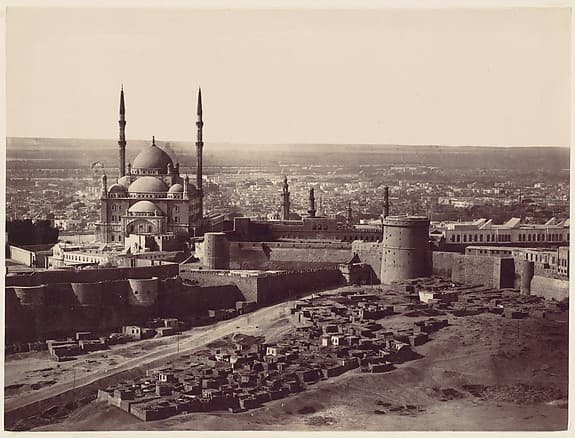
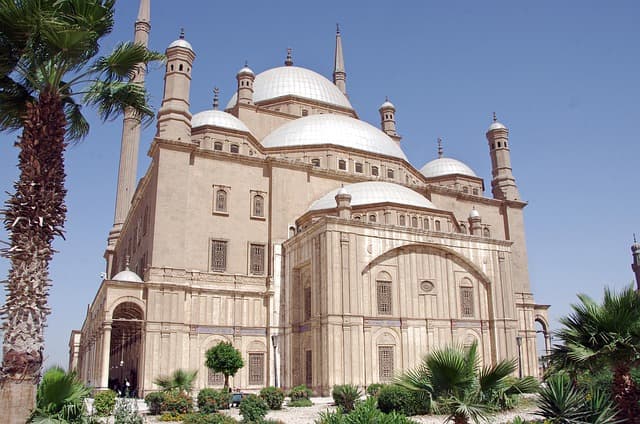
His mosque, completed in 1848 and modeled closely on the Sultan Ahmed Mosque in Istanbul, sits inside the Citadel of Saladin, the 12th-century fortress built by another foreigner who became Egypt's most celebrated ruler. The symmetry is not coincidental. Mohamed Ali understood the symbolism of building his signature monument inside Saladin's walls.
---
The Citadel, the Massacre, and What You Are Actually Walking Through
The Citadel of Saladin was begun in 1176 on a spur of the Muqattam Hills using stones stripped from the outer casing of the Giza pyramids. This is documented, not legend: medieval Arab historian al-Maqrizi wrote that Saladin's engineers found it easier to take dressed stone from the pyramids than to quarry new material from the Muqattam. When you look at the Citadel's lower courses, some of what you are seeing was shaped by Pharaonic craftsmen 4,500 years ago.
The Citadel's most famous moment under Mohamed Ali's rule happened on March 1, 1811. He invited the remaining Mamluk leaders, somewhere between 470 and 500 men depending on the source, to a celebration for his son Tusun's appointment to lead an Arabian campaign. They came in full ceremonial dress. As the procession moved through a narrow passage called the Bab al-Azab, Mohamed Ali's soldiers opened fire from the walls above. Every Mamluk in the passage was killed. One man, Amim Bey, reportedly survived by jumping his horse off the Citadel walls. His fate is disputed: some accounts say he died, others that he escaped to Upper Egypt.
You walk through the Bab al-Azab gate today without a sign marking what happened there. Most guided tours don't mention it. The Albanian officer who couldn't speak Arabic had just eliminated in a single afternoon the military class that had controlled Egypt for 500 years.
Inside the mosque itself, the Ottoman influence is explicit and deliberate. The twin minarets are pencil-thin Ottoman style, not the squat Mamluk minarets you see at the Sultan Hassan Mosque directly below. The interior is hung with hundreds of globe lights, and the acoustic is close and warm. Mohamed Ali is buried here in a white marble tomb on the right side of the entrance hall. The tomb is modest for a man who conquered most of the eastern Mediterranean. His architect, Yousuf Bushnak, was brought from Istanbul, and the interior alabaster cladding came from Luxor. The clocks in the courtyard, a gift from the French King Louis-Philippe in 1845, have never worked.
---
The Albanian Thread: From Kavala to Cairo
To understand Mohamed Ali's Albanian heritage in Egypt, you need to know what Albania meant in the Ottoman system. Albanian soldiers were prized by the Ottoman military for the same reason Circassian soldiers were: they were mountain peoples, fiercely loyal to kinship networks, and outside the Arab-Turkish ethnic matrix that complicated Ottoman politics. Mohamed Ali's specific unit, the Albanian irregulars, had a reputation for independence that verged on insubordination. This made them useful and dangerous in equal measure.
In Kavala today, the house where Mohamed Ali was born is preserved as a museum funded partly by the Egyptian government. The Egyptians send money to maintain the birthplace of their Albanian-born modernizer. This tells you something about how Egypt holds contradictions that other nations resolve through selective memory.
Back in Cairo, the Albanian influence is embedded in several places most visitors ignore. The Mohamed Ali Palace at Shubra, built between 1808 and 1821, was his pleasure palace north of Cairo, designed with a long ornamental canal leading to a pavilion that deliberately echoed Albanian lakeside architecture. The canal is gone now, but the pavilion remains, its mirrored reception hall stripped but structurally intact. Entry costs EGP 80 (approx $1.60 USD) and you will almost certainly be the only foreign visitor there.
The Manial Palace on Rhoda Island, built by his great-grandson Prince Mohamed Ali Tewfik in the early 20th century, shows what the dynasty became: a deliberate fusion of Ottoman, Moorish, Persian, and European styles, self-consciously constructing an Egyptian royal identity from multiple inheritances. The Albanian thread had by then dissolved into something more composite, which was perhaps the point all along.
---
The Connections: Everything This Site Links To
The Sultan Hassan Mosque and Madrasa, visible from the Citadel's northern walls and built between 1356 and 1363, is the most direct visual counterpoint to Mohamed Ali's mosque. Sultan Hassan was a Mamluk ruler, and the Mamluks were the military caste Mohamed Ali destroyed in 1811. The two buildings face each other across a plaza, and the architectural conversation between them is a compressed version of 600 years of Egyptian power: Mamluk military aristocracy below, Ottoman-styled Albanian modernizer above.
Below both is something most visitors never think about. The district of el-Darb el-Ahmar, which runs along the Citadel's western base, sits on the route of an ancient Pharaonic canal, the Khalij al-Masri, which the Romans maintained, which the Fatimid caliphs deepened in the 10th century, and which Mohamed Ali eventually ordered filled in during his urban modernization projects in the 1820s. The street pattern of el-Darb el-Ahmar still follows the old canal's curve. When you walk it, you are walking the ghost of a waterway that predates Islam by two thousand years.
The 19th-century cotton wealth that Mohamed Ali's agricultural reforms generated funded not only his military campaigns but also the Suez Canal, which his successor Said Pasha authorized in 1854. The canal was proposed by Ferdinand de Lesseps, who had first come to Egypt as a French consul in 1832, introduced to Egyptian society partly through connections Mohamed Ali cultivated with European powers. Pull any thread in modern Egyptian history and you find it attached to this Albanian officer from Kavala.
---
Common Mistakes
Arriving after 10am on weekends. Tour buses from Giza and downtown hotels converge on the Citadel between 10am and 1pm. The mosque's courtyard, which offers the best panoramic view of Cairo including the minarets of the Sultan Hassan Mosque below, becomes impassable. Arrive at 8am and you will share it with pigeons and a few Egyptian schoolchildren.
Skipping the Carriage Museum. Most visitors walk past it. It contains the ceremonial carriages of the Mohamed Ali dynasty and documents better than any panel text the dynasty's self-presentation: Ottoman in formal occasions, European in daily life, and insistently regal in a way that only families anxious about their legitimacy tend to be.
Taking the sound and light show. It costs EGP 400 and runs at the base of the Citadel three nights a week. It tells you nothing specific about Mohamed Ali's Albanian origins, the Mamluk massacre, or the architectural history of the complex. It tells you that Egypt is ancient and that power is dramatic. Skip it.
Not going to the Shubra Palace. Every guide recommends the Citadel and stops there. The Mohamed Ali Palace at Shubra is 20 minutes north, costs almost nothing, and shows you what his domestic life looked like as opposed to his public self-mythologizing. The two sites together form a complete portrait.
Hiring guides at the gate. Unofficial guides at the Bab al-Gabal entrance will tell you the clocks in the mosque courtyard don't work because Mohamed Ali forgot to wind them. This is not true. The more interesting truth is that Louis-Philippe sent them as a diplomatic gift in exchange for the obelisk that now stands in the Place de la Concorde in Paris. Egypt gave away a 3,200-year-old Luxor obelisk and received, in return, clocks that never worked.
Confusing the Mohammed Ali Club with the Mohamed Ali Mosque. First-time visitors sometimes spend twenty minutes in a taxi looking for Mohamed Ali's heritage while being driven to a sports and social club near Garden City that shares the name. Be specific with drivers: say "Qala'at Salah al-Din," which means Saladin's Citadel. Everyone knows it.
Rushing the view north from the mosque courtyard. The panorama from the mosque's northern terrace on a clear winter morning shows you almost the entire city: the minarets of Mamluk Cairo in the foreground, the glass towers of the New Administrative Capital rising 40 kilometers east, and the Giza plateau to the southwest. You are looking at four thousand years of urban ambition from a spot built by an Albanian officer who arrived knowing none of it and ended up shaping all of it.
---
Practical Tips
Dress codes are enforced at the mosque: shoulders and knees covered for everyone, shoes removed before entry. Shoe bags are provided free. Bring socks in winter because the marble floor is cold.
The Citadel sits at 75 meters above the surrounding city. Wind is frequent and strong, especially November through February. A layer is worth carrying even on warm days.
For the Shubra Palace, take a taxi or Uber from the Citadel (budget EGP 80 to 120). The palace is in the Shubra district, officially listed as Qasr Mohamed Ali at Shubra. It is not heavily signposted. Tell the driver "Qasr Shubra" and show the Google Maps pin.
If you want a licensed guide who specializes in the Ottoman and Albanian periods, the Egyptian Tourist Authority desk inside the Citadel can recommend certified guides. Expect to pay EGP 300 to 500 for a two-hour private tour. A good guide will take you to the Bab al-Azab passage and give you the full account of the 1811 massacre, which transforms the site from a scenic overlook into something with real moral weight.
Combine the Citadel with the Sultan Hassan Mosque and the Ibn Tulun Mosque on the same day. All three are within walking distance or a short taxi ride, and the chronological arc from 9th-century Abbasid (Ibn Tulun) to 14th-century Mamluk (Sultan Hassan) to 19th-century Albanian-Ottoman (Mohamed Ali) gives you a thousand years of Cairo in an afternoon.
Frequently Asked Questions
The Weekly Dispatch
More on Egypt, every Friday.
Cultural depth and places most guides never mention.
No spam. Unsubscribe anytime.