Mohamed Ali Pasha: Albanian Heritage and the Cairo That Built Modern Egypt
He was an Albanian tobacco merchant's son who never learned Arabic. He founded the dynasty that ruled Egypt until 1952. The mosque bearing his name is the least interesting thing about him.

Audio Guide: Mohamed Ali Pasha: Albanian Heritage and the Cairo That Built Modern Egypt
Quick Facts
- Best time to visit
- October through March for cool temperatures and clearer air. Early morning on weekdays for smaller crowds and better light.
- Entrance fee
- EGP 450 for foreigners (approx $9 USD), EGP 225 for students with valid ID. Covers entire Citadel precinct including the mosque.
- Opening hours
- Daily 8am to 5pm. Mosque accessible within those hours except during Friday midday prayer (approx 12pm to 1:30pm).
- How to get there
- Uber or taxi from Downtown Cairo: EGP 60 to 90. Metro to Sadat Station then microbus: EGP 15 total. No direct metro stop at the Citadel.
- Time needed
- 2 hours minimum for mosque and terrace. 3 to 4 hours to include Sultan Hassan and Al-Rifa'i mosques nearby.
- Cost range
- Budget EGP 600 to 900 including entry and transport. Mid-range EGP 1,500 to 2,500 with licensed guide and Islamic Cairo lunch.
Quick Facts
Best time to visit: October through March, when the Citadel plateau catches the winter light and the smog over Cairo is at its thinnest. Avoid Friday midday when the mosque fills for prayer and access is restricted.
Entrance fee: The Citadel complex (which includes the Mosque of Mohamed Ali, the Military Museum, and several other structures) costs EGP 450 for foreigners (approximately $9 USD). Students with valid ID pay EGP 225. The ticket covers the entire Saladin Citadel precinct.
Opening hours: Daily 8am to 5pm. The mosque itself stays open slightly later for evening prayer but tourists are asked to leave the main hall by 5:30pm.
How to get there: Take the Cairo Metro to Sadat Station (Line 1 and Line 2 interchange, EGP 10), then a microbus or taxi up to the Citadel gate on Salah Salem Street (roughly EGP 20 to 40 by taxi, EGP 5 by microbus if you can figure out which one to take, which you probably cannot on a first visit). Uber from central Cairo runs EGP 60 to 90 depending on traffic. Do not walk from Downtown. The hill is steep and the surrounding streets are disorienting.
Time needed: Two hours minimum for the mosque complex and its terrace views. Add another ninety minutes if you visit the Police Museum or the Carriage Museum inside the Citadel. A full morning well spent.
Cost range: Budget EGP 600 to 900 including transport and entry. Mid-range EGP 1,500 to 2,500 if you add a guided tour and lunch in Islamic Cairo afterward.
---
Why This Place Matters
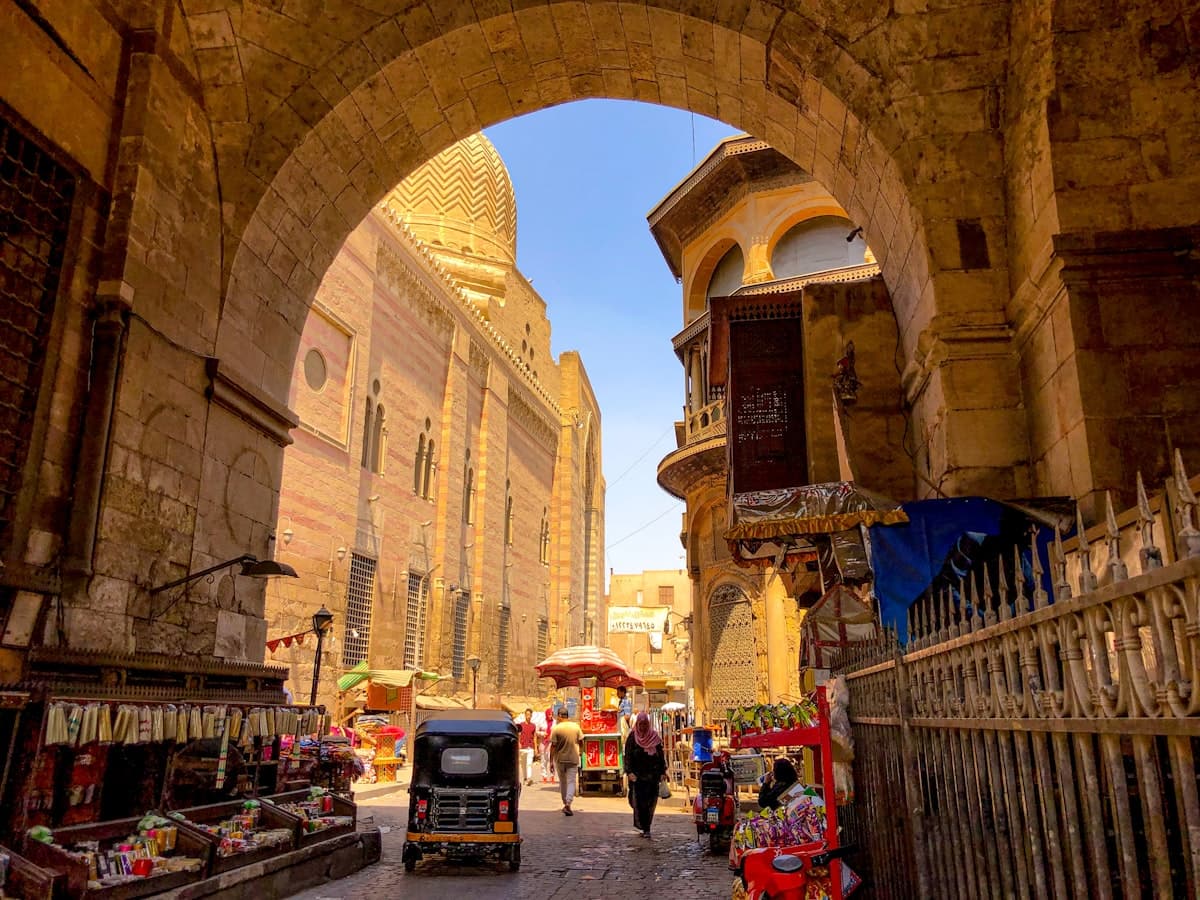
Mohamed Ali Pasha arrived in Egypt in 1801 as a junior officer in an Ottoman Albanian regiment, sent to help push out Napoleon's forces after the French occupation ended. He was approximately thirty years old, born in Kavala, in what is now northern Greece, the son of a local notable who traded tobacco and commanded a small militia. He spoke Albanian and Turkish. He never achieved fluency in Arabic. By 1805, through a combination of political maneuvering, strategic alliances with Egyptian ulema and merchants, and a willingness to eliminate rivals without sentiment, he had made himself the de facto ruler of Egypt. The Ottoman sultan in Istanbul ratified what he could not prevent.
What followed was one of the most transformative and brutal modernization campaigns in African history. Mohamed Ali Pasha's Albanian heritage shaped his methods in ways that Egyptian historians still debate. He brought with him a particular Ottoman-Balkan understanding of power: pragmatic, military-first, contemptuous of tradition when tradition got in the way. He sent Egyptian students to Paris and hired French military advisors. He conscripted Egyptian peasants into a modern army for the first time, something that had not happened since the Pharaonic period. He monopolized agriculture, industry, and trade, effectively making the Egyptian state the only employer in the country.
The dynasty he founded, the Muhammad Ali dynasty, ruled Egypt from 1805 until the Free Officers Revolution of 1952 deposed his great-great-great-grandson King Farouk. Every major Egyptian institution built between those dates, the military, the national university system, the cotton economy, the opera house, the Suez Canal company (though that required his grandson Khedive Ismail's ambitions and subsequent debt crisis), traces back to decisions he made from the Citadel above Cairo.
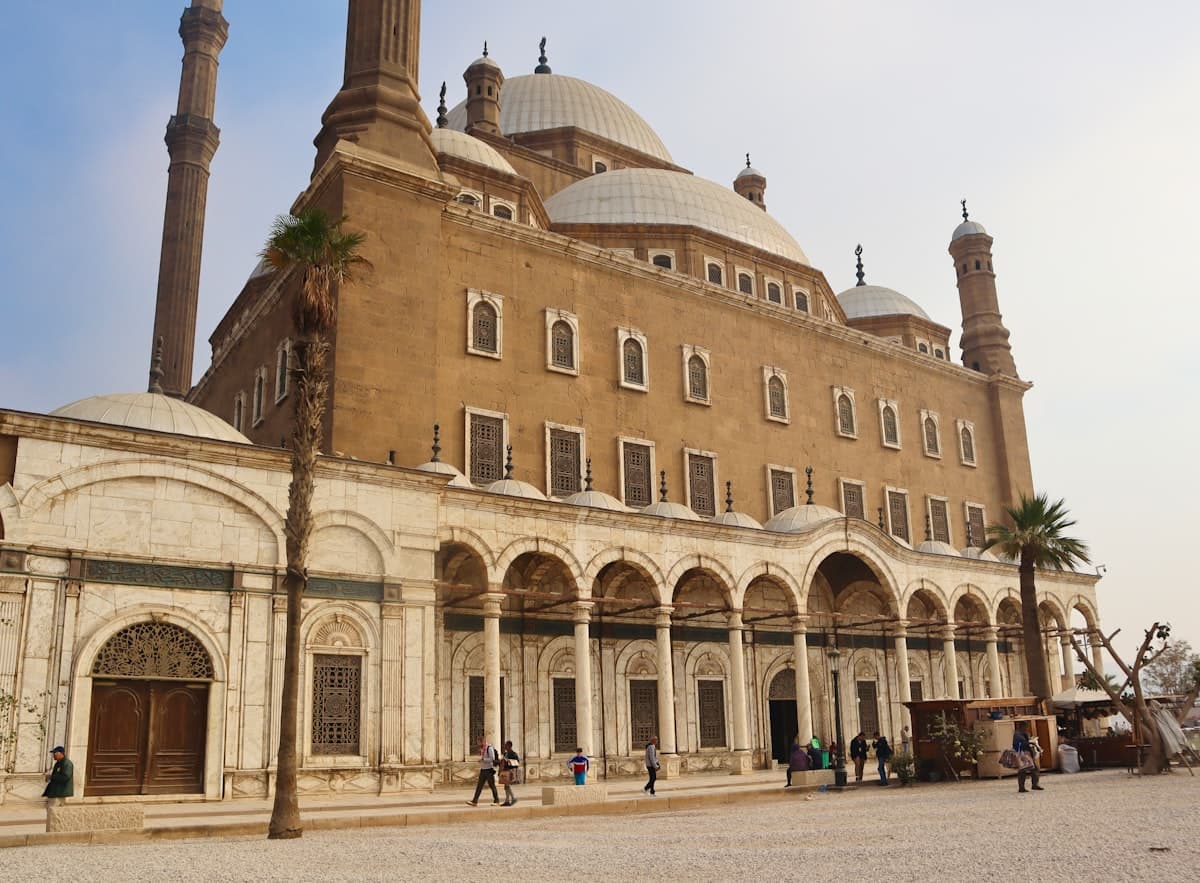
His mosque, which dominates the Cairo skyline from almost every angle in the city, was begun in 1830 and completed in 1848, the year he died in Alexandria, already suffering from dementia. He never saw it finished.
---
The Albanian Connection Most Visitors Miss
The Mosque of Mohamed Ali is usually described as Ottoman in style, and that is accurate as far as it goes. It was designed by a Greek-Armenian architect named Yusuf Bushnak, and modeled closely on the Sultan Ahmed Mosque in Istanbul. The two minarets are pencil-thin, unmistakably Ottoman, and visible from Giza on a clear morning. But the Albanian thread runs through the structure in ways that the standard guided tour ignores.
Mohamed Ali staffed his early administration heavily with Albanian officers and merchants from his home network in Kavala and the surrounding region. The Ottoman-Albanian military tradition he came from was distinct from the Mamluk military caste he inherited and then systematically destroyed. On 1 March 1811, he invited the remaining Mamluk beys, somewhere between 470 and 500 of them by most historical accounts, to a celebration at the Citadel for the investiture of his son as commander of a military campaign. When they entered the narrow passage between the Burg al-Muqattam and the lower gate, now called the Bab al-Azab, his Albanian soldiers opened fire from the walls above. Almost all of the Mamluks died in the passage. One, a man named Amin Bey, allegedly jumped his horse from the Citadel wall and survived. The Mamluk system that had ruled Egypt since 1250 effectively ended in that corridor in approximately twenty minutes.
Stand at the Bab al-Azab entrance on your visit. The gate is not always open to tourists, but the exterior is accessible and the stones of the passage are original. You are standing at the place where one civilization's military class was exterminated by a man from the Albanian highlands who had been in Egypt for less than a decade.
The mosque itself contains another overlooked detail. The large clock tower in the outer courtyard was a gift from King Louis-Philippe of France in 1846, sent in exchange for the obelisk from Luxor Temple that now stands in the Place de la Concorde in Paris. The French clock never worked properly. It is still there, still not working. The Luxor obelisk has been in Paris for nearly 180 years.
---
What You Actually See, and What It Costs to Misread It
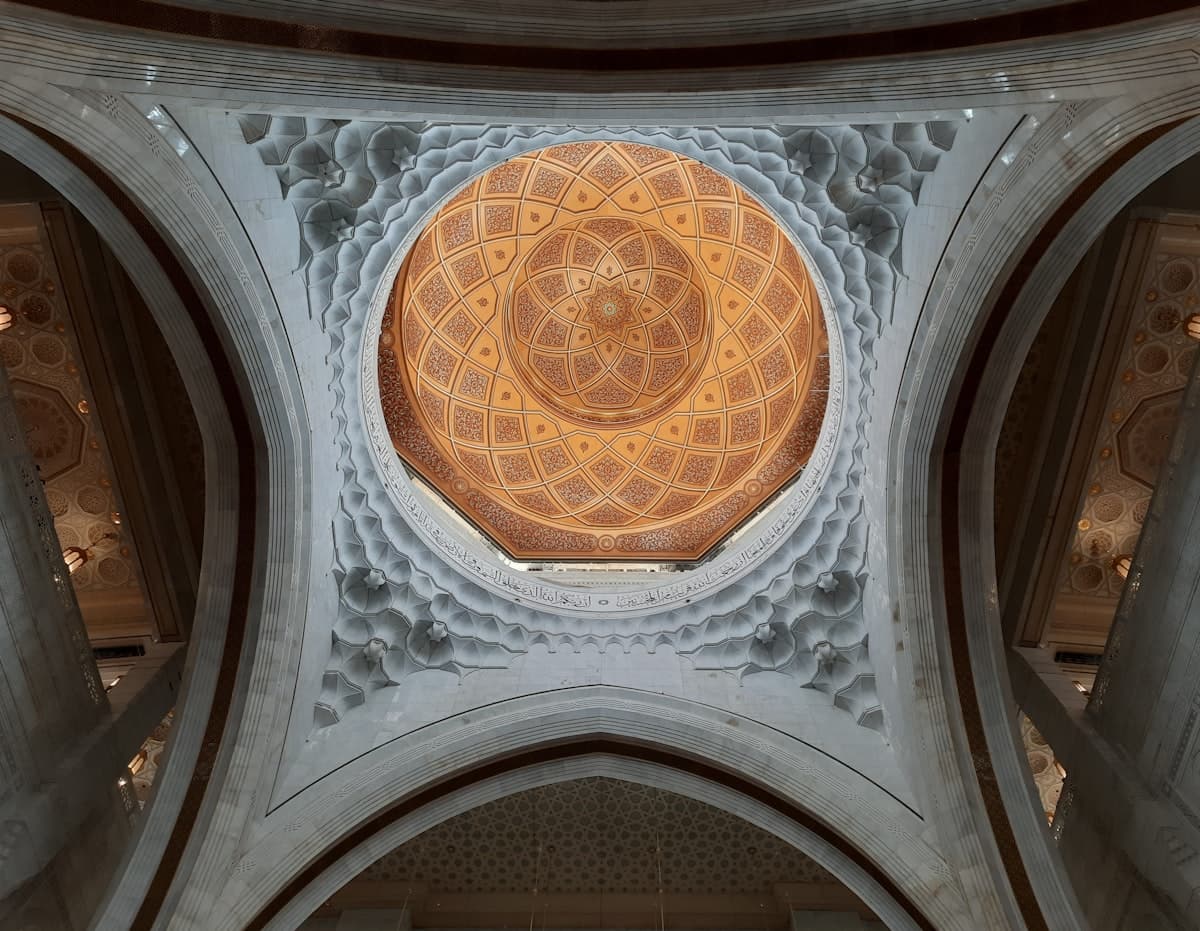
The mosque's interior is alabaster-faced, cool even in summer, lit by hundreds of hanging brass lamps. The dome rises 52 meters. The proportions are deliberate and slightly overwhelming, which was the point. Mohamed Ali built this mosque on the highest point of the Citadel, on the site of a medieval palace complex used by Mamluk sultans, over foundations that include earlier Fatimid and Ayyubid construction. The view from the terrace north of the mosque takes in the old medieval city of Cairo, the minarets of Ibn Tulun Mosque (the oldest intact mosque in Egypt, built in 879 AD), the domes of the Sultan Hassan and Al-Rifa'i mosques directly below, and on a clear day, the Giza pyramids to the southwest.
Mohamed Ali's tomb is inside the mosque, in the southwest corner behind an ornate marble screen. It is frequently walked past by tourists who do not know it is there. The man who created modern Egypt, who killed the Mamluks, built the first Egyptian army, sent the first Egyptian students to study in Europe, and whose bloodline produced both Khedive Ismail and King Farouk, is buried in a corner that most visitors photograph without registering what they are looking at.
The alabaster used throughout the interior was quarried from Hatnub, in Upper Egypt, the same quarry that supplied alabaster to New Kingdom pharaohs for canopic jars and offering tables. This was not symbolic. It was practical. Mohamed Ali controlled the quarry as part of his state monopoly on raw materials. But the continuity is real: the same Egyptian stone, extracted by Egyptian labor, used to decorate the spaces of whoever happened to be ruling Egypt at a given moment, across roughly 3,500 years of documented history.
---
The Connections: Cairo Through One Man's Ambition
Mohamed Ali's Cairo is inseparable from the Islamic Cairo that preceded it. The Citadel he governed from was built by Saladin in 1176, on a spur of the Muqattam Hills, specifically to defend the twin cities of Fustat and Cairo against Crusader attack. Saladin's own dynasty, the Ayyubids, gave way to the Mamluks he had imported as slave soldiers, who then ruled from this same Citadel for over 250 years before the Ottomans defeated the last Mamluk sultan, Tuman Bay, in 1517. Ottoman governors ruled from here for nearly three centuries before Napoleon arrived in 1798 and the entire structure of Ottoman authority in Egypt began collapsing. Mohamed Ali is, in a precise sense, the man who emerged from that collapse.
Walk fifteen minutes downhill from the Citadel to the mosque complex of Sultan Hassan, built between 1356 and 1363. It is one of the most technically audacious medieval buildings in the world: its walls are 36 meters high and its central courtyard is large enough to land a small aircraft. Sultan Hassan was a Mamluk sultan, twelve years old when he first took the throne, assassinated before his mosque was finished. The building survived because it was simply too large and too useful to demolish. Mohamed Ali's forces used it as a fortress and occasionally as an artillery position. The Mamluk stones, the Ottoman citadel, the Albanian ruler, the French clock, the Pharaonic alabaster: this is how Cairo actually works. Nothing is replaced. Everything is layered.
For travelers interested in specifically tracing Mohamed Ali Pasha's Albanian heritage in Egypt, the Manial Palace on Rhoda Island, built by his grandson Prince Mohamed Ali Tewfik between 1901 and 1929, shows what the dynasty became after four generations of intermarriage and cosmopolitan wealth. The Abdeen Palace, downtown, was built by Khedive Ismail in the 1860s and served as the royal family's main residence until 1952. Both are open to visitors and both are significantly undervisited.
---
Common Mistakes
Buying a ticket for the mosque only. There is no mosque-only ticket. The EGP 450 Citadel entry covers the entire precinct. If a tout near the gate offers to sell you a cheaper single-entry pass, it does not exist. Pay at the official booth.
Taking a guided tour that focuses only on the mosque interior. Most group tours spend forty-five minutes inside the mosque and leave. The terrace, the Bab al-Azab passage, the small Museum of Egyptian Police, and the elevated views of Islamic Cairo require at least as much time as the interior and are more instructive about who Mohamed Ali actually was and what he did.
The sound and light show at the Citadel. It runs some evenings, costs roughly EGP 300, and delivers a version of Egyptian history so simplified that it omits the Mamluk massacre entirely. Skip it. Read this article instead and spend the money on dinner in Islamic Cairo.
Visiting only the Citadel and not walking to Sultan Hassan and Al-Rifa'i. These two mosques are a five-minute walk from the Citadel's main gate and their combined entry is EGP 160 for foreigners. Al-Rifa'i Mosque contains the tomb of King Farouk, the last ruler of the dynasty Mohamed Ali founded, buried in the same building as several of his royal ancestors. The connection is almost too neat and almost nobody makes it.
Assuming the mosque is exclusively a religious site. It is an active mosque and you must remove shoes and women must cover their hair. But it is also a political monument, a dynastic statement, and a piece of nineteenth century Ottoman-Egyptian statecraft built on the ruins of everything that came before it. Treat it accordingly.
Going at midday in July or August. The Citadel plateau has almost no shade and the stone surfaces reflect heat aggressively. Morning visits before 10am are a different experience from the same site at 1pm in summer.
---
Practical Tips
Dress appropriately for the mosque: covered shoulders and knees for everyone, headscarves for women available at the entrance if you forget. The mosque provides plastic bags for your shoes; bring your own bag if you find the plastic ones undignified.
Hire a private licensed guide rather than accepting the unofficial guides who approach near the gate. A legitimate guide for a two to three hour Citadel visit runs EGP 400 to 600, negotiated in advance. The unofficial guides outside the main entrance are not licensed, their information is frequently wrong, and some will add a commission stop to a carpet or papyrus shop.
The Citadel gets genuinely crowded between 10am and 2pm on weekends and holidays. Arriving at 8am on a weekday gives you the mosque terrace nearly to yourself. The quality of light for photography is also better in the early morning, when the sun is low and to the east and the whole of Islamic Cairo below the plateau is still partly in shadow.
For context before visiting, the Egyptian Museum downtown has a room dedicated to Mohamed Ali's administrative reforms. The Abdeen Palace Museum, a twenty minute drive away, holds personal effects from the dynasty including correspondence and weapons. Neither is essential, but both add texture.
If you are specifically researching Mohamed Ali Pasha's Albanian heritage in Egypt, the Kavala municipality in Greece maintains a modest museum at his birthplace, the house in which he was born still stands, and there is a correspondence archive that documents his early life before Egypt. The Egyptian National Archives in central Cairo hold administrative documents from his rule but access requires institutional affiliation.
Frequently Asked Questions
The Weekly Dispatch
More on Egypt, every Friday.
Cultural depth and places most guides never mention.
No spam. Unsubscribe anytime.