Mohamed Ali Pasha: Albania's Gift to Egypt's Destiny
An Albanian tobacco merchant's son became Egypt's most consequential ruler since Saladin. The mosque he built on the Citadel was designed by an Armenian architect copying an Istanbul original.
Quick Facts
- Best time to visit
- October to April. November and March offer the clearest air and most comfortable temperatures on the exposed Citadel plateau. Summer heat on the unshaded terrace is severe.
- Entrance fee
- EGP 450 (approx $9 USD) for foreigners, covering the full Citadel complex including the Mohamed Ali Mosque, Al-Nasir Muhammad Mosque, Suleiman Pasha Mosque, and Military Museum. Students with valid ID pay EGP 225.
- Opening hours
- Daily 8am to 5pm. Closed to non-Muslim visitors during Friday prayers, approximately 12pm to 1:30pm. Last entry 4:30pm.
- How to get there
- Taxi or Uber from downtown Cairo: EGP 50 to 80. Metro to Sayeda Zeinab station (Line 2) plus a short taxi: EGP 15 to 25 total. Tourist bus from Tahrir Square (Line 1): EGP 15, runs infrequently. Microbus from Ataba Square toward the Citadel: EGP 5.
- Time needed
- 2 hours minimum for the mosque and immediate surroundings. 4 hours for the full Citadel complex. A full morning (4 to 5 hours) if combining with a walk through Darb al-Ahmar below.
- Cost range
- Budget EGP 600 to 900 per day combining Citadel with Islamic Cairo. Mid-range EGP 1,500 to 2,500 per day including a licensed guide, lunch, and transport.
Quick Facts
Best time to visit: October to April, when the Citadel sits above the city smog rather than inside it. November is ideal: clear skies, manageable crowds.
Entrance fees: The Citadel complex (which includes the Mohamed Ali Mosque and the Military Museum) costs EGP 450 for foreigners (approximately $9 USD). Students with valid ID pay EGP 225. Entry to the mosque itself is included in the Citadel ticket.
Opening hours: Daily, 8am to 5pm. The mosque is closed to non-Muslim visitors during Friday prayers (roughly 12pm to 1:30pm). Plan around this.
How to get there: The most honest option is a taxi or Uber from downtown Cairo, which runs EGP 50 to 80 depending on traffic. Cairo Metro stops at Sayeda Zeinab (Line 2), from which you take a microbus or taxi to the Citadel gates for another EGP 5 to 10. The tourist bus from Tahrir Square (Line 1) costs EGP 15 but runs infrequently. Do not walk from the Khan el-Khalili area in summer heat.
Time needed: Two hours minimum for the mosque and its courtyard. Four hours if you are combining it with the Citadel's Military Museum, the Al-Nasir Muhammad Mosque, or the views toward Giza. A full morning is ideal.
Cost range: Budget EGP 600 to 900 per day if you are combining with the nearby Islamic Cairo district. Mid-range EGP 1,500 to 2,500 per day including lunch at one of the Citadel-adjacent restaurants in the Darb al-Ahmar neighbourhood below.
---
Why This Place Matters
Mohamed Ali Pasha was not Egyptian. He was not Ottoman in any meaningful cultural sense either. He was born in 1769 in Kavala, a small port city in what is now northern Greece, to an Albanian family that had settled in Ottoman Macedonia. His first language was Albanian. He came to Egypt in 1801 as a low-ranking Ottoman military officer sent to help expel Napoleon's forces. He left, thirty-eight years later, having effectively founded the modern Egyptian state and forced the Ottoman sultan in Istanbul to grant his family hereditary rule over the country. His dynasty would govern Egypt until 1952, when his descendant King Farouk was removed by the Free Officers' Revolution.
This Albanian heritage is not a footnote. It shaped everything: his military instincts, his ruthlessness, his distrust of local power structures, and his drive to remake Egypt along European lines while maintaining Ottoman Islamic legitimacy. When he massacred the Mamluk leadership in 1811, inviting them to a banquet in the Citadel and then sealing the gates, he was not simply eliminating rivals. He was destroying a 500-year-old Circassian-Turkish military caste that had ruled Egypt since 1250. One Albanian Ottoman replaced an entire civilization's governing class in a single afternoon.
The mosque he built over the next three decades is the most visible monument to that ambition. It is modelled directly on the Sultan Ahmed Mosque in Istanbul, the so-called Blue Mosque, completed in 1616. The architect was Yusuf Bushnaq, an Armenian Ottoman from Constantinople. An Albanian pasha commissioned an Armenian architect to build a Turkish mosque on a medieval Islamic citadel over the ruins of Fatimid and Ayyubid structures, in the capital of Africa's most pharaonic nation. Egypt, in other words.
---
What You See and What It Means
You enter through the Bab al-Azab gate, which is where the 1811 massacre occurred. Most visitors walk through it without knowing that. The gate's passageway is where the last surviving Mamluk bey, tradition holds, rode his horse off the Citadel wall rather than be captured. Whether true or not, the story tells you everything about how this transition of power felt to those who lived through it.
The mosque's exterior, with its twin pencil minarets and cascading domes, was designed to assert Ottoman Turkish authority in a visual language that any Muslim from Cairo to Karachi would immediately recognise as legitimate and powerful. Inside, the space is cavernous and cool, lit by hundreds of hanging lamps and topped by a central dome 52 metres high. The alabaster cladding on the lower walls, which gives the mosque its popular name (Alabaster Mosque), was quarried from the mountains near Beni Suef in Middle Egypt, not imported from anywhere. This is Egyptian material shaped into a Turkish form commissioned by an Albanian man. The layers are not symbolic. They are literal.
Mohamed Ali's tomb is in a small chamber to the right of the entrance, behind an ornate marble screen. He died in 1849, two years after illness left him unable to govern, and was buried here at his own insistence. He wanted to be remembered in Egypt, not in the Balkans. Given what he built, this reads less like sentiment and more like a final claim of ownership.
The clock tower in the courtyard deserves a specific mention: it was a gift from King Louis-Philippe of France in 1845, sent as reciprocal thanks after Egypt gave France the obelisk now standing in the Place de la Concorde in Paris. The clock has never worked properly. Egyptians will tell you this with varying degrees of pride.
---
The Man Behind the Monument
Mohamed Ali Pasha could not read until his forties. He learned, reportedly, because he was embarrassed by the literacy of the scholars and advisers he was hiring to reform his new state. He then built Egypt's first modern school system, sent the first Egyptian student missions to Paris and Milan, founded a government printing press in Bulaq that published texts in Arabic and Turkish, and imported European military advisers to transform the Ottoman provincial army he commanded into something that could threaten the Ottoman Empire itself.
In 1832, his son Ibrahim Pasha's army, trained on Mohamed Ali's European-reformed model, defeated the Ottomans at the Battle of Konya and advanced to within 200 kilometres of Istanbul before European powers intervened diplomatically to stop him. An Albanian tobacco merchant's son from a Macedonian port city had, in thirty years, built an army capable of toppling the empire that had sent him to Egypt in the first place. This is the person whose mosque you are visiting.
His relationship to his Albanian heritage was complex. He never returned to Kavala. He raised his children as Ottoman Muslims. But he recruited Albanian soldiers and administrators throughout his career, trusting them with sensitive roles in ways he did not always trust Egyptian or Turkish officials. His Albanian identity was a tool, a resource, and occasionally a refuge. Today, the Albanian government maintains a modest cultural interest in Kavala's most famous export, and there is a small Mohamed Ali Pasha square in Kavala itself. Egypt does not have a diplomatic rivalry with Albania. This is probably fine.
---
The Connections
The Citadel on which the Mohamed Ali Mosque stands was built by Salah al-Din al-Ayyubi, known in the West as Saladin, beginning in 1176. Saladin himself was a Kurd from Tikrit, in what is now Iraq. The pattern of non-Egyptian rulers reshaping Cairo from this specific hilltop is therefore much older than Mohamed Ali. The Mamluks who followed Saladin's dynasty were Circassian and Kipchak Turks from the Caucasus and Central Asia. The Ottomans who preceded Mohamed Ali's effective autonomy were Anatolian Turks. The Citadel's entire history is a study in outside forces claiming Egyptian authority.
Below the Citadel, in the Darb al-Ahmar neighbourhood, you can walk through streets that were laid out during the Fatimid period (roughly 970 to 1171 CE) and still follow the same routes. The Aga Khan Trust for Culture has spent two decades and tens of millions of dollars restoring Darb al-Ahmar's housing stock and public spaces. This is worth an hour of your time after the Citadel, not for tourism but because it is one of the most serious urban conservation projects in the Arab world, and the streets themselves tell you what Cairo looked like before Mohamed Ali's nineteenth-century modernisation campaigns demolished much of the medieval fabric to build his new boulevards.
Mohamed Ali Pasha's Albanian heritage also connects directly to the Abdeen Palace in central Cairo, which his grandson Khedive Ismail built in the 1860s and 1870s as the dynasty's official residence, moving the seat of power down from the Citadel for the first time in seven centuries. Abdeen is open to visitors (EGP 200, approximately $4 USD) and contains a museum of royal arms and gifts that ranges from the fascinating to the deeply strange. It is worth an afternoon if you are serious about the Mohamed Ali dynasty.
---
Common Mistakes
Arriving without understanding the ticket structure. The Citadel complex contains multiple sites under one admission. Many visitors pay, see the Mohamed Ali Mosque, and leave without realising the ticket also covers the Al-Nasir Muhammad Mosque, the Suleiman Pasha Mosque (the oldest Ottoman mosque in Cairo, built in 1528), and the Citadel's Military Museum. You have paid for all of them. Use the time.
Going inside the mosque without knowing the clock story. The courtyard clock is a better conversation-starter than almost anything the official audio guides will tell you. Ask your guide or find a guard who speaks English: many of them know the full France-and-the-obelisk exchange story and tell it well.
Skipping Darb al-Ahmar. The neighbourhood immediately below the Citadel's eastern wall is not dangerous, not difficult to navigate, and not a detour. It is the point. If you visit Mohamed Ali's mosque without walking down into the medieval streets it overlooks, you have seen the frame without the painting.
Taking the sound and light show at the Citadel. It costs EGP 300 and presents a heavily dramatised version of the 1811 massacre that tells you less than one good paragraph of reading would. The Citadel by night is genuinely beautiful. Stand outside for free and look at it. This is sufficient.
Assuming the Mohamed Ali Pasha connection to Albania is decorative. Several visitors and even some local guides treat the Albanian heritage as a curiosity, a fun footnote before getting to the mosque's architecture. It is not a footnote. Understanding that Egypt has repeatedly been shaped by non-Egyptian rulers who chose to become Egyptian, at least politically and architecturally, is the central fact of Cairo's Islamic cityscape. Mohamed Ali Pasha is the clearest example of this pattern in the modern era.
Visiting only in high summer. July and August on the Citadel plateau, which has almost no shade, in 38-degree heat, is a specific kind of suffering that no amount of good history can redeem. October to April. This is not negotiable.
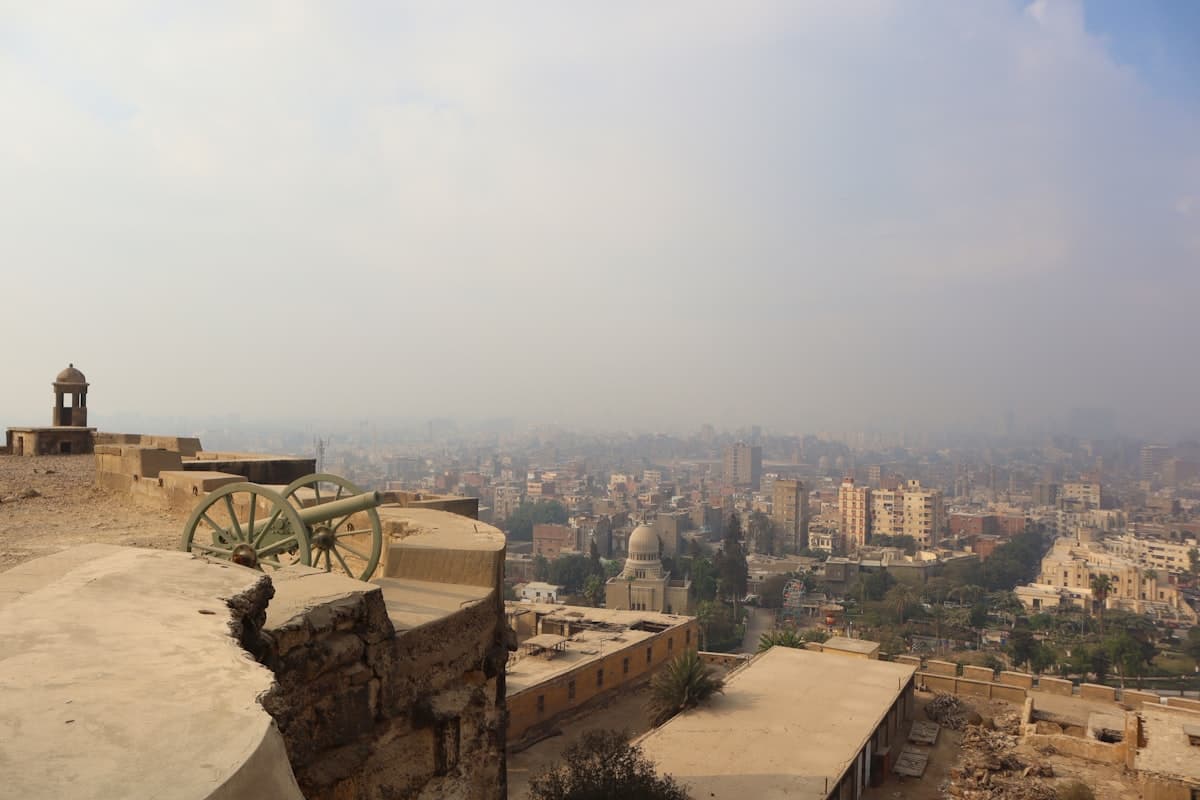
Overlooking the view toward Giza. On a clear morning in winter, usually between 6am and 9am before the haze builds, you can see the pyramids of Giza from the Citadel's northern terrace. This is not a metaphor about Egypt's layered history. You can literally see the Pharaonic monuments from the Ottoman-Albanian mosque. Allow yourself to stand there for five minutes and feel what that means.
---
Practical Tips
Dress conservatively for the mosque: shoulders and knees covered for all genders, and remove shoes before entering the prayer hall. Shoe covers are available at the entrance if you forgot. Headscarves for women are not strictly enforced at this particular mosque but are appreciated and will reduce the chance of being approached by well-meaning strangers offering unsolicited religious commentary.
The best light for photography inside the mosque falls in the late morning, when the eastern windows illuminate the hanging lamps and the alabaster walls glow without the washed-out quality that midday sun creates. Come between 9am and 11am if photography matters to you.
Hire a licensed guide for this site specifically. The history of the Mohamed Ali Albanian heritage in Egypt is dense enough that a knowledgeable guide earns their fee. Expect to pay EGP 300 to 500 for a two-hour guided tour of the Citadel. Agree on price and duration before you start.
The cafe just inside the Citadel complex serves decent tea and mediocre coffee. Eat lunch after, in Darb al-Ahmar or back in Islamic Cairo proper. The Citadel's official restaurant is overpriced for what it delivers.
Frequently Asked Questions
The Weekly Dispatch
More on Egypt, every Friday.
Cultural depth and places most guides never mention.
No spam. Unsubscribe anytime.