Mohamed Ali Pasha: Albania's Gift to Egypt's Making
He came from an Albanian tobacco merchant's family, spoke no Arabic, and built modern Egypt. The citadel mosque that bears his name is the least interesting part of his story.

Quick Facts
- Best time to visit
- October to March. The Citadel sits on a hill with limited shade and becomes brutal in summer heat. Morning visits between 8:30am and 11am give the best interior light in the mosque and the thinnest crowds regardless of season.
- Entrance fee
- EGP 450 for foreigners (approx $9 USD), EGP 225 for foreign students with valid ID, EGP 30 for Egyptian nationals. Covers the mosque, Al-Gawhara Palace, and military museum. Sultan Hassan Mosque nearby requires a separate ticket of approximately EGP 100.
- Opening hours
- Daily 8am to 4pm (October to April), 8am to 5pm (May to September). Mosque closes to tourists during Friday prayers approximately 11am to 1:30pm.
- How to get there
- Metro to Sadat station, then taxi or Uber to Citadel: EGP 40 to 60, around 15 to 20 minutes. Public bus 951 from Ramses Square: EGP 5. Avoid driving. No direct metro stop at the Citadel.
- Time needed
- 2 hours minimum for mosque and courtyard. 4 hours for mosque, palace museum, and battlements. Full day if combining with Sultan Hassan Mosque, Al-Rifa'i Mosque, and Islamic Cairo walk.
- Cost range
- Budget EGP 600 to 900 including entrance and lunch near Khan el-Khalili. Mid-range EGP 1,500 to 2,500 with licensed guide and restaurant meal in Islamic Cairo.
Quick Facts
Best time to visit: October to March, when the citadel's hilltop position doesn't mean standing in 40-degree heat with nowhere to shade.
Entrance fee: The Citadel complex (which includes the Mosque of Mohamed Ali and the military museum) costs EGP 450 for foreigners (approximately $9 USD at current rates). Students with valid ID pay EGP 225. Egyptian nationals pay EGP 30.
Opening hours: Daily 8am to 4pm in winter (October to April), 8am to 5pm in summer. Friday prayers pause access to the mosque interior between approximately 11am and 1:30pm. Plan accordingly.
How to get there: From Tahrir Square, take the metro to Sadat station and then a taxi or Uber to the Citadel (roughly EGP 40 to 60, about 15 minutes in moderate traffic). Public bus line 951 runs from Ramses Square for EGP 5 if you are on a tight budget. Avoid driving yourself. Parking near the Citadel is a negotiation with chaos.
Time needed: Two hours for the mosque and main courtyard, four hours if you want the military museum and the view from the battlements seriously. Full day if you combine it with the neighboring Islamic Cairo district.
Cost range: Budget EGP 600 to 900 for the Citadel plus lunch in the Khan el-Khalili area. Mid-range EGP 1,500 to 2,500 if you add a guide and a proper restaurant in Islamic Cairo.
---
Why This Place Matters
Mohamed Ali Pasha arrived in Egypt in 1801 as the commander of a small Albanian contingent within the Ottoman force sent to expel Napoleon. He spoke Ottoman Turkish and Albanian. He spoke no Arabic whatsoever. By 1805, through a combination of tactical brilliance, shameless political maneuvering, and a willingness to eliminate rivals with extraordinary efficiency, he had made himself the governor of Egypt. By the time he died in 1849, he had founded a dynasty that would rule Egypt until 1952.
This is the thing most visitors to the mosque miss entirely. They photograph the Ottoman domes and the French-designed clock tower (a gift from King Louis-Philippe that has never, according to long-running Cairo legend, worked correctly) and they leave without understanding that the man who built this complex had more in common culturally with Thessaloniki than with Cairo. Mohamed Ali Pasha's Albanian heritage was not incidental to the story of modern Egypt. It was the engine of it.
He came from Kavala, a port town in what is now northern Greece but was then Ottoman Macedonia. His father was a tobacco merchant and local commander. When Mohamed Ali came to Egypt, he came as an outsider with no inherited loyalties to the existing power structures, which meant he could dismantle them without sentiment. The most dramatic demonstration of this: on March 1, 1811, he invited approximately 470 Mamluk leaders to the Citadel for a banquet honoring his son. In the narrow corridor of Bab el-Azab, as the Mamluks rode out in procession, his soldiers opened fire from the walls above. Every Mamluk present was killed. The dynasty that had ruled Egypt for centuries ended in an afternoon.
The Citadel itself predates Mohamed Ali by six centuries. Salah al-Din (Saladin) began its construction in 1176, using stone quarried partly from the smaller pyramids at Giza. For 700 years it was the seat of Egyptian power. When Mohamed Ali chose it as his base and then built his mosque to crown it, he was making a deliberate statement about legitimacy and permanence.
---
What You Are Actually Looking At
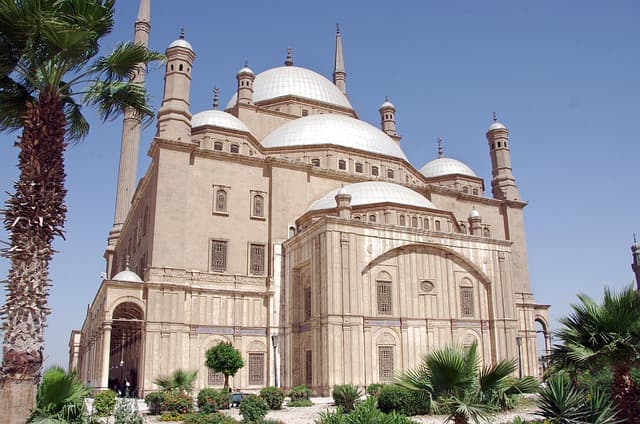
The Mosque of Mohamed Ali is modeled on the Sultan Ahmed Mosque in Istanbul, which is not a coincidence. Mohamed Ali wanted Egypt recognized as a peer of the Ottoman capital, not a provincial backwater. The two minarets are pencil-thin in the Ottoman style, rising 82 meters each. The interior is a single vast domed space, the dome itself rising 52 meters, with smaller half-domes at each corner creating a cascade effect that floods the interior with diffuse light.
The floor is covered in carpets. Visitors are asked to remove shoes. In the morning, particularly in winter, the quality of light inside is genuinely unlike anywhere else in Cairo. It falls in pale columns through windows set into the drum of the dome, and the alabaster panels on the lower walls (which give the mosque its nickname, the Alabaster Mosque) scatter it sideways. The total effect is cool and quiet in a city that is almost never either.
Mohamed Ali is buried here. His tomb is in the western hall, screened by a brass grille, understated to the point of invisibility. Most tourists walk past it.
Look also at the clock tower in the courtyard. The French gave it to Mohamed Ali in 1846 in exchange for the obelisk that now stands in the Place de la Concorde in Paris. That obelisk, taken from Luxor Temple, is 3,300 years old and once stood alongside a twin that remains in Luxor. The clock tower, by contrast, arrived broken and has spent most of its life in a state of decorative non-function. This is either a diplomatic metaphor or a mechanical tragedy, depending on your mood.
---
The Albanian Thread Through Egyptian History
The Mohamed Ali Pasha Albanian heritage story is not only about one man. It is about what the Ottoman system of power actually looked like at the ground level. The Ottoman Empire routinely elevated men from its Albanian, Circassian, Georgian, and Balkan populations to positions of military and administrative authority precisely because these men owed their loyalty to the Sultan personally rather than to local tribal or religious networks. The Mamluks themselves had been a version of this, an elite military caste originally drawn from Turkic and Circassian slaves who converted to Islam and were trained as soldiers.
Mohamed Ali broke the Mamluk system not because he opposed the principle of imported elites ruling Egypt, but because he wanted to be the imported elite ruling Egypt. His own military was built partly on Albanian and other Balkan recruits. His administrative reforms, which created the first modern Egyptian state, were designed and executed largely by European advisors and Ottoman-educated officials who were anything but ethnically Egyptian.
This has complicated legacies. Mohamed Ali is credited, accurately, with building Egypt's first modern army, navy, cotton industry, medical school, and printing press. He sent Egyptian students to study in France, and those students came back as the first generation of Egyptian nationalists who would eventually push his own dynasty out. He also depopulated Upper Egypt through forced labor conscription for his military campaigns in Sudan and Arabia, and his agricultural reforms concentrated land in ways that created the rural poverty that persisted well into the 20th century.
The man is genuinely difficult to summarize. Cairo does not try. The mosque stands. The dynasty's last king, Farouk, was exiled by Nasser's coup in 1952. What remains is stone and the structural shape of a modern state.
---
The Connections
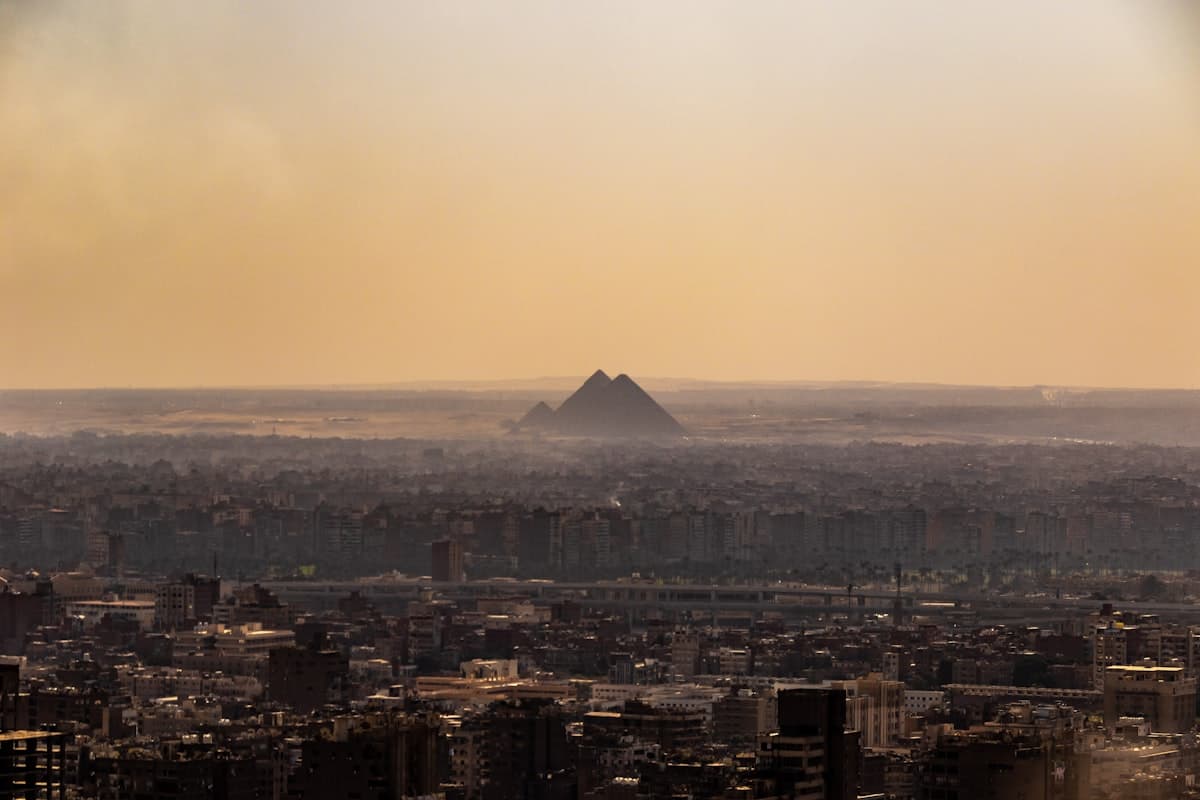
Stand on the Citadel's northern terrace and orient yourself. To the northwest, barely visible in the haze, the Pyramids of Giza mark the edge of the desert. Saladin quarried stone from Giza's satellite pyramids to build the walls beneath your feet. Mohamed Ali later quarried Saladin's walls to build palaces downstream. Every structure in this city has eaten another.
The Mosque of Ibn Tulun, about 800 meters southwest and visible from the battlements, was built by Ahmed Ibn Tulun in 879 AD. Ibn Tulun was himself a Turk, the son of a slave sent as tribute from the governor of Bukhara to the Abbasid Caliph. He became governor of Egypt and promptly stopped sending revenue to Baghdad. This is a pattern in Egyptian history: outsiders arrive, rule, go native, and declare some form of independence. Mohamed Ali followed Ibn Tulun's template by about a thousand years.
The Al-Rifa'i Mosque, directly across the square from the Citadel's main gate, was completed in 1912 and contains the tomb of King Farouk, Mohamed Ali's great-great-grandson, alongside the tombs of the last Shah of Iran (Mohammad Reza Pahlavi, who died in Cairo in 1980) and various members of the dynasty. It is a strange room, the final address of men who once ran empires and died as guests. The mosque is often overlooked because tourists are already tired by the Citadel. It is worth thirty minutes.
---
Common Mistakes
Arriving at midday on a Friday. The mosque closes for Friday prayers and the Citadel becomes extremely crowded as local visitors arrive. The light inside the mosque is also far better in the morning. Come between 8:30am and 10:30am on any day except Friday for the best combination of light and manageable crowds.
Buying a tour package that includes the Citadel plus the Pyramids in one day. These tours exist, they are popular, and they are a waste of both sites. Each deserves its own day. You will spend two hours in bus traffic and forty-five minutes at each place. Skip both if that is your only option.
Spending all your time in the mosque and ignoring the Al-Gawhara Palace. The palace, on the southern edge of the Citadel complex, was where Mohamed Ali conducted state business. It has been turned into a museum with his original furniture and personal effects, including gifts from European heads of state. The rooms give you a sense of the man that the mosque, which was a public statement, simply does not.
The sound and light show at the Citadel. It costs EGP 350, runs most evenings, and tells you nothing that a single hour of reading about Mohamed Ali would not cover more effectively. The script is the kind of narration that describes what you can already see, in a voice of theatrical significance. Save the money and the evening for dinner in Bab Zuweila instead.
Not walking down into the Sultan Hassan Mosque before leaving the area. It sits at the base of the Citadel hill, completed in 1363, and is one of the most impressive interior spaces in Egypt. The entrance portal is 37 meters tall, the largest in the Islamic world when it was built. Most Citadel visitors turn left toward taxis and never see it. Do not do this.
Tipping the mosque attendants for "private tours" they offer at the entrance. These men are not licensed guides. They will show you the tomb, explain the clock tower, and charge EGP 100 to 300 for information you already have in this article. If you want a guide, hire a licensed one through your hotel or a reputable agency before you arrive.
Assuming all the Citadel's museums are worth equal time. The Police Museum is not. The Carriage Museum is interesting for about fifteen minutes. The National Military Museum inside the main Harim Palace is genuinely good, with exhibits on Egyptian military history from the Pharaonic period forward, and poorly attended.
---
Practical Tips
Wear shoes that slip on and off easily. You will remove them at the mosque entrance, leave them on a rack outside, and retrieve them afterward. Sandals are ideal. Dress modestly: shoulders and knees covered for both men and women. The mosque provides abayas for women who need them at the entrance, but they are worn and impersonal. Bring your own scarf if you prefer.
The best photograph of the mosque's exterior is taken from the Al-Rifa'i Mosque's courtyard, looking northeast, in early morning light. Every postcard version of the Citadel skyline is taken from approximately this angle. It is free to stand there.
For lunch, walk fifteen minutes northeast into the Khan el-Khalili area and find a table at Naguib Mahfouz Café on El-Badestan Lane. It is slightly tourist-oriented but the food is solid, the prices are honest (EGP 150 to 300 per person), and you can watch the bazaar from a seated position, which is the correct way to watch any bazaar.
If you are specifically interested in Mohamed Ali Pasha's Albanian heritage and want to understand the wider Ottoman context, the Museum of Islamic Art on Bur Said Street (about 2km north) has one of the world's great collections of Islamic art and artifacts, including Mamluk and Ottoman pieces that give the political history a material reality. It was damaged by a car bombing in 2014 and has been partially restored. Entrance is EGP 200 for foreigners. It is chronically undervisited and entirely serious.
Frequently Asked Questions
The Weekly Dispatch
More on Egypt, every Friday.
Cultural depth and places most guides never mention.
No spam. Unsubscribe anytime.