Mohamed Ali Pasha: Albania's Greatest Export to Egypt
He arrived in Egypt as an Ottoman soldier with no formal education. He left as the man who accidentally invented modern Egypt. His mosque still dominates Cairo's skyline.

Quick Facts
- Best time to visit
- October to March. The Citadel plateau is exposed and windy in winter (bring a layer) but brutal in summer heat. Morning visits year-round beat the tour group rush.
- Entrance fee
- EGP 450 (approx $9 USD) for full Citadel complex including the mosque. Students with valid ID EGP 225. Ticket purchased at the Citadel gates, not the mosque entrance.
- Opening hours
- Daily 8am to 5pm. Mosque closes for Friday prayer approximately 11:30am to 1pm. Arrive by 8:15am for the best light inside the mosque.
- How to get there
- Metro Line 2 to Sayyida Zeinab, then ride-share app to Citadel gates (EGP 15 to 30). Taxi from Downtown Cairo EGP 60 to 100. Do not accept driver offers to 'show you the area' first.
- Time needed
- Mosque alone: 45 to 60 minutes. Full Citadel complex: 3 to 4 hours. Full half-day if combining with Sultan Hassan and Rifa'i mosques below.
- Cost range
- Budget EGP 500 to 800 including entrance, transport, and street lunch. Mid-range EGP 1,500 to 2,500 with a licensed guide and sit-down meal near Midan Salah al-Din.
Quick Facts
Best time to visit: October through March, when the Citadel plateau does not cook you. The mosque's interior stays cool regardless, but the walk up from the city gates is brutal in summer.
Entrance fee: EGP 450 (approx $9 USD) for the Citadel complex, which includes the Mosque of Mohamed Ali, the Military Museum, and the Carriage Museum. Students with valid ID pay EGP 225. The ticket is purchased at the Bab al-Azab or Salah Salem gate, not at the mosque door itself.
Opening hours: Daily 8am to 5pm. The mosque closes during Friday prayer from roughly 11:30am to 1pm. Plan around this or you will wait outside in full Citadel wind.
How to get there: Metro to Sayyida Zeinab station (Line 2), then a microbus or ride-share up to the Citadel gates (EGP 10 to 20). Taxis from Downtown Cairo run EGP 60 to 100. The walk from the metro is possible but uphill and poorly shaded. Do not let a driver take you to a papyrus shop first.
Time needed: The mosque alone takes 45 minutes if you are reading everything. The full Citadel, including the Military Museum and the view terraces, takes 3 to 4 hours. Combine with the Sultan Hassan Mosque directly below for a full half-day.
Cost range: Budget EGP 500 to 800 for the Citadel plus transport and lunch in the area. Mid-range EGP 1,500 to 2,500 if you add a guide and a sit-down meal.
---
An illiterate tobacco merchant from a small Albanian port town arrived in Egypt in 1801 as part of an Ottoman force sent to evict Napoleon's army. Within three years he had outmaneuvered the Ottomans, massacred the Mamluks who had ruled Egypt for five centuries, and declared himself its undisputed ruler. He never learned to read until he was in his forties. By the time he died, he had built Egypt's first modern army, its first secular schools, its first newspaper, its first cotton export economy, and the mosque that still defines Cairo's skyline from almost every angle.
Mohamed Ali Pasha's Albanian heritage is not a footnote in Egyptian history. It is the thread that explains nearly everything about how modern Egypt was assembled, why it looks the way it does, and why a mosque in Cairo has a clock tower that doesn't work, a gift from the French king it was built to impress.
Why This Place Matters
The Citadel of Saladin was already 600 years old when Mohamed Ali chose it as his seat of power. Salah al-Din al-Ayyubi had built it in 1176, partly on the foundations of a Fatimid palace, in a spot chosen because the prevailing winds kept plague and pestilence from climbing the hill. Every subsequent ruler of Egypt had used it. The Mamluks added their own palaces. The Ottomans garrisoned it. Mohamed Ali tore most of that down and built his mosque between 1830 and 1848, modeling it explicitly on the Ottoman imperial mosques of Istanbul, specifically the Sultan Ahmed Mosque, which itself was built to outshine the Hagia Sophia.
This is the detail most visitors miss entirely. Mohamed Ali was Albanian by birth, Ottoman by political formation, and Egyptian by ambition, but he built a Turkish mosque in Istanbul's style in the middle of Cairo. The architecture is a statement of legitimacy aimed at the Ottoman court he was simultaneously defying. He wanted to be recognized as a sultan-equivalent. The mosque is not devotion. It is diplomacy in stone.
The alabaster cladding on the mosque's exterior courtyard walls was quarried at Beni Suef, the same region that supplied material for monuments thousands of years earlier. The clock tower in the courtyard was given by Louis-Philippe of France in 1845, in exchange for the obelisk that now stands in the Place de la Concorde in Paris. The clock has never worked properly. The obelisk still stands in Paris. Make of that exchange what you will.
The Albanian in the Ottoman Machine
To understand Mohamed Ali's Albanian heritage and what it meant in the context of Egypt, you need to understand the Ottoman system called devshirme. For centuries, the Ottomans had conscripted Christian boys from Balkan communities, converted them to Islam, educated them in Istanbul, and deployed them as soldiers and administrators across the empire. Albania was one of the primary recruiting grounds. Many of the Ottoman empire's most powerful figures, including several grand viziers, were Albanian-born.
Mohamed Ali was not a devshirme conscript. He was a free Albanian Muslim from Kavala, born in 1769, the son of a local governor and a tobacco and shipping merchant. He came to Egypt voluntarily as part of a military force. But he carried the Albanian tradition of pragmatic, ruthless advancement through Ottoman structures. He understood how the game was played because Albanians had been playing it for generations.
His Albanian troops, the Albanians he brought with him and trusted above all others, were the foundation of his early power in Egypt. When he orchestrated the Citadel Massacre of 1811, inviting the Mamluk leaders to a celebration and having them killed in the narrow passage of Bab al-Azab below the very gates you walk through today, it was his Albanian soldiers who did the killing. One Mamluk, Amin Bey, reportedly jumped his horse from the Citadel wall and survived. The drop was roughly 20 meters. The story is probably embellished. The massacre itself was entirely real.
Stand at Bab al-Azab now, which is sealed to tourists but visible from the Citadel road, and consider that the passage behind those doors was where five centuries of Mamluk political power ended in an afternoon.
Inside the Mosque: What You Are Actually Looking At
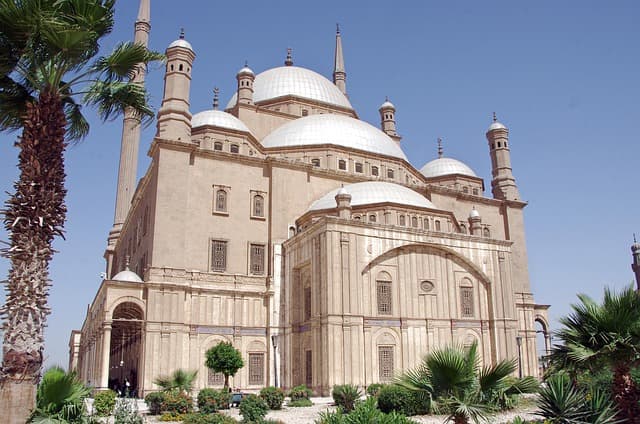
The Mosque of Mohamed Ali is Ottoman in plan: a large central dome flanked by smaller semi-domes, a wide courtyard with an ablution fountain, minarets that are Turkish in their pencil-thin profile rather than Egyptian in the fatter, more textured style you see in Mamluk mosques. The architect, Yusuf Bushnaq, was brought from Istanbul. The interior was completed after Mohamed Ali's death by his son Abbas I.
The dome reaches 52 meters at its highest point. The interior is lit by hundreds of glass globe lamps, which create a specific quality of light in the early morning that photographers know about and most tourists arrive too late to catch. If you are there by 8:15am, before the tour groups, the light through the dome windows hits the alabaster walls at an angle that makes the whole interior look as if it is generating its own warmth.
Mohamed Ali's tomb is inside, in the right-hand enclosure as you enter. It is a marble structure added later, and it is oddly modest for a man who rebuilt a country. His actual burial spot went through some revisions. He died in 1849, having suffered from dementia for the last two years of his life, a detail his official portraits do not record.
The two minarets are 84 meters tall and Ottoman in profile. From the courtyard, you can see across the whole city to the south and west. The Pyramids of Giza are visible on clear days in winter, which is not something most visitors expect when they look out from an Ottoman mosque built by an Albanian ruler in an Arab city.
The Connections
The Mohamed Ali Pasha Albanian heritage story does not end with his death. His descendants ruled Egypt until 1952, when the Free Officers' Revolution ended the dynasty. King Farouk, the last Egyptian king, was Mohamed Ali's great-great-great-grandson. The dynasty is called the Muhammad Ali dynasty, and it produced Khedive Ismail, who built modern Cairo's downtown grid on Haussmann's Paris model, and who accumulated debts so catastrophic they eventually handed Egypt to British control in 1882.
The cotton economy Mohamed Ali built, using forced labor on newly irrigated land in the Delta, directly funded the Suez Canal project that opened in 1869 under Khedive Ismail. The canal that defines Egypt's geopolitical importance today is a consequence of agricultural reforms begun by a semi-literate Albanian tobacco merchant in the 1810s.
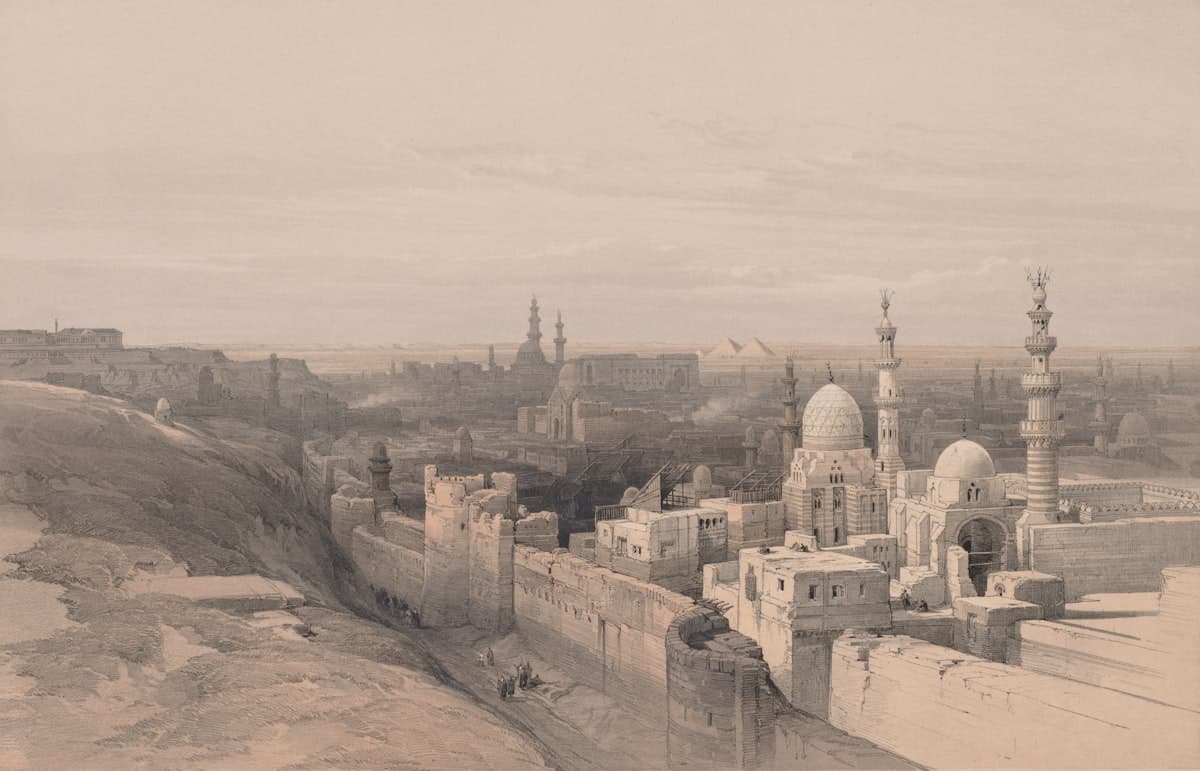
Directly below the Citadel, the Mosque and Madrasa of Sultan Hassan was built between 1356 and 1363, nearly 500 years before Mohamed Ali's mosque. It is one of the finest pieces of Mamluk architecture anywhere, and it represents exactly the political class Mohamed Ali destroyed. Standing in the square called Midan Salah al-Din and looking up at both buildings simultaneously, one Mamluk, one Ottoman-Albanian, is one of the better ways to feel the compression of Egyptian history into a single field of vision.
The Rifa'i Mosque beside Sultan Hassan, which looks medieval but was only completed in 1912, contains the tomb of King Farouk's father, King Fuad I, and, more unexpectedly, the tomb of the last Shah of Iran, Mohammad Reza Pahlavi, who was given asylum in Egypt by Anwar Sadat in 1980 and died in Cairo. Mohamed Ali's dynasty buried Egyptian kings. Cairo then became the final resting place for a Persian emperor. The Citadel hill collects fallen dynasties.
Common Mistakes
Skipping Sultan Hassan to spend more time in the Citadel. The Mosque of Mohamed Ali is the more famous building, but Sultan Hassan is the better one. The proportions, the carved stone, the quality of light through the qibla iwan are in a different category entirely. If you have two hours and have to choose, choose Sultan Hassan. You can see the Mohamed Ali mosque's exterior from the square.
Paying for the sound and light show at the Citadel. It costs around EGP 300 and summarizes Egyptian history in the most generic terms possible. Everything it tells you is in this article. The money is better spent on a proper lunch at one of the restaurants on Salah al-Din Square.
Arriving by tour group at 10am. This is when every organized tour arrives. The Citadel becomes genuinely difficult to move through between 10am and 1pm. Go at 8am or after 2pm.
Trusting the taxi driver who offers to wait and take you somewhere else afterward. He will take you to a papyrus shop or perfume bazaar where he earns commission. Use a ride-share app for the return.
Spending money on the Military Museum inside the Citadel. It is included in your ticket. It is also one of the drearier military museums in the Middle East, with poor labeling and exhibits that have not been updated in decades. Walk through quickly or skip it entirely.
Not looking at the Harem Palace ruins. Most visitors walk past the partially excavated remains of the Ottoman-era Harem Palace without realizing what they are. This was where the administrative and domestic life of the Citadel actually happened. A small museum inside displays Mamluk and Ottoman artifacts that are far more interesting than the military hardware next door.
Reading Mohamed Ali's story only through the mosque. The real legacy of his Albanian roots and Ottoman formation is visible in the city below, in the layout of institutions he built: the school of medicine at Qasr al-Aini, founded in 1827 with French instructors; the first Egyptian newspaper, Al-Waqa'i Al-Masriya, established in 1828; the textile factories in the Delta. The mosque is the monument. The institutions are the actual inheritance.
Practical Tips
Dress conservatively. The mosque requires covered shoulders and legs for everyone, and women will be offered an abaya at the door if needed. This is not an issue at the ticket gate but becomes relevant inside. Shoes come off at the mosque entrance.
Bring water. There is nowhere to buy it once you are inside the Citadel walls at a reasonable price. The vendors outside the gates charge accordingly.
A local guide who specializes in Islamic Cairo will change what you see here entirely. The difference between walking through the mosque with a pamphlet and walking through it with someone who can read the Quranic inscriptions on the walls and explain which Ottoman sultanic style each architectural choice is referencing is not a small difference. Expect to pay EGP 400 to 600 for a two-to-three hour guided session with a licensed guide.
The Citadel is one of the few major Cairo sites that is less crowded on Fridays than on other days, partly because of the prayer closure and partly because many Cairenes visit on Fridays when admission prices are sometimes adjusted. Check ahead.
If you are specifically tracing Mohamed Ali Pasha's Albanian heritage across Cairo, the sequence is: the Citadel and mosque first, then Sultan Hassan below, then the al-Gawhara Palace museum inside the Citadel complex (which contains portraits and personal objects from the dynasty), then the Manyal Palace on Rhoda Island, built by Mohamed Ali's grandson Prince Mohamed Ali Tewfik. That last one requires a separate half-day.
Frequently Asked Questions
The Weekly Dispatch
More on Egypt, every Friday.
Cultural depth and places most guides never mention.
No spam. Unsubscribe anytime.