Mohamed Ali Pasha: Egypt's Albanian Who Remade a Civilization
He came from Albania, spoke no Arabic, and rebuilt Egypt from scratch. The mosque bearing his name sits on a citadel he seized by massacring its previous owners at dinner.

Quick Facts
- Best time to visit
- October to March for clear skies and manageable temperatures. December and January mornings are cold inside the mosque so bring a layer.
- Entrance fee
- EGP 450 (approx $9 USD) for foreigners, covers full Citadel complex including mosque and Military Museum. Students EGP 225 with valid ID. Egyptian nationals EGP 30.
- Opening hours
- Daily 8am to 5pm. Ticket offices close at 5pm. Mosque may remain accessible for prayers after 5pm but staff will direct visitors out of the main complex.
- How to get there
- Metro Line 2 to Sayeda Zeinab (EGP 8), then microbus or tuk-tuk to Citadel (EGP 5 to 10). Uber or Careem from Downtown Cairo EGP 50 to 80. Taxi EGP 60 to 100.
- Time needed
- 2 hours minimum for mosque and courtyard. 4 hours for full Citadel including Military Museum and walls. Full day if combining with Sultan Hassan Mosque and Darb al-Ahmar walk.
- Cost range
- Budget EGP 600 to 900 including transport, entry, and street food. Mid-range EGP 1,500 to 2,000 with sit-down lunch in Islamic Cairo.
Quick Facts
Best time to visit: October to March, when Cairo's light is clear and the heat won't exhaust you before you've finished climbing.
Entrance fee: The Citadel complex (which includes the Mohamed Ali Mosque, the Military Museum, and the Police Museum) costs EGP 450 for foreigners, approximately $9 USD at current rates. Students with valid ID pay EGP 225. Egyptian nationals pay EGP 30.
Opening hours: Daily 8am to 5pm. The mosque itself stays open slightly later for prayer times but the ticket offices close at 5pm sharp.
How to get there: The cheapest route is the Cairo Metro to Sayeda Zeinab station (Line 2, EGP 8), then a microbus or tuk-tuk up the hill for EGP 5 to 10. Taxis from Downtown Cairo cost EGP 60 to 100. Ride-hailing apps like Uber and Careem run EGP 50 to 80 depending on traffic and time of day. Avoid Friday midday when the road to the Citadel clogs badly.
Time needed: Two hours minimum for the mosque and its courtyard. Four hours if you intend to walk the full Citadel walls and enter the Military Museum. Combine with a walk down to Souq el-Futuh and the Al-Azhar area if you have a full day.
Cost range: Budget EGP 600 to 900 including transport and entry. Mid-range EGP 1,500 to 2,000 if you add lunch at a sit-down restaurant in the Islamic Cairo neighborhood below.
---
Why This Place Matters
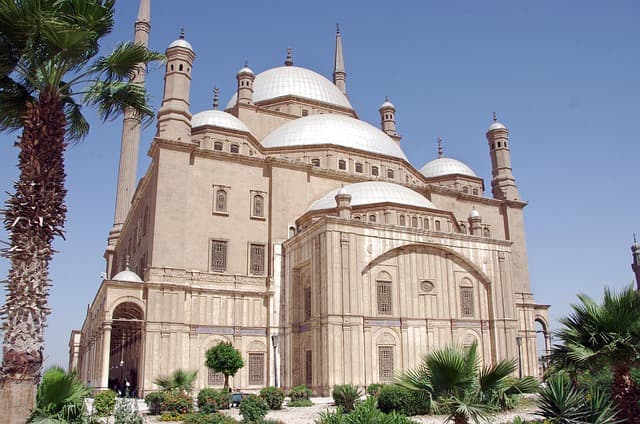
Mohamed Ali Pasha was born in Kavala, a port town in what is now northern Greece, in 1769. He was Albanian by ethnicity, Ottoman by subject status, and spoke Turkish and Albanian as his first languages. He arrived in Egypt in 1801 not as a conqueror but as a soldier in an Ottoman force sent to expel Napoleon's retreating army. He left Egypt only once after that, never voluntarily returned to the Balkans, and died in Alexandria in 1849 as the effective founder of modern Egypt. He did not speak Arabic fluently until well into his forties.
This is the first thing you need to understand about Mohamed Ali Pasha's Albanian heritage and Egypt: the country's modernizer, the man who abolished the medieval tax system, built the first Western-style military academy, sent the first Egyptian student missions to Paris, and constructed a network of irrigation canals that doubled agricultural output, was not Egyptian by birth, language, or culture. He was a product of the Ottoman world's tradition of using talented outsiders to govern distant provinces, a tradition that Egypt itself had been subject to for centuries before him.
The mosque that carries his name, completed in 1848 and modeled directly on the Sultan Ahmed Mosque in Istanbul, is the most visible monument to this hybrid identity. It was built by a Turkish architect named Yusuf Boshnak, with materials imported from Italy and Turkey, in a style that has almost nothing to do with the Mamluk or Fatimid architecture that surrounds it on the hill. Mohamed Ali was making a statement. He was not trying to blend in.
---
The Citadel: A Hill Built on Four Empires
The Citadel of Saladin, on which the Mohamed Ali Mosque sits, was begun in 1176 by Salah ad-Din al-Ayyubi using stones quarried from small pyramids at Giza. The quarrying is visible today if you look at the southern end of the Giza plateau, where a cluster of smaller pyramid bases were stripped to their cores. Salah ad-Din never finished the Citadel himself. It was completed by his nephew.
By the time Mohamed Ali arrived in 1805, the Citadel had passed through Ayyubid, Mamluk, and Ottoman hands. The Mamluks, who ruled Egypt from 1250 to 1517, had made it the seat of power for nearly three centuries. Their sultans built palaces, mosques, and a legendary Ablaq Palace with alternating bands of red and white stone that no longer exists. The Ottomans after them largely left the Mamluk structures standing and added their own layers on top.
Mohamed Ali demolished most of what the Mamluks had built. The Ablaq Palace, the great Mamluk mosques within the walls, the entire medieval urban fabric of the Citadel's interior: he cleared it. In its place he built his mosque, his administrative buildings, his mint, and his military barracks. He was not restoring Egypt's past. He was replacing it.
The Alabaster Mosque, as his mosque is sometimes called, uses Egyptian alabaster from the quarries near Beni Suef on its lower interior walls. The upper interior is painted in floral Ottoman patterns that feel more Topkapi Palace than Cairo. Standing inside, looking up at the four massive domes and the central chandelier hung so low you instinctively want to duck, you are in a room that was designed to communicate one thing: this man was not a local chieftain. He was the equal of any Ottoman sultan.
---
The Massacre That Made Him Ruler
In March 1811, Mohamed Ali invited the Mamluk beys, the remnant leadership of the old ruling class he had been slowly outmaneuvering for six years, to a celebration at the Citadel marking the departure of his son Tusun's military campaign to Arabia. Approximately 470 Mamluk leaders accepted the invitation. They were given a feast. Then, as they processed through the narrow passage between the outer and inner gates of the Citadel, the gates were locked and Mohamed Ali's soldiers opened fire from the walls above.
All 470 were killed. One Mamluk commander, a man named Amin Bey, allegedly leaped his horse from the Citadel walls and survived. Historians debate whether this happened, but the story is told in every Cairo coffeehouse even today. What is not debated is that within days of the Citadel massacre, Mohamed Ali's forces killed several thousand more Mamluk supporters across Egypt. The Mamluk ruling class, which had dominated Egypt in various forms since the thirteenth century, was effectively ended in an afternoon.
The passage where the massacre occurred still exists. It is the covered, dog-legged corridor between the Bab al-Azab gate and the lower Citadel courtyard. Most visitors walk through it without knowing what happened there. The walls are plain stone. There is no plaque. The Egyptian state has never decided quite how to frame an event that was simultaneously a founding atrocity and a necessary precondition for modernization.
This ambiguity is worth sitting with. Mohamed Ali's Albanian heritage made him, in Egyptian eyes, a foreigner using Egypt as a resource. And yet the schools he built, the canals he dug, the army he trained, the bureaucracy he created: these were the foundations on which every subsequent Egyptian nationalist would stand. Gamal Abdel Nasser, who nationalized the Suez Canal in 1956 and expelled the last of Mohamed Ali's dynasty in the revolution of 1952, was himself building on institutions Mohamed Ali had invented.
---
The Connections: From Ottoman Province to Nation-State
The Mohamed Ali Mosque sits 500 meters from the Ibn Tulun Mosque, completed in 879 AD by another outsider: Ahmad ibn Tulun, who was a Turkish slave soldier sent to govern Egypt and ended up founding his own dynasty. The parallel is not accidental. Egypt has a recurring pattern of being remade by men who arrived from elsewhere, absorbed its geography and its resources, and then declared themselves Egyptian enough to rule it permanently.
Walk down from the Citadel into the Darb al-Ahmar neighborhood and you pass through layers of this history in a single street. The blue-tiled minaret of the Aqsunqur Mosque, built in 1347 by a Mamluk amir, stands next to a Fatimid-era wall section that predates it by four centuries. Beneath that wall, archaeologists have found Roman-era construction material. Cairo is not a city built in sequence. It is a city built in collisions.
Mohamed Ali's own Albanian heritage connects to a broader Ottoman geography that most visitors to Egypt never consider. The Albanians were one of the ethnic groups the Ottoman military drew heavily upon, alongside Circassians, Georgians, and Bosnians. The Mamluks themselves had originally been drawn from Circassian and Kipchak Turkish populations. Egypt's ruling classes, from the Arab conquest in 641 AD to the British departure in 1952, were almost never ethnically Egyptian in the Nile Valley sense. Mohamed Ali's foreignness was not an exception. It was the rule of Egyptian governance for thirteen centuries.
---
Common Mistakes
Spending all your time inside the mosque and skipping the walls. The northern Citadel walls give you a view of medieval Cairo that no photograph has ever quite captured. The Mamluk minarets below, the domes of the Sultan Hassan Mosque, the crammed geometry of Islamic Cairo extending toward Al-Azhar: it takes ten minutes to walk and most group tours don't include it.
Arriving on a Friday around noon. The Citadel is adjacent to several large mosques that fill for Friday prayers. The access roads become impassable between 11:30am and 2pm. Go Thursday afternoon or Saturday morning.
Paying for the sound and light show. It costs EGP 400 and is a 45-minute narrated light display that tells you nothing you would not learn from a single page of reading. The lights themselves illuminate nothing architecturally interesting. This is the Citadel's least honest offering.
Ignoring the Sultan Hassan Mosque directly below. The Sultan Hassan Mosque, built between 1356 and 1363, is one of the finest pieces of Mamluk architecture on earth and receives a fraction of the Citadel's visitors. Its entrance portal is 38 meters tall, the tallest in the Islamic world at the time of construction. Entry costs EGP 180 and you will often have it nearly to yourself in the morning.
Hiring a guide at the gate. The unofficial guides who approach at the Bab al-Gadid entrance charge EGP 200 to 500 and typically have a commercial interest in taking you to specific shops in the bazaar afterward. If you want a guide, book through an accredited operator in advance.
Assuming the mosque is always open to non-Muslim visitors. During the five daily prayer times, non-Muslim visitors are asked to wait in the courtyard. This is not an inconvenience. The courtyard, with its Ottoman clock tower (a gift from King Louis-Philippe of France in 1845, given in exchange for the obelisk now standing in the Place de la Concorde in Paris) is worth extended time on its own.
Wearing inadequate footwear. The Citadel's stone paths are uneven and the mosque requires removing shoes. Slip-on shoes or sandals with socks are practical. Flip-flops make the stone slippery in winter mornings.
---
Practical Tips
Bring a headscarf if you are a woman visiting the mosque, though loaners are sometimes available at the entrance. The interior is cool even in summer, so a light layer is useful year-round.
The Citadel's ticket office accepts cash only. Bring Egyptian pounds. The nearest ATM is at the bottom of the Citadel hill near the Salah Salem road, approximately a ten-minute walk.
The Military Museum inside the Citadel is housed in the Harim Palace, which was Mohamed Ali's actual residential complex. The museum's collection of weapons and uniforms is secondary to the palace architecture itself, which includes rooms tiled in the same Ottoman-Italian hybrid style as the mosque. Entry is included in the Citadel ticket. Budget 30 minutes.
The best light for photography inside the mosque falls between 9am and 11am on clear days, when the eastern windows flood the alabaster walls. The courtyard's clock tower photographs best in late afternoon.
For the most direct connection to Mohamed Ali's Albanian heritage and Egypt's modernization, visit the Mohamed Ali Palace in Shubra, in northern Cairo, which is separate from the Citadel and far less visited. Built in 1808 as his summer residence, it sits beside a rectangular pool 185 meters long that was used for boat parties. Entry costs EGP 200. Almost no one goes. It is one of Cairo's most rewarding mornings.
Frequently Asked Questions
The Weekly Dispatch
More on Egypt, every Friday.
Cultural depth and places most guides never mention.
No spam. Unsubscribe anytime.