Your Egypt

Napoleon's Egypt Campaign Sites: The Full Cultural Guide

Napoleon brought 167 scientists to Egypt and they accidentally founded modern Egyptology. The battle sites, forts, and institutes they left behind are largely unvisited. Here is where to find them.

·12 min read
Napoleon's Egypt Campaign Sites: The Full Cultural Guide

Quick Facts

Best time to visit
October to March. Alexandria's Mediterranean climate makes summer sites like Abu Qir Bay manageable but Cairo in July is genuinely punishing. October gives you cool mornings, good light, and post-summer crowd reduction.
Entrance fee
Qaitbay Citadel Alexandria: EGP 100 (approx $2 USD). Alexandria National Museum: EGP 100 (approx $2 USD). Cairo Citadel including Military Museum: EGP 180 (approx $3.50 USD). Rashid Fort: approx EGP 60 (approx $1.20 USD). Bibliotheca Alexandrina day visitor: EGP 70 (approx $1.50 USD). Rashid Amasyali House: EGP 40.
Opening hours
Alexandria sites generally daily 9am to 5pm. Cairo Citadel daily 8am to 4pm winter, 8am to 5pm summer. Bibliotheca Alexandrina Saturday to Thursday 10am to 7pm. Rashid Fort hours variable, confirm locally before traveling.
How to get there
Cairo to Alexandria: train from Ramses Station, EGP 60 to 120 second class, 2.5 hours. Alexandria to Abu Qir: microbus from Sidi Gaber, EGP 5 to 10, 40 minutes. Alexandria to Rashid: microbus from Misr Station (Moharram Bey), EGP 20 to 35, 1.5 hours. Cairo Citadel: taxi from central Cairo EGP 40 to 80, or metro to Mar Girgis then taxi.
Time needed
Minimum two full days for Alexandria sites plus Rashid day trip. One additional day for Cairo Citadel and Garden City. Three days total is the practical minimum for serious engagement with the campaign geography.
Cost range
Budget EGP 600 to 900 per day covering transport, entries, and simple meals. Mid-range EGP 1,800 to 3,000 per day with comfortable hotels and sit-down restaurants. The sites themselves are inexpensive; accommodation in Alexandria is the main variable cost.

Quick Facts

Best time to visit: October to March, when Alexandria's sea air is cool and Cairo's light is soft enough to read inscriptions without squinting.

Key sites and entrance fees: Citadel of Qaitbay, Alexandria: EGP 100 (approx $2 USD), built in 1477 on the exact site of the Pharos lighthouse, briefly occupied by French forces in 1798 Abu Qir Bay coastal area (Battle of the Nile site): free to view from shore; the bay itself off the coast of Rosetta Fort of Aboukir: EGP 50 (approx $1 USD), limited opening hours, verify locally before going Mosque of Mohammed Ali, Cairo Citadel: EGP 180 (approx $3.50 USD), built partly in response to the political vacuum Napoleon's campaign created Institut d'Égypte reconstruction, Cairo: not open to public as a tourist site but the building on Shaykh Rihan Street in Garden City is visible from the street

Opening hours: Most Alexandria sites daily 9am to 5pm; Cairo Citadel daily 8am to 4pm in winter, 8am to 5pm in summer.

Getting there: Cairo to Alexandria by train from Ramses Station, roughly EGP 60 to 120 (approx $1.20 to $2.50 USD) second class, 2.5 hours. Abu Qir from central Alexandria by microbus, around EGP 5 to 10 one way. Rosetta (Rashid) from Alexandria by microbus or service taxi, EGP 20 to 35, about 1.5 hours.

Time needed: Two full days minimum if you want Cairo and Alexandria together. Three days if you add Rosetta.

Cost range: Budget EGP 600 to 900 per day outside Cairo hotels; mid-range EGP 1,800 to 3,000 per day.

---

Why This Place Matters

Serene scene of fishing boats anchored in calm waters off Alexandria's coast under a bright summer sky.

Napoleon Bonaparte arrived in Egypt on July 1, 1798, with 38,000 soldiers and 167 scholars, scientists, mathematicians, and artists. He called the scholars the Commission des Sciences et Arts. They called themselves, more practically, the savants. Within three years, they had catalogued everything from ancient temples to contemporary agricultural methods, launched a printing press in Arabic (the first in Egypt's history), founded an institute modeled on the Institut de France, and produced the twenty-three volume Description de l'Égypte, a work so comprehensive that it effectively created the modern academic discipline of Egyptology before a single hieroglyph had been decoded.

Napoleon himself was in Egypt for only fourteen months before abandoning his army and sailing back to France. His campaign was, militarily, a failure. Horatio Nelson destroyed the French fleet at Abu Qir Bay on August 1, 1798, in a battle so decisive that Napoleon's entire strategic rationale for controlling Egypt collapsed overnight. Within three years, the French were gone.

What they left behind was something stranger and more durable than conquest. The Description de l'Égypte filled the libraries of Europe with images of monuments most Europeans had never seen. It made ancient Egypt fashionable, urgent, and legible in ways it had not been since the fall of Rome. It also left Egypt itself transformed: the Ottoman response to French occupation produced Mohammed Ali Pasha, the Albanian-born commander who would modernize Egypt more thoroughly than Napoleon ever dreamed of doing.

The sites connected to this campaign are scattered across a roughly 200-kilometer arc from Alexandria through Rosetta and the Delta to Cairo. Most Napoleon Egypt campaign sites guides treat this as a military history tour. That misses the point entirely. This is a tour about what happens when a civilization collides with another civilization that thinks it is being saved.

---

Alexandria: Where It Began and Where the Fleet Died

Napoleon landed near Alexandria and took the city within hours on July 2, 1798. The Alexandria he found was a provincial port of perhaps 8,000 people, a shadow of the city that had held the greatest library in the ancient world. He gave a famous speech to his troops reminding them that from the heights of the Pyramids, forty centuries looked down upon them. He gave this speech before he had actually seen the Pyramids, which is either inspiring or revealing, depending on your temperament.

The Citadel of Qaitbay sits on the eastern harbor precisely where the Pharos lighthouse stood until an earthquake in 1303 brought it down. The Mamluk sultan Qaitbay used the fallen limestone blocks of the lighthouse itself as building material for the fort in 1477, which means the walls you touch today contain stones that once guided ships in the ancient Mediterranean. French forces used the fort as a garrison. It later passed to the British. The layering here is almost absurd in its density: Pharaonic stone, inside a Mamluk fort, occupied by Napoleonic troops, then British imperialists, now Egyptian schoolchildren on field trips.

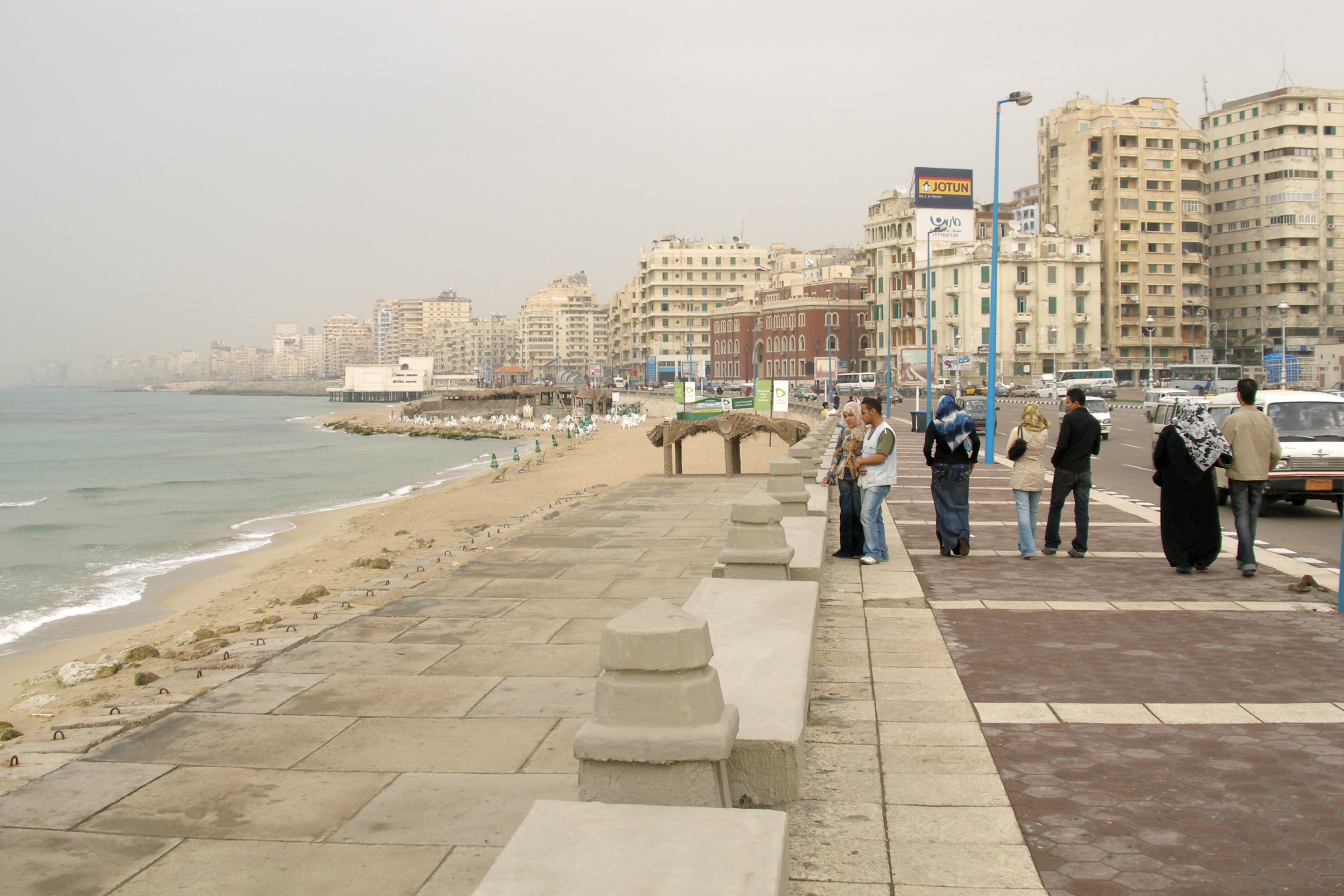
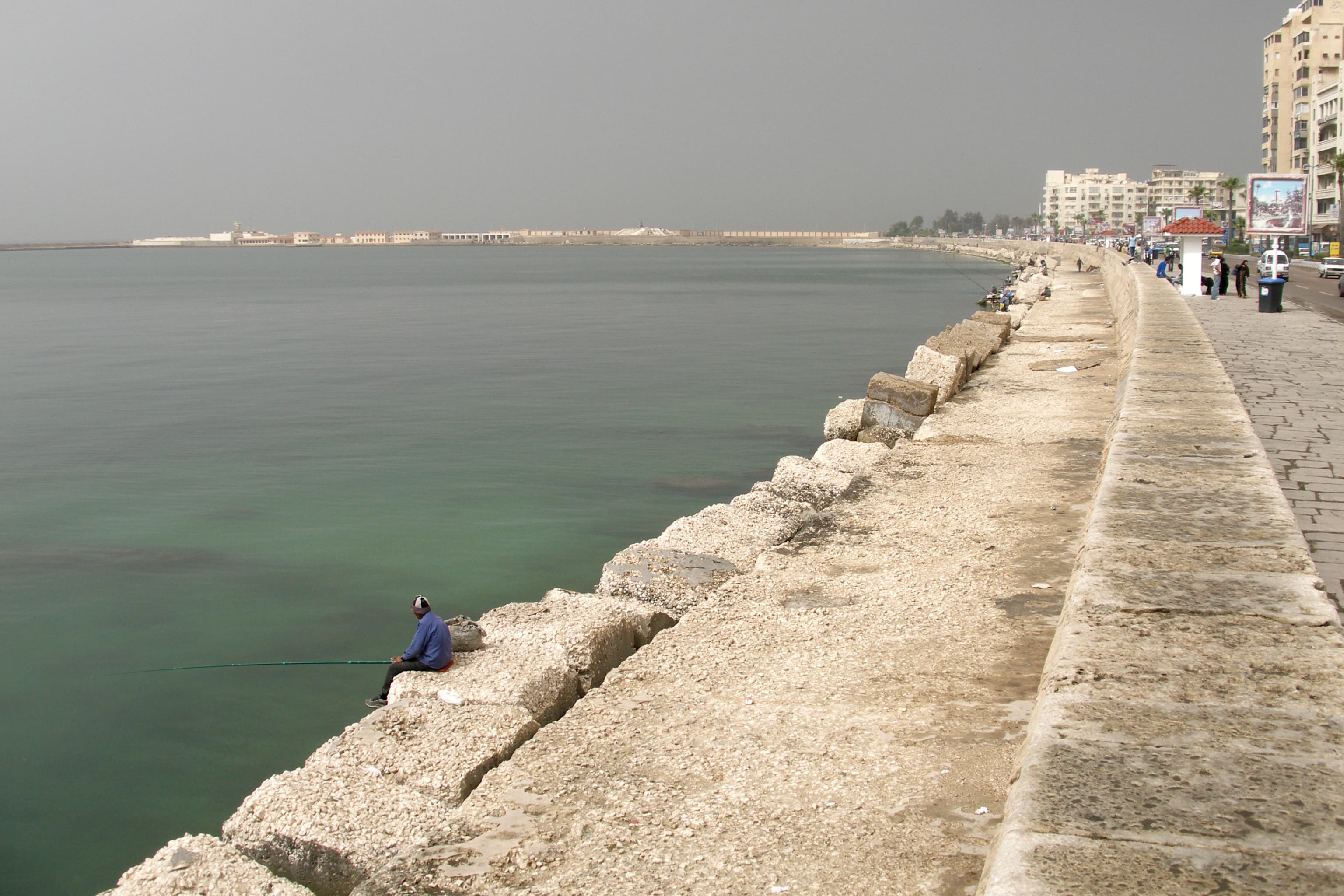
Abu Qir Bay, about 25 kilometers east of Alexandria, is where Nelson annihilated the French fleet in what the British called the Battle of the Nile. The French lost eleven of their thirteen ships of the line. Nelson lost none. Napoleon learned of the defeat weeks later and understood immediately that his Egyptian adventure had become a trap: he could conquer on land but he could not leave. The bay today is a fishing and resort area. There is no monument to the battle visible from shore. The wrecks of French ships have been partially excavated by underwater archaeologists since the 1980s and have yielded coins, cannons, and personal effects that are now in the Alexandria National Museum. The museum holds these objects well and is worth two hours of your time for this material alone, located on Tariq al-Hurriya in central Alexandria, entrance EGP 100.

---

Rosetta and the Stone That Changed Everything

brown and gray concrete building

The town of Rashid, which Europeans call Rosetta, sits where the western branch of the Nile meets the Mediterranean. A French officer named Pierre-François Bouchard found a fragment of granodiorite here in July 1799 while his troops were reinforcing a fort. The stone was carved with a priestly decree issued in 196 BC during the reign of Ptolemy V, written in three scripts: ancient Egyptian hieroglyphics, Demotic, and Greek. Because scholars could read Greek, they could begin working backward to decode the other two. Jean-François Champollion cracked the hieroglyphic system definitively in 1822, twenty-three years after Bouchard's discovery, using the Rosetta Stone as his primary key.

The original stone is in the British Museum in London, where it has been since 1802, when the British took it from the French as part of the Treaty of Alexandria. Egypt has formally requested its return. The British Museum has declined. A replica sits in the fort at Rashid, which is called Fort Julien or Qaitbay Fort of Rashid, entrance around EGP 60.

Rashid itself is a town most tourists skip entirely, and this is a mistake with real cultural cost. The Ottoman-era merchant houses here, built between the seventeenth and nineteenth centuries, are among the best-preserved examples of Delta Islamic architecture anywhere in Egypt. The House of Amasyali, with its intricate wooden mashrabiya screens and painted ceilings, takes about forty minutes to walk through and costs EGP 40. The town is navigable on foot from the microbus drop-off point. There are no crowds. The light off the Nile branch in the morning is precise and quiet.

---

Cairo: The Political Wreckage That Built Modern Egypt

Napoleon established the Institut d'Égypte in Cairo in August 1798, modeled on the Institut de France, with four sections covering mathematics, physics, political economy, and literature and arts. It met in the palace of the Beys in what is now the Nasiriya neighborhood. The savants worked there producing observations, measurements, and descriptions of everything they encountered. When Egypt's population revolted against French rule in October 1798, scholars sheltered behind soldiers in the same compound.

In December 2011, during unrest following the revolution, the Institut d'Égypte building in Garden City caught fire. An estimated 200,000 manuscripts and books were destroyed, including irreplaceable maps and scientific manuscripts. Some were saved by Egyptians forming human chains to pass books out of burning rooms. The building has since been restored. It is not open for tourist visits but it stands on Shaykh Rihan Street and the exterior renovation is visible. Go and look at it anyway. The gap between what was there and what remains is part of the story.

The Cairo Citadel, visible from much of the city, is where Mohammed Ali Pasha consolidated power after the French departed and the Ottomans fumbled their return. He invited the Mamluk leadership to a feast there in 1811 and had them massacred in the citadel's narrow entrance passage, ending the Mamluk political class permanently. His mosque, completed in 1848 and modeled on the Yeni Cami in Istanbul, dominates the citadel's skyline. The irony is precise: the Ottoman-Albanian governor who filled the power vacuum left by Napoleon built an Ottoman-style mosque on a Mamluk fortress constructed on a Pharaonic ridge overlooking a city that had been Islamic for nearly a thousand years. The French campaign did not build any of this. But without the French campaign, none of it happens when or how it did.

---

The Connections

The Napoleonic episode sits at the intersection of several long historical arcs that Egypt was already running.

The Mamluks Napoleon defeated at the Battle of the Pyramids on July 21, 1798, were the descendants of a slave-soldier system established by the Ayyubid sultanate in the thirteenth century. Mamluk rulers had been governing Egypt, with interruptions, since 1250. They had defeated the Mongols at the Battle of Ain Jalut in 1260, which is the first time a Mongol army was ever decisively stopped. Napoleon's cavalry routed them in under two hours. The Mamluks were extraordinary horsemen with outdated tactics facing field artillery they had no answer to. The battle took place in the shadow of the Giza plateau. You can stand roughly where the French artillery was positioned today, on the plateau's western edge, near the camel and horse stables that crowd the site.

The Rosetta Stone connects to a Ptolemaic Egypt that was itself already a hybridized civilization: Greek rulers using Egyptian religious forms to legitimize their power, writing their decrees in three scripts to reach every subject. The French found this text and the British took it, and the academic apparatus built around decoding it became the foundation of Egyptology as practiced from Paris, London, Berlin, and eventually Cairo. The Egyptian Museum on Tahrir Square, opened in 1902, is the direct institutional descendant of the Description de l'Égypte's cataloguing impulse. The French started something they could not control and did not benefit from.

---

Common Mistakes

Treating this as a military history tour only. The battle sites are largely unmarked and underwater. What survives is intellectual and architectural, not military. If you come looking for Napoleonic monuments the way you would look for D-Day beaches, you will find almost nothing. Come looking for consequences instead.

Skipping Rosetta. Almost every Napoleon Egypt campaign sites guide focuses on Alexandria and Cairo because the logistics are easier. Rosetta requires a microbus and some navigational confidence. It rewards that effort with a completely unmediated experience of a significant historical place and some of the finest Islamic domestic architecture in Lower Egypt.

Paying for the Cairo sound and light show at the Citadel. It costs EGP 300 and delivers theatrical narration over colored lights. It tells you nothing about the Napoleonic or Mamluk periods that this article does not cover better. Skip it and spend the evening at a café on Al-Muizz Street instead.

Assuming the Alexandria National Museum is secondary to the Egyptian Museum in Cairo. For specifically Ptolemaic and Greco-Roman material, including objects from the Abu Qir underwater excavations, it is arguably more focused and easier to absorb. Two hours there is more useful than two hours in the crowded ground floor of the Cairo museum.

Going to Abu Qir expecting a historical site. There is no interpretive infrastructure at the bay itself. The value is in understanding the geography: standing on the shore and looking at the shallow, enclosed water where Nelson trapped the French fleet and realizing how obvious the tactical situation was once you see it. Combine it with lunch at one of the seafood restaurants the town is locally famous for, and treat it as geography rather than tourism.

Missing the Description de l'Égypte volumes in the Bibliotheca Alexandrina. The BA holds a facsimile edition of the original publication. The reading rooms are accessible to visitors. Seeing the scale and precision of what the savants produced in three years of occupied Egypt reframes everything else on this itinerary.

Rushing the Cairo Citadel to see Mohammed Ali's mosque and leaving. The Military Museum inside the citadel complex covers the French campaign with period weapons, maps, and objects. Entrance is included with the main citadel ticket. Most visitors walk past it to photograph the mosque exterior. The museum is less crowded, better lit for reading, and contains original French campaign maps that are worth examining slowly.

---

Practical Tips

Book Alexandria accommodation on the corniche rather than in the center if you plan to visit Abu Qir: you are already oriented eastward and the morning light on the water is worth waking up for.

Rashid microbuses leave from Misr Station (Moharram Bey) in Alexandria. Tell the driver Rashid, not Rosetta. Journey is 1.5 hours and costs EGP 20 to 35. The fort is a ten-minute walk from the main drop-off. A local tuk-tuk to the Amasyali House costs EGP 10 to 15.

For Cairo, the Citadel is most comfortable in the morning before tour groups arrive. Be there by 8:30am. The Mohammed Ali mosque interior is used for prayer: dress accordingly, remove shoes, and do not enter during prayer times (roughly 1pm Friday is the busiest).

The Institut d'Égypte building on Shaykh Rihan Street is in Garden City, walkable from Tahrir. There is no admission because there is no public access. The exterior tells you enough.

Carry water everywhere. The distances between significant sites in Alexandria's eastern harbor area are deceptive on a map: 4 kilometers of corniche walking in October is pleasant; in July it is not.

For the Bibliotheca Alexandrina, which is worth half a day regardless of your interest in Napoleon, bring your passport. Day visitor access costs EGP 70 (approx $1.50 USD). The architecture alone justifies the visit: the roof is a tilted disc of Aswan granite inscribed with 120 different world scripts.

Frequently Asked Questions

The Weekly Dispatch

More on Egypt, every Friday.

Cultural depth and places most guides never mention.

No spam. Unsubscribe anytime.

Share:XFacebookPinterest