Ottoman Cairo and Mohamed Ali: The Citadel's Brutal Reinvention
Mohamed Ali invited 470 Mamluk leaders to a feast at the Citadel in 1811, then killed them all. His mosque stands above the site. Here is the full picture.

Audio Guide: Ottoman Cairo and Mohamed Ali: The Citadel's Brutal Reinvention
Quick Facts
- Best time to visit
- October to March for clear air, manageable heat, and the chance to see the Pyramids from the northern terrace. Arrive at opening time (8am) to avoid tour groups.
- Entrance fee
- EGP 450 (approx $9 USD) for foreign adults, EGP 225 for students with valid ID. Cash preferred.
- Opening hours
- Daily 8am to 5pm (winter), 8am to 6pm (summer). Mohamed Ali Mosque closed to non-Muslims during Friday prayers approx 11:30am to 1:30pm.
- How to get there
- Taxi from Downtown Cairo EGP 60 to 100. Uber EGP 70 to 90. Bus 72 from Tahrir Square for EGP 5 (steep walk from stop). 15-minute walk from Khan el-Khalili southward.
- Time needed
- 2 hours minimum for Mohamed Ali Mosque and terrace view. Half day for the full compound. Full day if combining with Sultan Hassan Mosque and Ibn Tulun Mosque.
- Cost range
- Budget EGP 600 to 900 including transport, entry, and street food. Mid-range EGP 1,500 to 2,500 with a licensed guide and a sit-down meal.
Quick Facts
Best time to visit: October to March, when the haze over Cairo thins enough to see the Pyramids from the Citadel's northern terrace. Summer light is harsh and the stone radiates heat by 10am.
Entrance fees: The Citadel complex (Saladin's Citadel, Mohamed Ali Mosque, Military Museum, and the Carriage Museum) costs EGP 450 for foreign adults, approximately $9 USD at current exchange rates. Students with valid ID pay EGP 225. Bring cash. The card reader at the ticket booth has not worked reliably in years.
Opening hours: Daily 8am to 5pm in winter, 8am to 6pm in summer. Friday prayers close the Mohamed Ali Mosque to non-Muslim visitors from approximately 11:30am to 1:30pm. Plan your timing accordingly.
How to get there: A taxi from Downtown Cairo runs EGP 60 to 100 depending on traffic and your negotiating confidence. Uber is more predictable at EGP 70 to 90. The 72 bus from Tahrir Square stops near the Citadel gate for EGP 5, but the walk up the hill from the stop is steep. No metro line reaches here directly. From Islamic Cairo's Khan el-Khalili, it is a 15-minute walk south along Salah Salem Street.
Time needed: Two hours minimum for the mosque and the main terrace view. Half a day if you intend to walk the full compound including the Al-Nasir Muhammad Mosque and the Police Museum (odd, worth it). A full day if you combine with the Mosque of Ibn Tulun, which is 20 minutes south by taxi.
Cost range: Budget EGP 600 to 900 including transport, entry, and a meal in the Citadel district. Mid-range EGP 1,500 to 2,500 if you add a guide and lunch at a restaurant on the Moqattam ridge.
---
Why This Place Matters
Mohamed Ali Pasha did not build his mosque as an act of faith. He built it as an act of erasure.
When he arrived in Egypt in 1801 as an Albanian officer in an Ottoman army sent to push out Napoleon, the Citadel was Mamluk territory. The Mamluks had ruled Egypt in various configurations since 1250, and their grip on the Citadel was more than symbolic: it was the administrative and military center of the country. Mohamed Ali spent a decade maneuvering them out of power, and when maneuvering wasn't enough, he invited 470 of their leaders to a celebration at the Citadel in March 1811, locked the gates, and had them massacred. One Mamluk, a man named Amim Bey, allegedly escaped by jumping his horse from the Citadel walls. Egyptians still argue about whether the jump was real or invented.
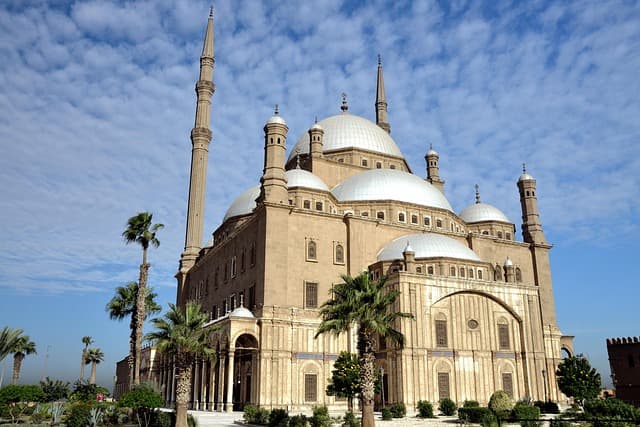
The mosque he built over this history was not Egyptian in style, not Mamluk, not even traditionally Ottoman. Mohamed Ali hired a Greek architect named Yusuf Boshnak and gave him a brief: build something that looks like the Sultanahmet Mosque in Istanbul. The result is an Ottoman imperial statement planted in the heart of Cairo, completed in 1848, the year Mohamed Ali lost his mind to dementia and the same year Egypt's first railway concession was being negotiated by his successors. The coincidences of that year alone deserve a book.
What most visitors don't register is that the Citadel itself predates all of this by six centuries. Saladin began constructing it in 1176, using laborers he had sourced from Crusader prisoners of war. The limestone he used came partly from the outer casing stones of the smaller Giza pyramids, which Saladin's engineers dismantled for the project. The Pyramids you see today are slightly smaller than they were in 1176 because of decisions made to build the walls you are standing inside.
---
The Mosque You Think You Know
The Mohamed Ali Mosque is sometimes called the Alabaster Mosque, and the name is accurate. The lower interior walls are lined with alabaster panels quarried from Beni Suef, and in the morning light they glow with a quality that is less reflective than translucent, as if the stone is lit from behind. The smell inside is cool limestone and old wood and the faint trace of incense that seems to live permanently in Egyptian religious buildings regardless of faith.
What you are less likely to notice without looking for it: the clock in the mosque's courtyard was a gift from King Louis-Philippe of France in 1846, sent in exchange for the obelisk that Mohamed Ali gave Paris from the Luxor Temple, which now stands in the Place de la Concorde. The Cairo clock has never worked properly. The Luxor obelisk has been standing in Paris for over 170 years. Egyptians have opinions about this exchange.
The mosque's two minarets are 82 meters tall and were, for a period in the nineteenth century, the tallest structures in Cairo. They were deliberately designed to be visible from the Nile, from the Delta, from the road to Sinai: a statement of sovereignty addressed to anyone approaching the city from any direction.
Mohamed Ali is buried here, in a small marble mausoleum in the western corner that most visitors walk past without stopping. His tomb is quieter than it deserves to be. The man reorganized the Egyptian state, built the first secular schools, sent the first Egyptian students to Europe, established a cotton industry that would eventually make Egypt one of the wealthiest countries in Africa, and laid the administrative foundations that lasted in recognizable form until 1952. He also presided over forced labor, brutal taxation, and military conscription that stripped villages of their men for decades. Both things are true. The tomb is small and usually empty.
---
The Citadel Beyond the Mosque
Most visitors see the Mohamed Ali Mosque, look at the view, and leave. This is understandable and also a significant waste of what the Citadel contains.
The Al-Nasir Muhammad Mosque, built between 1318 and 1335 by the Mamluk sultan who ruled Egypt three separate times, is the oldest intact structure on the Citadel and architecturally more interesting than the Mohamed Ali Mosque by most technical measures. Al-Nasir Muhammad brought craftsmen from Persia to work on its minarets, which are covered in faience tilework in a style that appears nowhere else in Egyptian Islamic architecture. He also stripped decorative elements from Crusader churches in Acre and incorporated them into the mosque's portico. You can see the Gothic columns if you know to look for them.
Al-Nasir Muhammad ruled for a combined total of over 40 years across his three reigns, which is extraordinary given that the Mamluk system was essentially organized around assassination as a succession mechanism. Of the 24 Mamluk sultans who ruled after him, most were removed by violence. He died in his bed, which in Mamluk terms was an exceptional achievement.
The northern terrace, beyond the Al-Nasir mosque, is where the view opens. On a clear winter morning, the Pyramids of Giza are visible to the southwest as pale geometric interruptions in the horizon haze. The entire sweep of Cairo spreads below: minarets in every direction, the green thread of the Nile, the university towers of Zamalek, and to the southeast the desert beginning immediately where the city ends, as if someone drew a line. No buffer, no suburbs fading into landscape. Cairo, then sand.
---
The Connections
The Citadel sits at the intersection of every major period in Cairo's history, and understanding those connections changes what you see.
Saladin built the Citadel as part of a larger fortification project that also included a wall around Fustat, the original Arab city of Cairo founded in 641 AD by Amr ibn al-As, the general who led the Islamic conquest of Egypt and who reportedly said of the country that he would not describe it because no description was adequate. Fustat's ruins are visible south of the Citadel and are almost completely unvisited.
The Mamluks who followed Saladin were not Egyptian. They were enslaved soldiers, mostly from the Caucasus and Central Asia, bought as children and trained as warriors. The word Mamluk means "one who is owned." They ruled Egypt as a slave dynasty for 267 years, built the finest medieval architecture in Cairo, and were massacred by a man who himself arrived in Egypt as a foreign military officer with no legitimate claim to power. The circularity is not lost on Egyptian historians.
Mohamed Ali's descendants ruled Egypt until 1952, when Farouk, his great-great-grandson, was deposed by the Free Officers movement. The last of the dynasty to hold formal power, Farouk left Egypt on a yacht from Alexandria. He died in Rome in 1965, reportedly during dinner, in a restaurant. His father, Fuad I, is buried in a mosque in Heliopolis that most Cairenes have never visited. His grandfather Ismail built the Cairo Opera House and the European-style streets of Downtown Cairo while bankrupting the country, which led to British occupation in 1882. Every Cairo neighborhood contains a chapter of this family's decisions.
The Citadel itself was the seat of Egyptian government until 1874, when Khedive Ismail moved the official residence to Abdeen Palace in what is now Downtown. He wanted to be closer to the European Cairo he was building. The Citadel became a military garrison. It remained one until 1983, when Mubarak's government converted it to a heritage site and opened it to the public. The soldiers left, the tourists arrived, and the view from the northern terrace remained exactly as it had been for 800 years.
---
Common Mistakes
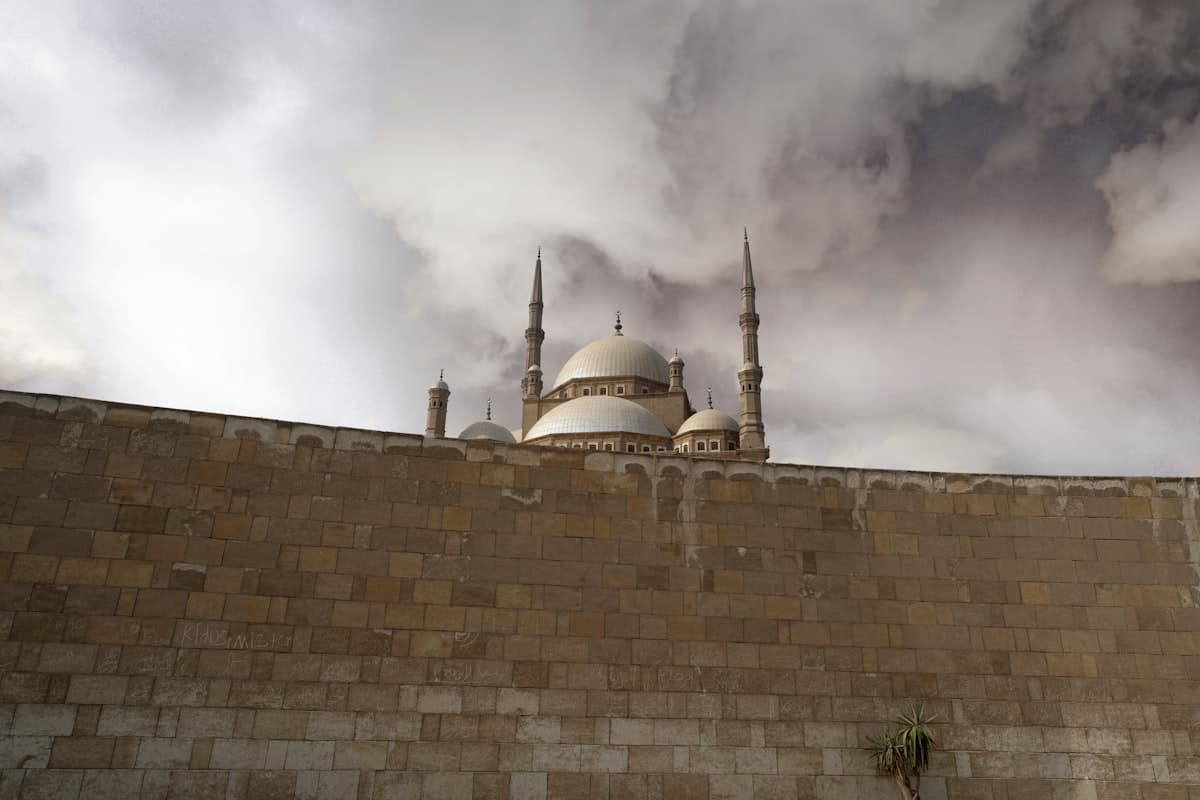
Arriving after 10am on a weekend. Tour buses begin arriving from the main hotels by 9:30am. By 10am the courtyard of the Mohamed Ali Mosque is crowded enough that the alabaster walls are invisible behind phone screens. Arrive at 8am when the gates open. The light is better and you will have the courtyard nearly to yourself.
Skipping the Al-Nasir Muhammad Mosque. Every group goes to the Mohamed Ali Mosque and very few walk the extra five minutes to the Al-Nasir mosque. The Crusader columns in the portico and the Persian tilework on the minarets are specific, unusual, and worth the walk. If you only have time for one interior, the Mohamed Ali Mosque is the more photogenic. If you have time for both, start with Al-Nasir.
Paying for a guide at the gate. The unofficial guides who approach you at the Citadel entrance vary widely in quality. Several are excellent. Several will rush you through the Mohamed Ali Mosque in 20 minutes and spend the rest of your time steering you toward their cousin's papyrus shop. Hire a licensed guide through your hotel or through the Egyptian Tourist Authority's registry before arriving.
Doing the sound and light show. It costs EGP 300, runs about an hour, uses colored floodlights to illuminate the mosque exterior, and narrates a version of Mohamed Ali's history that would embarrass a secondary school textbook. Reading this article will give you more context for a fraction of the cost. Skip it without guilt.
Underestimating the heat and the incline. The Citadel is on a hill. The ground inside is uneven stone. In summer, the reflected heat from the limestone walls is significant by 11am. Wear shoes with grip, bring water, and if you are visiting with elderly travelers or anyone with mobility concerns, know that the walk between the main gate and the northern terrace involves a sustained uphill section with no shade.
Missing the city view because of the mosque. Many visitors spend their entire time inside the Mohamed Ali Mosque and forget to walk to the northern terrace for the panoramic view of Cairo. The view, not the mosque, is the reason the Citadel has been strategically significant for 800 years. Do not leave without standing at the terrace railing.
Expecting the neighborhood around the Citadel to be tourist-ready. The streets immediately north and west of the Citadel gate are a working Cairo neighborhood with butchers, mechanics, and coffee shops that have no particular interest in foreign visitors. This is not a problem. It is, in fact, the best part of the visit for anyone who wants to understand that the Citadel exists inside a living city, not a theme park. Walk five minutes in any direction and buy tea from somewhere that does not have an English menu.
---
Practical Tips
Dress conservatively for the mosque: covered shoulders and knees for everyone, and women will be offered an abaya at the entrance if they need one. There is no charge but a small tip to the attendant is customary.
The best photographs of the mosque's exterior are from the southeastern corner of the courtyard in the morning, when the alabaster domes catch direct light and the minarets are sharp against blue sky rather than white haze.
If you are combining the Citadel with Islamic Cairo, do the Citadel first, then walk north toward the Sultan Hassan Mosque and the Al-Rifai Mosque, which face each other across a square at the Citadel's base. Sultan Hassan was built between 1356 and 1363 and has one of the tallest facades in Islamic Cairo at 36 meters. Al-Rifai is where King Farouk and the last Shah of Iran are both buried, a detail so historically compressed it warrants its own article.
The Military Museum inside the Citadel is often empty and occasionally interesting, with a collection of weapons, uniforms, and maps that spans Pharaonic times to the 1973 October War. The presentation is dated and patriotic to the point of selective history. Go in for 20 minutes if the museum is included in your ticket, which it is.
There are no particularly good restaurants immediately at the Citadel. The cafes inside the complex serve tea, cold drinks, and packaged snacks. For a proper meal, take a taxi 10 minutes north to Farouk Street in the Hussein district, or south to the Sayyida Zeinab neighborhood, where local restaurants serve ful, falafel, and grilled meats at prices that have nothing to do with tourism.
Frequently Asked Questions
The Weekly Dispatch
More on Egypt, every Friday.
Cultural depth and places most guides never mention.
No spam. Unsubscribe anytime.