Ottoman Cairo and Mohamed Ali: The Citadel's Forgotten Empire
Mohamed Ali massacred the last 470 Mamluks at the Citadel in 1811, then built his mosque on their rubble. The view from it explains everything about who controlled Cairo.

Quick Facts
- Best time to visit
- October to March for tolerable temperatures on the exposed plateau. Morning visits (8am to 10am) in any season give the best light and the smallest crowds.
- Entrance fee
- EGP 450 (approx $9 USD) full complex, students EGP 225 with valid ID. Includes all museums and mosques inside the Citadel.
- Opening hours
- Daily 8am to 5pm (winter), 8am to 6pm (summer). Friday mosque access may be limited 11:30am to 1:30pm for prayers.
- How to get there
- Taxi from central Cairo EGP 50 to 80. Uber or Careem EGP 40 to 60. Metro to Sadat station then taxi or microbus to Bab el-Wazir (ask for 'El-Qala'a').
- Time needed
- 2 hours minimum for mosque and terrace. Half-day (3 to 4 hours) if including Military Museum and Al-Nasir Muhammad Mosque.
- Cost range
- EGP 600 to 900 for entrance, transport, water, and basic food near the gate.
Quick Facts
Best time to visit: October to March, when the Citadel plateau is cool enough to walk without suffering. July and August at the Citadel means midday heat radiating off limestone that has been absorbing sun since the 12th century.
Entrance fee: EGP 450 (approx $9 USD) for the full Citadel complex, which includes the Mohamed Ali Mosque, the National Military Museum, and the Carriage Museum. Students with valid ID pay EGP 225. Photography is included in the ticket price.
Opening hours: Daily 8am to 5pm in winter, 8am to 6pm in summer. Friday prayers can limit access to the mosque interior between roughly 11:30am and 1:30pm.
How to get there: From Tahrir Square, take the Metro to Sadat station, then a microbus or taxi to Bab el-Wazir (the lower Citadel gate). Taxis from central Cairo cost EGP 50 to 80. The walk up from Salah Salem Street is steep and not well-signed. Tell the driver "El-Qala'a" and they will understand.
Time needed: Two hours minimum for the mosque and its terrace. A full half-day if you include the Military Museum, which is genuinely worth it and almost never crowded.
Cost range: EGP 600 to 900 for entrance, transport, water, and a meal at one of the cafes near the Citadel gate.
---
Why This Place Matters
Forty-seven meters above the streets of Islamic Cairo, the Mohamed Ali Mosque sits at the highest point of the Citadel plateau, and it was positioned there deliberately. When Mohamed Ali Pasha completed it in 1848, the year before he died, the message was not architectural. It was political. The mosque's twin minarets, at 84 meters each, could be seen from every quarter of Cairo. The Ottoman sultan in Istanbul had just been told, politely but unmistakably, that Egypt had its own ruler now.
The Citadel itself is older than the Ottoman period by three centuries. Saladin began construction in 1176 using limestone quarried from the small pyramids at Giza, and some of that original Ayyubid wall is still visible on the northern face. The site was chosen because a prevailing north wind kept the plateau free of the fetid air that settled over the Nile floodplain. When Napoleon's scientists surveyed Cairo in 1798, they noted that the Citadel's air quality was measurably better than the city below. Cairo's medieval rulers had understood this intuitively for six hundred years.
The Ottoman history of the Citadel begins in 1517, when Selim I defeated the Mamluk sultan Tuman Bay at the Battle of Raydaniyya, just north of Cairo, and had him hanged from the Zuweila Gate. The Ottomans ruled Egypt for the next three centuries through a governor system, but in practice the Mamluks never really went away. They ran local administration, controlled trade, and treated Cairo as their personal property. This is the backstory you need to understand what Mohamed Ali did here in 1811.
---
The Massacre That Built a Dynasty
On March 1, 1811, Mohamed Ali invited 470 Mamluk beys to the Citadel to celebrate his son Tusun's appointment to lead a military campaign in Arabia. The Mamluks arrived in full ceremonial dress, rode through the narrow corridor between the Muqattam cliff and the outer Citadel wall, and were locked in. His Albanian and Turkish soldiers opened fire from above. Every Mamluk was killed. One man, Amin Bey, reportedly survived by leaping his horse from the wall, a story that appears in every Egyptian history textbook and that historians now consider almost certainly invented. The horse would have died. The man certainly did.
This event is called the Massacre of the Citadel, and it is the founding moment of modern Egypt. Mohamed Ali did not just eliminate his rivals that day. He ended a military caste that had effectively controlled Egypt, on and off, since 1250. Within the next decade he would build Egypt's first modern army, conscript its peasants, establish its first state printing press, and send students to Paris to study medicine and engineering. The Ottoman Cairo history most tourists associate with the Citadel is actually the story of how Egypt stopped being Ottoman.
The spot where the massacre happened is now a car park inside the lower Citadel. There is no marker. Most visitors walk across it without knowing.
---
Inside the Alabaster Mosque
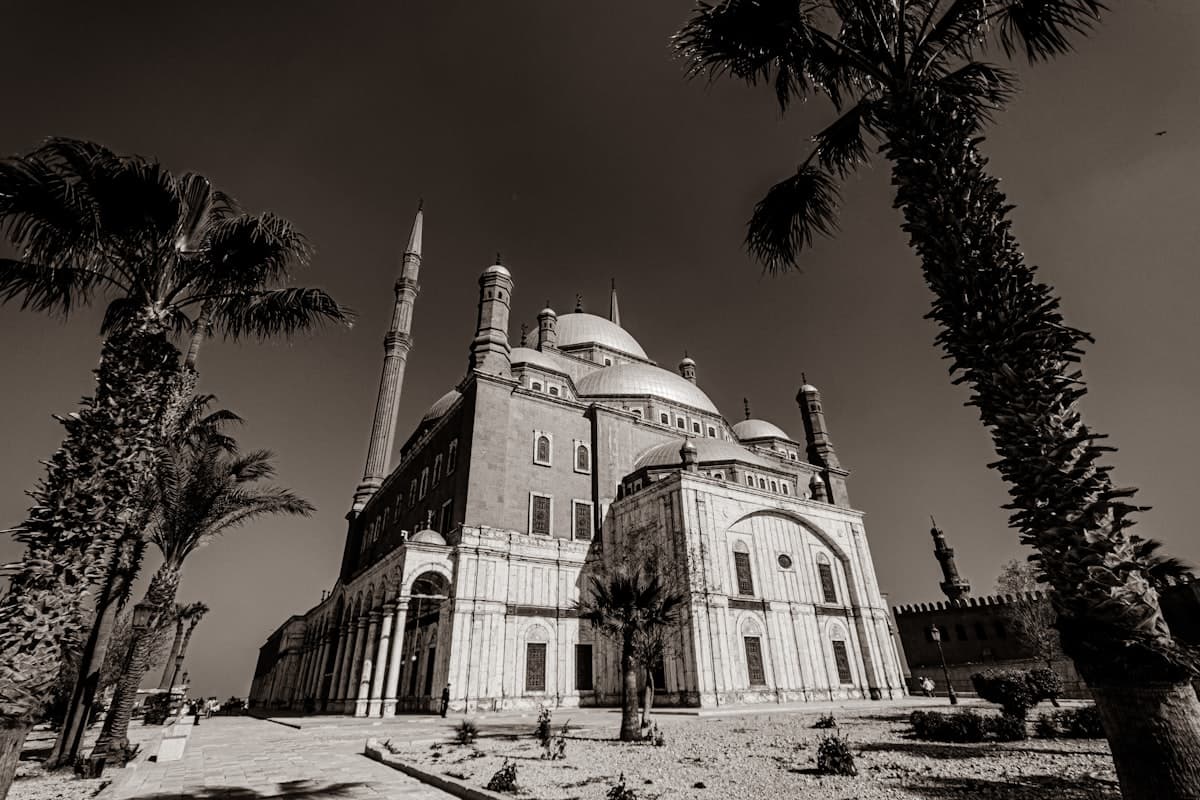
The Mohamed Ali Mosque is often called the Alabaster Mosque because its lower interior walls and courtyard surfaces are faced with alabaster quarried from the Eastern Desert near Beni Suef. This is accurate but slightly misleading. What you see on the walls is calcite alabaster, which is not the same mineral as true alabaster and is geologically common in Egypt. What makes the mosque interior genuinely extraordinary is scale and light. The central dome reaches 52 meters, and the four half-domes that surround it are each large enough to contain a small church. The architect, Yusuf Bushnak, was brought from Istanbul, and the design is openly modeled on the Sultan Ahmed Mosque in Istanbul, which itself was modeled on Hagia Sophia. This means the Mohamed Ali Mosque is, in a direct architectural lineage, a descendant of a 6th-century Byzantine cathedral.
In the courtyard, on the western side, stands a clock tower given to Mohamed Ali by King Louis-Philippe of France in 1845. It has never worked reliably. In exchange, Mohamed Ali gave France the obelisk that now stands in the Place de la Concorde in Paris. France got significantly the better of this trade.
Mohamed Ali is buried inside the mosque, in a white marble tomb enclosed by a gilded screen on the right side of the prayer hall. His tomb is almost always empty of visitors when I have been there. People photograph the domes and leave. Spend five minutes at the tomb instead. The man who redrew Egypt's entire political and economic structure for the next century and a half is buried in a room most tourists use as a shortcut to the exit.
---
The Citadel Beyond the Mosque
The Mohamed Ali Mosque is the reason most people come to the Citadel. It should not be the only reason they stay.
The Mosque of al-Nasir Muhammad, standing in the northern courtyard, is older by five centuries and more architecturally interesting to anyone who has studied the period. Al-Nasir Muhammad ibn Qalawun built it between 1318 and 1335, and its minarets are covered in a faience tilework that arrived in Egypt via Persia and is essentially unique in Cairo. The Ottomans used the mosque as a stable for their horses after 1517, which explains why the interior mihrab is damaged but the exterior survived. The insult was deliberate. The preservation was accidental.
The National Military Museum, housed in the former Harem Palace built by Mohamed Ali's successor Abbas I, contains a room dedicated to the 1973 October War that is more emotionally honest than anything you will find in most national war museums. The Egyptian losses are documented alongside the military gains. This is not typical of state-sponsored military history anywhere in the world, and it is worth noting.
The terrace between the two mosques offers a view north over Islamic Cairo that no other point in the city can replicate. On a clear winter morning, you can see the Pyramids of Giza to the southwest, the minarets of the Ibn Tulun and Sultan Hassan mosques directly below, and the distant smudge of the desert plateau. Cairo is a city of 22 million people and from here it looks like a single continuous organism that has been growing for fourteen centuries without interruption, which is almost exactly what it is.
---
The Connections
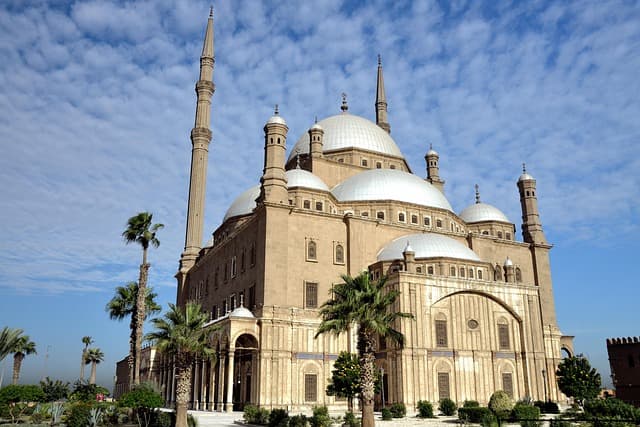
The Citadel sits at the intersection of every major period in Egyptian history, and the layers are literal. Saladin's Ayyubid walls incorporated Roman-era stones taken from earlier structures near Babylon, the Roman fortress that preceded Coptic Cairo and now underlies it. The Mamluks built their palaces over Ayyubid foundations. The Ottomans demolished Mamluk structures and recycled their columns. Mohamed Ali demolished Ottoman structures and shipped their marble to his new palace at Shubra.
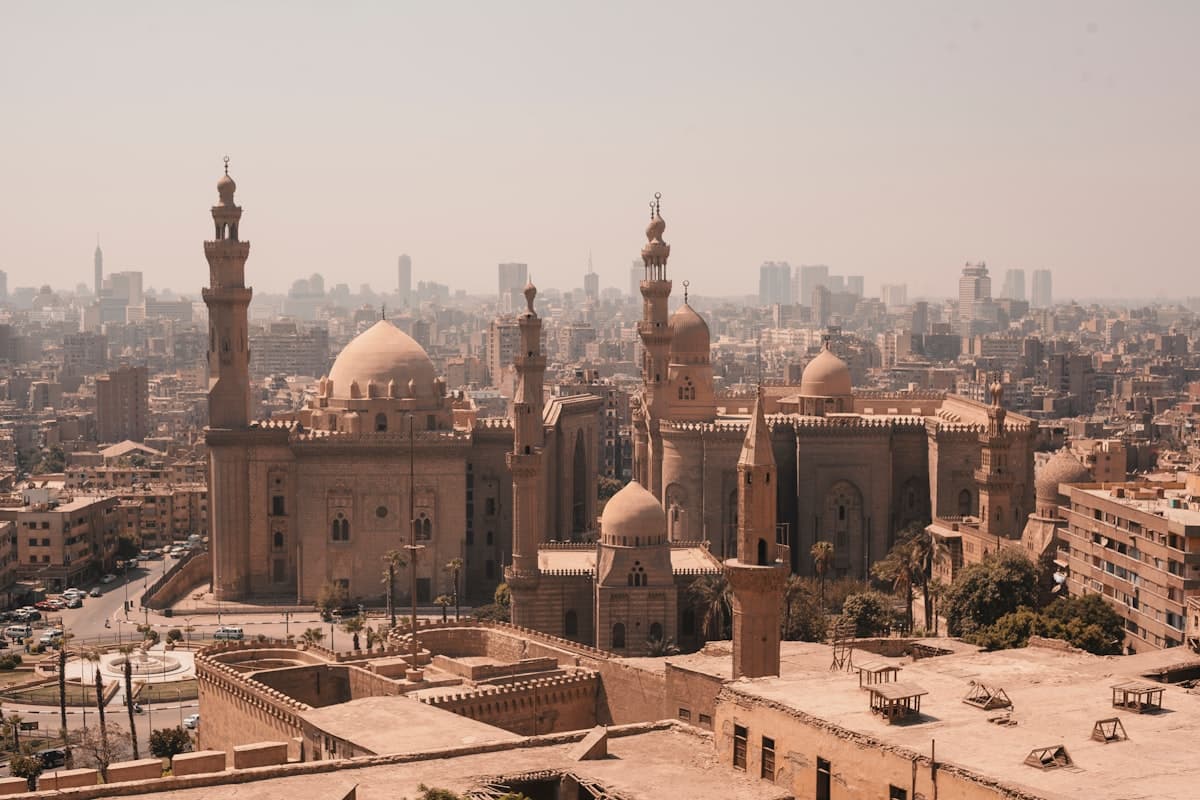
The Sultan Hassan Mosque, visible directly below the Citadel's western wall, was built between 1356 and 1363 and represents the high point of Mamluk architecture in Cairo. Sultan Hassan was murdered before the mosque was finished, and his body was never placed in the mausoleum he built for himself. The two minarets on the western facade were never completed because the Mamluk emirs who succeeded him feared that anyone controlling those heights could fire down into the Citadel. Architecture as military threat: this is how Cairo's medieval rulers thought about their own buildings.
The Mosque of Ibn Tulun, a 20-minute walk north, predates all of this by five centuries. Built in 879 by the Abbasid governor Ahmad ibn Tulun, it was constructed on a hill called Gebel Yashkur where, according to tradition, Noah's Ark came to rest after the flood. Ibn Tulun built his mosque here deliberately, stacking his own religious authority onto a site that already carried sacred meaning. Mohamed Ali did the same thing at the Citadel a thousand years later. The language of Egyptian sacred geography has been consistent across every religion and every dynasty.
---
Common Mistakes
Arriving at midday in summer. The Citadel plateau is exposed limestone at altitude. Between 11am and 3pm from May through September, it becomes genuinely punishing. Morning visits mean better light for photography and cooler stone underfoot.
Spending all your time in the Mohamed Ali Mosque and leaving. This is the most common pattern and it wastes the ticket price. The Al-Nasir Muhammad Mosque next door takes twenty minutes and is the finer building. The terrace view requires no extra time and is the best elevated view in Cairo.
Booking the sound and light show. It costs EGP 350, runs about an hour, and delivers a version of Egyptian history so simplified that it would embarrass a primary school teacher. Everything it tells you is in this article. Skip it and spend the money on dinner in Islamic Cairo instead.
Taking a tour that combines the Citadel with the Egyptian Museum in one day. You will see neither properly. The Citadel alone is a half-day if you are doing it correctly. The Egyptian Museum is another half-day minimum. These are different places for different moods. Do not combine them.
Ignoring the Carriage Museum. Included in your ticket, almost never visited, it contains the state carriages used by Egypt's royal family from Mohamed Ali through King Farouk. The objects are bizarre and beautiful and they tell you more about the khedival obsession with European legitimacy than any history book will.
Entering from the tourist gate on the eastern side without walking the outer walls. The approach from Bab el-Azab on the southern side, which requires a slightly longer walk from your taxi, gives you the original medieval entry sequence and the full scale of the fortifications. The tourist-designated gate exists for bus access, not for experience.
Assuming the Citadel is primarily Ottoman. Most guides emphasize the Mohamed Ali Mosque because it dominates the skyline. The Citadel's twelve centuries of continuous occupation by every major power in Egypt are the real story. The Ottoman Cairo history here is one chapter, not the whole book.
---
Practical Tips
Dress for the mosque interior: shoulders and knees covered for both men and women. Shoe removal is required and there are plastic bags available at the entrance if you prefer not to carry them. The marble floor inside is cold in winter and polished enough to be slippery in socks.
Friday is the most crowded day because local Cairo families visit on their day off. Tuesday and Wednesday mornings are consistently the quietest in my experience. Avoid national holidays entirely unless you enjoy being in a crowd that makes movement difficult.
Water is sold inside the Citadel at roughly EGP 15 to 20 per bottle. Bring your own from outside. There is a reasonable café near the northern courtyard that serves tea and basic food, but the kitchen is slow.
The walk from the Citadel down to the Sultan Hassan Mosque and Ibn Tulun Mosque is manageable on foot if you are comfortable with Cairo traffic and do not mind asking directions. The distance from the Citadel gate to Ibn Tulun is about 1.5 kilometers. A taxi between them costs EGP 20 to 30 and is worth it in summer heat.
If you have a guide, ask them specifically about the Massacre of 1811 and where it happened. If they can show you the physical location and explain its consequences, you have a good guide. If they take you directly to the Mohamed Ali Mosque and describe the dome height, find someone else.
Frequently Asked Questions
The Weekly Dispatch
More on Egypt, every Friday.
Cultural depth and places most guides never mention.
No spam. Unsubscribe anytime.