Ottoman Cairo and Mohamed Ali: The Citadel's Second Empire
Mohamed Ali built his alabaster mosque over Saladin's citadel using stones stripped from Giza's smaller pyramids. Cairo's Ottoman layer is stranger than anyone tells you.

Quick Facts
- Best time to visit
- October to March for cooler temperatures and clearer air with views toward the Pyramids. December and January after rain offer the sharpest visibility from the mosque courtyard.
- Entrance fee
- EGP 450 (approx $9 USD) for foreign adults, EGP 225 for foreign students with valid ID. Covers the Mohamed Ali Mosque, Military Museum, and Carriage Museum.
- Opening hours
- Daily 8am to 5pm (winter), 8am to 6pm (summer). Mosque closes briefly on Fridays from approximately 12pm to 1:30pm for midday prayer.
- How to get there
- Taxi or Careem from Downtown Cairo: EGP 60 to 120, about 20 minutes. Metro Line 1 to Sayyida Zeinab (EGP 10) then tuk-tuk EGP 5 to 10. No direct metro stop.
- Time needed
- 2 to 3 hours for mosque and main Citadel. Full morning (4 to 5 hours) adding Sultan Hassan and Al-Rifa'i mosques at the base of the hill.
- Cost range
- Under EGP 600 for entrance plus transport from central Cairo. Add EGP 150 to 300 for lunch near Salah el-Din Square.
Quick Facts
Best time to visit: October to March, when the Citadel plateau gets a cool northerly breeze and the smog that blankets Cairo in summer thins enough to see the Pyramids from the mosque's courtyard.
Entrance fees: The Citadel complex costs EGP 450 (approximately $9 USD) for foreign visitors, EGP 225 for foreign students with valid ID. This covers the Mohamed Ali Mosque, the Military Museum, and the Carriage Museum inside the walls. The National Police Museum is included but skip it.
Opening hours: Daily 8am to 5pm in winter, 8am to 6pm in summer. The mosque closes briefly on Fridays during midday prayer, usually between 12pm and 1:30pm.
How to get there: A taxi from Downtown Cairo runs EGP 60 to 100 depending on your negotiating patience. The Cairo Metro does not reach the Citadel directly. Take Line 1 to Sayyida Zeinab station (EGP 10), then a tuk-tuk or local microbus up Salah Salem for another EGP 5 to 10. Uber and Careem are reliable from most neighborhoods at EGP 80 to 120.
Time needed: Two to three hours for the mosque and immediate surroundings. A full morning if you walk the full Citadel circuit and sit long enough in the mosque's courtyard to understand why Mohamed Ali chose this spot.
Cost range: The Citadel visit itself, including transport from central Cairo, can be done for under EGP 600. Add lunch at a restaurant on Salah el-Din Square for another EGP 150 to 300.
---
Why This Place Matters
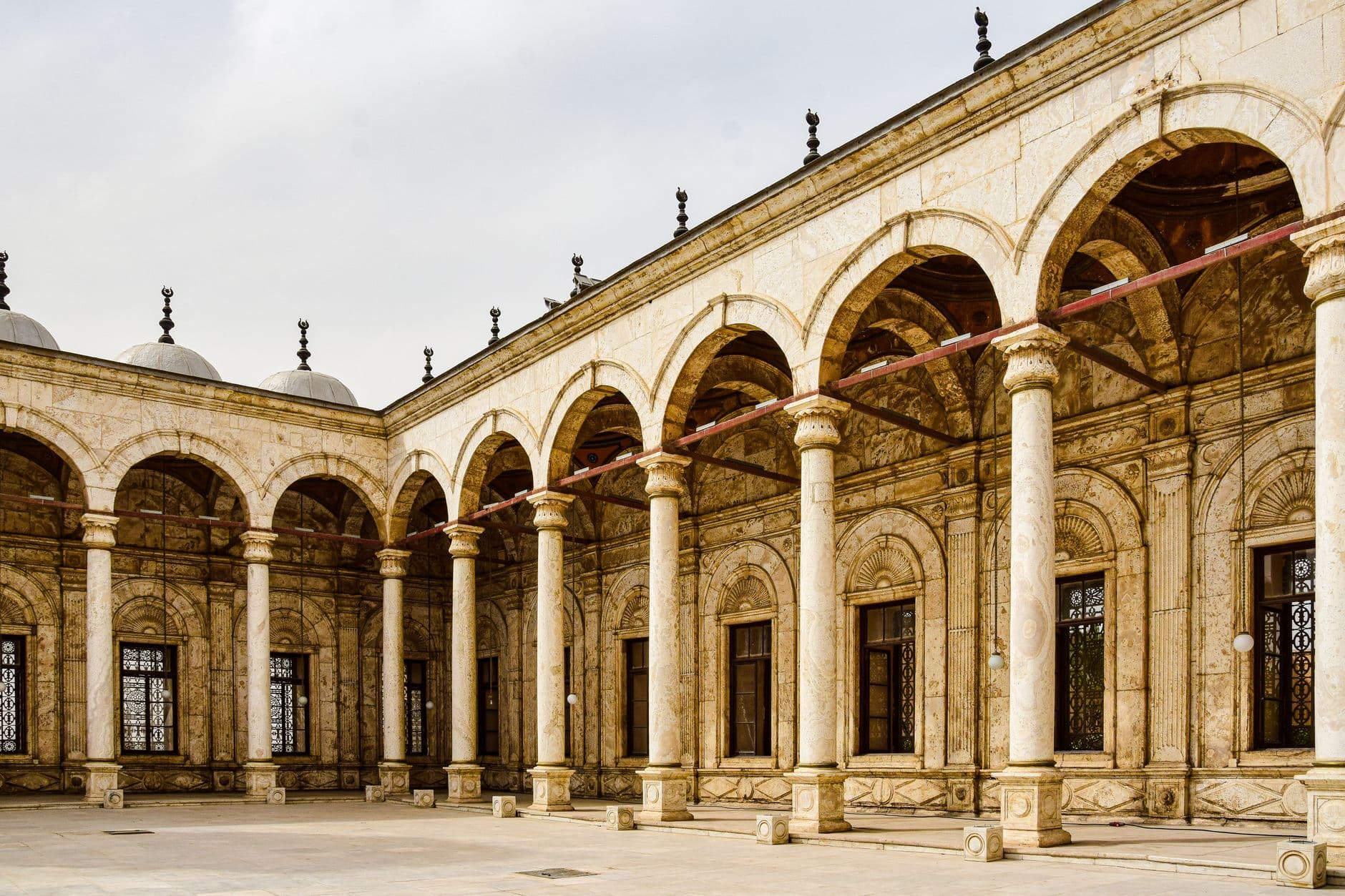
Mohamed Ali Pasha was not Egyptian. He was an Albanian-born Ottoman officer from Kavala, in what is now northern Greece, who arrived in Egypt in 1801 as part of a force sent to push out Napoleon. Within five years he had outmaneuvered the French, the British, the Ottoman court in Istanbul, and the Mamluk beys who had run Egypt for centuries. By 1805 he was governor. By 1811 he had solved the Mamluk problem permanently, inviting their leaders to a banquet at the Citadel and massacring them in the narrow lane that runs down from Bab al-Azab. The gate still exists. The blood dried long ago.
He then spent forty-three years building something that Egypt had not seen since the Fatimid caliphs: a centralized, modernizing state. He sent Egyptian students to Paris, abolished the tax-farming system that had bled the countryside for generations, built the first modern military-medical school in the Arab world at Qasr al-Aini, and constructed a navy capable of threatening the eastern Mediterranean. He also stripped stone from the smaller pyramids at Giza to build Cairo's infrastructure, which is why several of those structures look as though they have been partially disassembled. They have.
The Citadel he chose as his seat was already seven hundred years old. Saladin founded it in 1176 CE as a fortified headquarters linking Cairo and Fustat, the older Arab capital to the south. The rock it sits on was known to be good in a specific way: Saladin's engineers noticed that meat stored on the Muqattam plateau stayed fresh far longer than meat stored at street level, correctly deducing that the elevation produced a cooling air current. He built his citadel on a refrigerator.
---
The Mosque That Ate a Pyramid
The Mohamed Ali Mosque was begun in 1830 and not completed until 1857, twelve years after Mohamed Ali's death. The architect was a Greek named Yusuf Bushnaq, and the design was copied explicitly from the Sultan Ahmed Mosque in Istanbul, which most people know as the Blue Mosque. This is not coincidence and not flattery. Mohamed Ali was making a political statement to Istanbul: I am your equal, possibly your better, and here is a mosque to prove it.
The material he used for the interior cladding is alabaster quarried from the Eastern Desert near Beni Suef, which is why the building glows a particular warm cream-yellow in afternoon light and why it earned the name by which Cairenes still call it: the Alabaster Mosque. The exterior, however, is limestone, and some of that limestone came from the casing stones of the pyramids at Giza. The smoother outer casing of the smaller pyramids was systematically removed in the early nineteenth century for Cairo's building projects. When you stand inside the mosque's courtyard and look south, you are partially surrounded by material that once faced structures four thousand years old.
The clock tower in the courtyard is the other thing everyone photographs and almost no one explains. It is French, sent as a gift from King Louis-Philippe in 1845 in exchange for the obelisk that now stands in the Place de la Concorde in Paris. The clock has never reliably worked. The obelisk has stood in Paris for nearly two centuries without incident, which tells you something about the terms of that exchange.
Inside the mosque, the space is enormous and the acoustics are strange: sound pools in the corners rather than carrying to the center, which means the call to prayer from the minaret is more effective than conversation inside. The two minarets are Ottoman in profile, thin and pencil-like, which is a different silhouette from the fatter Mamluk minarets you will see at the mosques of Sultan Hassan and Ibn Tulun below. Mohamed Ali understood visual language. His minarets were meant to be read from a distance as Ottoman, not Mamluk.
---
What Surrounds the Mosque: The Rest of the Citadel
Most tourists enter the Citadel, go directly to the mosque, take photographs of the view north toward Cairo and west toward the Pyramids, and leave. This is an entirely reasonable decision if your time is short, but it misses several things worth knowing.
The Sultan Hassan Mosque is not inside the Citadel. It is directly below it, at the foot of the hill, and it is one of the most important buildings in Cairo. Built between 1356 and 1363 CE during the Mamluk period, it was constructed so that its height would have allowed the Mamluks to station archers on its roof to fire down into the Citadel. The Mamluk sultan who commissioned it, Hassan ibn Muhammad ibn Qalawun, was murdered before its completion. His body was never placed in the mausoleum he built for himself inside it. The building he never saw finished was funded in part by an outbreak of plague so severe that it left property and endowments unclaimed across Egypt, giving the state an unprecedented surplus. This is where that money went.
Back inside the Citadel walls, the Military Museum occupies the former Harim Palace built by Mohamed Ali's son Abbas I. The collection is uneven, but the building itself is the point: its painted ceilings and ornate reception halls were constructed explicitly to receive European diplomatic visitors and demonstrate that Egypt was a modern state, not a provincial backwater. The museum presentation is chaotic by European standards, but the Ottoman Cairo history embedded in these rooms is more legible than the exhibits suggest.
The Carriage Museum is housed in what was once Mohamed Ali's stables. It contains the gilded carriages used by successive Egyptian rulers for ceremonial occasions. One of them was used in the opening procession of the Suez Canal in 1869. This is not explained anywhere on the premises.
---
The Connections: Four Layers on One Hill
The Citadel's Muqattam ridge is one of those places where Egypt's chronological layers are physically stacked in ways you can see if you know to look.
The Fatimid caliphs who built medieval Cairo in 969 CE did not build on this ridge; they built below it, in the city that became Islamic Cairo. But they quarried this limestone plateau for the walls of their new city. The blocks they cut are still in those walls.
Saladin's Ayyubid dynasty then built the Citadel on the quarried plateau in 1176 CE, using it as a military headquarters that could observe both Cairo and the Nile. The wells he sank inside the Citadel walls, including the famous Joseph's Well (Bir Yusuf, named for Saladin's Arabic name, Yusuf ibn Ayyub), descend nearly 90 meters through the bedrock to reach the Nile water table. The well has two helical ramps wide enough for donkeys to carry water up in relays: an engineering solution to supplying a fortress on a hill.
The Mamluks who replaced the Ayyubids in 1250 CE built their own mosques and palaces inside the Citadel and in its shadow. Their most important monument, Sultan Hassan, sits at the base of the hill and was built, as noted, with enough height to threaten the Citadel itself.
Then Mohamed Ali arrived and remade the top of the hill entirely. His mosque demolished earlier Mamluk structures on the plateau and established an Ottoman visual signature visible from twenty kilometers away. The Ottoman Cairo history and Mohamed Ali guide cannot be separated from everything that was destroyed to make it.
This is not unusual in Cairo. It is the pattern.
---
Common Mistakes
Arriving at midday in summer. The Citadel plateau has almost no shade outside the mosque itself. In July and August, arriving after 10am means crossing stone that has been absorbing heat for four hours. Come at 8am when it opens.
Paying for a guided tour at the gate. The touts near Bab al-Gabal are persistent and their information is often either wrong or generic. The Ottoman Cairo history and Mohamed Ali guide available inside on printed panels, while sparse, is more accurate than what most of them offer. Hire a licensed guide through your hotel or a reputable agency if you want human context.
The sound and light show. It costs EGP 400 and runs some evenings. The production values have not been updated in more than a decade and the narration tells you nothing a fifteen-minute read could not provide. The nighttime view of Cairo from the plateau is worth having; stand outside the entrance for free instead.
Skipping Sultan Hassan. Most Citadel visitors do not descend the hill to the Sultan Hassan Mosque and its neighbor, the Al-Rifa'i Mosque. Al-Rifa'i, finished in 1912 and designed in neo-Mamluk style, contains the tomb of the last Shah of Iran, Mohammad Reza Pahlavi, who died in Cairo in 1980 after Anwar Sadat offered him asylum. The juxtaposition of medieval Mamluk architecture and a Cold War exile's final resting place is the kind of thing that makes Cairo unlike anywhere else.
Assuming the view toward the Pyramids is always clear. Cairo's haze is real and worst between April and September. In midwinter, particularly after rain, the air clears enough to see all three Giza pyramids from the mosque's courtyard as a distinct silhouette. This is why Mohamed Ali chose this site for his grandest building: he could look from his mosque to the things he was dismantling.
Ignoring the Joseph's Well. The entrance to Bir Yusuf is inside the Citadel complex and usually uncrowded. The well is 91 meters deep with a double helix ramp system. It is genuinely unusual engineering and takes ten minutes. Almost nobody goes.
Treating this as a half-day trip. If you combine the Citadel with Sultan Hassan, Al-Rifa'i, and even a walk into the medieval bazaar lanes of Darb al-Ahmar below, you have a full day that moves through six distinct periods of Egyptian history in a sequence of less than two kilometers.
---
Practical Tips
Dress modestly. The mosque is an active place of worship. Shoulders and knees should be covered for both men and women. Shoe bags are provided at the entrance; you carry your shoes inside. The floor is carpeted and the marble in the courtyard is polished to a degree that makes it slippery when worn socks are involved.
Photography inside the mosque is permitted without a tripod. The interior light is best in the morning when sun comes through the western windows. By afternoon the interior goes flat.
The plateau gets strong wind. This is a feature in summer and occasionally a problem in winter, when it can be cold enough at elevation to feel like a different city than the streets below.
Water is sold inside at EGP 10 to 20 per bottle. Bring your own from outside the gates.
If you are visiting during Ramadan, the mosque atmosphere is different in a way worth experiencing: crowded, lit, and genuinely in use in a way that ordinary tourist visits do not replicate. Timings shift and some areas close earlier.
For the walk from the Citadel down through Darb al-Ahmar to the Bab Zuweila gate, wear shoes you can walk uneven stone in for forty-five minutes. This route passes the restored Khayrbek complex, a Mamluk-period mosque and house that was converted by an Ottoman governor and is now an Aga Khan Trust restoration project. It is free, usually empty, and among the most beautiful interior spaces in Islamic Cairo that no standard tour visits.
Frequently Asked Questions
The Weekly Dispatch
More on Egypt, every Friday.
Cultural depth and places most guides never mention.
No spam. Unsubscribe anytime.