Ottoman Cairo and the Mohamed Ali Mosque: The Full Guide
Mohamed Ali wasn't Egyptian, didn't speak Arabic, and modeled his mosque on Istanbul. Cairo loved him anyway. Here's what that contradiction built.

Quick Facts
- Best time to visit
- October through March. Summer heat in the fully exposed Citadel compound is considerable and shade is limited.
- Entrance fee
- EGP 450 (approximately $9 USD) for the full Citadel complex. Students with valid ID pay EGP 225. Ticket includes the Mohamed Ali Mosque, Al-Nasir Mohamed Mosque, Military Museum, and Police Museum.
- Opening hours
- Daily 8am to 5pm (winter), 8am to 6pm (summer). Mohamed Ali Mosque closes for Friday midday prayers approximately 11:30am to 1:30pm.
- How to get there
- Uber or Careem from Tahrir Square: EGP 35 to 55. Street taxi: EGP 40 to 60 (negotiate before entering). Microbus from Attaba toward Salah Salem drops you within a 10-minute walk. Metro does not serve the Citadel directly.
- Time needed
- 2 to 3 hours for the Citadel compound alone. 4 to 5 hours if combining with Darb al-Ahmar walk and Ibn Tulun Mosque.
- Cost range
- Budget EGP 600 to 900 per day including transport and street food. Mid-range EGP 1,800 to 2,800 with a licensed guide and a sit-down lunch in Islamic Cairo.
Mohamed Ali Pasha had every reason to build a Turkish mosque. He was Albanian, had spent his formative years in the Ottoman Balkans, and owed his rise to power to an Ottoman appointment that was never meant to make him dominant. He arrived in Egypt in 1801 as part of an Albanian contingent sent to help expel Napoleon. By 1805, he had maneuvered himself into the position of governor. By 1811, he had invited the remaining Mamluk leaders to a banquet inside the Citadel, locked the gate, and had them massacred. He then built a mosque visible from almost every point in Cairo, modeled directly on the Sultanahmet in Istanbul, as if to say: I know exactly whose tradition this is, and I have decided it belongs to me now.
This is Ottoman Cairo history at its sharpest. It is not a story about ancient Egypt. It is a story about power, appropriation, architectural ambition, and the very modern question of what it means to rule a country you were not born in.
Quick Facts
Best time to visit: October through March. Cairo heat between June and September is serious and the Citadel is fully exposed.
Entrance fee: EGP 450 (approximately $9 USD) for the Citadel complex, which includes the Mohamed Ali Mosque, the Military Museum, and the Police Museum. Students with valid ID pay EGP 225. Foreigners pay the foreign-rate ticket at the gate.
Opening hours: Daily 8am to 5pm in winter, 8am to 6pm in summer. The mosque itself closes briefly for Friday prayers around noon. Time your visit accordingly.
How to get there: From Tahrir Square, a taxi should cost EGP 40 to 60 depending on traffic and your negotiating. Ride-hailing apps (Uber and Careem both operate in Cairo) are more reliable at around EGP 35 to 55. Microbus from Attaba to Salah Salem Road drops you within a ten-minute walk of the Citadel gate. The metro does not go directly to the Citadel. Ramses station is roughly 3km away.
Time needed: Two to three hours for the Citadel complex alone. Add another hour if you walk down through the historic district of Darb al-Ahmar afterward, which you should.
Cost range: Budget EGP 600 to 900 per day including transport and meals nearby. Mid-range EGP 1,800 to 2,800 if you add a guide and lunch in Islamic Cairo.
Why This Place Matters
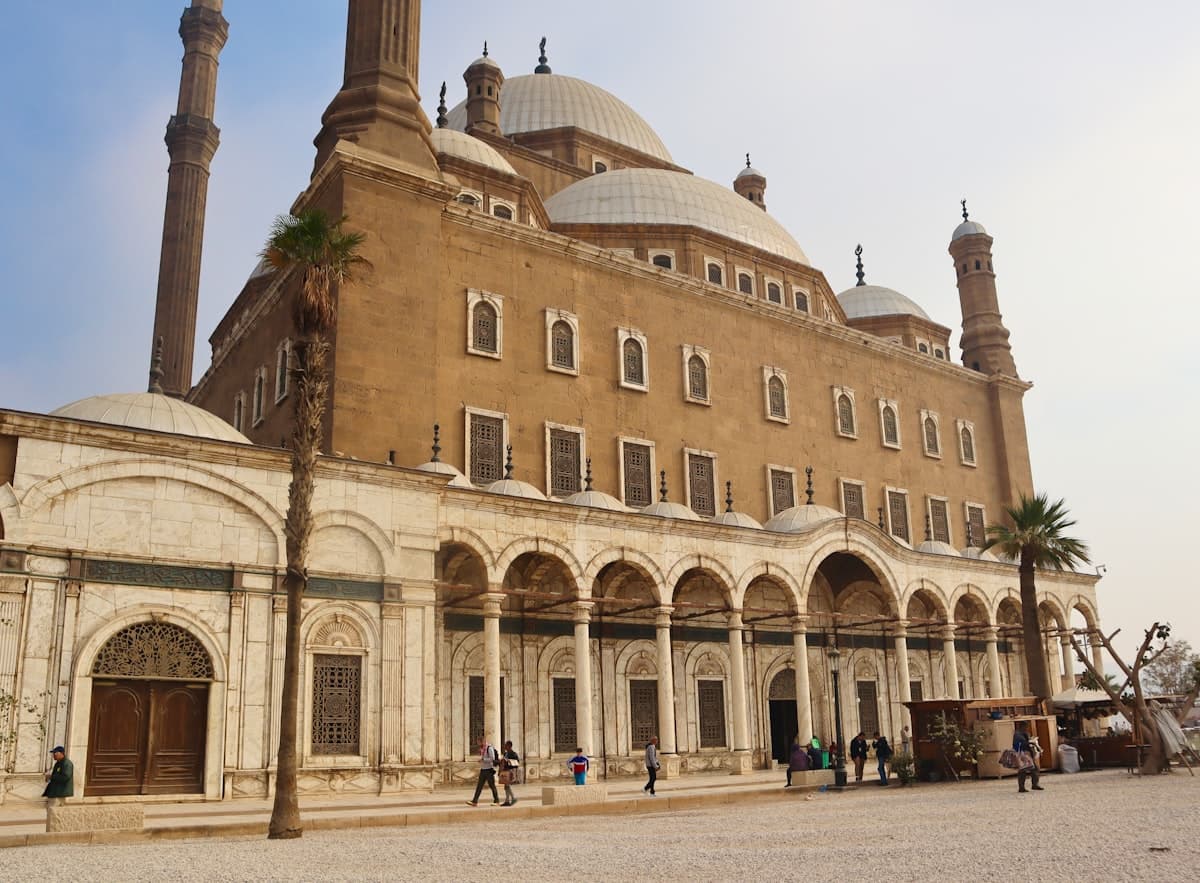
The Citadel of Cairo was begun by Saladin in 1176, on a spur of the Muqattam Hills, using stone quarried from smaller pyramids at Giza. That detail bears repeating: the limestone casing you see on parts of the Citadel walls came from actual pyramids, dismantled and repurposed because Saladin needed material and the pyramids were the nearest available quarry. The Ayyubid dynasty built on Pharaonic bones, then the Mamluks took it, then the Ottomans in 1517, then Mohamed Ali in the early nineteenth century. The Citadel is not a monument to one civilization. It is a palimpsest of every power that has held Cairo.
Mohamed Ali's mosque, completed in 1848 and named after him, sits at the highest point of this compound. Its twin minarets are 82 meters tall, visible from the Nile. The architect was Yusuf Bushnaq, a Greek-born Ottoman, which adds another layer to the question of who exactly built Ottoman Cairo. The alabaster on the lower interior walls came from Beni Suef, roughly 120km south, which is why the mosque is sometimes called the Alabaster Mosque. The clock in the courtyard was a gift from King Louis-Philippe of France, given in exchange for the obelisk that now stands in the Place de la Concorde in Paris. The French got significantly the better deal.
What You Will Actually See Inside
The courtyard hits you first. It is wide, open, and organized around a fountain for ritual ablution. The clock tower at the western side holds the broken French clock, which has never worked properly and now functions mostly as evidence that diplomatic gifts do not always travel well.
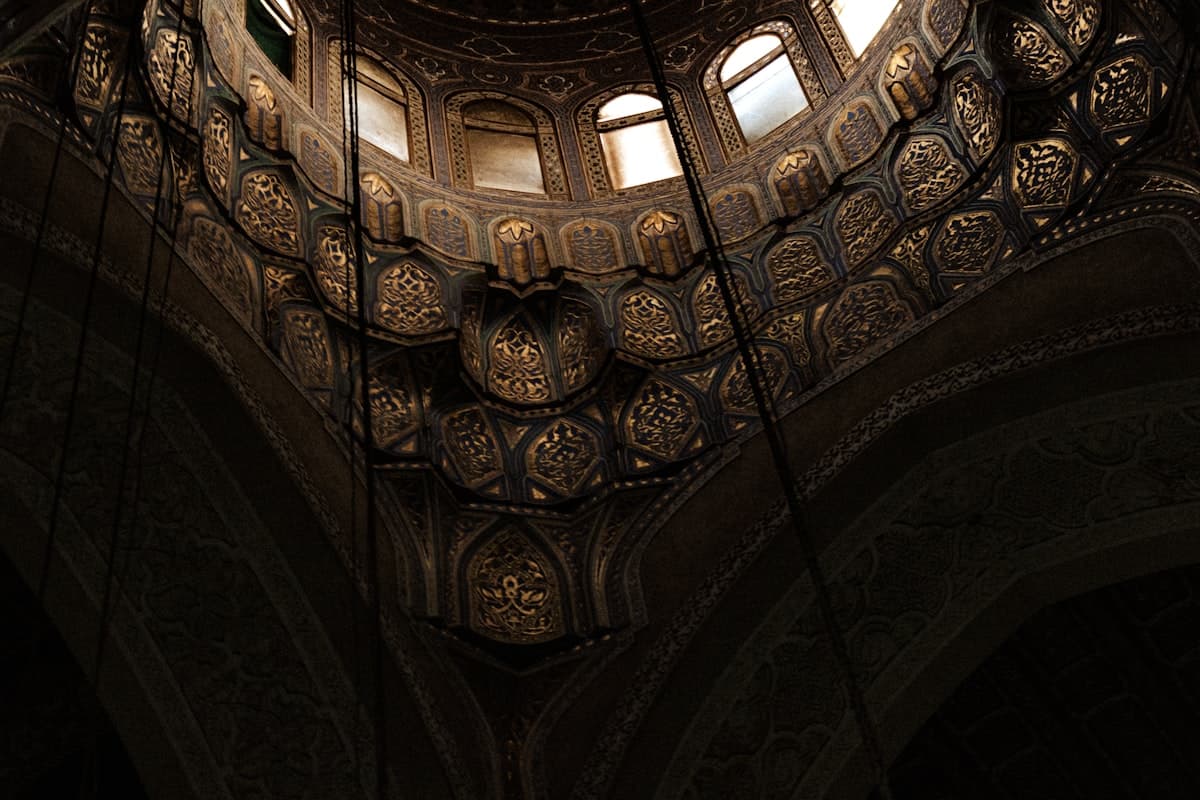
The interior of the dome is 52 meters high. The hanging lamps, hundreds of them, were added by successive restoration campaigns and create a layered, almost geological quality of light in the afternoon. What most visitors miss: the painted wooden ceiling panels in the lower gallery were not part of the original design. They were added during a restoration in the 1930s and represent a later aesthetic entirely. When you look up at the dome and then down at those panels, you are seeing two different centuries trying to speak the same architectural language.
Mohamed Ali is buried here, in a white marble tomb in the southeastern corner of the mosque. The tomb is modest by the standards of the building around it. He died in 1849, one year after the mosque's completion, having never fully recovered from the decline of his mental faculties in his final years. The khedive who built modern Egyptian infrastructure, sent the first Egyptian students to Europe, reformed taxation, and massacred the Mamluks at that same Citadel gate, spent his last months unable to recognize his own ministers.
The Al-Nasir Mohamed Mosque: The One Most People Walk Past
Do not spend your entire Citadel visit inside Mohamed Ali's mosque. Walk north through the compound to the Al-Nasir Mohamed Mosque, built between 1318 and 1335 by the Mamluk sultan who is arguably the most consequential builder in Cairo's medieval history. Al-Nasir Mohamed ibn Qalawun ruled Egypt three separate times, for a combined total of over forty years, and his mosque inside the Citadel reflects the self-assurance of a ruler who had survived being deposed twice.
The mosque's columns are not Mamluk work. They are Roman columns, taken from older structures across Egypt, which was a standard Mamluk building practice. The minarets have a stucco decoration in the Maghrebi style, unusual for Cairo and likely the work of craftsmen brought specifically from Morocco or Andalusia. One minaret is Gothic in its lower section, because it was taken from a Crusader church in Acre after the city fell to the Mamluks in 1291. If you look at it knowing that, the entire story of medieval Mediterranean power is visible in about four meters of stone.
The Al-Nasir mosque is included in your Citadel ticket and sees roughly one-tenth of the visitors that Mohamed Ali's mosque receives. Go there.
The Connections: From Pharaonic Quarry to Albanian Pasha
The Mohamed Ali Mosque guide that most tour operators provide stops at 1848. But the ground it stands on connects to at least three other civilizations. Directly below the Citadel's south wall, along the street called Salah Salem, archaeologists have traced the route of a Fatimid-era aqueduct that was itself built along an older channel. Medieval Cairo's water supply was an engineering project that modified Pharaonic irrigation infrastructure.
Walk down from the Citadel's Bab al-Azab gate into the district of Darb al-Ahmar, which means Red Road in Arabic, and you are in a neighborhood built primarily between the fourteenth and sixteenth centuries. The Aqsunqur Mosque, about a ten-minute walk from the gate, contains Iznik tile panels added by a seventeenth-century Ottoman governor who wanted his mosque to look like Istanbul and had the tiles shipped from Turkey. The mosque is Mamluk in structure and Ottoman in decoration. Cairo does not do categories cleanly.
Further north, the Sultan Hassan Mosque, built between 1356 and 1363, sits almost in the shadow of the Citadel. It was built by a Mamluk sultan who was later assassinated before it was completed. The stones used in its construction were reportedly taken, without ceremony, from the outer casing of the Giza pyramids. The connection between Egypt's ancient monuments and its medieval buildings is not metaphorical. It is lithological.
Common Mistakes
Arriving after 11am on a weekend. The Citadel fills quickly with both tourists and Cairo families on Fridays and Saturdays. The light for photography inside the mosque courtyard is also best before 10am, when the sun hits the alabaster walls at an angle that shows the material's natural veining.
Paying for a guide at the gate. The informal guides who approach at the Bab al-Gadid entrance are not licensed by the Ministry of Tourism and Antiquities in most cases. The quality varies enormously. If you want a guide, book one in advance through a reputable operator or directly through a licensed Egyptologist. The price should be agreed before you enter, not negotiated as you walk.
Skipping the Darb al-Ahmar walk downhill. The Citadel is the obvious destination. The medieval streetscape between it and the Al-Azhar area is where you actually understand how a city was organized around a fortress. The Darb al-Ahmar renovation project, supported in part by the Aga Khan Trust for Culture, restored several Mamluk buildings along this route. None of them are crowded. Several are free.
Spending money on the Military Museum inside the Citadel. It is included in your ticket and you can walk through it. The exhibits are poorly labeled in English and the collection, while historically significant, is organized in a way that communicates very little to someone without prior knowledge of Egyptian military history. Spend that time in the Al-Nasir mosque instead.
Taking a taxi that insists on stopping at a papyrus shop. This is not specific to the Citadel but it will happen on the way. Drivers receive commissions from fixed shops. Use a ride-hailing app.
Expecting the tomb of Mohamed Ali to be a major spectacle. It is not. It is a simple marble enclosure behind a grille. People who expect something commensurate with his historical impact are consistently surprised by the understatement. That understatement is interesting in its own right, but prepare yourself.
The sound and light show at the Citadel costs EGP 350 and tells you nothing not covered in this article. Skip it. The production is aimed at group tours and moves slowly through information that a thirty-minute walk with a good book would give you more efficiently. The Citadel itself, at dusk before closing, is the experience the sound and light show is trying to simulate.
Practical Tips
Dress modestly. The Mohamed Ali Mosque is an active place of worship. Shoulders and knees covered for everyone. Shoes come off at the entrance; there are racks and bags provided. Socks are worth wearing in winter months when the marble floor is cold.
Bring water. The Citadel is entirely outdoors except for the mosque interiors, and the site involves more walking and elevation change than the maps suggest. A small kiosk sells water inside the compound at roughly EGP 20 to 25 per bottle, which is the tourist markup but still reasonable.
The Citadel's cellular reception is inconsistent in some of the lower areas of the compound. Download an offline map before arriving.
If you are combining the Citadel with Khan el-Khalili or Al-Azhar, do the Citadel first. You will be fresher for the climb and the market will still be open and active in the afternoon. The walk between the Citadel's main gate and Al-Azhar mosque is about 1.5km through Darb al-Ahmar and is entirely worth doing on foot.
The best single photograph of the Citadel from outside is taken from the Ibn Tulun Mosque area, roughly 800 meters to the southwest. Mohamed Ali's twin minarets above the Ibn Tulun minaret, with the city between them: this is the image. Ibn Tulun's own mosque, built in 879 AD and one of the oldest surviving mosques in Egypt, charges EGP 100 entry and is almost never crowded. It is the oldest large mosque in Africa built by its original patron still standing in something approaching its original form. If that fact does not make you walk the extra 800 meters, nothing will.
Frequently Asked Questions
The Weekly Dispatch
More on Egypt, every Friday.
Cultural depth and places most guides never mention.
No spam. Unsubscribe anytime.