Ottoman Cairo and the Mohamed Ali Mosque: The Full History Guide
Mohamed Ali built his mosque on the Citadel to erase the Mamluks. He also invited them to a banquet there first, then killed 470 of them on the road down.

Audio Guide: Ottoman Cairo and the Mohamed Ali Mosque: The Full History Guide
Quick Facts
- Best time to visit
- October to March for cooler temperatures and better light. Arrive by 8am on any day to avoid tour group crowds, which peak between 10am and 1pm.
- Entrance fee
- EGP 450 (approx $9 USD) for the full Citadel complex including Mohamed Ali Mosque. Students with valid ID pay EGP 225. Sultan Hassan Mosque across the street is a separate EGP 180 (approx $3.50 USD).
- Opening hours
- Daily 8am to 5pm. Mohamed Ali Mosque closed to visitors during Friday prayers approximately 11:30am to 1:30pm.
- How to get there
- Uber or Careem EGP 60 to 100 from central Cairo. Metered taxi EGP 50 to 80. CTA Bus 951 from Tahrir Square EGP 5. Enter via Bab al-Gadid on Salah Salem Street (south entrance).
- Time needed
- 2 hours minimum for the Mohamed Ali Mosque and courtyard. 4 hours for the full Citadel. Half-day if combining with Sultan Hassan Mosque and Mosque of Ibn Tulun.
- Cost range
- Budget EGP 600 to 900 including transport, entry, and water. Mid-range EGP 1,500 to 2,500 adding lunch and a licensed guide.
Quick Facts
Best time to visit: October to March, when the Citadel plateau gets afternoon light rather than midday glare. Arrive by 8am to beat tour buses.
Entrance fees: The Citadel complex (which includes the Mohamed Ali Mosque, the Military Museum, and the Gawhara Palace) costs EGP 450 for foreign visitors (approximately $9 USD at current rates). Students with valid ID pay EGP 225. Entry to the National Police Museum inside the complex is a separate EGP 30.
Opening hours: Daily 8am to 5pm. Friday prayers close the mosque to visitors from approximately 11:30am to 1:30pm. Plan accordingly.
How to get there: From Downtown Cairo, a metered taxi to the Citadel runs EGP 50 to 80. The CTA Bus 951 runs from Tahrir Square to Salah Salem Street near the Citadel entrance for EGP 5. Uber and Careem are reliable and typically cost EGP 60 to 100 from central Cairo. Do not let anyone tell you the entrance is on the north side. It is on the south, on Salah Salem.
Time needed: Two hours for the mosque and courtyard alone. Four hours if you walk the full Citadel, including the Mosque of al-Nasir Muhammad (which you should). A half-day is the honest minimum.
Cost range: Budget EGP 600 to 900 including transport and entry. Mid-range EGP 1,500 to 2,500 if you add lunch at one of the Khan al-Khalili restaurants nearby.
---
In March 1811, Mohamed Ali Pasha invited the Mamluk beys and their retinues to a celebration at the Citadel in honor of his son Tusun, who was about to lead an expedition to Arabia. Somewhere between 470 and 500 Mamluks arrived. They were fed, honored, and then locked into the narrow passage between the Bab al-Azab gate and the lower walls. Mohamed Ali's soldiers fired down from the walls above. One Mamluk, a man named Amin Bey, reportedly escaped by jumping his horse off the wall. Everyone else died. Within months, Mohamed Ali had sent troops across Egypt to kill every Mamluk commander still breathing outside Cairo. The ruling military class that had governed Egypt, with interruptions, since 1250 was finished in an afternoon.
The mosque he built on the Citadel afterward is not subtle about what it replaced.
Why This Place Matters
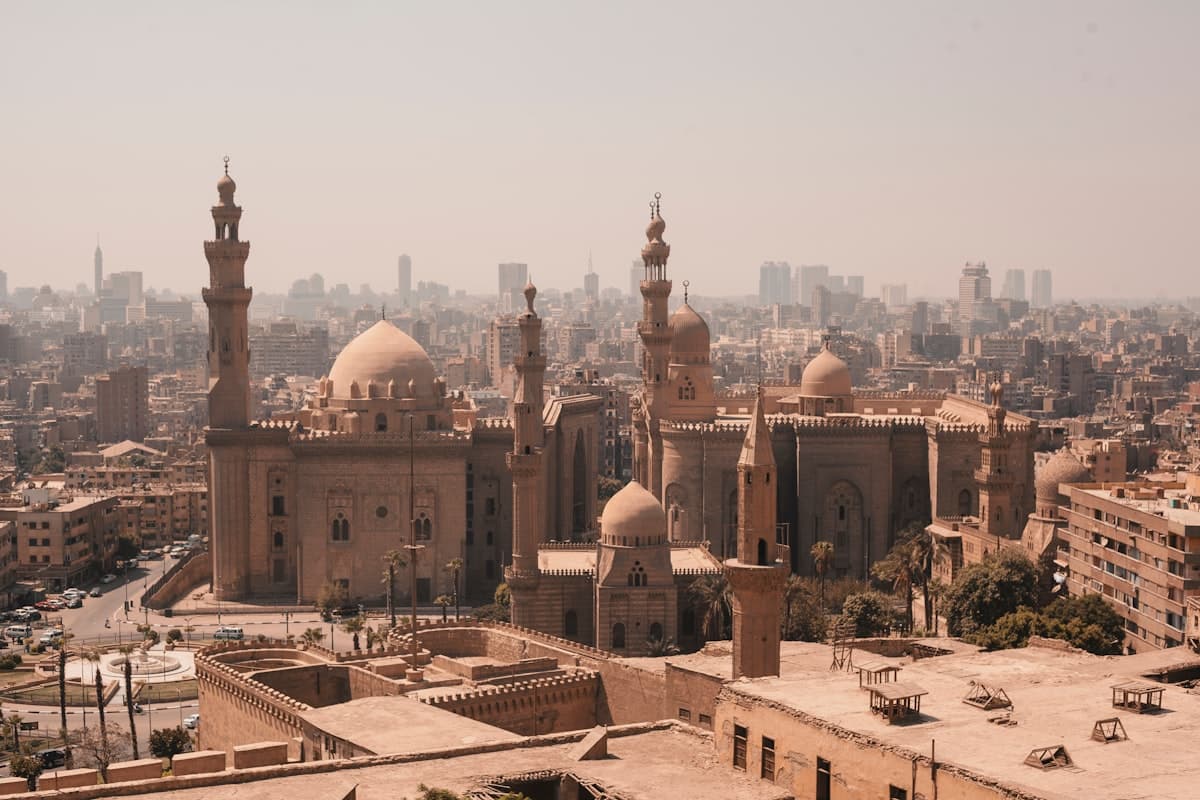
The Citadel of Cairo was not Mohamed Ali's idea. Saladin, the Kurdish general who became sultan of Egypt and Syria, began construction in 1176 using stones stripped from the smaller Giza pyramids. He chose the spur of the Muqattam Hills because it was the one point in medieval Cairo that controlled everything: the city to the north, the Nile to the west, the trade routes to the east. For 700 years after Saladin, whoever held the Citadel held Egypt.
The Mamluks expanded it. The Ottoman sultan Selim I took it in 1517, ending the Mamluk Sultanate after 267 years, and turned it into the seat of Ottoman provincial power. For the next three centuries, Egypt was a province administered by a governor appointed from Istanbul, with real day-to-day power still held by the Mamluk beys the Ottomans had never fully displaced. This is the contradiction that shaped Mohamed Ali's Egypt: the Ottomans were nominally in charge, the Mamluks were practically in charge, and a low-ranking Albanian officer named Mohamed Ali would eventually outmaneuver both.
Mohamed Ali arrived in Egypt in 1801 as part of an Ottoman force sent to expel Napoleon's army. He was born in Kavala, in what is now northern Greece, in 1769, the same year as Napoleon and the Duke of Wellington. By 1805, through a combination of military skill, political maneuvering, and popular support from Cairo's religious establishment, he had made himself pasha. By 1811, he had eliminated the Mamluks. By the 1830s, his armies had conquered Sudan, the Hejaz, and most of Greater Syria, and come close enough to Istanbul that European powers intervened to stop him from toppling the Ottoman Empire itself.
The mosque on the Citadel was begun in 1830 and completed, with modifications, in 1848. It is a deliberate echo of the Sultan Ahmed Mosque in Istanbul, known in the West as the Blue Mosque. Mohamed Ali wanted Egypt to look imperial, and he wanted it to look Ottoman in the grand Istanbul manner rather than in the provincial Cairo manner. He hired a Greek architect named Yusuf Bushnak. He covered the interior in alabaster quarried from Beni Suef, which is why Egyptians call it the Alabaster Mosque. The two minarets are 82 meters tall and are visible from much of southern Cairo.
What You Will Actually See
The courtyard hits you before the mosque does. It is open, clean, and oriented around a central ablution fountain with a clock tower on the western side. The clock tower contains a French clock, a gift from King Louis-Philippe of France in 1845, exchanged for the obelisk of Ramesses II that now stands in the Place de la Concorde in Paris. The Paris obelisk works. The Cairo clock has almost never worked. Egyptians have been pointing this out for 180 years.
The mosque interior is a single large dome 21 meters in diameter surrounded by four semi-domes, lit by hundreds of hanging lanterns and globes that were electrified in the early twentieth century. The floor is covered in carpet. The alabaster paneling on the lower walls gives the interior a pale, cool quality that feels different from every other mosque in Cairo. Most visitors spend fifteen minutes inside, take photographs, and leave. This is a mistake.
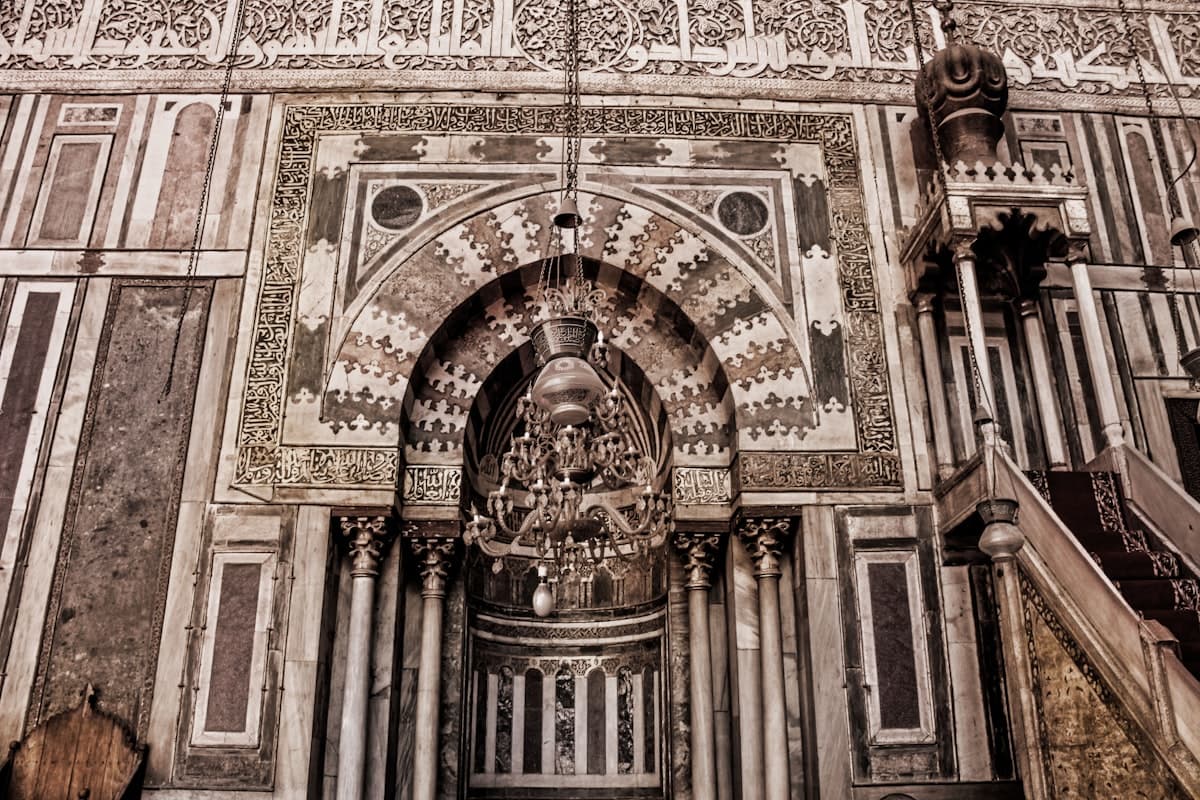
Spend time with the chandeliers. Mohamed Ali commissioned them from European manufacturers, and they are enormous, ornate, and completely at odds with any Ottoman or Mamluk decorative tradition. The mosque is full of these collisions: Ottoman spatial grammar, Italian-influenced decoration, Egyptian materials, French clocks. It is a portrait of a man who wanted to modernize Egypt while using the symbolic language of Islamic imperial power to legitimize himself.
Mohamed Ali is buried here, in a white marble tomb behind a gilded screen in the southwest corner. The tomb itself is nineteenth century, but the location is deliberate. He built the mosque partly as his own mausoleum, and the choice to place it on the exact spot where the Mamluks had been massacred, inside the citadel that Ottoman governors had occupied for three centuries, was not accidental.
The Mosque of al-Nasir Muhammad: What Most Visitors Miss
Fifty meters north of the Mohamed Ali Mosque, most tour groups walk past a smaller, older mosque without stopping. This is a serious error. The Mosque of al-Nasir Muhammad ibn Qalawun was built between 1318 and 1335 and is one of the finest surviving examples of Mamluk religious architecture in Cairo. Al-Nasir Muhammad ruled Egypt three separate times over a fifty-year period, a tenure so long and so marked by construction projects that he is effectively responsible for the visual character of medieval Islamic Cairo.
The mosque's two minarets are unlike anything else in Egypt. One is covered in faience tilework that al-Nasir Muhammad had brought from a mosque he demolished in Acre, in what is now Israel, after the Crusaders were expelled. It is the only Gothic-influenced minaret in Egypt, and you can see the pointed arches and decorative stonework from the Crusader period clearly if you look. The columns inside the mosque were taken from Pharaonic and early Christian sites across Egypt. Al-Nasir Muhammad had no particular interest in where they came from. He wanted columns, and Egypt had thousands of them lying around.
Entrance to this mosque is included in the Citadel ticket. There is almost never a crowd.
The Connections
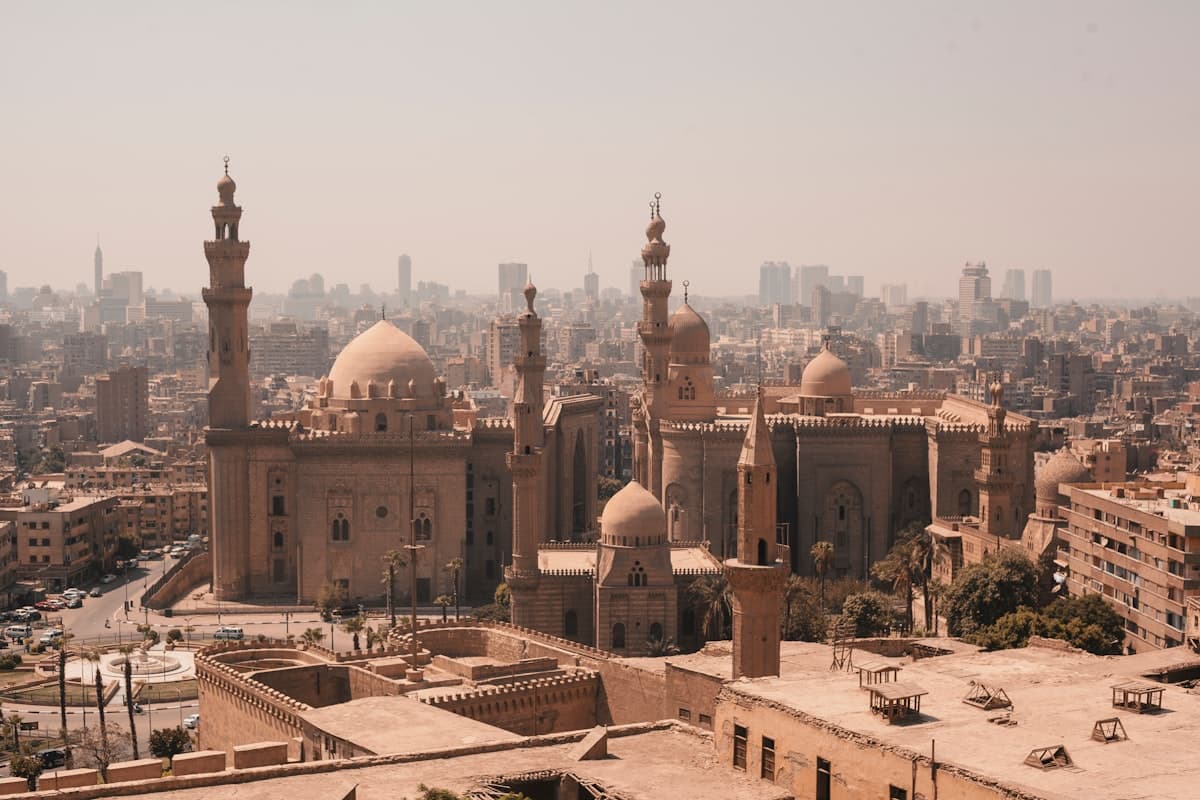
The Citadel and the Mohamed Ali Mosque sit at the intersection of every major period in Egyptian history, and the connections run in multiple directions.
Saladin's walls were built partly with casing stones from the Giza pyramids. When you stand on the Citadel's northern terrace and look toward Giza, you are looking at monuments that were partially cannibalized to build the platform beneath your feet. The Mamluk sultans who followed Saladin built their own monuments in the city below, including the extraordinary complex of Sultan Hassan directly across the road from the Citadel entrance, begun in 1356, whose mosque is so large that when it was completed, Mamluk authorities were reportedly afraid to finish the minarets in case enemies used them to fire on the Citadel.
The Ottoman conquest of 1517 did not erase Mamluk culture. The Ottomans kept Mamluk administrative structures in place and continued to import enslaved Circassian and Georgian boys to be trained as soldiers and administrators, the same system the Mamluks had used for centuries. The word Mamluk means owned, in Arabic. The system that produced the warriors who stopped the Mongols at Ain Jalut in 1260 was still functioning, in modified form, when Mohamed Ali arrived in 1801.
Mohamed Ali's own modernization project connected Cairo to Europe in ways that are still visible. He sent Egyptian students to France. He invited European engineers, doctors, and military advisors. The Citadel's Military Museum, housed in the nineteenth-century Harim Palace, contains documents and weapons from every phase of this history, including Ottoman firman decrees, Mamluk armor, and letters from Napoleon's Egyptian campaign. It is understaffed and underfunded and has labels that are sometimes wrong, but it is one of the few places in Cairo where you can hold the full sweep of the Ottoman Cairo history Mohamed Ali created in a single room.
The Gawhara Palace, also within the Citadel complex, was Mohamed Ali's private residence before it partially burned in 1972. What remains, including French furniture, Ottoman tiles, and painted ceilings, makes the collision of influences in the mosque make more sense. Mohamed Ali was genuinely living between worlds.
Common Mistakes
Arriving after 10am on a weekend. Tour buses from Sharm el-Sheikh and Hurghada start arriving at the Citadel around 9:30am on Fridays and Saturdays. By 10:30am, the courtyard of the Mohamed Ali Mosque is so crowded that you cannot see the ablaster walls without someone's selfie stick in your face. Come at 8am, when the light is better anyway.
Paying for a guide at the gate. The informal guides who approach visitors outside the Bab al-Gadid entrance charge EGP 200 to 400 for a forty-minute tour that tells you the mosque was built by Mohamed Ali and that the clock doesn't work. You already know more than that. A licensed Egyptologist-guide hired through a reputable agency costs more (EGP 600 to 1,000 for a half-day) but covers the full Citadel with actual historical depth.
Skipping the Sultan Hassan Mosque across the street. The Mosque-Madrasa of Sultan Hassan, directly opposite the Citadel's main gate, is a separate admission (EGP 180 for foreigners, approximately $3.50 USD) and is arguably the most impressive medieval Islamic building in Africa. The interior courtyard is 68 meters long. The entrance portal is 38 meters high. It is less visited than the Mohamed Ali Mosque and far more architecturally significant. Do not let proximity to the Citadel cause you to skip it.
Doing the sound and light show. The Citadel sound and light show costs EGP 350, runs in heavy-accented English, and tells you roughly what is in the first two paragraphs of this article. The production values belong to 1985. The money is better spent on dinner in the Sayeda Zeinab neighborhood afterward.
Missing the northern terrace view. The view from the northern terrace of the Citadel, looking out over Islamic Cairo toward the minarets of al-Azhar and the Mosque of Ibn Tulun, is one of the best views in the city. Most visitors photograph the mosque and leave without finding it. Walk north through the Citadel grounds past the Military Museum to reach it.
Wearing unsuitable footwear. The Citadel grounds are uneven stone and worn marble. The Mohamed Ali Mosque requires you to remove your shoes at the entrance, and the floor inside can be cold in winter. Slip-on shoes, or shoes with easy fastenings, save time and discomfort.
Confusing the entrance gates. The Citadel has multiple gates, but visitors enter through the Bab al-Gadid (New Gate) on the south side, off Salah Salem Street. Bab al-Azab, the northern gate where the 1811 massacre occurred, is currently closed to visitors. Taxi drivers sometimes drop you at the wrong side, especially if you are coming from Khan al-Khalili. Confirm the destination as Bab al-Gadid.
Practical Tips
Dress modestly. The Mohamed Ali Mosque is an active place of worship. Shoulders and knees should be covered for both men and women. Headscarves for women are required inside the mosque and are available to borrow at the entrance, though bringing your own is more comfortable.
The Citadel complex has a cafe near the Military Museum with mediocre coffee and good views. It is overpriced (EGP 80 to 120 for a drink) but the terrace seating is useful if you need to rest mid-visit. Bring water regardless, particularly between April and October when the stone of the Citadel retains heat through the afternoon.
Photography is permitted throughout the Citadel and inside the Mohamed Ali Mosque. No tripods without prior permission from the Supreme Council of Antiquities.
The Citadel and Sultan Hassan Mosque together are a natural full morning. Combine with the Mosque of Ibn Tulun (a twenty-minute walk or short taxi) for a full survey of Islamic Cairo from the ninth century through the nineteenth. Ibn Tulun was built in 879 AD, before the Fatimids founded Cairo, and its spiral minaret is a direct reference to the Great Mosque of Samarra in Iraq. It is the oldest intact mosque in Africa and almost always quiet.
Frequently Asked Questions
The Weekly Dispatch
More on Egypt, every Friday.
Cultural depth and places most guides never mention.
No spam. Unsubscribe anytime.