Suez Canal History, British Egypt, and the Port Said Question
Britain occupied Egypt in 1882 to protect a waterway it didn't own and left 74 years later. Port Said still carries the argument in its bones.

Quick Facts
- Best time to visit
- October through March. Port Said's Mediterranean position makes summer humidity genuinely unpleasant. Winter light on the canal water is clear and flat, ideal for both photography and walking.
- Entrance fee
- Suez Canal Authority Museum, Ismailia: approximately EGP 80 (under $3 USD). Port Said National Museum: approximately EGP 60 (under $2 USD). Canal corniche and ferry to Port Fouad: free.
- Opening hours
- Port Said National Museum: Saturday through Thursday 9am to 4pm, closed Friday. Suez Canal Authority Museum, Ismailia: approximately 9am to 3pm, closed Friday. Call ahead; hours shift seasonally.
- How to get there
- Cairo to Port Said by bus from Gateway terminal: EGP 120 to 180, approximately 2.5 hours. Cairo to Ismailia by bus from Turgoman terminal: EGP 80 to 120, under 2 hours. Private taxi Cairo to Port Said: EGP 900 to 1,400 negotiated.
- Time needed
- Port Said alone: half-day. Port Said plus Ismailia: full day. Canal zone including eastern bank 1973 war sites: 2 days minimum.
- Cost range
- Budget EGP 600 to 1,000 per day including transport and museum entry. Mid-range EGP 1,800 to 2,800 with private driver and a waterfront meal in Port Said.
The British did not occupy Egypt to govern Egyptians. They occupied Egypt in 1882 to protect a canal they did not own, built by a French company, dug by Egyptian corvée labor, financed partly by a bankrupt khedive who had already sold his own shares to Disraeli for four million pounds in 1875. The formal justification was "order." The actual reason was 10 percent of global trade moving through a 193-kilometer ditch in the desert. This is the Suez Canal at its most honest: not a feat of engineering so much as a trigger mechanism for a century of contested sovereignty that Egypt is still processing.
Quick Facts
Best time to visit: October through March. Port Said sits at the Mediterranean mouth of the canal; summer humidity is brutal and serves no one. Winter light on the water is flat and clear in a way that photographs well and breathes easily.
Canal crossing: The public ferry from Port Said to Port Fouad runs continuously and is free. Take it. The canal from a moving vessel is the only honest vantage point.
Suez Canal Authority Museum, Ismailia: Entry approximately EGP 80 (under $3 USD). Hours roughly 9am to 3pm, closed Fridays. Phone ahead; hours shift without notice.
Port Said National Museum: Entry approximately EGP 60 (under $2 USD). Open Saturday through Thursday, 9am to 4pm.
Getting there: Cairo to Port Said by road is about 220 kilometers. Buses from Cairo Gateway terminal run regularly; ticket approximately EGP 120 to 180 one way (under $6 USD). Minibuses serve the same route for less. Taxis from Cairo will negotiate; expect EGP 900 to 1,400 for a private car. Cairo to Ismailia is 120 kilometers, under two hours by car or bus from Turgoman terminal.
Time needed: Port Said alone warrants a half-day. Combine with Ismailia for a full day. The canal zone as a serious historical circuit, including the 1973 war sites on the eastern bank, needs two days minimum.
Cost range: Budget EGP 600 to 1,000 per day including transport and entry fees. Mid-range EGP 1,800 to 2,800 with a private driver and a waterfront meal in Port Said.
Why This Place Matters
Suez Canal history is often told as a story about ships. It is actually a story about what happens when a small country controls something large countries need.
The canal opened in 1869 after ten years of construction. The official estimates said it would require 30,000 workers. At peak periods it used 60,000, most of them Egyptian peasants conscripted under a feudal labor system that the Egyptian government had technically agreed to phase out under British pressure. This is the foundational irony: Britain, which would later claim to have saved Egypt from mismanagement, was simultaneously pressuring Egypt to stop the forced labor system while Ismail Pasha was using it to build the canal that Britain most needed.
By 1882, British warships were shelling Alexandria. By 1883, Lord Cromer was effectively running Egypt as Consul-General, a position he held for 24 years. Egypt was not officially a British colony. It was nominally an autonomous province of the Ottoman Empire, technically under a khedive, practically under London. This ambiguity was not an accident. A formal annexation would have required Britain to assume Egypt's enormous foreign debts. The fiction of Egyptian sovereignty meant the debt stayed Egyptian while the control stayed British.
Nasser understood this arithmetic completely. When he nationalized the canal on July 26, 1956, the anniversary of King Farouk's abdication, the speech was three hours long. The code word for Egyptian forces to seize canal facilities was the name "de Lesseps," repeated in the text. By the time Nasser said it, engineers in Ismailia and Port Said had already moved.
Port Said: The City the Canal Made
Port Said did not exist before 1859. The canal company created it, named it after Said Pasha (the khedive who granted the original concession), and populated it with workers from across the Mediterranean. By 1900 the city had Greeks, Italians, Maltese, Syrians, French, and British citizens living in a waterfront arrangement that had more in common with Alexandria than with the Egyptian interior.
The architecture still shows this. Walk the corniche facing the canal and you will see wooden verandas of a style found in no other Egyptian city: double-tiered balconies with latticework screens that the residents called "Port Said style," a fusion of Levantine screened windows with European colonial framing that is genuinely specific to this place. Much of it is deteriorating. Some of it has already fallen. A few buildings have been restored with a seriousness that makes the ones left alone look worse by comparison.
The Port Said lighthouse at the canal entrance was completed in 1869 and is still operational. It is one of the oldest continuously functioning lighthouses in the Arab world. You cannot enter it, but you can stand at its base and watch container ships pass close enough that their hull markings are legible. The ships today are far wider than the original canal could accommodate. The canal has been widened and deepened five times since 1869. Its current depth of 24 meters and width of 313 meters at the surface bear almost no physical relationship to the ditch that opened to Ferdinand de Lesseps's fanfare.
The National Museum in Port Said is not large, but it contains the one object that justifies the visit: the original deed of the Suez Canal Company, displayed alongside photographs of the nationalization ceremony. The juxtaposition is unsubtle and entirely intentional. Spend an hour here before you walk the corniche; it reframes everything you are looking at.
Ismailia and the British Quarter
Ismailia is the administrative capital of the canal zone and was built by the canal company as its operational headquarters. The British, after 1882, kept the structure and added their own layer. The result is a city with a French company town at its core, a British colonial overlay on top, and an Egyptian city grown around both.
The Suez Canal Authority Museum in Ismailia houses the actual tools, maps, and survey instruments used during canal construction. One display that few visitors stop at long enough: the original dredging equipment specifications, which reveal that the canal required removal of 75 million cubic meters of earth, almost entirely by hand in the early phases. The steam dredges that eventually replaced human labor arrived years into the project, after the hardest digging was already done.
The Garden of the Suez Canal Authority, adjacent to the museum, contains a tree planted by Ferdinand de Lesseps in 1864. Whether this specific tree is the one de Lesseps planted or a later replacement is a question the groundskeepers answer with comfortable certainty in both directions depending on the day. The neighborhood around the museum, still called the "European Quarter" on some maps, retains colonial-era villas with wraparound gardens that feel almost entirely disconnected from the rest of Egypt's urban fabric. Some are now government offices. Some are abandoned. One houses the Ismailia Museum, a separate institution from the Canal Authority Museum, containing Pharaonic artifacts from Tell el-Maskhuta, a site 15 kilometers west that served as a store-city on an ancient canal predating Suez by three thousand years. Necho II began a canal connecting the Nile to the Red Sea around 600 BC. Darius I completed it. The Ptolemies used it. The Romans maintained it. The Arabs reopened it under Amr ibn al-As and called it the Canal of the Commander of the Faithful. It silted up in the 8th century. Ferdinand de Lesseps did not invent the idea of connecting these two bodies of water. He industrialized it.
The Connections: From Necho to Nasser
The 1973 October War changed the canal more concretely than any previous conflict. Egypt's crossing of the Bar-Lev Line on October 6, 1973, used high-pressure water cannons to dissolve Israeli sand fortifications, a solution devised by Egyptian engineer General Yusuf Afifi that took six hours to breach defenses Israel had spent two years and $500 million constructing. The crossing point at Ismailia is now commemorated by the October War Panorama in Cairo, but the actual canal bank east of Ismailia still has remnants of the Bar-Lev fortifications visible at certain points. This is not on any standard tour.
The canal closed completely twice: from 1956 to 1957 after the Tripartite Aggression (Britain, France, and Israel attacked Egypt following nationalization), and from 1967 to 1975 after the Six-Day War. During the second closure, fifteen cargo ships were trapped in the Great Bitter Lake for eight years. The crews, from multiple nations, formed a self-governing community, organized a postal service, held Olympic Games, and celebrated weddings. They called themselves the Yellow Fleet, because the ships were coated in desert sand. The last ships left in 1975. The canal reopened the same year Sadat prepared to go to Jerusalem.
The connection most visitors do not make: the canal's nationalization revenue funded the Aswan High Dam after the United States and Britain withdrew their financing offer in 1956. The dam that controls the Nile flood, that ended the ancient agricultural calendar Egyptians had followed for five thousand years, was built with money extracted from the waterway Britain had occupied Egypt to protect. This is Egyptian history at its most structurally satisfying.
Common Mistakes
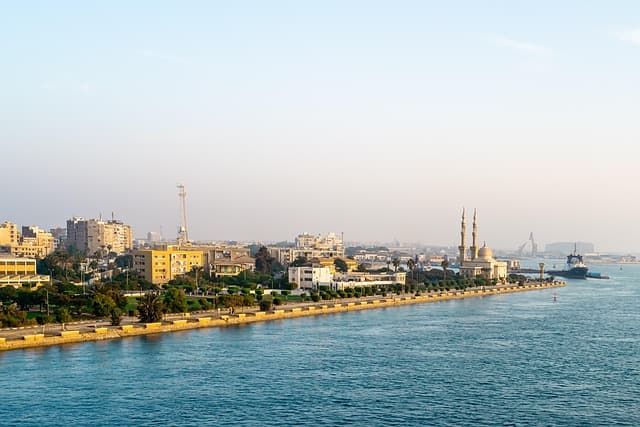
Skipping Port Fouad. Most visitors stand on the Port Said side and photograph the canal. Take the free ferry across. Port Fouad was the French residential quarter of the canal company, and its streets are quieter, its buildings better preserved, and its scale more human. Ten minutes by boat, no ticket required.
Treating the Canal Authority Museum as optional. It is not large and it is not glossy, but it contains original construction documents and equipment that no other museum holds. Tour operators skip it because it does not photograph dramatically. Go anyway.
The sound and light show at Port Said harbor, if one is currently operating. Skip it. Every version of this format in Egypt delivers the same theatrical patriotism in exchange for an entry fee and ninety minutes you cannot recover. The National Museum delivers more content in less time for a fraction of the price.
Arriving without cash in smaller denominations. Museum ticket sellers in the canal zone often cannot break large bills. Arrive with EGP 100 and 50 notes.
Planning only a day trip from Cairo. Cairo to Port Said and back in one day is logistically possible and experientially thin. The canal zone rewards a night's stay in Port Said, which allows you to see the canal at dawn when the first ships move through and the city has not yet assembled itself. This is the image you came for. Day-trippers almost never see it.
Ignoring the eastern bank. The 1973 crossing happened here. The Israeli fortifications were here. The crossing memorial at Kilometer 101 on the Suez road marks where Egyptian and Israeli officers negotiated the ceasefire. These are not marked on tourist maps. A local guide who served in the military, easily found through hotels in Ismailia, can show you things the official narrative still minimizes.
Reading British sources exclusively for pre-1952 history. Lord Cromer's memoir "Modern Egypt" (1908) is a masterwork of self-justification. Read it alongside Wilfrid Scawen Blunt's "Secret History of the English Occupation of Egypt" (1907), written by a British poet who opposed the occupation on principle. The dissonance between them is the most accurate account of what actually happened.
Practical Tips
Port Said waterfront hotels range from adequate to genuinely comfortable. The area around the corniche and the ferry terminal is the right neighborhood. Book directly with hotels when possible; canal zone properties are not well represented on international booking platforms and phone rates are often lower.
Hire a local guide specifically for the eastern bank war sites. This is not a trip you navigate well with a general Cairo guide who has never been to the canal zone. Ismailia-based guides can be found through the governorate tourism office or through recommendations from your hotel. Expect to pay EGP 600 to 1,000 for a half-day.
The canal itself can be watched for free from the corniche at any hour. There is no requirement to pay anything to observe ships passing. The canal handles roughly 50 ships per day; intervals between vessels vary. Arrive before 7am for the first convoy movement, which is the densest concentration of ships you will see.
Friday is the worst day for museum visits across the canal zone. Most facilities close for midday prayers and some do not reopen. Plan around it.
The Bitter Lakes, between Ismailia and Suez city, are visible from the main road and beautiful in the late afternoon when the salt flats catch the low light. They are not a stop on any standard itinerary. They should be.
Frequently Asked Questions
The Weekly Dispatch
More on Egypt, every Friday.
Cultural depth and places most guides never mention.
No spam. Unsubscribe anytime.