Suez Canal History, British Egypt, and the War for Water
Britain occupied Egypt to protect a canal it didn't build and didn't own. The story of how 164km of water remade empires is stranger than the textbooks admit.

Audio Guide: Suez Canal History, British Egypt, and the War for Water
Quick Facts
- Best time to visit
- October to March. Summer temperatures in the canal corridor regularly exceed 40°C with little shade on the corniche.
- Entrance fee
- Ismailia Museum: EGP 50 (approx $1 USD). Corniche viewpoints in Ismailia and Port Said: free. October War Panorama in Suez: EGP 80 (approx $1.50 USD). Canal boat crossings: EGP 200 to 400 depending on route.
- Opening hours
- Ismailia Museum: daily 9am to 4pm, closed Tuesdays. Port Said Museum: daily 9am to 4pm. Corniche areas accessible at all hours.
- How to get there
- Bus from Cairo Turgoman Station to Ismailia: EGP 60 to 80, every 45 minutes, 1.5 to 2 hours. Train from Cairo Ramses to Ismailia: EGP 25 to 45, 3 to 4 trains daily. Bus to Port Said from Cairo: EGP 70 to 100, around 3 hours. Private taxi Cairo to Ismailia: EGP 400 to 600.
- Time needed
- Half day for Ismailia alone. Full day for Ismailia and Port Said combined. Two days to cover Port Said, Ismailia, and the October War Panorama in Suez seriously.
- Cost range
- Budget EGP 400 to 700 per day including transport, food, and museum entry. Mid-range EGP 1,200 to 2,000 with private guide and waterfront dining.
Quick Facts
Best time to visit: October to March. The canal corridor runs north-south through the desert, and summer heat between Port Said and Suez is unforgiving, regularly hitting 40°C.
Entrance fees: The Suez Canal Authority Museum in Ismailia: approximately EGP 50 (around $1 USD). The Canal itself is viewable for free from the corniche in Ismailia or from the observation deck at Port Said's canal terminus. Organized boat crossings via the canal authority run EGP 200 to 400 depending on the route.
Opening hours: Ismailia Museum is open daily from 9am to 4pm, closed Tuesdays. The corniche viewing areas in Ismailia and Port Said are accessible at all hours.
How to get there: From Cairo, buses to Ismailia run from Turgoman Bus Station approximately every 45 minutes. Journey time is 1.5 to 2 hours, cost around EGP 60 to 80. Trains from Cairo Ramses to Ismailia run three to four times daily, EGP 25 to 45 depending on class. Port Said is accessible by bus from Cairo in around 3 hours, EGP 70 to 100. Taxis from Ismailia to the canal viewpoint cost EGP 30 to 50.
Time needed: Half a day for Ismailia alone. A full day if you move between Port Said, Ismailia, and the canal observation points. Two days if you want to follow the canal's full narrative seriously.
Cost range: Budget EGP 400 to 700 per day including transport and food. Mid-range EGP 1,200 to 2,000 with a private guide and a meal at one of Ismailia's waterfront restaurants.
---
Britain never built the Suez Canal, never paid for it, and for the first fifteen years of its operation held no shares in it at all. Then, in 1875, the Khedive Ismail ran out of money and sold his government's 44 percent stake to Benjamin Disraeli for £4 million, a sum the British Prime Minister borrowed overnight from the Rothschild banking house because Parliament was in recess and there was no time to wait. Within seven years, British soldiers were in Cairo. Within eighty, they were being thrown out. The canal sits at the center of that entire arc.
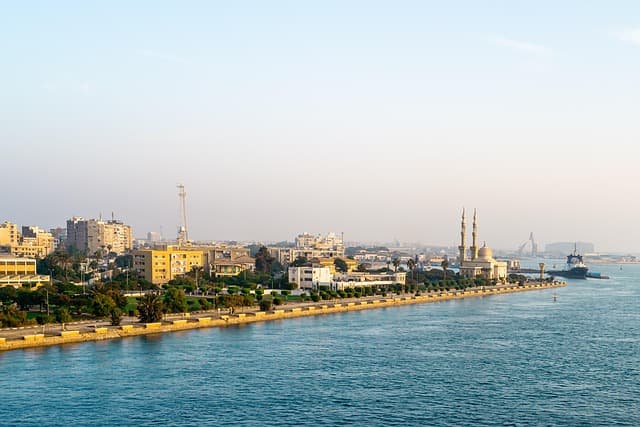
To visit the Suez Canal today is to visit something that functions simultaneously as a modern infrastructure project, a colonial wound, and a point of national pride so specific that Egypt named a war after reclaiming it. Standing on the corniche in Ismailia, watching a 400-meter container ship slide past at eye level like a building that has come loose from its foundations, you are standing at the intersection of three different empires and one very determined republic.
Why This Place Matters
The canal that opened in 1869 was not the first attempt to connect the Mediterranean to the Red Sea. Pharaoh Necho II began a canal in the 7th century BC, abandoned it after an oracle reportedly warned that he was building a road for his enemies. Darius I of Persia completed a version of it in 500 BC. The Romans maintained it. The Arab general Amr ibn al-As reopened it after the Islamic conquest of Egypt in 641 AD, and it stayed open until the Abbasid Caliph al-Mansur ordered it blocked in 767 AD to prevent supplies reaching a rebel stronghold in the Hejaz. Egyptians have been digging this route for 2,600 years.
What Ferdinand de Lesseps built between 1859 and 1869 was therefore not a new idea. It was a French-engineered revival of a Pharaonic concept, funded primarily by Egyptian peasant labor. An estimated 1.5 million Egyptians worked on the modern canal during its construction, with Egyptian corvée labor providing the early workforce before international pressure from Britain, which opposed the canal throughout its construction and only reversed its position once it became profitable, forced de Lesseps to switch to paid workers and mechanical excavators.
The canal reduced the shipping distance from London to Bombay by approximately 7,000 kilometers overnight. It broke the monopoly of the overland route through Egypt that Britain had spent decades developing via Alexandria, Cairo, and Suez. The irony is precise: Britain opposed the canal to protect its overland trade route, then seized Egypt to protect the canal that replaced it.
The Three Cities and What Each One Holds
Port Said: Where the Canal Meets the Mediterranean
Port Said was purpose-built for the canal and shows it. The city did not exist before 1859. De Lesseps needed a northern terminus and a labor headquarters, so he built one on a sandbar where the Nile Delta meets the sea. The grid is rational and colonial, the architecture a mixture of French administrative buildings and later British-era customs houses, many of them now faded to the color of old photographs.
The statue of Ferdinand de Lesseps stood at the harbor entrance for eighty-seven years. Nasser had it toppled in 1956, four days after nationalizing the canal in a speech in which he said the word "de Lesseps" twenty-seven times, which was the pre-arranged signal to his engineers to seize canal operations simultaneously across the entire waterway. It was one of the most elegant pieces of political choreography of the twentieth century, and it happened during a public address in Alexandria's Mansheyya Square, 220 kilometers away.
What you can see in Port Said today: the Canal Authority building, still operational, its distinctive wooden verandas a remnant of the original administrative compound. The Port Said Museum contains artifacts from the 1956 nationalization period and the subsequent tripartite invasion by Britain, France, and Israel, the first military campaign in which the United States actively sided against its European allies to force a ceasefire. The canal's harbor entrance is best viewed from the breakwater at dawn, when the first northbound convoy assembles.
Ismailia: The Colonial Dream Town
Ismailia is the canal's heart and its most readable city. De Lesseps headquartered himself here during construction, and the French administrative quarter still stands largely intact, which is unusual in Egypt and not sufficiently appreciated. The Ferdinand de Lesseps House, now the Ismailia Museum, contains his original furniture, his personal correspondence, and a mosaic map of the canal that covers an entire floor and was commissioned for the 1869 opening ceremony that Empress Eugénie of France attended aboard the imperial yacht.
The British built a separate residential quarter in Ismailia during the occupation period from 1882 onward, a grid of bungalows with gardens that still functions as a residential neighborhood today. Walking through it is disorienting in the way that colonial architecture always is in Egypt: the proportions are English, the light is Egyptian, and the people living there now have no particular relationship to either inheritance.
The canal in Ismailia is narrow enough that you can see the opposite bank clearly. Ships pass so close to the corniche that you can read the names on their hulls. This is the best place in Egypt to watch the canal actually work, and it costs nothing.
Suez: The Southern End and the Memory of War
The city of Suez was almost entirely destroyed during the War of Attrition that followed the 1967 Six-Day War, when Israeli forces held the eastern bank of the canal and Egyptian artillery batteries on the western bank maintained a continuous exchange for three years. The population of 264,000 people evacuated. The city that exists now was largely rebuilt after 1975 and is architecturally thin, but the October War Panorama at the northern edge of the city is one of the most serious war museums in the Arab world, depicting the Egyptian crossing of the canal on October 6, 1973, which Egyptian military planners considered technically impossible until they did it.
The British Chapter: Occupation as Infrastructure Project
The British occupation of Egypt from 1882 to 1952 is officially seventy years long, but it was never clean or uniform. It began with a military response to the Urabi Revolt, in which an Egyptian army colonel named Ahmed Urabi led a nationalist uprising against Khedival rule and its European creditors. Britain bombarded Alexandria in July 1882 and landed troops the same month. The stated justification was protecting European lives and canal access. The actual mechanism was debt: Egypt had borrowed heavily from British and French banks to fund the canal and Ismail's modernization projects, defaulted, and become subject to dual European financial oversight.
What Britain built during the occupation, and this is the part that does not appear in simple nationalist narratives, was substantial: irrigation networks that quadrupled cotton production, a functioning railway system, and a public health infrastructure that reduced mortality from cholera and plague. What it did not build was any meaningful pathway to Egyptian self-governance. Lord Cromer, the British Agent and Consul-General who effectively ran Egypt from 1883 to 1907, believed Egyptians were incapable of governing themselves. He wrote this, at length, in public, and governed accordingly.
The canal was the reason Britain stayed. Everything else was a rationalization of the canal.
The Connections
The Suez Canal story runs through almost every major site in Egypt if you pull the right thread. The cotton that financed Ismail's modernization project and his eventual debt, which financed the canal company shares he then had to sell to Disraeli, came from the same Nile Delta irrigation systems that Pharaonic engineers had dug two thousand years earlier. The overland route from Alexandria to Suez that Britain had invested in before the canal opened ran directly through Cairo, which is why Cairo's railway infrastructure, Ramses Station included, has a British-era skeleton under its contemporary chaos.
Nasser's canal nationalization speech happened in Alexandria, not Cairo, partly because the canal itself was an Alexandrian project in the Ptolemaic imagination: the ancient canal systems that connected the Delta to the Red Sea were maintained by Greek-Egyptian engineers working for a dynasty that understood trade routes as empire.
The 1956 Suez Crisis, which ended with Britain, France, and Israel withdrawing under US and Soviet pressure, effectively ended the British imperial project in the Middle East. Eisenhower's refusal to support the invasion was driven partly by Cold War calculations but partly by a genuine reading that colonial gunboat diplomacy had a limited future in a world with television cameras. The canal was the last occasion on which Britain acted as a Victorian power. It did not work.
Common Mistakes
Treating this as a day trip from Cairo and nothing more. The canal corridor is three cities and a hundred and sixty years of layered history. People who do it in a single day from Cairo see a body of water and a museum and come back with photographs of ships. Budget at least one night in Ismailia.
Going directly to Port Said and ignoring Ismailia. Port Said is more accessible and more frequently organized into day tours. Ismailia is more interesting, better preserved, and far less visited. The colonial French quarter alone justifies the additional hour of travel.
Paying for a canal boat tour without confirming what it shows you. Most organized boat crossings cross the canal rather than running along it. You cross in about four minutes. This is not an experience worth EGP 300 to 400. The view from the Ismailia corniche, which is free, is substantially more informative.
The sound and light show at the October War Panorama in Suez. Skip it. The narration is propagandistic in a way that adds nothing to your understanding of the 1973 war, and the panoramic paintings inside the building, without the show, are genuinely impressive on their own. The admission to the panorama itself is the worthwhile expenditure.
Assuming the canal museums are in English. The Ismailia Museum has minimal English signage. The Port Said Museum has somewhat more. Bring a guidebook with translated materials, or arrange a guide in advance. The stories in these museums deserve to be understood rather than photographed without context.
Ignoring Ismail's ghost. Most visitors to canal history focus on 1956 and 1973 without engaging with Khedive Ismail's catastrophic and visionary role in building the thing. The opening ceremony in 1869 cost so much, including a purpose-built opera house in Cairo for which Verdi was commissioned to write Aida, though Aida did not premiere until 1871 due to Franco-Prussian War delays, that it materially accelerated Egypt's national bankruptcy. Understanding Ismail is understanding why Britain was able to walk in.
Practical Tips
Ismailia's corniche restaurants serve fresh fish from Lake Timsah, the lake the canal passes through at the city's midpoint. Eat there. It is cheaper than Cairo and considerably fresher.
The best time to watch the convoys is early morning. Northbound convoys depart from Suez around midnight and pass Ismailia between 6am and 9am. Southbound convoys pass in the afternoon. The canal operates a convoy system rather than continuous traffic because sections of it are still single-lane, though the 2015 expansion added a parallel channel for part of the northern section.
If you are interested in the Suez Canal history and British Egypt period specifically, hire a guide who has worked in both Ismailia and Cairo. The best local guides can connect the colonial administrative buildings in Ismailia's Garden City quarter to the Abdeen Palace complex in Cairo, where the British resident effectively controlled Khedival decisions from an adjacent office.
Drink water. The canal corridor is desert on both sides and the open corniche has no shade. This is not a warning for the faint-hearted; it is a practical note about a place where people routinely underestimate the sun.
Frequently Asked Questions
The Weekly Dispatch
More on Egypt, every Friday.
Cultural depth and places most guides never mention.
No spam. Unsubscribe anytime.