Suez Canal History, British Egypt, and the War Over Water
Britain occupied Egypt in 1882 to protect a canal it didn't build, didn't own, and couldn't afford to lose. The Canal Zone still carries that wound.

Audio Guide: Suez Canal History, British Egypt, and the War Over Water
Quick Facts
- Best time to visit
- October through March. Winter months bring clear light, walkable temperatures, and emptier viewing terraces. Summer humidity in the Canal Zone is severe and adds nothing to the experience.
- Entrance fee
- Ismailia Canal Museum EGP 100 to EGP 150 (approx $3 to $5 USD). Port Said Canal Museum EGP 100 (approx $3 USD). De Lesseps House EGP 80 (approx $2.50 USD). Canal viewing terraces free.
- Opening hours
- Ismailia Canal Museum: Saturday to Thursday 9am to 4pm, closed Friday. Port Said Canal Museum: similar hours. Viewing terraces and corniche: unrestricted.
- How to get there
- East Delta Bus from Cairo Abbassiya terminal to Ismailia: EGP 50 to EGP 70, 90 minutes. To Port Said: EGP 60 to EGP 80. Local tuk-tuks within Ismailia: EGP 10 to EGP 20 per trip. Rented microbus with driver for full Canal Zone day: EGP 600 to EGP 800.
- Time needed
- Ismailia alone: full day. Port Said: full separate day. All three canal cities (Ismailia, Port Said, Suez City): two nights minimum. One overnight in Ismailia is the practical minimum.
- Cost range
- Budget EGP 600 to EGP 900 per day including transport, entry fees, and food. Mid-range EGP 1,500 to EGP 2,200 including canal-view hotel and sit-down meals.
In 1956, Gamal Abdel Nasser nationalized the Suez Canal in a speech that lasted four and a half hours. He said the word "de Lesseps" twenty times. That was the signal. Egyptian officers listening on the radio immediately moved to seize the Canal Company's offices in Ismailia and Port Said. By the time the speech ended, Egypt controlled the canal. Britain, France, and Israel invaded anyway. The United States told them to leave. They did. It was the moment the British Empire understood it was over.
This is the Canal Zone: a 193-kilometer trench that remade the world economy, cost 120,000 Egyptian workers their lives during construction, triggered a war that humiliated three nations simultaneously, and today handles approximately 12 percent of global trade. Most visitors to Egypt never come here. That is a serious miscalculation.
Quick Facts
Best time to visit: October through March. Canal Zone summers are punishing: humid, over 40°C, and the Ismailia waterfront turns into a local beach scene that leaves no room for walking. Winter light on the water is clear and cool.
Entrance fees: The Suez Canal Authority building in Ismailia is not a museum with a ticket booth, it is a functioning government institution. Admission to the viewing platforms and the Canal Museum in Ismailia runs approximately EGP 50 to EGP 150 (roughly $1.50 to $5 USD) depending on current access. The Suez Canal Museum in Port Said charges EGP 100 (approx $3 USD). The De Lesseps House in Ismailia, when open, charges EGP 80 (approx $2.50 USD).
Opening hours: The Ismailia Canal Museum is open Saturday through Thursday, 9am to 4pm. Closed Fridays. Port Said's museum keeps similar hours. Viewing points along the canal are unrestricted.
How to get there: From Cairo, buses to Ismailia depart East Delta Bus Company terminal in Abbassiya every 30 to 45 minutes, fare approximately EGP 50 to EGP 70 (about $1.50 to $2 USD), journey time 90 minutes. Microbuses from Cairo to Port Said run from the same terminal for EGP 60 to EGP 80. Taxis from Ismailia to the viewing terrace at Bitter Lakes cost EGP 100 to EGP 150 for the round trip. There is no train that runs directly along the canal in a useful tourist configuration.
Time needed: Ismailia alone warrants a full day. Port Said deserves a separate day. Combining the Suez City war memorial with the Canal Zone requires staying overnight in Ismailia, which has workable mid-range hotels starting around EGP 800 per night.
Cost range: Budget EGP 600 to EGP 900 per day including transport, food, and entry fees. Mid-range EGP 1,500 to EGP 2,200 if you include a canal-view hotel and a dinner at one of the Ismailia waterfront restaurants.
Why This Place Matters
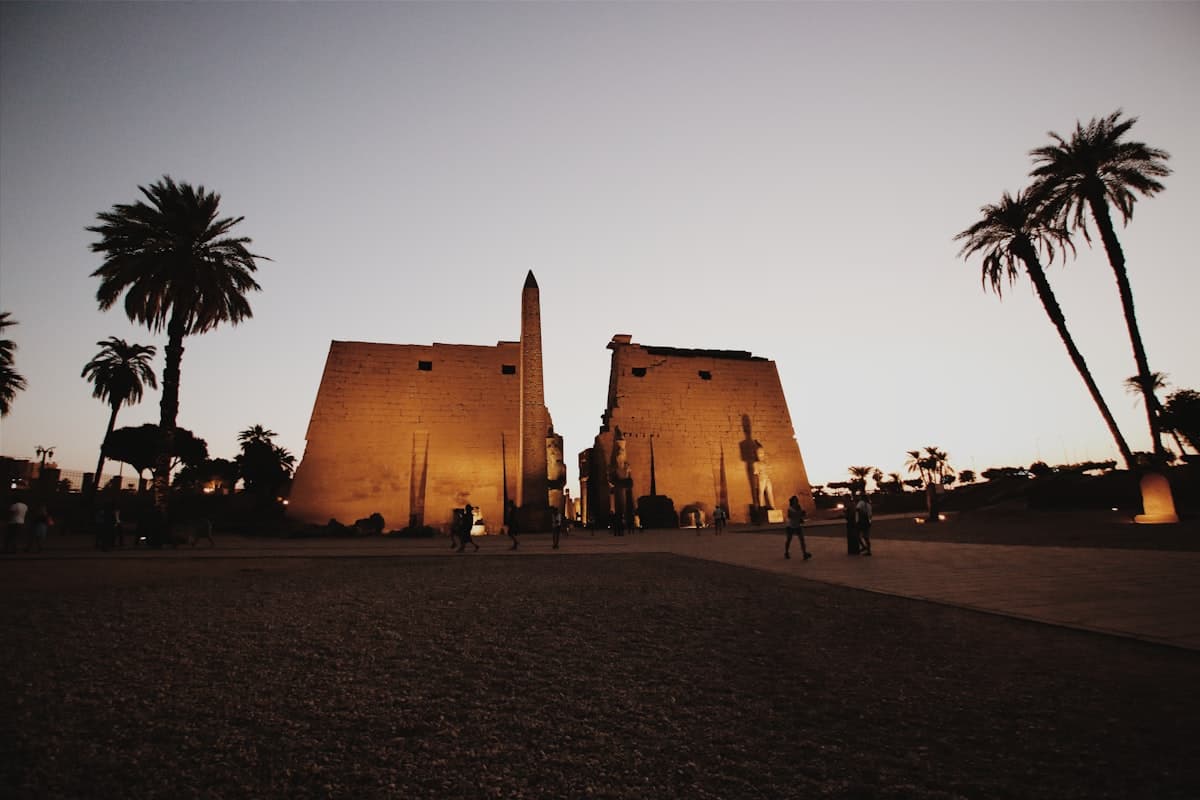
The canal that exists today was not the first attempt to connect the Red Sea to the Mediterranean. Senusret III, a Middle Kingdom pharaoh ruling around 1878 BC, dug a channel linking the Nile to the Red Sea via the Bitter Lakes. Ramesses II restored it. The Persian king Darius I rebuilt it again. The Greek geographer Strabo described a version of it. Napoleon surveyed the isthmus in 1799 and his engineers incorrectly calculated that the Red Sea was ten meters higher than the Mediterranean, which would have flooded the Nile Delta, so he abandoned the idea. The miscalculation was discovered decades later. By then, Ferdinand de Lesseps had already obtained his concession from Said Pasha.
De Lesseps was not an engineer. He was a diplomat and a promoter of extraordinary skill. The canal he championed, completed in 1869, was dug almost entirely by Egyptian corvée labor: forced labor extracted from the peasant population under conditions that combined disease, desert heat, and inadequate food. British historians long argued that British opposition to the canal project was humanitarian, rooted in objection to forced labor. The British government was simultaneously using forced labor in India. The objection was strategic, not moral. Britain feared a French-controlled shortcut to India.
When the canal opened, Britain controlled none of it. Six years later, in 1875, the British government purchased the Egyptian Khedive Ismail's shares for £4 million, becoming the largest single shareholder. Seven years after that, Britain invaded and occupied Egypt, officially to suppress a military revolt led by Ahmed Urabi but functionally to control the canal route to India. The occupation was supposed to last months. It lasted 72 years.
What You Actually See: Ismailia and the Colonial Blueprint
Ismailia is the city de Lesseps built to house the Canal Company's European employees, and it still looks like it. The Garden City district, a grid of wide streets lined with flame trees and colonial villas, feels dislocated from the Egypt you know. The De Lesseps House, a pink villa where the canal's promoter actually lived during construction, sits near the Canal Authority complex. Inside, when access is permitted, you will find period furniture, maps, and photographs that make the colonial project feel less abstract and more specific: these people built themselves a little France on the shores of the Bitter Lakes and expected it to last forever.
The Ismailia Museum holds objects that most visitors to Egypt miss entirely. The collection includes artifacts from the ancient canal attempts: Pharaonic stone inscriptions, Persian-era finds, and objects recovered from the corvée labor camps. One exhibit shows the administrative paperwork the Canal Company used to requisition Egyptian laborers. The number is not contested: roughly 1.5 million Egyptians were conscripted over the construction period, and an estimated 120,000 died from cholera, heat exhaustion, and accidents between 1859 and 1869.
The viewing terrace at Kilometer 23, near the Ismailia section of the canal, is where the Suez Canal history becomes physical. You stand on flat desert ground and watch a container ship the size of a residential block pass fifty meters away, close enough to read the hull markings. There is no roaring engine sound, only a deep mechanical hum and displaced water. The ships move at 12 to 14 knots and take 12 to 16 hours to transit the full canal. Since the 2015 expansion, a second lane allows simultaneous north and south transit in the northern section, reducing convoy waiting times from 18 hours to 11 hours.
Port Said and the 1956 War
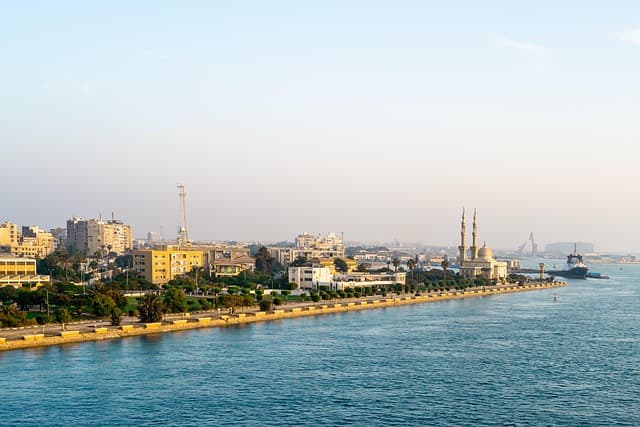
Port Said remembers 1956 differently than London does. The British and French bombing campaign began on October 31 and lasted until November 7. Paratroopers landed at Port Said on November 5. Egyptian civilians fought building to building using weapons smuggled in from the countryside. The city was not occupied quietly.
In Port Said today, the Martyrs' Monument on the corniche lists names. The Canal Museum, housed in a building that was itself shelled during the conflict, holds photographs that are not in any Western archive: images of Port Said neighborhoods after the bombing, of Egyptian militia fighters, of the Canal Authority offices occupied by British soldiers who understood, even as they sat in those chairs, that Washington had told them to leave. The United States threatened to withhold IMF support from Britain and trigger a run on the pound unless British forces withdrew. They withdrew within weeks.
The Canal Museum's collection also includes the original canal construction documents, Persian and Pharaonic artifacts from earlier canal attempts, and a scale model of the 1869 opening ceremony, which Empress Eugénie of France attended on a royal yacht. The Khedive spent 28 million Egyptian pounds on that party, a sum that contributed directly to Egypt's bankruptcy, which is what created the conditions for the British purchase of shares, which is what enabled British occupation. One party, 72 years of consequences.
The Connections: From Pharaonic Trench to Cold War Pivot
The Suez Canal history connects to Egypt's other colonial layers in ways that Ismailia's streets make visible. The canal concession was granted by Said Pasha, the son of Muhammad Ali, the Ottoman-appointed ruler who is also the man responsible for the Alabaster Mosque in Cairo's Citadel and the massacre of the Mamluks in 1811. Muhammad Ali's dynasty built modern Egypt and also sold it, piece by piece, to European creditors whose governments eventually arrived with gunboats to collect.
In Ismailia, the British military built barracks that remained occupied until 1956. The Canal Zone, as the British called the 20-kilometer-wide strip on either side of the canal, housed 80,000 British troops at its peak in the early 1950s. Egyptian guerrilla attacks on British installations in the Canal Zone between 1951 and 1952 are what precipitated the political crisis that brought Nasser's Free Officers to power. Without the Canal Zone occupation, there is no 1952 revolution. Without the 1952 revolution, there is no nationalization. The canal is not a footnote to modern Egyptian history. It is the thread.
Suez City itself, at the southern end of the canal, was almost entirely destroyed in the 1973 October War. Egyptian forces held the city block by block against Israeli encirclement for weeks after the ceasefire. The rebuilt city contains a war museum that is one of the most honest accounts of modern Egyptian military history you will find anywhere, including sections on the 1967 defeat that Egyptian institutions usually prefer to minimize.
Common Mistakes
Skipping Ismailia for Port Said only. Port Said has the corniche and the duty-free shopping, so it gets more visitors. But Ismailia has the museum, the De Lesseps House, the viewing terrace, and the colonial urban fabric. If you only go to Port Said, you get the aftermath without the cause.
Taking the guided tour boats on the canal. Several operators in Ismailia offer short boat tours on the canal. They cost EGP 300 to EGP 500 per person and last about 45 minutes. You see water. You see a ship at a distance. You get no information that standing on the viewing terrace at Kilometer 23 does not give you for free. Skip it.
Treating the De Lesseps House as optional. Most visitors note it is closed and move on. It is only intermittently open and requires asking at the Canal Authority complex for access. The asking is worth doing. The house is the most concrete evidence available that the canal was built by specific people with specific ambitions and specific blind spots, not by an abstract historical force.
Arriving without Egyptian pounds. The Canal Zone is not Cairo. Card payments are rare at smaller museums and viewing areas. Bring cash.
Missing the Martyrs' Monument in Port Said at the wrong time. The monument area fills with local families on Friday afternoons and becomes genuinely moving: older Port Said residents bring their children and explain what the photographs mean. Come at 10am on a weekday if you want quiet. Come on a Friday afternoon if you want to understand what 1956 means to the people who actually lived there.
Assuming the Suez Canal Authority viewing areas are tourist infrastructure. They are not. The authority is a functioning government body operating a waterway that generates approximately $9 billion USD in annual revenue. You are a guest in a working institution, not a theme park. Dress accordingly, carry your passport, and do not photograph military installations.
Underestimating the distance between cities. Ismailia to Port Said is 75 kilometers. Ismailia to Suez City is 80 kilometers. You cannot do all three comfortably in one day without your own vehicle. Pick two. Do them well.
Practical Tips
Stay in Ismailia overnight. The city functions as the genuine center of the Canal Zone, and the waterfront at dusk, when the lights of container ships moving through the channel are visible from the Corniche El Forsan, is the best single image the canal offers. Mid-range hotels on or near the canal run EGP 800 to EGP 1,500 per night.
For transport between canal cities, East Delta buses are reliable and cheap. For local movement within Ismailia, tuk-tuks charge EGP 10 to EGP 20 per short trip. A rented microbus with a driver for a full day in the Canal Zone costs approximately EGP 600 to EGP 800 and is worth negotiating for if you want to reach the Bitter Lakes viewing area and the Kilometer 23 terrace in the same day.
The canal itself is best observed at the Bitter Lakes section, where the widened channel makes ship traffic most visible. Ships pass in convoys, so there can be long gaps. Check convoy schedules at the Suez Canal Authority website or ask your hotel: the first northbound convoy typically passes Ismailia between 7am and 9am.
If your interest in Suez Canal history extends to the 1973 war specifically, the Suez City War Museum is the essential stop. Take a bus or service taxi from Ismailia, two hours, fare approximately EGP 30, and budget half a day. The museum is understaffed and underfunded but contains original military equipment, maps, and first-person accounts that no other institution in Egypt makes available in this form.
Frequently Asked Questions
The Weekly Dispatch
More on Egypt, every Friday.
Cultural depth and places most guides never mention.
No spam. Unsubscribe anytime.