Suez Canal History, British Egypt, and the Waterway That Rewrote the World
Britain occupied Egypt in 1882 to protect a canal it didn't build, didn't own, and couldn't afford to lose. Ismailia still carries the bruises.

Quick Facts
- Best time to visit
- October to March. Canal cities are flat and fully exposed with no shade. Summer temperatures exceed 37 degrees Celsius with high humidity from the water. Winter light is clear and the waterfront is genuinely pleasant.
- Entrance fee
- Canal viewing areas free. Suez Canal Authority Museum EGP 100 (approx $2 USD). Ismailia Museum of Antiquities EGP 200 (approx $4 USD). De Lesseps House Museum Port Said EGP 50 (approx $1 USD). Port Said to Port Fuad ferry free for pedestrians.
- Opening hours
- Canal waterfront public access 24 hours. Suez Canal Authority Museum Saturday to Thursday 9am to 2pm, closed Friday. Ismailia Museum of Antiquities Saturday to Thursday 9am to 2pm, closed Friday.
- How to get there
- Buses from Cairo Gateway to Ismailia EGP 60 to 80, journey 2 hours. Buses to Port Said EGP 80 to 100, journey 3 hours. Shared service taxis Cairo to Ismailia EGP 50 per seat from Abbassiya. No passenger train to Port Said.
- Time needed
- Half day covers Ismailia museum and waterfront. Full day in Port Said adds canal crossing and old European quarter. Two days across both cities recommended for anyone interested in the full Suez Canal history and British Egypt story.
- Cost range
- Budget EGP 400 to 700 per day covering accommodation, food, local transport, and museum entry. Mid-range EGP 1,200 to 2,000 per day with a waterfront hotel.
In 1956, Gamal Abdel Nasser nationalized the Suez Canal in a speech that lasted four and a half hours. He embedded the name 'Ferdinand de Lesseps,' the French engineer who built the canal, as a codeword. Every time Nasser said it, Egyptian officers moved to seize the Canal Company offices. The audience in Alexandria thought he was just giving another long speech. By the time they understood what was happening, Egypt had taken back the waterway that had cost 120,000 Egyptian laborers their lives to build and had delivered its profits to French and British shareholders for eighty-seven years.
This is the story of the Suez Canal, which is also the story of British Egypt, which is also the story of how a 193-kilometer ditch between two seas changed the entire architecture of global power. You can walk parts of it today. You can sit in the cafes of Ismailia and drink tea in a city that was purpose-built for a canal that hadn't yet opened. You can cross it on a free ferry at Port Said and feel the strange sensation of stepping, in thirty seconds, from Africa to Asia.
Most visitors treat the canal as scenery. It is better understood as a crime scene, a monument, and a living artery, all at once.
Quick Facts
Best time to visit: October to March. Canal cities sit on flat desert terrain with no shade. Summer temperatures in Port Said and Ismailia regularly exceed 37°C, and the humidity from the water makes it worse. The light in winter is sharp and clear.
Entrance fees: The canal itself has no admission charge. You watch ships pass from public viewing areas. The Suez Canal Authority Museum in Ismailia charges EGP 100 (approx $2 USD). The De Lesseps House Museum in Port Said charges EGP 50 (approx $1 USD). The Ismailia Museum of Antiquities charges EGP 200 (approx $4 USD).
Opening hours: Canal viewing areas are open at all hours. The Suez Canal Authority Museum is open Saturday to Thursday, 9am to 2pm. The Ismailia Museum of Antiquities keeps similar hours but closes Fridays.
How to get there: From Cairo, buses to Ismailia depart from Cairo Gateway station and cost EGP 60 to 80 (approx $1.50 to $2 USD), journey time roughly 2 hours. Buses to Port Said cost EGP 80 to 100 and take about 3 hours. Shared service taxis from Abbassiya in Cairo to Ismailia run around EGP 50 per seat. There is no passenger train to Port Said as of the time of writing.
Time needed: A half day in Ismailia covers the museum, the De Lesseps villa ruins, and a waterfront sit. A full day in Port Said adds the war memorial, the canal crossing, and the old European quarter. Two days across both cities is the right amount for anyone serious about the canal's history.
Cost range: Budget EGP 400 to 700 per day (accommodation, food, transport). Mid-range EGP 1,200 to 2,000 per day.
Why This Place Matters
The canal did not begin with Ferdinand de Lesseps. Ancient Egyptians dug an east-west channel connecting the Nile to the Red Sea as far back as the reign of Senusret III, around 1850 BCE. The Ptolemies extended it. The Romans used it. The Arab general Amr ibn al-As reopened it in 642 CE and renamed it the Canal of the Commander of the Faithful, using it to ship grain from Egypt to Arabia. It silted up, was abandoned, was dug again, silted up again. The idea of connecting the Mediterranean to the Red Sea is one of the oldest engineering ambitions in human history.
What De Lesseps built beginning in 1859 was something different: a north-south sea-level canal requiring no locks, cutting 7,000 kilometers off the voyage from Britain to India. The geopolitical consequences were immediate and violent. The canal made Egypt the most strategically important piece of territory on earth. Britain, which had opposed the canal's construction, rapidly understood that whoever controlled it controlled the trade routes of the entire British Empire.
In 1875, the Ottoman-appointed Khedive Ismail, who had spent so extravagantly on modernizing Egypt that he had bankrupted the country, sold his 44 percent share in the Suez Canal Company to the British government for four million pounds. Prime Minister Benjamin Disraeli borrowed the money overnight from the Rothschild bank because Parliament was not in session to authorize it. Seven years later, Britain occupied Egypt militarily, claiming it was protecting the canal from instability. The occupation was supposed to be temporary. It lasted seventy-two years.
The Canal Cities: What You Will Actually See
Ismailia: The Company Town That Survived
Ismailia was designed from scratch in the 1860s by De Lesseps as the administrative headquarters of the Suez Canal Company. It has wide tree-lined boulevards, European-style villas, and a level of order that feels strange against the chaos of most Egyptian cities. This is not an accident. It was literally planned by French engineers who had no intention of living like Egyptians.
The De Lesseps house, a wooden chalet shipped from France and assembled on the shores of Lake Timsah, still stands in a state of managed decay behind locked gates. You can photograph it through the fence. The garden has gone feral. There is something appropriate about that.
The Ismailia Museum of Antiquities is a genuinely undervisited institution. Its collection includes a sphinx of Amenemhat III, a limestone stele from the reign of Ramesses II describing a battle campaign, and artifacts from the ancient east-west canal that predate the modern one by three millennia. The building itself is a 1930s colonial structure with a garden of pharaonic fragments arranged on the grass as though someone left them there mid-thought. Admission is low enough that you should feel slightly embarrassed about considering whether it is worth it.
The British military presence in Ismailia left its own layer. The British maintained a garrison in the Canal Zone after formal independence in 1922, and the zone was effectively a state within a state until 1954. In January 1952, British forces surrounded the Ismailia police headquarters and demanded the Egyptian auxiliary police inside surrender. They refused. The British attacked. Forty-one Egyptians were killed. The following day, Cairo burned in what became known as Black Saturday. The 1952 Revolution that brought the Free Officers to power happened six months later. The canal ran underneath all of it.
Port Said: Where the Canal Meets the Mediterranean
Port Said was built on sand, literally. There was nothing at the northern terminus of the canal route before construction began in 1859. The city was dredged and deposited into existence, a Mediterranean port city manufactured in the desert.
For much of the late nineteenth and early twentieth centuries, Port Said was one of the most cosmopolitan cities on earth, with Greek, Italian, French, British, Syrian, and Jewish communities living alongside the Egyptian majority. The department store Simon Artz, founded in 1887 by a Jewish merchant from Port Said, became so famous among passengers transiting between Europe and Asia that sailors used it as a landmark. The building still stands on the waterfront, though it is no longer a department store.
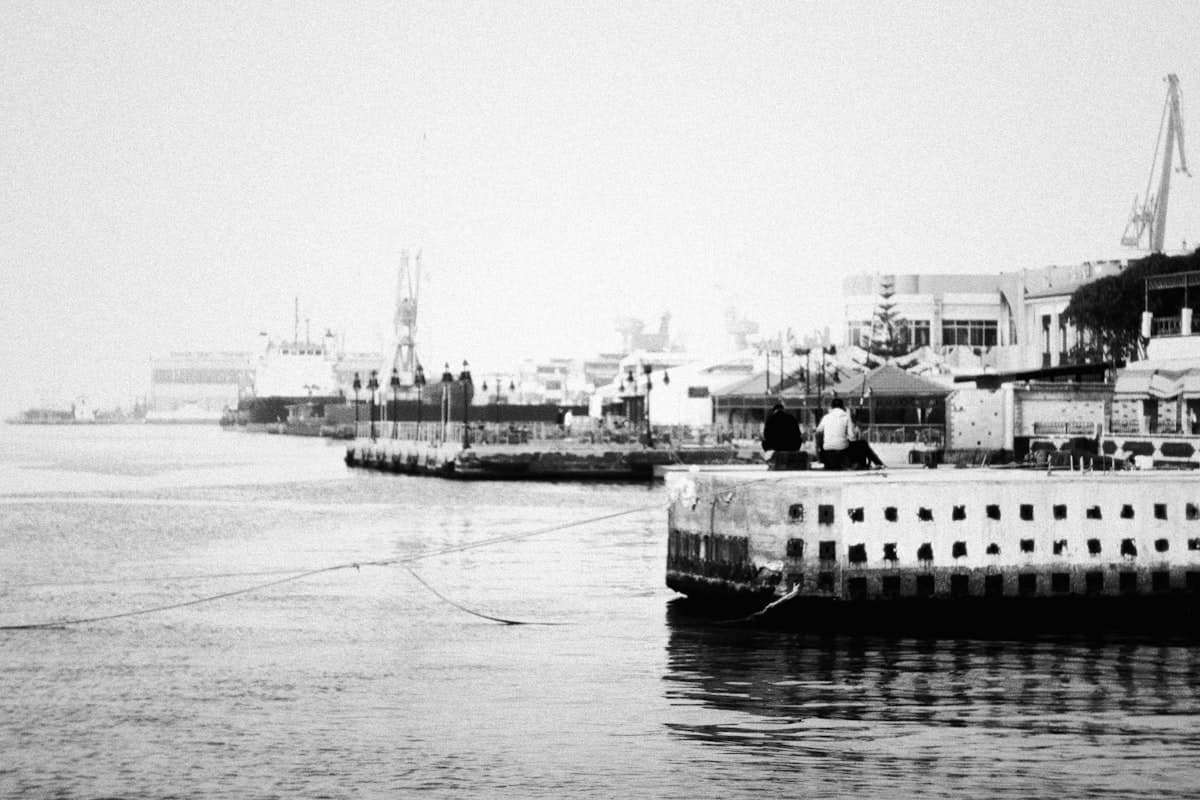
The canal viewing platform on the western bank is free and open to the public. Container ships pass close enough that you can read their names without binoculars. The scale is genuinely disorienting. A fully laden supertanker is longer than the Empire State Building is tall, and watching one slide silently past a row of low Egyptian buildings short-circuits something in the brain's sense of proportion.
The free public ferry across the canal operates between Port Said and Port Fuad on the eastern bank. Crossing takes about four minutes. You go from Africa to Asia over a cup of tea distance. The ferry is free for pedestrians. Take it.
The British Occupation and What It Left Behind
Britain's presence in Egypt from 1882 to 1954 was not an occupation in the sense of tanks in the streets, though it was also exactly that in the Canal Zone. It operated through a system called the Veiled Protectorate: Egyptian khedives and later kings nominally ruled, but British Agents and Consul-Generals held the actual power. Evelyn Baring, Lord Cromer, served as effective ruler of Egypt for twenty-four years, from 1883 to 1907, without ever holding an official Egyptian government position.
Cromer believed Egyptians were incapable of self-government, wrote so explicitly in his memoir 'Modern Egypt,' and structured the colonial administration accordingly. He slashed education spending, convinced that literacy would produce nationalists, which it did. The Egyptian nationalist movement that eventually produced the 1952 Revolution was educated in the schools Britain underfunded.
The canal was the lever that made the whole mechanism work. As long as Britain needed the canal route to India, Egypt was non-negotiable. When India became independent in 1947, the strategic logic collapsed. Britain still tried to hold on. The 1956 Suez Crisis, in which Britain and France colluded with Israel to invade Egypt after Nasser's nationalization, ended with American and Soviet pressure forcing a humiliating withdrawal. It is widely considered the moment the British Empire definitively ended.
The Connections
The Suez Canal sits at the intersection of three thousand years of the same strategic obsession. The ancient east-west canal that preceded it is documented in inscriptions at Karnak, where Thutmose III listed the trade goods arriving from the east. The spice routes that made the Red Sea connection valuable in pharaonic times were the same routes that made the modern canal worth dying for in 1956.
The 1973 October War, in which Egyptian forces crossed the canal and broke through the Bar-Lev Line in one of the most precisely planned military operations of the twentieth century, is commemorated at the Panorama War Museum in Cairo. But the canal cities themselves carry the physical memory. Ismailia still has blocks of buildings that were shelled in the War of Attrition between 1967 and 1970, when the city was essentially evacuated for three years. People came back to find their homes intact, destroyed, or simply different.
The Coptic community in the canal zone is smaller than in the Nile Valley but present, connected to trade networks that predate Islam by centuries. The canal cities' Greek Orthodox churches date to the mid-nineteenth century boom, when Greek merchants followed the construction crews. One civilization's waterway is always built on another civilization's idea.
Common Mistakes
Treating Suez City as the destination. Most people who come to see the canal go to Suez City at the southern terminus because it is closest to Cairo. It is also the least interesting of the three canal cities, heavily industrial, with fewer historical sites and no good waterfront access. Ismailia and Port Said are significantly better and worth the extra travel time.
Skipping the Ismailia Museum of Antiquities. Every guide mentions the canal and the waterfront. Almost none mention that Ismailia has a serious archaeological collection covering three thousand years of east-west trade history. It is two hours well spent.
Taking the Cairo-organized day trip. Tour operators sell canal day trips from Cairo that spend forty-five minutes in Port Said, involve a shopping stop at a perfume shop, and return you to Cairo having seen the canal from a bus window. Book transport independently and stay overnight.
The sound and light show at Port Said. It runs seasonally, costs EGP 200 to 300, and delivers a theatrical retelling of the 1956 war that you can get more accurately and in more depth from a single good book. Skip it. Read Mahmoud Darwish's 'Memory for Forgetfulness' instead, for the texture of what the canal conflicts actually felt like to the people inside them.
Ignoring the human geography of the canal zone. The Canal Zone was home to a British military camp of up to 80,000 troops as late as the early 1950s, the largest British military base in the world. The traces are still there in the road layouts, the occasional British-era building, the war cemeteries. The Commonwealth War Graves cemetery in Ismailia contains the graves of soldiers from the First and Second World Wars and is maintained to the precise standard of every other Commonwealth cemetery on earth. It is a strange, quiet place to sit with the full weight of what the canal cost.
Going in July or August. The canal does not look different in summer. You will just be miserable. October to April is the entire point.
Practical Tips
The Suez Canal Authority runs convoys: ships transit in groups, northbound and southbound, on a set schedule. If you want to watch ships pass rather than an empty canal, check the convoy schedule in advance. The port authority website publishes it, and local hotel staff can usually tell you when the morning convoy is expected.
Ismailia has a handful of decent mid-range hotels near the lake and canal front. Port Said has more options including some atmospheric older hotels in the European quarter. Book ahead on weekends when Egyptian families from Cairo come for the day.
Food in both cities centers on fish. The Mediterranean influence in Port Said means the seafood is grilled simply and served with bread and salad. The restaurants on the waterfront near the ferry terminal in Port Said are reliable. Avoid anything that has an English-language sign directed at tourists.
Bring a hat and water regardless of season. The waterfront is fully exposed. There are almost no trees between you and the canal.
If you are combining the canal with a broader Egypt itinerary, Ismailia makes a sensible overnight stop between Cairo and Sinai. The ferry at Port Said is a practical, free crossing into Sinai if you are continuing north. The road south along the canal from Ismailia to Suez is flat, fast, and one of the more quietly strange drives in Egypt: you pass container ships on your left while the desert extends on your right, and for a long moment the scale of what human beings are capable of building, and fighting over, becomes entirely clear.
Frequently Asked Questions
The Weekly Dispatch
More on Egypt, every Friday.
Cultural depth and places most guides never mention.
No spam. Unsubscribe anytime.