Suez Canal History, British Egypt, and the Zone Between Empires
Britain occupied Egypt in 1882 to protect a canal it didn't build and didn't own. The consequences lasted 74 years. Here's what that looks like on the ground.

Quick Facts
- Best time to visit
- October to March. Avoids extreme humidity from overlapping Mediterranean and Red Sea weather systems. Canal convoys run year-round.
- Entrance fee
- Ismailia Museum: EGP 60 (approx $2 USD). Port Said National Museum: EGP 100 (approx $3 USD). Canal bank viewing: free.
- Opening hours
- Ismailia Museum: Saturday to Thursday 9am to 4pm, closed Friday. Port Said National Museum: Tuesday to Sunday 9am to 3pm.
- How to get there
- East Delta bus from Cairo Turgoman station: EGP 50 to 90 depending on destination. Train from Ramses station to Ismailia: EGP 30 to 60. Service taxi: EGP 80 to 100 per person. Private car from Cairo: EGP 600 to 900 for the day.
- Time needed
- Minimum two days: one full day in Ismailia including museum and corniche, one day in Port Said including Port Fouad ferry crossing.
- Cost range
- Budget EGP 400 to 700 per day including transport, food, and admissions. Mid-range EGP 1,200 to 2,000 per day with hotel.
The Suez Canal was dug by Egyptian forced laborers, financed by French capital, and then seized by Britain, which had voted against building it. When the canal opened in 1869, the British government owned not a single share. Twelve years later, Britain occupied the entire country to protect it. The logic was imperial, the irony was total, and the scar it left on Egypt is visible in every port city from Port Said to Ismailia if you know what to look for.
This is not a guide to the canal as an engineering achievement. You can read the engineering story anywhere. This is a guide to the canal as a political wound, a cultural dividing line, and a landscape you can actually walk through, where the colonial period is still embedded in the brickwork, the street names, and the faces of the people who live alongside one of the world's most strategically consequential waterways.
Quick Facts
Best Time to Visit: October to March. The canal zone in summer sits at 35 to 42 degrees Celsius with high humidity from the Mediterranean and the Red Sea simultaneously. Spring and autumn give you cool mornings, manageable afternoons, and the bonus of watching container ships pass against golden-hour light.
Entrance Fees: The Suez Canal Authority Museum in Ismailia charges approximately EGP 60 (about $2 USD). The Ferdinand de Lesseps villa in Ismailia is periodically accessible for EGP 30 to 50 depending on current agreements with the Canal Authority. Port Said's National Museum charges EGP 100 (about $3 USD). Most of the real experience, including watching ships transit the canal from the banks, costs nothing.
Opening Hours: Ismailia Museum: Saturday to Thursday, 9am to 4pm, closed Fridays. Port Said National Museum: Tuesday to Sunday, 9am to 3pm.
How to Get There: From Cairo, buses to Ismailia depart from Turgoman station (EGP 50 to 70, about 2 hours). Service taxis run from Cairo to Port Said for around EGP 80 to 100 per person and are faster but more chaotic. Trains from Cairo's Ramses station to Ismailia run daily for EGP 30 to 60 depending on class. A private car from Cairo costs around EGP 600 to 900 for the day.
Time Needed: Two days minimum to do the canal zone properly: one day in Ismailia with the museum and lakeside corniche, one day in Port Said to walk the colonial grid and take the ferry across to Port Fouad.
Cost Range: Budget EGP 400 to 700 per day including transport, food, and admission. Mid-range EGP 1,200 to 2,000 per day with a decent hotel.
Why This Place Matters
The canal that connects the Mediterranean to the Red Sea shortened the sea route between Britain and India by approximately 7,000 kilometers. Before it opened in November 1869, ships sailing from London to Bombay had to round the Cape of Good Hope at the southern tip of Africa. That single fact explains almost everything about the colonial century that followed.
Ferdinand de Lesseps, the French diplomat who led the project, began digging in 1859 using a system of corvée labor, meaning forced labor drafted from the Egyptian peasantry, the fellahin. An estimated 1.5 million Egyptian workers were conscripted over the decade of construction. The death toll is disputed but almost certainly exceeded 100,000, with cholera, heat, and brutal working conditions as the causes. The khedive Ismail, Egypt's ruler, contributed those laborers and bought heavily into the project with Egyptian treasury funds, running up debts that eventually forced him to sell Egypt's shares in the Suez Canal Company to the British government in 1875 for 4 million pounds, a desperate transaction that gave Britain the foothold it needed.
When Egyptian army officer Ahmed Urabi led a nationalist revolt against khedival mismanagement and foreign financial control in 1882, Britain used the disorder as justification to bombard Alexandria and land troops. The occupation was officially described as temporary. It lasted until 1956.
Gamal Abdel Nasser nationalized the Suez Canal Company on July 26, 1956, in a speech that lasted three hours and contained a coded message: every time he said the name "de Lesseps," Egyptian forces moved to seize canal installations across the zone. The subsequent invasion by Britain, France, and Israel collapsed under American and Soviet pressure, and Egypt kept the canal. That sequence of events, which Egyptians call the Tripartite Aggression and Westerners call the Suez Crisis, is possibly the clearest single moment in twentieth-century history when European imperial power visibly ended.
What You Actually See: Ismailia and the Canal's Nerve Center
Ismailia was purpose-built by de Lesseps as the administrative capital of the canal project, and it looks like someone tried to build Geneva in the Sinai desert. The streets in the European quarter are wide, tree-lined, and ordered in a colonial grid that has nothing to do with the organic Arabic urbanism of Cairo or Alexandria. The de Lesseps family villa still stands near the shore of Lake Timsah, a freshwater-turned-saltwater lake that the canal passes through. The garden contains a pink granite statue base that once held a de Lesseps monument, removed after 1956. The absence of the statue is more eloquent than the statue would have been.
The Ismailia Museum, modest in scale but serious in content, holds artifacts recovered from the ancient canal routes that preceded the modern one. The Pharaoh Senusret III appears to have dug an early canal connecting the Nile to the Red Sea around 1850 BC, a project later maintained by the Persian king Darius and then by the Roman emperor Trajan. Navigating between the two seas is not a nineteenth-century idea. It is a four-thousand-year-old Egyptian obsession that de Lesseps happened to complete.
The museum also contains documents and photographs from the construction period that are worth more time than the rooms that follow. The photographs of forced laborers working with hand tools on a scale project that required moving 74 million cubic meters of earth are the most important things in the building. Sit with them.
From the corniche along Lake Timsah, you can watch cargo ships pass at what feels like an impossible proximity to land. Container vessels from China, tankers from the Gulf, car carriers from South Korea move through at roughly 14 kilometers per hour, silently, their hulls taller than the buildings behind you. Nothing else in Egypt produces quite that sensation of watching the world's supply chains in motion.
Port Said: The City at the Canal's Mouth
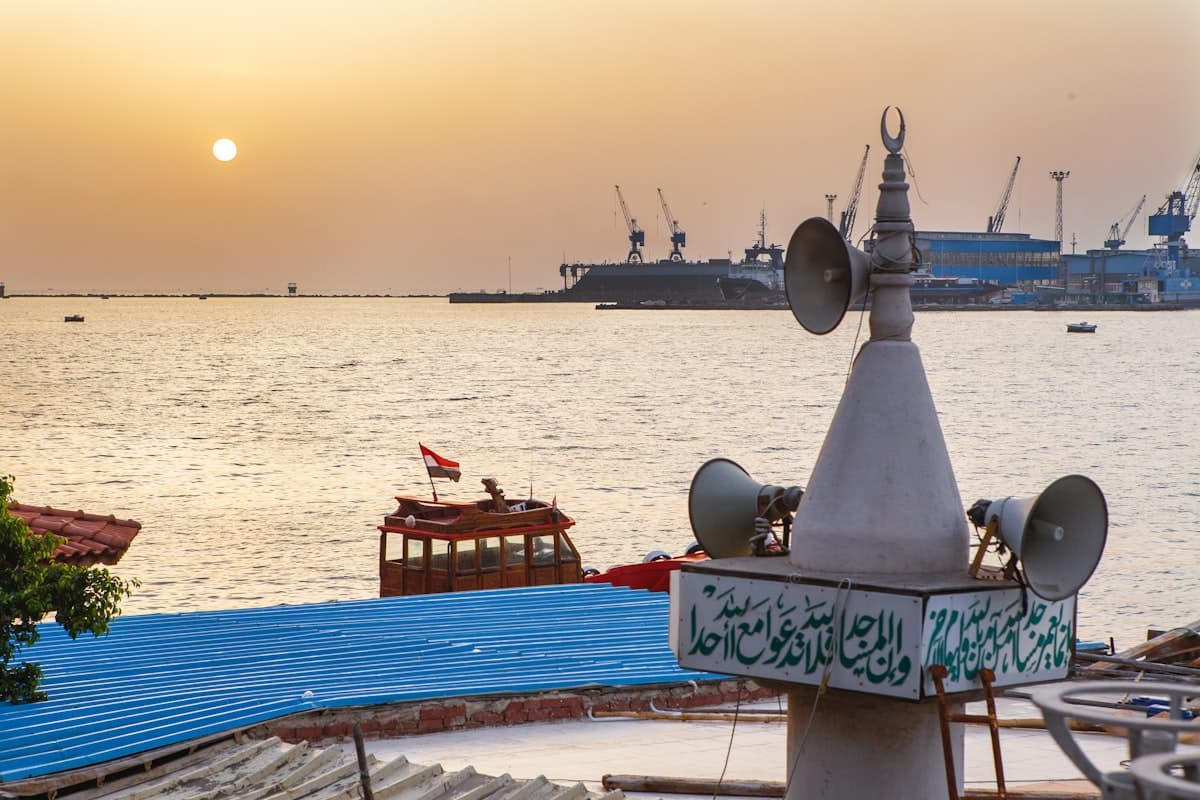
Port Said sits at the northern entrance of the canal where it meets the Mediterranean, and it has the particular atmosphere of a city that has been fought over so many times that it has decided to be indifferent to grandeur. The city was founded from nothing in 1859 as the canal's construction base. It sits on reclaimed sand, which means that beneath every building there is, effectively, nothing. The city is built on a constructed reality, which feels appropriate.
The architecture of the European-built quarters is Ottoman-Mediterranean with iron balconies, colonnaded ground floors, and upper stories that catch the sea breeze. Many of these buildings are in advanced decay, which makes the walking better, not worse. You are looking at what colonialism actually built: functional, confident, and aging badly.
The Port Said Military Museum, which is more interesting than it sounds, covers the 1956 war in detail, including the British and French bombardment of the city that killed several hundred Egyptian civilians and destroyed large sections of the harbor. The museum's presentation is transparently nationalist but the facts it presents are accurate enough. Britain and France bombed a civilian city to retake a canal that Egypt had nationalized legally. The museum is useful for grounding the Suez Canal history and British Egypt narrative in something concrete and local.
Take the free ferry across the canal from Port Said to Port Fouad. The crossing takes six minutes. Port Fouad was the residential quarter built for Canal Authority employees, and it has a quieter, more faded atmosphere. The French consulate garden, now technically public, contains mature trees that were planted in the 1890s. It is the calmest place in the canal zone.
The Connections: From Pharaonic Canals to Nasser's Gamble
The canal zone is not an isolated colonial episode. It sits inside a much longer Egyptian story about controlling the space between the Mediterranean and the Red Sea.
The ancient Egyptians called the route connecting the Nile Delta to the Gulf of Suez the "Waters of Horus." Necho II, a Twenty-sixth Dynasty pharaoh ruling around 600 BC, began digging a canal from the Nile's eastern branch toward the Red Sea but abandoned it after an oracle warned him that he was laboring for foreigners. He was not entirely wrong: the Persian king Cambyses conquered Egypt forty years later, and Darius I completed Necho's canal and inscribed granite stelae commemorating it, some of which survive and are displayed in Cairo's Egyptian Museum.
The connection to the Islamic period is direct. The Arab general Amr ibn al-As, who conquered Egypt in 641 AD, reopened and extended the ancient canal to allow grain shipments from Egypt to supply the Hijaz during a famine. That canal, called the Amnis Trajanus by the Romans and the Canal of the Commander of the Faithful by the Arabs, was later blocked deliberately by the Abbasid caliph al-Mansur in 767 AD to cut off supplies to a rebel province. The idea of weaponizing canal access is not a modern imperial innovation.
Nasser's nationalization speech in 1956 was delivered in Alexandria, in the same square where his statue now stands. He gave it on the fourth anniversary of the revolution that deposed King Farouk. The timing was precise, the staging was political theater of the highest order, and the Egyptian public understood every layer of it. When you stand on the banks of the canal today, you are standing on four thousand years of that kind of calculation.
Common Mistakes
Treating Port Said as a day trip from Cairo only. Port Said deserves an overnight stay. The city has a completely different character after the tour groups from Cairo leave, and the harbor light at dawn, when the first northbound convoy clears the canal mouth, is something that cannot be experienced on a day trip schedule.
Skipping Ismailia in favor of Port Said. Most Cairo-based itineraries default to Port Said because it is easier to explain. Ismailia is more historically layered, less visited, and has the better museum. If you have to choose one, choose Ismailia.
Paying for a canal transit tour. Several operators in Ismailia sell boat tours that take you onto the canal itself. The price ranges from EGP 400 to 800 per person and the view from the water is less impressive than the view from the bank. You cannot stand close to the ships from a small tourist boat. You can stand extremely close from the public corniche. Save the money.
Reading the British colonial period as simply oppressive and nothing more. The reality is more complicated, and the most honest Egyptian historians will say so. The British built infrastructure, courts, and agricultural systems that served Egyptian interests in specific ways while extracting wealth in others. Reducing it to simple villain-and-victim framing means you miss the actual complexity of how Egyptians navigated, resisted, collaborated with, and eventually expelled the occupation. The museums in the canal zone are better than that narrative, and you should be too.
Visiting in July or August. The heat and humidity in the canal zone in midsummer is not the dry desert heat of Luxor or Aswan that your body can adapt to. It is wet, heavy, and genuinely unpleasant for walking. October through March is the correct window.
Expecting the Canal Authority viewpoints to be accessible without planning. The official observation areas on the canal banks are managed by the Suez Canal Authority, and some require prior arrangement or are located inside Authority compounds. The public corniche in Ismailia and the harbor front in Port Said give you excellent views without any bureaucratic negotiation.
Buying the glossy coffee-table books sold at Port Said tourist shops. They are printed on cheap stock, their historical captions contain errors, and they cost EGP 200 to 400. The Suez Canal Authority Museum in Ismailia sells a thin but accurate Arabic-English history booklet for EGP 25 that is worth twenty times as much.
Practical Tips
The canal zone is considerably more conservative than Cairo or Alexandria in terms of dress expectations, particularly in Ismailia's older neighborhoods. Women should have a scarf available and shoulders covered when moving away from tourist areas.
Food in Ismailia is built around fish from Lake Timsah: bolti (Nile tilapia farmed in the lake), mullet, and shrimp. The restaurants along the corniche are unlicensed for alcohol but the fish is good and the prices are honest. Budget EGP 80 to 150 per person for a full meal with drinks.
If you are arriving by service taxi from Cairo, negotiate the fare before you get in and be clear about your destination. Service taxis to Port Said and Ismailia depart from different points at Turgoman, and the drivers are not always patient with directional confusion.
The Sinai side of the canal, accessible by tunnel from Ismailia or by bridge from Port Said, is technically a different administrative zone and has different security dynamics. Day trips to the Ahmed Hamdi Tunnel area are fine. Deeper into Sinai requires current security checks and is outside the scope of a canal zone itinerary.
For the Suez Canal history and British Egypt context, the single best preparatory reading is Robert Tignor's "Egypt: A Short History" combined with John Marlowe's "World Ditch: The Making of the Suez Canal." Read them before you arrive. The landscape makes more sense when you know what the arguments were about.
Frequently Asked Questions
The Weekly Dispatch
More on Egypt, every Friday.
Cultural depth and places most guides never mention.
No spam. Unsubscribe anytime.