Suez Canal History, British Egypt, and What Ismailia Won't Tell You
Britain occupied Egypt in 1882 to protect a canal it didn't build and didn't own. The consequences lasted 74 years. Here's the full, complicated picture.

Quick Facts
- Best time to visit
- October to March. Summer temperatures exceed 38°C with no shade on canal embankments. Autumn and winter bring manageable heat and clearer light.
- Entrance fee
- Canal viewing areas: free. De Lesseps House Museum: EGP 50 (approx $1 USD). Ismailia Museum: EGP 30 (approx $0.60 USD). No charge to watch convoys from public embankments.
- Opening hours
- De Lesseps House Museum: Saturday to Thursday 9am to 2pm, closed Friday. Canal embankments and Port Said corniche: always accessible. Northbound convoys pass Ismailia approximately 11am to 3pm.
- How to get there
- Bus from Cairo Turgoman station to Ismailia: EGP 60 to 90, approximately 2 hours. Service taxi Cairo to Ismailia: EGP 80 per person. Bus Cairo to Port Said: EGP 80 to 120, 2.5 to 3 hours. Car rental from Cairo: approximately EGP 600 to 900 per day, allows full Canal Zone circuit.
- Time needed
- Half day for Ismailia alone. Full day for a Port Said and Ismailia circuit from Cairo. Overnight stay in Ismailia recommended for convoy timing flexibility.
- Cost range
- Budget EGP 400 to 700 per day including transport and lakeside fish lunch. Mid-range EGP 1,200 to 2,000 per day with private car and Mercure Ismailia hotel.
Quick Facts
Best time to visit: October to March. The Canal Zone sits in open desert with no shade infrastructure. Summer temperatures in Ismailia regularly exceed 38°C and the town empties of its own residents.
Entrance fees: The Suez Canal Authority Museum in Ismailia: free entry (subject to change, confirm on arrival). The De Lesseps House Museum: EGP 50 (approx $1 USD). Canal viewing platforms at Port Said and Ismailia: free and publicly accessible. The Canal itself is not a tourist attraction in the formal sense; it is a working waterway and you watch it from the banks.
Opening hours: De Lesseps House Museum: Saturday to Thursday 9am to 2pm, closed Friday. Canal viewing areas: always accessible.
How to get there: From Cairo, buses from Turgoman station to Ismailia take approximately 2 hours and cost EGP 60 to 90. Service taxis from Cairo to Ismailia cost around EGP 80 per person. To Port Said, buses from Cairo run frequently and cost EGP 80 to 120, taking 2.5 to 3 hours. Renting a car gives you access to the whole Canal Zone in one day: Cairo to Port Said, south to Ismailia, optional extension to Suez city.
Time needed: Ismailia alone takes half a day if you are thorough. A full Canal Zone circuit from Cairo, covering Port Said, Ismailia, and the Canal monuments, requires a full day or an overnight in Ismailia.
Cost range: Budget EGP 400 to 700 per day including transport and food. Mid-range EGP 1,200 to 2,000 per day with a private car and a night in Ismailia's Mercure hotel.
---
Why This Place Matters
Britain went to war in 1882 to protect a canal it had voted against building, signed no treaty to defend, and would not legally own for another seventy-three years. That contradiction is the entire story of British Egypt, and it begins at a narrow strip of water connecting two seas that had already been connected once before.
The Pharaoh Necho II attempted a canal linking the Nile to the Red Sea around 600 BCE. He abandoned it after an oracle warned that the project would benefit foreigners. The warning proved prescient, just about 2,400 years too early. Darius I of Persia completed a version of the canal. So did Ptolemy II. By the eighth century CE it had silted up entirely and the medieval Islamic world traded around Africa instead.
When Ferdinand de Lesseps broke ground on the modern Suez Canal in 1859, he was building on a geography that had already been contested for twenty-five centuries. His company, the Compagnie Universelle du Canal Maritime de Suez, was 44 percent owned by the Egyptian Khedive Ismail and 53 percent owned by private French shareholders. Britain, under Prime Minister Palmerston, had actively lobbied against the canal's construction, fearing it would shift Mediterranean power toward France. Ten years after opening, in 1875, Khedive Ismail was so indebted that he sold Egypt's 44 percent stake to the British government for £4 million, a transaction arranged in four days by Prime Minister Disraeli using a personal loan from the Rothschild banking house because Parliament was in recess. Britain became the canal's largest single shareholder without ever intending to be.
Seven years later, a military revolt led by Colonel Ahmed Urabi against foreign financial control of Egypt gave Britain the justification it needed to send in the fleet. The bombardment of Alexandria in July 1882 and the subsequent Battle of Tel el-Kebir in September of that year took approximately ninety minutes to decide. Egypt became, in everything but name, a British protectorate. It would remain so until 1956.
The Suez Canal history and British Egypt guide industry tends to simplify this into a story of imperial greed. The reality is messier and more interesting: Egypt's own ruling class had borrowed catastrophically, a French engineer had built a canal that reorganized global shipping, a British prime minister had bought shares on a banking house's credit, and a genuine Egyptian nationalist movement had risen against all of them at once. The British stayed for seventy-four years because no subsequent Egyptian government could make them leave until one finally did.
---
What You See at the Canal and What It Means
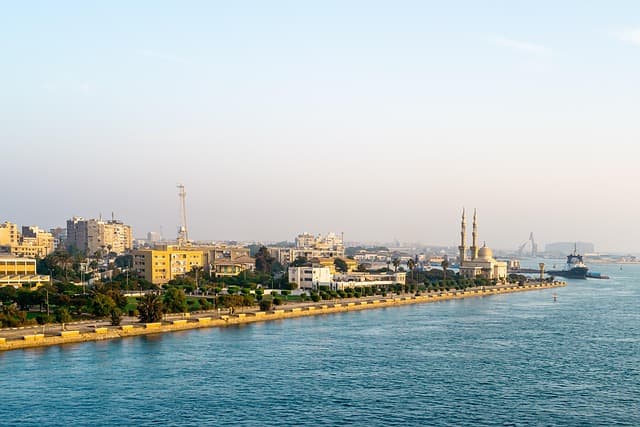
The ships never stop. This is the first thing that surprises visitors who arrive at Ismailia expecting a monument and find instead a working industrial artery. Container vessels longer than the Eiffel Tower is tall pass at roughly 14 kilometers per hour, so close to the viewing embankment that you can read the lettering on their hulls. About 12 percent of global trade moves through this channel. On a slow day that is still forty ships.
Ismailia was purpose-built for the canal's European administrators, and it retains the strange architectural hybrid that produces. The old European quarter along Mohammed Ali Quay has wide, tree-lined streets, villas with Italianate shutters, and a garden suburb logic entirely unlike the organic density of Cairo. The De Lesseps House Museum preserves the residence of the canal's builder as a period piece: furniture imported from France in the 1860s, correspondence mounted on walls, the particular quality of a house designed to impress visiting dignitaries while its owner genuinely believed he was participating in human progress. De Lesseps was not cynical about the canal. That is what makes him interesting.
The Ismailia Museum nearby houses artifacts discovered during canal construction including objects from the ancient canal routes of the Pharaonic and Persian periods, proof that every shovel of earth turned in 1859 was passing through layers of older ambition. The museum is small, genuinely undervisited, and worth an hour of your time for exactly this reason.
Port Said, at the canal's northern mouth, tells a different story. Founded in 1859 as a construction base, it became one of the most cosmopolitan cities in the world within thirty years: Greek merchants, Italian engineers, Levantine traders, British officers, and a Maltese community large enough to maintain its own churches. The wooden-latticed buildings of the old commercial quarter, their upper floors cantilevered over the street in a style that is neither European nor traditionally Egyptian but a Canal Zone hybrid, are slowly being restored after decades of neglect. Port Said was also the site of the 1956 Anglo-French invasion following Nasser's nationalization of the canal, an event so catastrophically misjudged that it ended Anthony Eden's political career and confirmed the end of British imperial reach in the Middle East in a single week.
---
The Human Cost They Don't Put on the Plaques
The canal was built with corvée labor: Egyptian peasants conscripted by the Egyptian government at de Lesseps's request. Estimates suggest between 20,000 and 30,000 Egyptian workers were employed at any given time during construction, rotating in forced rotations. The total number of laborers who passed through the project over ten years is estimated at 1.5 million individuals. The death toll from disease and accident has never been precisely established, but contemporary European observers reported cholera outbreaks in the labor camps as routine.
De Lesseps publicly opposed the corvée and eventually replaced human digging with steam-powered dredgers, partly under pressure from British diplomats who opposed the canal by whatever means available. The diplomatic objection to forced labor was, in this context, not entirely altruistic. The replacement of human labor with machines actually accelerated the project. The canal opened in November 1869, an event celebrated with a Khedival opera house commission that became Verdi's Aida, though Aida was not ready in time and Rigoletto was performed at the opening instead. The opera house in Cairo built for that occasion still stands in Opera Square, having been rebuilt after a fire.
The workers who dug the canal are not commemorated anywhere along its length. The statue of de Lesseps that stood at Port Said's entrance for decades was toppled by crowds in 1956 following nationalization. There is nothing in its place.
---
The Connections
The Canal Zone does not exist in isolation from the rest of Egyptian history, though it is usually treated as a purely modern story.
The ancient canal route that Necho II began and Darius completed ran through the Wadi Tumilat, the same valley where, according to most archaeological and textual evidence, the Israelite settlement of Goshen was located during the period described in Exodus. The labor dynamics of the modern canal, including state conscription of agricultural workers for a foreign-backed infrastructure project, have an uncomfortable echo in the oldest narratives attached to this geography.
The British garrison towns built along the Canal Zone between 1882 and 1954 sit on ground that was contested during the Crusades, administered by the Fatimid caliphate, and before that part of the Byzantine defensive frontier against Sassanid Persia. The Sinai crossing at the canal's southern end was the route of every army that ever moved between Africa and Asia: from Thutmose III's seventeen military campaigns into the Levant to Napoleon's 1798 Syrian expedition, which crossed here and failed spectacularly at the siege of Acre.
Nasser's nationalization of the canal in July 1956 was announced in a speech in Alexandria that used the name "de Lesseps" as a code word for his engineers to begin seizing canal company offices across Egypt. The British and French response, coordinated secretly with Israel in what became known as the Suez Crisis, was condemned by both the United States and the Soviet Union, a Cold War alignment so unusual it has not been repeated since. Eisenhower threatened to collapse the pound sterling by selling US holdings of British currency unless Britain withdrew. It withdrew. The canal has been Egyptian ever since.
That connection runs directly to the Nasser era monuments and the Suez War memorial in Port Said, which sits approximately two kilometers from the colonial-era Canal Authority building where British administrators managed global shipping revenues for decades. The proximity is not accidental.
---
Common Mistakes
Treating this as a day trip afterthought. The Canal Zone requires its own itinerary. Visitors who bolt it onto a Cairo schedule typically drive to Ismailia, stare at a ship for twenty minutes, and leave without entering a single building. Budget a full day minimum.
Skipping Ismailia for Port Said. Port Said is architecturally interesting but has been heavily developed for domestic tourism and feels accordingly crowded on weekends and public holidays. Ismailia is quieter, has better access to the colonial residential quarter, and the De Lesseps House has no equivalent in Port Said. If you only have time for one, Ismailia is the choice.
Taking the organized "Suez Canal cruise" tours from Cairo. These cost EGP 600 to 900 per person, run on a fixed itinerary, spend approximately forty minutes at the canal itself, and fill the rest of the time with shopping stops at Canal Zone souvenir markets. You will learn nothing you would not learn from reading this article and you will see less. Take a bus or rent a car.
Expecting English signage at the smaller museums. The De Lesseps House Museum has minimal English labeling. The Ismailia Museum has more, but it is uneven. Download a translation app, bring a basic Arabic phrasebook, or arrange a local guide in advance through Ismailia's small but functional tourism office.
Photographing military installations. The Suez Canal is a strategic national security asset. The Egyptian military maintains a visible presence along its length. Photography of military personnel, vessels, or installations is prohibited and this is enforced. Canal ships and the civilian embankment are fine. Anything with a uniform or a wire fence is not.
Missing the timing window for northbound convoys. Ships traverse the canal in convoys. The northbound convoy typically passes Ismailia between 11am and 3pm. If you arrive after 3pm, you will see an empty channel. Check convoy schedules on the Suez Canal Authority website before you travel.
Paying for the Ismailia sound and light show. It runs sporadically, costs EGP 200, and adds nothing to an understanding of the canal or its history. The canal at night is a sequence of enormous lit ships moving in darkness, which is genuinely worth seeing from the embankment for free.
---
Practical Tips
Ismailia has one hotel worth recommending: the Mercure Ismailia, which occupies a mid-century building on the canal embankment and has rooms with direct water views. Book ahead if visiting between October and December when domestic tourism peaks. Rates run EGP 2,500 to 4,000 per night.
The best meal in the Canal Zone is fish from Lake Timsah, the salt lake that the canal passes through at Ismailia. The lakeside restaurants, particularly those clustered near the yacht club, serve tilapia and mullet pulled that morning. Expect to pay EGP 150 to 250 for a full meal including bread and salad.
Friday is the worst day to visit Port Said. It is the primary domestic tourism day and the corniche becomes impossible to walk. Saturday morning in Port Said is manageable. Any weekday in Ismailia is uncrowded.
If you read Arabic, the Egyptian National Archives in Cairo holds declassified documents from the 1956 nationalization period that are genuinely extraordinary: internal British diplomatic telegrams, Nasser's annotated speech drafts, Canal Authority handover records. Access requires an academic affiliation letter but is otherwise open to researchers. It changes how you stand on the embankment watching the ships.
Wear sun protection that you apply before leaving the car. The viewing embankments have no shade and the light off the water at midday is severe. This is not a suggestion.
Frequently Asked Questions
The Weekly Dispatch
More on Egypt, every Friday.
Cultural depth and places most guides never mention.
No spam. Unsubscribe anytime.