Suez Canal History, British Egypt, and What the Water Hides
Britain bought a 44% stake in the Suez Canal for £4 million in 1875, then occupied Egypt seven years later. The canal didn't just connect seas. It ended an empire and started a war.

Quick Facts
- Best time to visit
- October to March. The Canal Zone has no shade and no elevation. Summer heat is punishing and adds nothing to the experience.
- Entrance fee
- Canal Authority Museum: EGP 80 (approx $1.60 USD). De Lesseps House: EGP 50 (approx $1 USD). Canal viewing from public corniche: free.
- Opening hours
- Museums: Saturday to Thursday 9am to 4pm, Friday 10am to 2pm. Canal visible from public banks at all hours.
- How to get there
- Bus from Cairo Turgoman station to Ismailia: EGP 60 to 80 (approx $1.20 to $1.60), about 2 hours. Private car from Cairo: EGP 600 to 900 for the day. Train to Ismailia via Ain Shams station: EGP 40 to 60, about 3 hours.
- Time needed
- Ismailia alone: full day. Port Said added: second day. Suez city: separate trip, better combined with Sinai travel.
- Cost range
- Budget EGP 800 to 1,200 per day including Cairo transport. Mid-range with private car and guide: EGP 2,500 to 3,500.
Quick Facts
Best time to visit: October to April, when the Delta heat drops to something human. Ismailia is cooler than Cairo but still brutal in July.
Entrance fees: The Suez Canal Authority Museum in Ismailia: EGP 60 (approx $1.20 USD). The de Lesseps House Museum: EGP 50 (approx $1 USD). Viewing the canal itself from the Ismailia corniche or the Suez observation platforms: free. The new Canal Museum in Ismailia opened in a renovated colonial-era building and charges EGP 80 for adults.
Opening hours: Most Ismailia museums run Saturday through Thursday, 9am to 4pm. Friday hours are reduced to 10am to 2pm. The canal is a working waterway visible from the banks at all hours.
How to get there: Ismailia is the most useful base. Buses from Cairo's Turgoman station run hourly, cost EGP 60 to 80 (approx $1.20 to $1.60 USD), and take roughly two hours. Trains exist but serve Cairo's Ain Shams station and take three hours. A private car from Cairo costs EGP 600 to 900 for the day. Suez city is 130km from Cairo. Port Said is the northern terminal and about 220km.
Time needed: Ismailia alone deserves a full day. If you want Port Said and the northern entrance markers, add another day. Suez city to the south is a separate trip, better combined with Sinai.
Cost range: Budget EGP 800 to 1,200 per day including transport from Cairo. Mid-range with a guide and private car: EGP 2,500 to 3,500.
---
Why This Place Matters
The Suez Canal was not dug by Egyptians. It was dug by them in the sense that approximately 1.5 million Egyptian labourers were conscripted between 1859 and 1869 under the corvée system, a form of forced labour that the Egyptian government had agreed to provide as its contribution to the project. Estimates of worker deaths range from 125,000 to over 200,000, mostly from cholera and exhaustion. The French engineer Ferdinand de Lesseps, whose statue once dominated Port Said's harbour until it was pulled down in 1956, is the name history attached to the canal. The names of the men who actually excavated it are not on any monument.
What the canal did to the world's trade routes was immediate and total. The journey from London to Bombay dropped from 19,800km around the Cape of Good Hope to 11,600km through the canal. British shipping costs fell by roughly 30% overnight. This made Egypt the most strategically important piece of real estate on the planet for the next eighty years, and it explains almost everything about what Britain did here.
The canal opened on November 17, 1869. Egypt's Khedive Ismail had borrowed so heavily to fund the inauguration celebrations, which included a new opera house in Cairo and a specially commissioned opera (Verdi's Aida was intended for the opening but wasn't ready, so Rigoletto was performed instead), that Egypt went bankrupt within six years. That bankruptcy is directly what gave Britain its entry point.
---
The Purchase That Changed Everything
In November 1875, Benjamin Disraeli's government bought 176,602 shares of the Suez Canal Company from the nearly insolvent Khedive Ismail for £4 million. The money was borrowed in 48 hours from the Rothschild bank because Parliament was in recess and there was no time for the normal appropriation process. Britain became a 44% shareholder in a waterway it had not built and did not yet control. The French remained the majority shareholders.
This is the fact that most Suez Canal narratives rush past: Britain did not build the canal, did not own most of it, and did not govern Egypt when it made that purchase. It was a purely financial bet that the canal would be essential to the empire's survival, and the bet was correct. Seven years after the purchase, Britain occupied Egypt militarily. The canal was the reason.
The 1882 occupation followed an Egyptian nationalist uprising led by Colonel Ahmed Urabi, who opposed the growing influence of European creditors over Egyptian governance. Britain bombarded Alexandria in July 1882 and defeated Urabi's forces at the Battle of Tel el-Kebir in September. The occupation was described as temporary. It lasted 72 years.
Ismailia, the city that sits at the canal's midpoint, was built specifically to house the canal's European administrators. Its street plan, its villas with their bougainvillea gardens, its club buildings, its Catholic church, all of it was designed to reproduce a French provincial town in the Egyptian desert. Walking through Ismailia's older residential streets today you can still see the architectural logic of occupation: wide, tree-lined avenues designed for European comfort, surrounded by the Egyptian city that actually fed and serviced it.
---
What You Will See, and What It Means
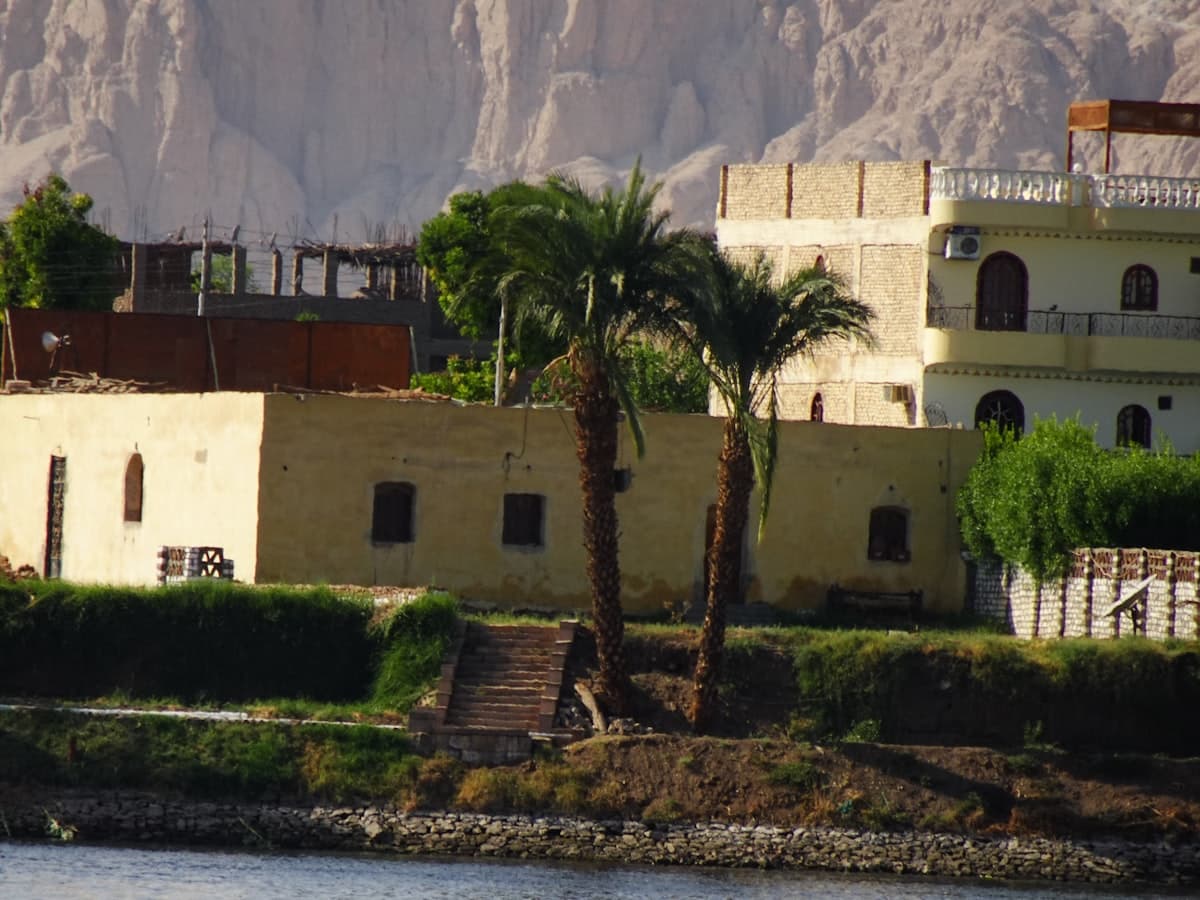
Standing on the Ismailia corniche at dawn, watching a container ship the length of twenty football fields slide past in silence, is genuinely strange. The ships are enormous relative to everything around them. They appear to move through the desert because from the western bank, you cannot always see the water below them, only the hulls drifting past date palms and concrete apartment blocks. This is the canal's most disorienting visual trick, and no photograph captures it properly.
The de Lesseps House is a faded colonial villa that contains furniture and personal effects from the canal's construction period. It is not particularly well-curated, the labels are sparse, and the building shows its age. But it has something more useful than good signage: it has atmosphere. You can stand in the room where the European administrators of the canal company made decisions about a waterway that ran through a country they did not govern, and feel the particular arrogance of that arrangement in the building's proportions, its distance from the canal itself, its garden designed for European leisure.
The Canal Authority Museum is the better institution. It holds maps, engineering drawings, and dredging equipment from the original construction, and it presents the canal's history with enough detail to make the engineering comprehensible. The canal is not simply a ditch. It is 193km long, 24 metres deep, and wide enough to accommodate two lanes of modern supertankers through the new parallel channel completed in 2015. The original channel took ten years to dig without mechanized equipment in any significant quantity.
Port Said at the northern end is where the canal meets the Mediterranean, and it is where the colonial architecture is most concentrated and most decayed. The city was once a major commercial port and a notoriously lawless free zone. Somerset Maugham wrote about it. Noel Coward passed through it. It sold contraband, opium, and English novels with equal enthusiasm. What remains is a city that has not entirely decided what it is now that it is no longer any of those things.
---
The Connections: 1956 and the World It Made
On July 26, 1956, Gamal Abdel Nasser announced the nationalization of the Suez Canal Company in a speech in Alexandria. He used the name "de Lesseps" as a code word. Every time he said it, technicians in Ismailia seized control of the canal's operations. Britain and France, acting with Israel in secret, launched a military intervention in October 1956 to retake the canal.
The United States refused to support them. The Soviet Union threatened nuclear action. Britain withdrew in humiliation. Nasser kept the canal. The 1956 Suez Crisis is the precise moment historians date the end of Britain as a global imperial power. A waterway in Egypt, financed by France, built by conscripted Egyptian labour, purchased by a Victorian prime minister in a 48-hour loan transaction, nationalized by a pan-Arab nationalist, and then defended not by military force but by American economic pressure, is the hinge point of the 20th century's geopolitical order.
The canal connects to Egyptian history in ways that extend beyond the colonial period. The ancient Egyptians built a precursor. Pharaoh Necho II began a canal linking the Nile to the Red Sea around 600 BC. Darius the Great of Persia completed it. Ptolemy II restored it. The Roman emperor Trajan rebuilt it. It silted up. The Arab general Amr ibn al-As reopened it after the Islamic conquest of Egypt in 642 AD to ship grain to Arabia. It was deliberately blocked by the Abbasid caliph al-Mansur in 767 AD to cut off a rival's supply lines. The idea of connecting the Mediterranean to the Red Sea is not a 19th-century European innovation. It is an idea Egypt has been attempting and abandoning for 2,600 years.
---
Common Mistakes
Going straight to Suez city instead of Ismailia. Most people associate the canal's name with Suez, but the city itself has little to show for that association. Ismailia is the canal's real home, the place built around it, shaped by it, and still living with its colonial inheritance in every building.
Expecting a museum experience equivalent to Cairo. The Canal Museum and de Lesseps House are underfunded and inconsistently staffed. They reward visitors who come with their own knowledge and use the objects and spaces to anchor what they already understand. Come having read something first.
Taking a canal cruise billed as a historical tour. Several operators in Ismailia sell boat tours that take you onto the canal itself. The views are real but the commentary is frequently wrong, delivered in approximate English, and focused almost entirely on current shipping statistics rather than the history. You will see the same ships from the corniche for free.
The Port Said duty-free shopping detour. Port Said retains a nominal duty-free status, and many Cairo visitors combine a canal trip with shopping for electronics or alcohol. This will eat your day, particularly on weekends when the shopping streets are genuinely impassable. If you are going to Port Said to understand the Suez Canal, go on a weekday morning and leave before noon.
Skipping the colonial residential district in Ismailia. The museums get all the attention, but the streets north of the Canal Authority headquarters, with their fading French and Italian villas, are where occupation becomes visible as an urban form. No entrance fee, no crowds, and more genuinely revealing than most of what is behind the ticket desks.
Expecting dramatic scenery. The Canal Zone is flat, industrial, and punctuated by container shipping infrastructure. If you come expecting the drama of Luxor or the desert geometry of Giza, you will be confused by what you find. Come for the history and the specific weirdness of watching supertankers cross the desert, not for landscape.
Hiring a local guide without checking their specialty. Guides in the Canal Zone often have strong backgrounds in Pharaonic or Islamic history and considerably weaker command of the 19th and 20th century colonial and geopolitical history that makes the canal significant. Ask specifically what period they focus on before booking.
---
Practical Tips
October through March is the window. April starts getting hot fast in the Delta.
Ismailia's lakeside corniche along Lake Timsah is the most pleasant place in the city for an evening. The restaurants along it serve decent grilled fish and the canal traffic is visible in the distance. Prices are modest: a full meal for two runs EGP 300 to 500.
The crossing to the Sinai from Ismailia uses the Ahmed Hamdi Tunnel, which runs under the canal. It is not a tourist attraction but it is an engineering achievement that matters: when the tunnel opened in 1981 it was the first fixed crossing of the canal in history. All previous crossings had been by ferry.
For photography, the western bank of the canal north of Ismailia offers the best angle for the "ships through the desert" effect, best in morning light. The eastern bank in the same area shows the same ships against open sky, which is less interesting.
Bring water, sunscreen, and patience. The logistics of moving between Port Said, Ismailia, and Suez require either a private car or careful coordination of buses and local microbuses. The three cities form a triangle; no single day trip covers all three adequately from Cairo.
Frequently Asked Questions
The Weekly Dispatch
More on Egypt, every Friday.
Cultural depth and places most guides never mention.
No spam. Unsubscribe anytime.