Suez Canal History, British Egypt, and What the Water Remembers
Britain occupied Egypt in 1882 over a canal that Egyptian laborers built with forced conscription. The canal is still running. The occupation left deeper marks than anyone admits.

Audio Guide: Suez Canal History, British Egypt, and What the Water Remembers
Quick Facts
- Best time to visit
- October through March: lower humidity, clearer light, pleasant walking temperatures in the Delta. Avoid July and August when temperatures exceed 35C and humidity off Lake Timsah is oppressive.
- Entrance fee
- Ismailia Museum: EGP 30 (approx $1 USD). Port Said National Museum: EGP 50 (approx $1.50 USD). Canal corniche and city walking: free.
- Opening hours
- Ismailia Museum: Saturday to Thursday, 9am to 3pm, closed Fridays. Port Said National Museum: similar hours, Saturday to Thursday. Both close without warning on public holidays.
- How to get there
- Cairo to Ismailia: bus EGP 80 to 120 (90 min) or shared taxi EGP 70 to 100 per person. Cairo to Port Said: bus EGP 100 to 150 (2.5 hours). Driving from Cairo takes 90 minutes via the Desert Road. No passenger rail to Port Said currently operational.
- Time needed
- Ismailia: full day minimum. Port Said: half to full day. Two days total to cover both properly, including time on the canal corniche to watch ship convoys.
- Cost range
- Budget EGP 600 to 900 per day (transport, street food, cheap accommodation, museum fees). Mid-range EGP 1,800 to 2,800 per day (decent hotel in Port Said, sit-down meals with canal views, private transport between cities).
The Suez Canal was dug almost entirely by Egyptian peasants working under forced labor, a system called corvée, which Napoleon had tried to abolish decades earlier. Ferdinand de Lesseps, the French diplomat who gets the credit and the statues, never lifted a shovel. Somewhere between 1.5 and 2.4 million Egyptians worked on the canal between 1859 and 1869. At least 125,000 of them died. That number does not appear on any plaque along the waterfront in Ismailia.
Quick Facts
Best time to visit: October through March, when the Delta humidity drops and the canal light in the morning is clear rather than bleached white. April through September is survivable but uncomfortable, particularly in Port Said, where the breeze off the Mediterranean is the only relief.
Entrance fees: The Suez Canal Authority Museum in Ismailia charges EGP 30 (approximately $1 USD). The Ferdinand de Lesseps statue has been removed from Port Said, so there is nothing to pay to not see it. The Canal Zone cities themselves are free to walk.
Opening hours: The Suez Canal Authority Museum is open Saturday through Thursday, 9am to 3pm. Closed Fridays. Port Said's National Museum keeps similar hours. Both close on official public holidays without advance warning.
How to get there: From Cairo, buses to Ismailia run from Turgoman station and cost EGP 80 to 120 (under $4 USD), taking approximately 90 minutes. Buses to Port Said cost EGP 100 to 150 and take around 2.5 hours. A servees (shared taxi) from Cairo to Ismailia costs EGP 70 to 100 per person. Driving from Cairo takes about 90 minutes via the Desert Road. There is no passenger train to Port Said currently in service.
Time needed: Ismailia alone deserves a full day. Port Said can be added as a second day. Do not try to do both in one day and expect to understand what you are looking at.
Cost range: Budget EGP 600 to 900 per day including transport, meals, and a cheap hotel in Ismailia. Mid-range EGP 1,800 to 2,800 per day if you want a decent hotel in Port Said and sit-down meals with canal views.
Why This Place Matters
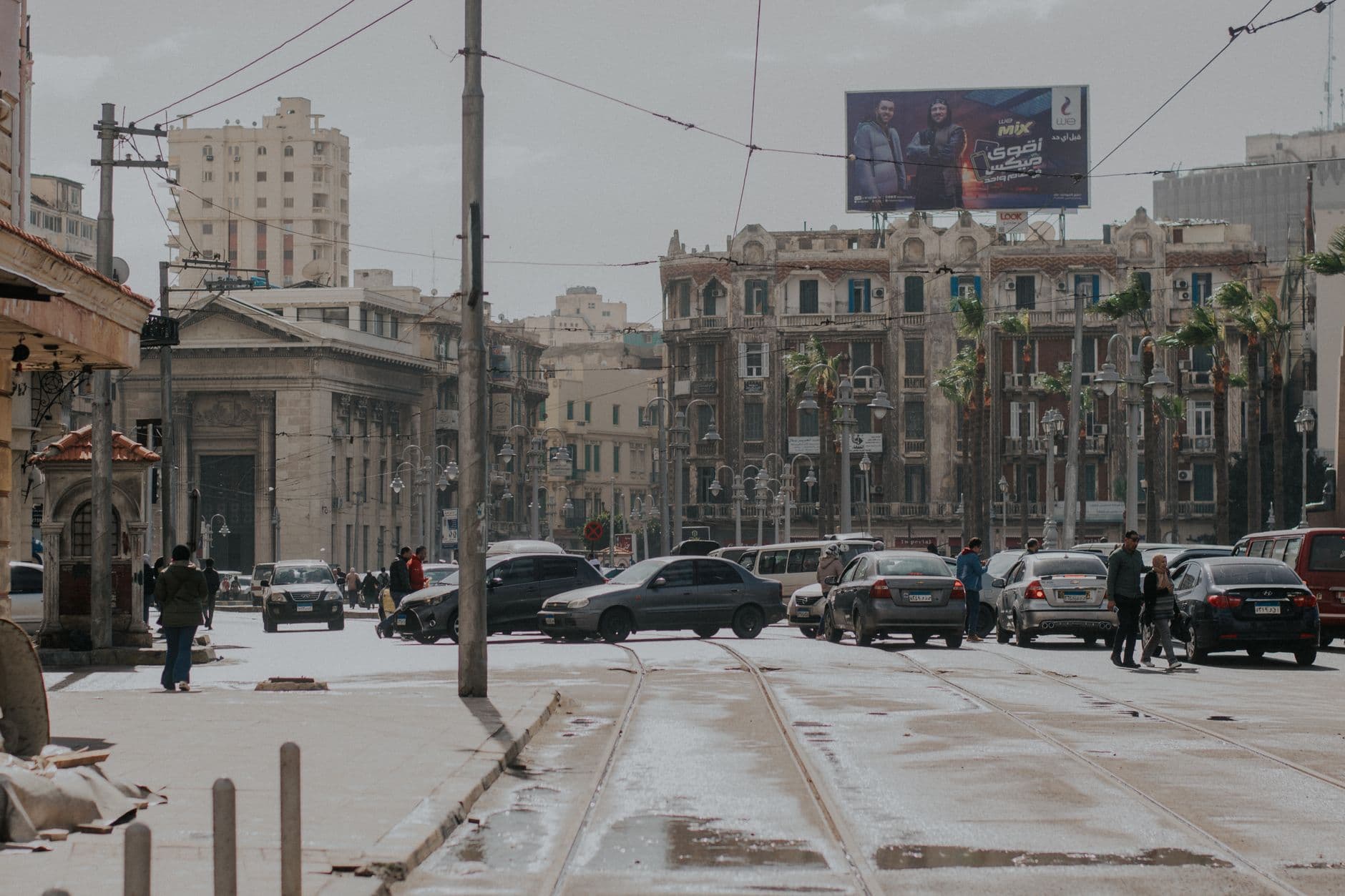
The canal that opened in 1869 did not just connect two seas. It ended Egypt's geographic irrelevance to global trade and immediately made it the most strategically important piece of real estate on earth. Britain, which had opposed the canal's construction for twenty years out of fear it would undermine overland trade routes through its Indian empire, reversed course entirely once the canal was open. In 1875, when the financially ruined Khedive Ismail needed cash, Prime Minister Benjamin Disraeli borrowed four million pounds from the Rothschild banking house overnight, without parliamentary approval, and bought Egypt's 44 percent share in the canal in a single transaction. Parliament was outraged. Disraeli didn't care. He knew what he had bought.
The British occupation that followed in 1882 was, at its core, a canal protection operation dressed up in the language of fiscal reform and the suppression of a nationalist rebellion led by Ahmed Urabi. Urabi's movement was the first coherent Egyptian nationalist uprising of the modern era, a coalition of military officers and peasants who were tired of European debt commissioners running their country. Britain defeated it in 85 days, exiled Urabi to Ceylon, and then stayed in Egypt for 72 years.
The canal today carries approximately 12 to 15 percent of global trade by volume. On a clear morning in Ismailia, you can watch a container ship the length of four soccer fields slide past the corniche in what appears to be complete silence. It is one of the stranger experiences available in Egypt, a country that specializes in strange experiences.
Ismailia: The City Built to Govern a Canal
Ismailia was purpose-built in the 1860s by the Suez Canal Company as its operational headquarters. Ferdinand de Lesseps designed his own villa here, a colonial confection on the shore of Lake Timsah that still stands and is now the Ismailia Museum's garden. The house has been preserved with a determination that says more about French cultural lobbying than Egyptian historical priorities: inside, de Lesseps's furniture remains, his hunting trophies, his personal effects. The 125,000 dead Egyptian laborers have a room dedicated to them nowhere.
The Canal Zone architecture in Ismailia is genuinely worth examining if you know what you are looking at. The European Quarter, built for company employees and their families, contains rows of late-19th-century villas with wide verandas, jacaranda trees, and iron gates that could have been lifted from a neighborhood in Lyon or Marseille. They were not built by the French for aesthetic reasons. They were built to make European employees feel that they had not left home, in a country the company treated as infrastructure rather than civilization.
The Ismailia Museum, small and frequently ignored in favor of the big Cairo museums, holds something worth finding: a mosaic floor from a Roman villa discovered during canal construction, depicting the god Dionysus. It is a useful reminder that the canal zone has been occupied and re-occupied for millennia. Ancient Egyptian texts refer to a canal connecting the Nile to the Red Sea that may have been partially operational as early as the reign of Seti I in the 13th century BC. Herodotus writes about it. Darius the Great of Persia reportedly expanded it. The modern canal does not follow an empty desert corridor. It follows water.
Port Said: The End of Empire, Literally
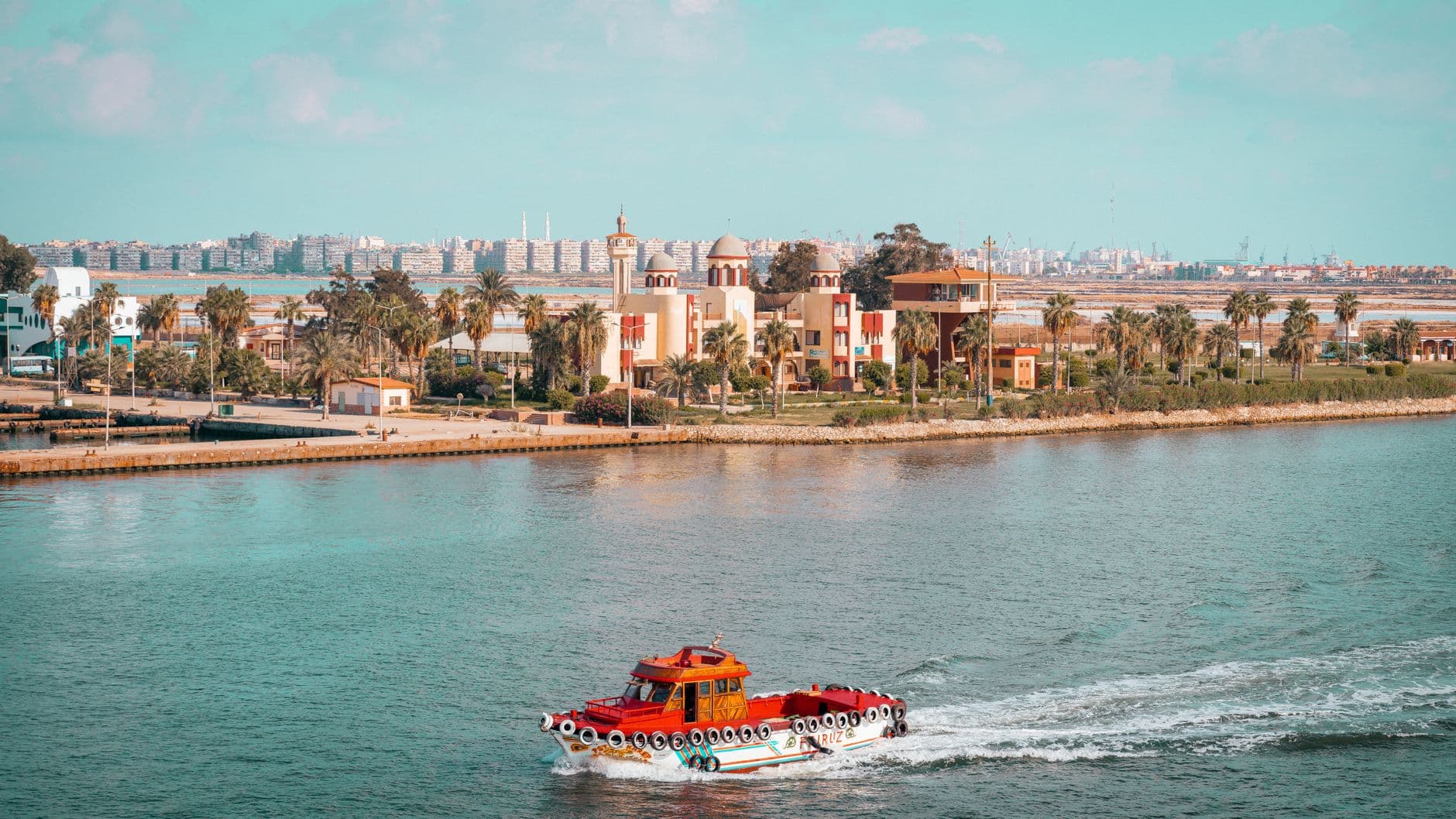
Port Said is where you go to understand 1956, which is the hinge year of modern Egyptian history and one of the most consequential moments of the 20th century. When Gamal Abdel Nasser nationalized the Suez Canal on July 26, 1956, he did it in a speech delivered in Alexandria that contained a single code word. When Nasser said the name "de Lesseps" in the address, Egyptian officers stationed at canal facilities across the zone moved simultaneously to take control. The British and French, who had operated the canal through the Universal Suez Canal Company, did not see it coming.
What followed was the Suez Crisis: Britain and France secretly colluding with Israel to attack Egypt, Eisenhower forcing them to withdraw under threat of economic pressure, and the end of Britain's pretense that it was still a global power. The crisis is taught in British schools as a lesson in imperial decline. It is taught in Egyptian schools as the moment Egypt took back what was always Egyptian. Both readings are correct.
The Port Said National Museum covers this period with a directness that is unusual for state museums anywhere. The British bombardment of Port Said in November 1956 killed approximately 2,700 Egyptian civilians. The museum does not understate this. Photographs of the destruction are displayed at eye level, not tucked into corners.
Port Said's physical fabric still shows the layers. The Mohammed Ali Square area contains buildings from the colonial period alongside mosques built in the late Ottoman style and newer construction that is mostly unremarkable. The lighthouse at the canal's Mediterranean entrance, built in 1869, still functions. It is one of the oldest operational lighthouses in Africa.
The Connections: Nothing Here Is Only One Thing
The Suez Canal Authority's headquarters in Ismailia sits on ground that was a major station on ancient caravan routes between the Nile Delta and the Sinai Peninsula. The same geographic logic that made this corridor useful to Pharaonic traders made it useful to Ferdinand de Lesseps and makes it useful to Maersk container ships today. Geography does not negotiate.
The British military camps established in the Canal Zone during the occupation became, after 1936, a nominally agreed British presence under the Anglo-Egyptian Treaty, which allowed up to 10,000 British troops to remain in the zone. By the early 1950s, there were 80,000. Egyptian fedayeen fighters began attacking British installations in 1951 in what is called the Canal Zone Conflict, a guerrilla campaign that is almost entirely absent from British histories of the period and treated as foundational resistance in Egyptian ones.
The Coptic community in Ismailia, though small, maintained churches throughout the British period. St. George's Coptic Church on Sultan Hussein Street dates to the early 20th century. The Coptic presence in the canal zone is a reminder that the population who built this corridor were not a blank colonial canvas. They had a civilization that predated de Lesseps by several thousand years. The canal cut through it, in more than one sense.
Nasser's nationalization speech connected the canal explicitly to the High Dam at Aswan: the tolls collected from the nationalized canal would fund the dam that Britain and America had just refused to finance. The Aswan High Dam, completed in 1970, displaced approximately 100,000 Nubian people. The canal fees that paid for it were extracted from a labor force whose ancestors built it under corvée. Egyptian history has a habit of compounding.
Common Mistakes
Skipping Ismailia for Port Said. Most travelers who make the effort to visit the canal zone go straight to Port Said because it sounds more dramatic. Ismailia is the better destination. The architecture is more intact, the museum is more specific, and you can actually see ships passing at close range from the corniche in a way that makes the scale of the operation comprehensible.
Taking the Suez Canal Authority public boat crossing as a tourist activity. The free ferry that crosses the canal at Ismailia is used by locals commuting between the city and the east bank. It is not a scenic cruise. It is a five-minute utility crossing on a small flat-bottomed boat. Take it if you need to get to the other side. Do not take it as the centerpiece of a day trip.
Reading the de Lesseps mythology without pushback. Every English-language source on the canal leads with de Lesseps as a visionary genius. He was a skilled promoter who raised capital and managed a bureaucracy. The engineering was done by Alois Negrelli (an Austrian engineer whose design de Lesseps appropriated), and the labor was done by Egyptian peasants under a system that Egyptians actively petitioned to end. Said Pasha, the Khedive who signed the original concession agreement, gave de Lesseps terms so favorable that later Egyptians regarded it as a form of looting. The concession ran for 99 years and gave Egypt 15 percent of profits. Egypt built the canal and received 15 percent.
The sound and light show in Port Said, if you encounter one being advertised, is not worth attending. It covers the 1956 crisis with the subtlety of a state propaganda film, which is essentially what it is. The museum does the same material better, with actual photographs and artifacts, in daylight, for a fraction of the cost.
Coming without basic knowledge of 1956. The canal zone is not legible without understanding the Suez Crisis. This is not optional background. It is the entire point of the place. Read something before you arrive. Kennett Love's "Suez: The Twice-Fought War" is specific and serious. Even a detailed Wikipedia read is better than arriving blank.
Expecting the canal crossing at Suez city to be picturesque. Suez city at the southern end of the canal was heavily damaged in the 1967 and 1973 wars with Israel and was essentially evacuated and then rebuilt. It is an industrial port city with none of the colonial-era architecture that makes Ismailia worth photographing. Go if you have a specific reason. Do not make it the canal visit.
Practical Tips
Ismailia in winter is genuinely pleasant, a midsize Egyptian city that does not get the tourism pressure of Cairo or Luxor and retains a slightly slower pace that makes it easier to actually look at things. The corniche along Lake Timsah is worth an evening walk.
The Ismailia Museum's mosaic floor and the de Lesseps villa garden are both worth your time, but budget only about 90 minutes for the museum itself. It is small. The serious time in Ismailia is spent walking the European Quarter and watching ships from the canal bank.
For the canal bank itself, the Ismailia Fishing Club area gives you the closest legal pedestrian access to the waterway. Container ships pass approximately every 20 to 40 minutes during transit convoys, which typically run in the morning hours. The New Suez Canal, a parallel channel that was excavated between 2014 and 2015 at a cost of $8.5 billion, allows two-way traffic and reduced average transit time from 18 hours to 11 hours. The project was funded entirely by Egyptian citizens who bought investment certificates. That fact is not in the tourist materials, but it is the kind of detail that explains modern Egyptian nationalism to anyone paying attention.
In Port Said, stay near the corniche rather than inland. The seafood is the reason to eat here: the restaurants along the harbor serve fresh fish from the Mediterranean at prices that will seem impossible if you have been eating in Cairo tourist restaurants. Order whatever came in that morning. Ask the waiter, not the menu.
Do not hire a guide for the canal zone unless they are specifically a history guide with knowledge of the British period and the 1956 crisis. Generic Egyptological guides will try to connect everything to the Pharaohs, which is not wrong but is not the story here. The story here is water, and power, and who controls both.
Frequently Asked Questions
The Weekly Dispatch
More on Egypt, every Friday.
Cultural depth and places most guides never mention.
No spam. Unsubscribe anytime.