Suez Canal History, British Egypt & the Ismailia Guide
Britain occupied Egypt for 72 years but never officially colonized it. The canal they desperately wanted cost 120,000 Egyptian laborers their lives to build. Neither fact appears on the tour.

Quick Facts
- Best time to visit
- October to March. Winter temperatures stay between 15 and 25 degrees Celsius, the Corniche is walkable, and museum crowds are minimal. Avoid July and August: humidity from Lake Timsah and the canal makes outdoor exploration genuinely unpleasant.
- Entrance fee
- Suez Canal Authority Museum EGP 60 (approx $1.25 USD). De Lesseps House Museum EGP 50 (approx $1 USD). Ismailia Museum of Antiquities EGP 150 (approx $3 USD). Port Said National Museum EGP 100 (approx $2 USD). Canal viewing from Corniche: free.
- Opening hours
- Most Ismailia museums 9am to 4pm daily except Monday. Port Said National Museum 9am to 5pm Tuesday to Sunday. De Lesseps House occasionally closes for events: call the Ismailia tourist office to confirm before visiting.
- How to get there
- East Delta bus from Cairo Turgoman station to Ismailia: EGP 60, approximately 2.5 hours. Bus to Port Said: EGP 80, approximately 3 hours. Microbus between Ismailia and Port Said: EGP 30. Private taxi from Cairo to Ismailia return: approximately EGP 800 to 1,200 negotiated.
- Time needed
- Minimum one full day for Ismailia alone. Two days recommended to include Port Said and Port Fouad. Add a morning if you want to see the Tell el-Maskhuta site outside the city.
- Cost range
- Budget EGP 400 to 700 per day covering bus transport, museum entries, and local meals. Mid-range EGP 1,200 to 2,000 per day with a hotel night in Ismailia. Mercure Forsan Island runs EGP 2,500 to 3,500 for a canal-view room.
The British did not build the Suez Canal. They did not finance it, design it, or dig a single meter of it. They opposed it so loudly that the French engineer Ferdinand de Lesseps spent fifteen years fighting British lobbying before the first shovel broke ground in 1859. Then, sixteen years after it opened, Britain bought a controlling stake for £4 million, a sum that the bankrupt Khedive Ismail accepted in a single weekend negotiation in 1875, and proceeded to run the canal as if it had always been theirs. The story of the Suez Canal and British Egypt is a story about who controls the narrative of their own history. Egypt is still telling that story.
Quick Facts
Best time to visit: October through March. The canal zone in summer sits at 38 to 42 degrees Celsius with punishing humidity from the nearby lakes. Winter light on the water is extraordinary, and the Ismailia Corniche is actually walkable.
Entrance fees: Suez Canal Authority Museum (Ismailia): EGP 60 (approx $1.25 USD), students EGP 30 De Lesseps House Museum (Ismailia): EGP 50 (approx $1 USD) Ismailia Museum of Antiquities: EGP 150 (approx $3 USD) Port Said National Museum: EGP 100 (approx $2 USD) Canal viewing platforms (Port Said, Ismailia): Free
Opening hours: Most Ismailia museums 9am to 4pm daily except Monday. Port Said National Museum 9am to 5pm Tuesday to Sunday.
Getting there: Cairo to Ismailia: East Delta buses from Turgoman station (Cairo), approximately EGP 60, journey 2 hours Cairo to Port Said: Direct bus from Turgoman, approximately EGP 80, journey 3 hours Microbus from Ismailia to Port Said: EGP 30 Private taxi from Cairo to Ismailia: approximately EGP 800 to 1,200 return
Time needed: Ismailia deserves a full day; combine with a half-day in Port Said if you are thorough. Budget two days if you want the canal zone properly.
Cost range: Budget EGP 400 to 700 per day including transport and entry. Mid-range EGP 1,200 to 2,000 with a hotel night in Ismailia.
Why This Place Matters
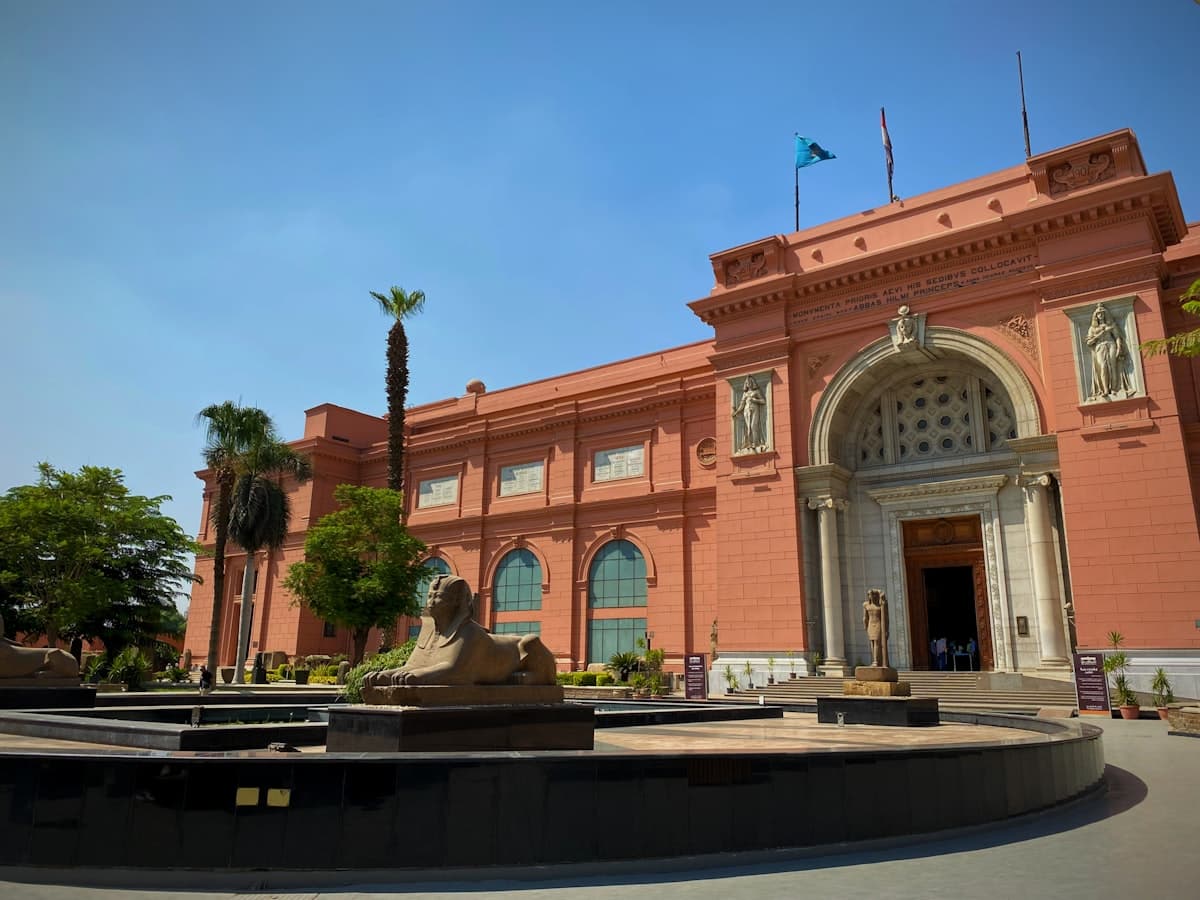
The Suez Canal shortened the sea route between Europe and Asia by approximately 7,000 kilometers, eliminating the need to circumnavigate Africa via the Cape of Good Hope. That single fact reorganized global trade, reshaped colonial empires, and made Egypt one of the most strategically important pieces of land on earth for the better part of a century. It is also a fact that obscures something more important: the canal was dug almost entirely by Egyptian peasants working under a system called corvée labor, which was legally indistinguishable from conscription. An estimated 120,000 workers died during construction between 1859 and 1869, mostly from cholera and exhaustion. No memorial exists at the waterway itself.
The canal connects to Egyptian history in layers that most visitors do not reach. The Pharaoh Necho II attempted a canal between the Nile and the Red Sea around 600 BC, reportedly abandoning it after an oracle warned that the project would benefit foreigners. The Persian king Darius I completed a version of it around 500 BC. The Roman emperor Trajan restored it. The Arab general Amr ibn al-As reopened it after the Islamic conquest of Egypt in 642 AD and used it to send grain to Arabia during a famine, a move that briefly made it the most important waterway in the medieval world, before the Abbasid caliph al-Mansur ordered it blocked in 767 AD to starve a rebellion in Medina. De Lesseps was not inventing something new. He was finishing something ancient.
The British occupation that followed their canal stake purchase lasted from 1882 to 1954, a period that shaped modern Egyptian identity more than almost any other. The occupation was officially a temporary measure to restore financial order after a nationalist uprising led by Ahmed Urabi. It lasted 72 years.
What You Actually See in Ismailia
Ismailia is the most coherent relic of British Egypt that survives. The French built the city in 1862 as the administrative headquarters for canal construction, and the British expanded and refined it into something that looked, deliberately, like a colonial English suburb transplanted to the desert. The tree-lined boulevards around Lake Timsah, the bungalows with their irrigated gardens, the Ismailia Club where British officers played tennis through the 1940s: these are not ruins. Many are still standing and in use.
The de Lesseps House, where the canal's chief engineer lived during construction, is a particular kind of experience. The furniture is largely original. The personal effects, surveying equipment, and correspondence on display create a portrait of a man who genuinely believed he was building one of civilization's great projects and had almost no consciousness of the human cost behind it. The house costs EGP 50 to enter. It receives perhaps a dozen visitors a week. This is a problem of Egyptian heritage promotion, not of visitor interest.
The Suez Canal Authority Museum is small, obsessively detailed, and worth every minute. The scale models of the original canal and the subsequent widenings of 1956, 1980, and 2015 tell you more about the waterway's engineering and geopolitical history than any book you are likely to find in a tourist shop. The 1956 section is handled with appropriate weight: Nasser's nationalization of the canal on July 26 of that year triggered a joint British, French, and Israeli military invasion that was ultimately reversed by American and Soviet pressure in what became the Suez Crisis, the moment that definitively ended British imperial ambitions in the Middle East. Britain and France were forced to withdraw in what is often described as the last gasp of nineteenth-century European imperialism. A large painting of Nasser in the museum shows a man who understood exactly what he had done.
The Canal Itself
You can watch ships transit the canal from the Ismailia Corniche for free. This is a stranger and more powerful experience than any museum. Container ships the length of six football fields slide through what appears to be a narrow urban park, their hulls rising above the palm trees, their names painted in letters two meters tall: EVER GIVEN (yes, that ship), COSCO SHIPPING DENALI, MSC GENEVA. The canal handles approximately 15,000 ships per year, carrying roughly 12 percent of global trade. Standing at the edge and watching a vessel from Singapore pass a vessel from Rotterdam while a man on the Corniche sells karkadeh from a cart is the correct Suez Canal experience. It costs nothing.
Port Said and the 1956 Scars
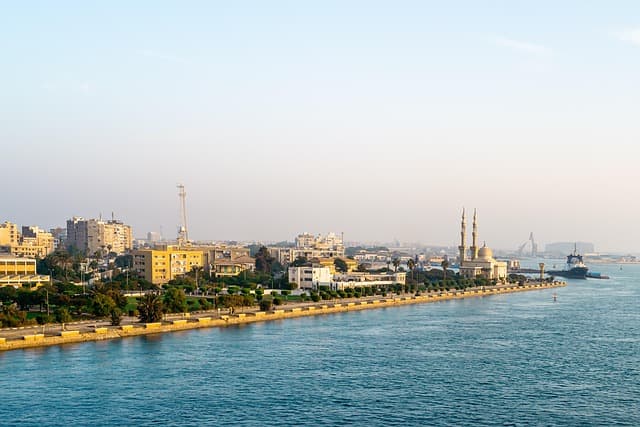
Port Said sits at the northern mouth of the canal, and it carries its history differently from Ismailia. The city was heavily bombarded during the Anglo-French-Israeli invasion of November 1956, and the marks of that are still readable in the architecture and the attitude. The Port Fouad district, across the canal on the Asian side, was the European residential quarter, reached by a free ferry that takes four minutes and crosses between Africa and Asia. Port Fouad's colonial villas are in various states of decay and adaptation, and walking its streets on a weekday morning, when most of the shops are still closed and cats occupy every doorstep, is one of the genuinely unmediated historical experiences left in the canal zone.
The Port Said National Museum holds a collection that bounces between pharaonic artifacts, Islamic manuscripts, and the military hardware of 1956 in a way that makes more sense than it should. Egypt does not separate these histories into different eras. They are the same country, continuously inhabited, continuously contested. A display case near the entrance holds a British officer's service revolver recovered from the 1956 battlefield. The placard beneath it is in Arabic only. Ask the guard to translate if your Arabic is not strong enough: his English almost certainly is.
The famous Port Said lighthouse, completed in 1869 for the canal's opening ceremonies, was built by Gustave Eiffel, who would go on to build something rather more famous nineteen years later in Paris.
The Connections
The Suez Canal does not exist in isolation from the rest of Egyptian history, though it is often taught as if it does. The khedives who borrowed the European money that eventually bankrupted Egypt and enabled British occupation were themselves the descendants of Muhammad Ali, the Albanian-born Ottoman commander who took control of Egypt in 1805 and modernized it at enormous human cost in ways that directly prepared the ground for foreign exploitation. Muhammad Ali's mosque in Cairo, begun in 1830, sits above the Citadel that Saladin built in 1176 on a ridge that Pharaonic Egyptians considered sacred. The layers are not metaphorical. They are architectural.
The corvée labor system that killed 120,000 canal workers was itself a Pharaonic institution, adapted by the Ptolemies, preserved by the Romans, maintained by the Arabs, refined by the Ottomans, and deployed one final devastating time by a French engineer who called it a necessary inconvenience. The fellahin, the Egyptian peasant farmers who built the canal, were the same social class that built the pyramids. Four thousand years of corvée. The canal is the last project they died for under that system. The Egyptian government abolished it in 1882, under British pressure, at roughly the same time Britain completed its occupation.
Common Mistakes
Skipping Ismailia for a day trip to the canal from Cairo. The canal is three hours from Cairo. Spending two hours in a car to stare at a container ship for fifteen minutes and drive back is a common itinerary and a waste of time. Ismailia requires a night. Budget for it.
Visiting only in summer. The canal zone in July and August is not a cultural experience. It is a test of endurance. The museums are air-conditioned; the walks between them are not.
Taking an organized tour from Cairo. Every organized tour to the Suez Canal area stops at a designated viewing platform, delivers thirty minutes of generic history, allows photographs, and returns to Cairo. You will learn exactly what you could have learned from a Wikipedia article. Take the bus. Walk the Corniche yourself. Eat at a local restaurant in Ismailia. This is the difference between visiting and being present.
The Port Said Duty-Free shopping trip. Port Said has had duty-free status for decades, and you will see Egyptians making day trips there purely to buy electronics and cigarettes. The duty-free stores are real and the prices are lower than Cairo. This has nothing to do with why you came here, and the shopping crowds significantly affect the quality of time in the heritage areas from Thursday evening through Friday. Visit earlier in the week.
Ignoring the Ismailia Museum of Antiquities. This small museum holds artifacts from Tell el-Maskhuta, the ancient site believed to be biblical Succoth, one of the stopping points of the Exodus, located 15 kilometers from Ismailia. Whether you take the biblical connection seriously or not, the site produced extraordinary Greek and Roman-era statuary and Ramesside sphinxes that almost nobody outside specialist Egyptology has heard of. The museum is EGP 150, receives almost no tourist traffic, and is run by a curator who will give you a personal tour if you arrive when it is quiet and express genuine interest. Express genuine interest.
Reading the Suez Crisis as a British story. British and American accounts of 1956 focus on the diplomatic humiliation and the end of empire. Egyptian accounts focus on the dead, the bombed neighborhoods, and the national triumph of holding the canal. Both are true. Neither is complete without the other. Come with that understanding, or you will misread everything you see.
Practical Tips
Ismailia is a quiet, leafy city that is almost entirely ignored by international tourism. This works heavily in your favor. Hotels are cheap, EGP 800 to 1,500 for a decent room. The Mercure Forsan Island, on a small island in Lake Timsah, is the best-positioned property for canal views and runs approximately EGP 2,500 to 3,500 per night, which is reasonable for what it offers.
Eat on the Corniche. Ismailia's fish restaurants serve Lake Timsah tilapia and mullet, grilled simply, with bread and salad, for EGP 150 to 300 per person. This is not a restaurant tip. This is an instruction.
The canal authority runs organized ship transit tours occasionally, but scheduling is irregular and primarily aimed at Egyptian groups. Your better option is simply the Corniche and patience. Ships transit in convoys, and the wait between convoys can be ninety minutes to two hours. Bring something to read.
For the suez canal history British Egypt angle specifically: the Ismailia Club, now the Ismailia Sporting Club, still stands and its architecture is a direct artifact of British social life in the canal zone. Non-members can sometimes arrange a visit through the front office with a polite request. It is worth attempting.
If you are researching British Egypt more broadly, the Egyptian Museum in Cairo's Tahrir Square holds the archive photograph collection from the colonial period, not on public display but accessible to researchers and journalists through the documentation center. The images are extraordinary and almost entirely unpublished outside academic contexts.
Frequently Asked Questions
The Weekly Dispatch
More on Egypt, every Friday.
Cultural depth and places most guides never mention.
No spam. Unsubscribe anytime.