Suez Canal History, British Egypt & the War Over Water
Britain occupied Egypt in 1882 over a canal it didn't build and didn't own. The crisis that ended their empire began in the same place. Here's what to see.

Quick Facts
- Best time to visit
- October to March. Cooler temperatures make walking the waterfront and colonial districts manageable. Summer heat in the canal zone regularly exceeds 38°C with little shade.
- Entrance fee
- Canal Museum Ismailia: EGP 50 (approx $1.60 USD). Port Said National Museum: EGP 120 (approx $4 USD). Canal viewpoints: free.
- Opening hours
- Canal Museum Ismailia: Sat to Thu 9am to 2pm, closed Fridays. Port Said National Museum: Daily 9am to 4pm. Canal bank viewpoints: no formal hours, best before 8am.
- How to get there
- Go Bus or West Delta from Cairo Turgoman station to Ismailia: EGP 80 to 120, approx 2 hours. To Port Said: EGP 110 to 150, approx 3 hours. Private taxi Cairo to Ismailia: EGP 600 to 900. Microbus Ismailia to Port Said: EGP 25 to 35.
- Time needed
- Full day for Ismailia alone. Overnight stay recommended if combining Ismailia and Port Said. Minimum half day for Port Said waterfront and museum.
- Cost range
- Budget EGP 400 to 700 per day including budget accommodation. Mid-range EGP 1,200 to 2,000 per day with Mercure Ismailia or equivalent and private transport.
The man who built the Suez Canal died broke, disgraced, and largely forgotten in France. Ferdinand de Lesseps completed what many said was impossible in 1869, watched Empress Eugénie sail through on the inaugural voyage aboard the imperial yacht, and then spent the next two decades watching the British, who had loudly opposed the project, maneuver until they controlled it entirely. By 1875, Britain owned 44 percent of Canal Company shares after buying out a financially desperate Khedive Ismail. By 1882, British troops were garrisoned along its banks. De Lesseps, meanwhile, went to prison over the Panama Canal scandal and died in 1894. The canal outlasted him, outlasted the British Empire, outlasted Nasser's opponents who said nationalizing it in 1956 would end in catastrophe. It is still running. It carries roughly 12 percent of global trade. And almost no one who visits Egypt thinks to visit it.
Quick Facts
Best time to visit: October through March. Summer temperatures in Ismailia and Port Said routinely exceed 38°C and the cities offer little shade. The Canal itself is open year-round; the light on the water is best at dawn and late afternoon.
Entrance fees: The Suez Canal Authority Museum in Ismailia charges approximately EGP 50 (around $1.60 USD). The viewing platforms along the Canal banks in Ismailia are free. Port Said's National Museum charges EGP 120 (approximately $4 USD). The New Suez Canal observation area near Ismailia opened in 2015 and is accessible by taxi without an entrance fee.
Opening hours: Ismailia Canal Museum: Saturday to Thursday, 9am to 2pm. Closed Fridays. Port Said National Museum: Daily 9am to 4pm. Canal viewpoints: no formal hours, best visited before 8am when convoy traffic begins.
How to get there: From Cairo's Turgoman bus station, Go Bus and West Delta run hourly services to Ismailia (roughly 2 hours, EGP 80 to 120) and to Port Said (3 hours, EGP 110 to 150). Taxis from Cairo to Ismailia run EGP 600 to 900 for a private car. Microbuses between Ismailia and Port Said cost EGP 25 to 35 and take about 90 minutes.
Time needed: Ismailia alone deserves a full day. Combining Ismailia and Port Said requires an overnight stay or a very early start. Allow half a day minimum for Port Said's waterfront and museum.
Cost range: Budget traveler EGP 400 to 700 per day including accommodation in Ismailia. Mid-range EGP 1,200 to 2,000 per day with a decent hotel and private transport.
Why This Place Matters
The Suez Canal did not simply connect two seas. It deleted 7,000 kilometers from the Europe-to-Asia shipping route, making the Cape of Good Hope passage redundant almost overnight. Before 1869, the fastest way to move goods from London to Bombay went around the entire African continent. Afterward, it went through 193 kilometers of Egyptian desert. The canal changed the logic of global trade so completely that within a decade, every major European power had reconsidered its imperial strategy based on who controlled this strip of water.
For Egypt, the cost was catastrophic. Khedive Ismail borrowed so heavily to fund the canal's construction and the lavish opening ceremonies, including a commission to Giuseppe Verdi for an opera (Aida, though it was delayed and not performed until 1871), that Egypt was essentially bankrupt by 1876. The Caisse de la Dette Publique, a European debt-control commission, took over Egyptian finances. This financial subjugation was the direct precursor to the British military occupation of 1882, which was sold to the British public as a temporary stabilization measure and lasted seventy-four years.
The Suez Canal history Britain Egypt relationship is not ancient history. It is the fulcrum on which modern Egypt turned. Nasser's nationalization of the Canal on July 26, 1956, the date was chosen deliberately to mark the fourth anniversary of King Farouk's abdication, triggered the Suez Crisis, in which Britain, France, and Israel invaded Egypt and were then forced to withdraw under American and Soviet pressure. It was the moment historians generally agree the British Empire accepted its own diminishment. For Egyptians, it remains the moment the country took back something that had always been theirs.
What You Will Actually See: Ismailia
Ismailia is the canal's capital in every sense that matters. De Lesseps built his headquarters here. The Canal Authority's administrative center is still here. The city has a peculiar colonial geometry: wide boulevards, European-style villas with wrought-iron gates, jacaranda trees that bloom purple in spring, and a lake, Timsah, that sits between the canal and the city like a mirror held up to the sky.
The Suez Canal Authority building is not open to the public, but you can walk its perimeter on Al Tahrir Street and understand immediately why this city felt different from the rest of Egypt. It was designed to feel different. The French engineers and British administrators who ran the Canal Company for nearly a century built Ismailia as a company town, a piece of Europe transplanted to the desert, with a separate district for Egyptian workers that was less pleasant and much less photographed.
De Lesseps' house still stands in a small garden near the Canal. It is modest by the standards you might expect, a two-story villa with green shutters, and it is now maintained as a minor museum site. The garden contains an ancient granite sarcophagus that de Lesseps kept as garden furniture, which tells you something about nineteenth-century attitudes toward Egyptian antiquity. The sarcophagus predates the canal by roughly 3,000 years.
The Canal Museum in Ismailia holds documents, maps, and engineering drawings from the original construction. The dioramas are dated and the labeling inconsistent, but one exhibit is worth the EGP 50 alone: the original firman, the Ottoman imperial decree granting de Lesseps permission to build the canal, displayed alongside the original concession agreement that gave the Canal Company control for ninety-nine years from 1869. Read the terms. Then read when Egypt finally got the canal back. The math is not coincidental.
For the canal itself, the viewing platform near the Ismailia ferry crossing is your best option. Container ships that are eleven stories tall pass within meters of the bank. There is no fence, no dramatic barrier. You stand on a low concrete platform and watch the largest moving objects on earth slide past you in near silence. The ships move at roughly 14 kilometers per hour to minimize bank erosion. At that speed, something that size should make noise. It does not. The silence is the thing you will remember.
What You Will Actually See: Port Said
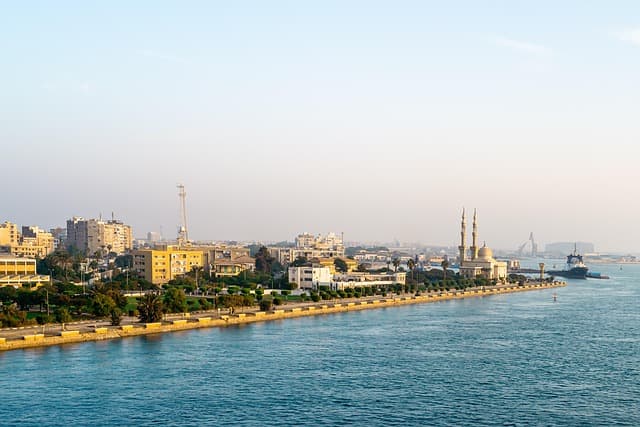
Port Said sits at the canal's Mediterranean entrance and carries a different kind of history. It was founded in 1859 specifically to house canal construction workers, which makes it younger than almost any city in a country where cities measure age in millennia. For a place that young, it accumulated history at speed.
During the 1956 Suez Crisis, Port Said absorbed the initial British and French bombardment and then the amphibious assault. The city was partially destroyed. The statue of de Lesseps that stood at the canal entrance, a sixteen-meter bronze pointing toward Asia, was torn down by Egyptian crowds after the crisis and melted. The base still exists. Egyptians call it the base of the statue of imperialism, and they mean it without irony.
The Port Said National Museum covers Egyptian history from Pharaonic through Islamic periods, which is worth noting: a city built in 1859 has curated a collection that stretches back 5,000 years, because Egypt's past belongs to all of it, not just to the sites built on top of ancient ground. The ground floor Pharaonic section is competent. The top floor, covering the canal era and the 1956 war, is genuinely affecting. There are photographs of Port Said residents armed with whatever was available standing against a professional army. They did not win militarily. Politically, they did.
The waterfront corniche in Port Said is good for an hour at sunset. The distinctive wooden architecture of the old commercial buildings, with their wide covered balconies designed to catch sea breezes, is unlike anything else in Egypt. Several are derelict. Some have been restored badly. A few remain as they were, which is the best way to see them.
The Connections
The Suez Canal does not begin with de Lesseps. Ancient Egyptians built a forerunner connecting the Nile to the Red Sea as early as the reign of Senusret III, around 1850 BC. The Ptolemies restored it. The Romans used it. The Arab general Amr ibn al-As, who conquered Egypt in 641 AD, reopened it again and used it to ship grain to Arabia during a famine. The canal was later deliberately blocked by the Abbasid Caliph al-Mansur in 767 AD to prevent supplies reaching a rival in the Hejaz. The idea that a canal through the Egyptian isthmus was a nineteenth-century European innovation is simply incorrect. It was a nineteen-century European re-engineering of a concept Egypt had been executing and abandoning for 3,600 years.
The British occupation triggered by canal politics also reshaped Cairo permanently. The Heliopolis suburb, built by Belgian entrepreneur Édouard Empain from 1905 onward, the garden city neighborhood, the layout of downtown Cairo with its Haussmann-influenced boulevards: all of these are products of the occupation era. When you walk through downtown Cairo and admire the nineteenth-century European facades, you are walking through the physical residue of canal economics. The money that built those buildings flowed through what was, legally, an Egyptian waterway managed by a foreign company under British military protection. The architecture is beautiful. The circumstances that produced it were not.
Nasser's canal nationalization also connects directly to the Aswan High Dam. Britain and the United States withdrew funding for the dam in July 1956, partly in retaliation for Nasser's non-alignment policies. Nasser nationalized the canal one week later and explicitly said the canal's revenues would fund the dam instead. The dam was eventually built with Soviet assistance and completed in 1970. It is still generating electricity and controlling the Nile flood. The canal paid for it.
Common Mistakes
Treating this as a day trip add-on to Cairo. Ismailia and Port Said are each worth a full day. Visitors who combine both cities into a single rushed trip from Cairo see neither properly. The canal's scale only registers if you sit beside it and wait for a convoy. That takes time and patience, not a forty-minute stop.
Going on a Friday. The Canal Museum in Ismailia is closed Fridays. Many of the older commercial buildings in Port Said are locked or minimally staffed. Friday morning is also when the waterfront is busiest with local families, which is pleasant but makes photography of the buildings difficult.
Taking the organized Cairo to Suez Canal tour packages. Most of these spend forty-five minutes at a highway viewpoint, hand you a bottle of water, and call it canal history. They charge EGP 800 to 1,500 per person. The Go Bus to Ismailia costs EGP 100 and delivers you to the actual city. There is no comparison.
Visiting only the New Canal observation area near Ismailia. The 2015 New Suez Canal expansion is impressive engineering, and the Authority has made it accessible to visitors with a viewing platform and an occasional light show. The light show costs EGP 200, runs about forty minutes, and tells you nothing about the canal's history, the construction, the politics, or the human cost. Skip it. The viewing platform is free and the ships are the same.
Skipping the de Lesseps house in Ismailia. It is not dramatic. It is not large. It is not well-labeled. It is, however, the place where the man who reshaped global trade lived and worked, and the garden contains a Pharaonic sarcophagus he used as a planter, which is one of the more vivid illustrations of colonial attitudes toward Egyptian history that you will find anywhere.
Expecting Port Said to look like a war memorial. The city has rebuilt and continued. The 1956 damage is not visually obvious unless you know where to look and what the pre-war photographs showed. The memorial sites are understated. If you are expecting dramatic ruins, you will be confused. If you are looking for a city that absorbed an invasion and kept functioning, Port Said is that.
Missing the ferry crossing at Ismailia. A free public ferry crosses the canal at Ismailia, connecting the city to the Sinai side. The crossing takes about eight minutes. You will be surrounded by Egyptian workers, students, and families commuting across one of the most consequential waterways on earth as if it were an ordinary river. It is the most honest way to understand what the canal actually is to the people who live beside it.
Practical Tips
Book accommodation in Ismailia rather than Port Said if you are choosing one base. Ismailia has better waterfront access, more of the colonial-era architecture, and a calmer atmosphere. The Mercure Ismailia hotel sits directly on Lake Timsah and offers canal-adjacent views without canal-entrance crowds.
Bring identification. The canal zone is an active security and military area. You will not be stopped constantly, but occasional checkpoints exist, particularly near Authority buildings and along the canal bank south of Ismailia. A passport or a clear photocopy is sufficient.
The best convoy viewing times are early morning, when northbound ships move through the Ismailia stretch, typically between 6am and 10am. Arrive at the Ismailia ferry crossing before 7am if you want the platform to yourself and the light to be useful for photographs.
For context before you go, read Robert Tignor's Egypt: A Short History for the British occupation background, and for the 1956 crisis specifically, Diane Kunz's The Economic Diplomacy of the Suez Crisis is thorough without being academic to the point of unreadability. Neither will take more than a week. Both will make everything you see at the canal mean considerably more.
Frequently Asked Questions
The Weekly Dispatch
More on Egypt, every Friday.
Cultural depth and places most guides never mention.
No spam. Unsubscribe anytime.