Syrian Community Egypt History Guide: Cairo's Hidden Arab Quarter
Syrians have been reshaping Cairo's streets, kitchens, and trade routes since the Mamluk era. The newest wave is just the latest chapter in 700 years of exchange.

Quick Facts
- Best time to visit
- October through April for comfortable temperatures. Ramadan evenings add a distinct social atmosphere worth experiencing if timing allows.
- Entrance fee
- Neighborhoods are free. Islamic Art Museum EGP 100 (approx $2 USD). Coptic Museum EGP 200 (approx $4 USD). Citadel complex including Sultan Hassan Mosque EGP 450 (approx $9 USD).
- Opening hours
- Medieval quarter streets accessible all hours, best before 10am or after 4pm. Syrian restaurants in Mohandiseen and Nasr City typically 10am to midnight. Islamic Art Museum Saturday to Thursday 9am to 5pm.
- How to get there
- Metro Line 2 to Attaba for old city (EGP 8 from central Cairo). Taxi from Tahrir to Mohandiseen EGP 30 to 50. Bus 24 from Ramsis to Nasr City EGP 5. Uber from downtown to Nasr City approximately EGP 60 to 90.
- Time needed
- Two half-days minimum: one in the medieval quarter around Muizz Street and Khan el-Khalili, one in Mohandiseen or Nasr City for the contemporary community. Add three hours for the Islamic Art Museum.
- Cost range
- Budget EGP 300 to 600 per day eating at Syrian-owned neighborhood spots. Mid-range EGP 800 to 1,500 including museum entries, a guide, and transport.
Quick Facts
Best time to visit: October through April, when the streets around Attaba and the old Arab Quarter are coolest and most active. Ramadan evenings bring an entirely different, slower, more generous Cairo to the surface.
Entrance fees: The neighborhoods themselves are free. The Khan el-Khalili area is open and public. The Coptic Museum at nearby Fustat costs EGP 200 (approx $4 USD); the Islamic Art Museum on Port Said Street costs EGP 100 (approx $2 USD) and is criminally undervisited.
Opening hours: The Syrian-owned restaurants and sweet shops in Mohandiseen and Nasr City typically run 10am to midnight or later. The historic quarters of medieval Cairo are best before 10am or after 4pm.
How to get there: Metro Line 2 to Attaba (EGP 8) drops you in the center of old Cairo's trading district. From Tahrir, a taxi to Mohandiseen runs EGP 30 to 50 depending on traffic. The 24 bus from Ramsis covers Nasr City for EGP 5.
Time needed: Two half-days minimum: one in the old city tracing the medieval Syrian commercial presence, one in Mohandiseen or Nasr City for the contemporary community's food, culture, and institutions.
Cost range: Budget EGP 300 to 600 per day eating well at Syrian-owned spots. A full spread of mezze, grilled meats, and sweets for two rarely exceeds EGP 500 in the neighborhoods where Syrians actually eat.
---
Cairo received roughly 1.5 million Syrian refugees and migrants between 2011 and 2023, making Egypt one of the largest Syrian host countries outside of Turkey, Lebanon, and Jordan. What the numbers do not say is that this was not the beginning of the Syrian presence in Cairo. It was a resumption.
The Mamluks, who ruled Egypt from 1250 to 1517, maintained Damascus as a co-capital. Levantine merchants, scholars, craftsmen, and soldiers moved continuously between Cairo and Syria for over two centuries. The spice trade that built Khan el-Khalili in 1382 ran on Syrian middlemen. The marble inlay technique that covers the walls of Mamluk mosques in old Cairo was imported from Syrian workshops in Aleppo. Even the word for a type of Cairo street food, the hawawshi, likely shares a root with Levantine preparation styles that traveled with traders. The Syrian community in Egypt does not begin in 2011. It begins in the fourteenth century.
Why This Place Matters
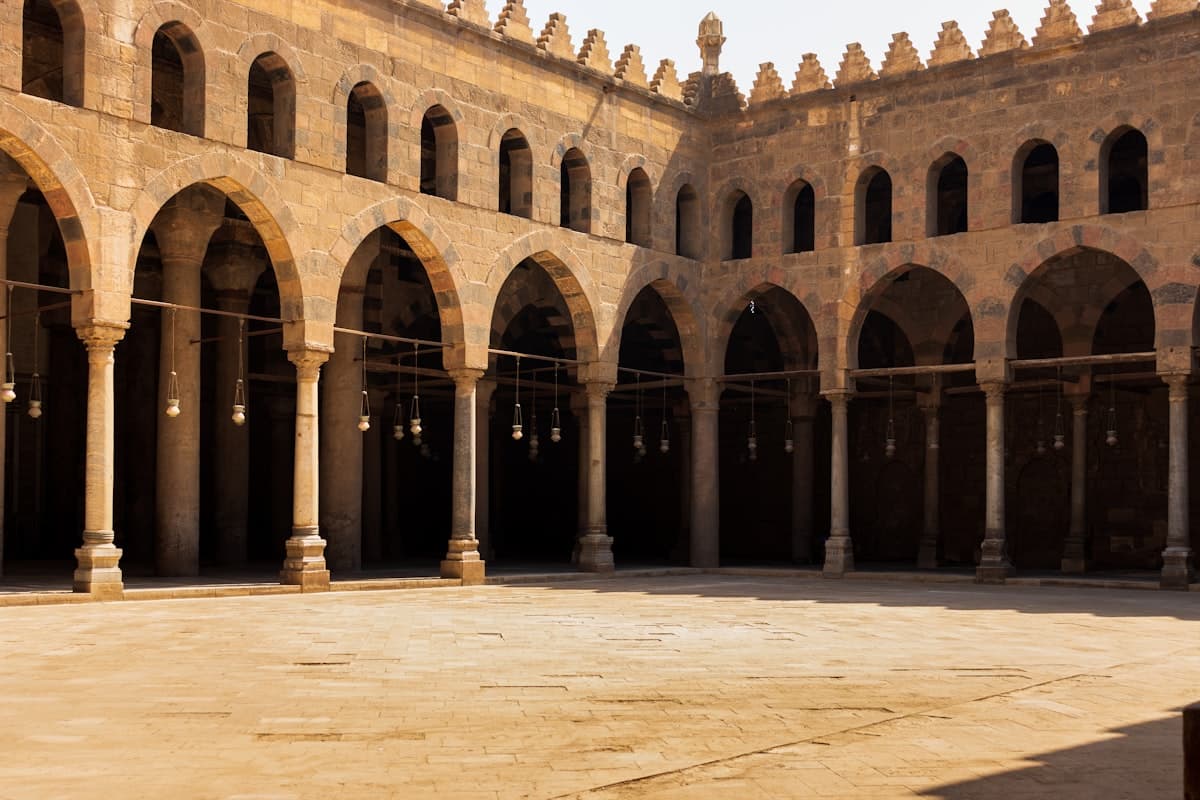
When Sultan Barquq built the first Mamluk khanqah in Cairo in 1384, he staffed it partly with Sufi scholars who had fled Tamerlane's destruction of Syrian cities. This was the medieval pattern: Cairo as refuge and continuation for Syrian intellectual and commercial life disrupted by war. The Ibn Khaldun connection runs deeper than most visitors realize. The great historian and sociologist spent the last years of his life in Cairo, arriving from the Maghreb via a Syria already under pressure. He is buried in a small tomb near the northern Fatimid wall that almost no one visits.
The Fatimid caliphs who founded Cairo in 969 CE were themselves from Ifriqiya, but they modeled their new city partly on the commercial logic of Aleppo's covered markets. The architectural form of the wakala, the caravanserai-style trading hall that dominates medieval Cairo, arrived from Syria. Wakala el-Ghouri, built in 1504 near al-Azhar, is the best preserved of these in Cairo and still hosts artisan workshops on its upper floors. The ground floor once housed Syrian merchants trading in spices, textiles, and glass. The Venetians who traded in Cairo called these buildings the fondaco, and considered the Syrian merchants inside their most reliable intermediaries.
The current Syrian community history guide to Cairo is therefore not purely a refugee story, though that dimension is real and recent and should be understood clearly.
The Old City: Mamluk Trade Routes and Syrian Stone
Walk from Bab Zuweila north toward al-Azhar on the street called Muizz li-Din Allah. This was Cairo's medieval spine, the processional and commercial artery of Fatimid and then Mamluk Cairo. Every significant building you pass, the Palace of the Amir Bashtak, the Madrasa of Sultan Hassan, the Madrasa of al-Nasir Muhammad, carries Syrian influence in some material or structural form. The stone itself is often Syrian limestone, quarried near Beni Suef but worked in techniques brought from Aleppo and Damascus.
At the Mosque of al-Muayyad Sheikh, completed in 1421, look at the bronze doors. They were taken directly from the Sultan Hassan Mosque and installed here by the new sultan as a statement of legitimacy. The craftsmen who made the originals were almost certainly Levantine. The mother-of-pearl inlay technique visible on the interiors of several Mamluk mosques along this street was a Syrian specialty. Cairo absorbed it so completely that most Egyptians today consider it locally native.
Khan el-Khalili itself, the famous bazaar built in 1382 by Emir Jaharks el-Khalili, was designed specifically as a transit hub for the Levantine spice trade. The original caravanserai provided lodging and warehousing for merchants from Damascus, Aleppo, and Homs. The coffeehouse culture that makes Khan el-Khalili distinctive today, the slow tea, the backgammon, the extended negotiation, comes directly from that Syrian commercial inheritance.
The Syrian community in Egypt did not simply pass through this space. They shaped the commercial and social grammar of it.
What Most Visitors Walk Past
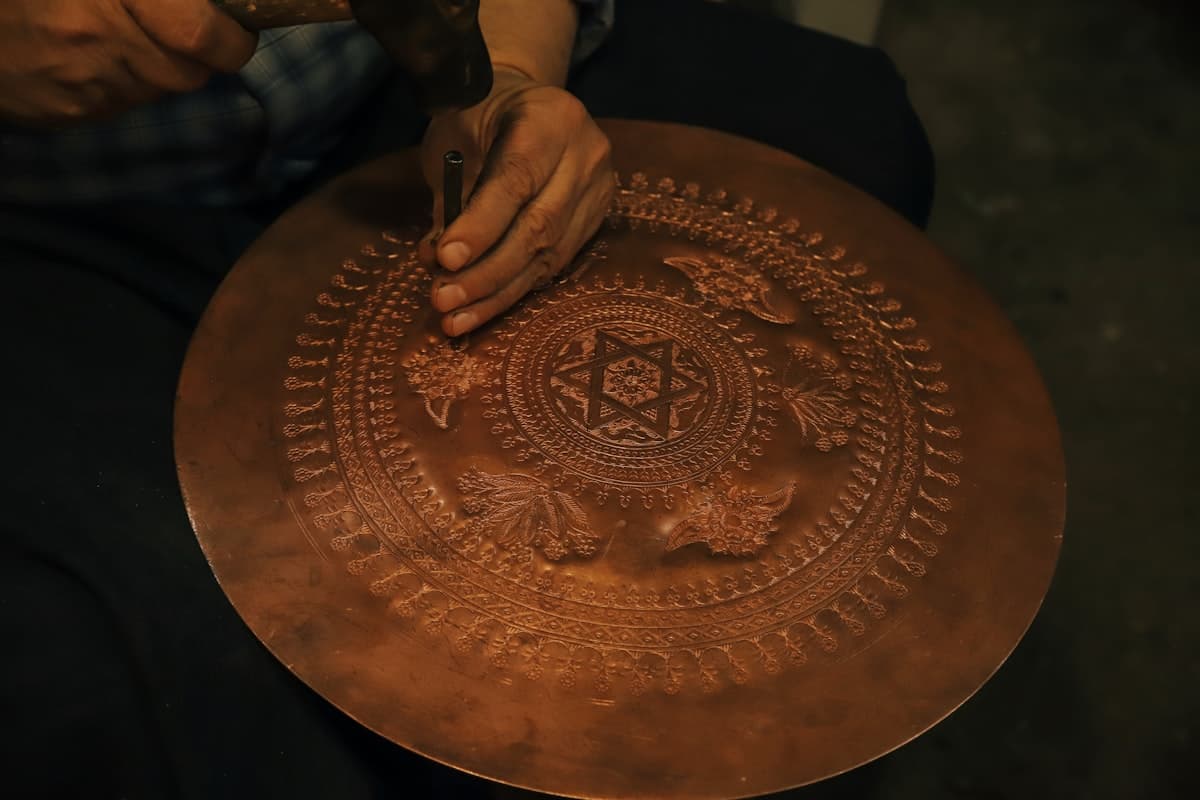
Behind the main Khan el-Khalili tourist street, in the gold and copper alleys that run toward Muski, there are still family workshops descended from Levantine artisan lineages. Copper engraving using a technique called tarsia, which involves inlaying different metals into a base plate, arrived in Cairo from Syria in the fourteenth century. You will find old men still practicing this in the narrow passage called Sikket el-Badistan, off the main bazaar. They rarely speak to tourists because tourists rarely find them. Go in, ask to watch, buy something small. The work takes hours per square centimeter.
Modern Cairo and the Syrian Presence
Mohandiseen, the upper-middle-class district west of the Nile, has absorbed successive waves of Arab migration since the 1960s. Gulf Arab professionals arrived in the 1970s and 1980s. Iraqi families came after 2003. Syrians began arriving in significant numbers after 2011, and they concentrated in Mohandiseen and the adjacent Agouza district partly because the existing Arab social infrastructure made integration marginally easier.
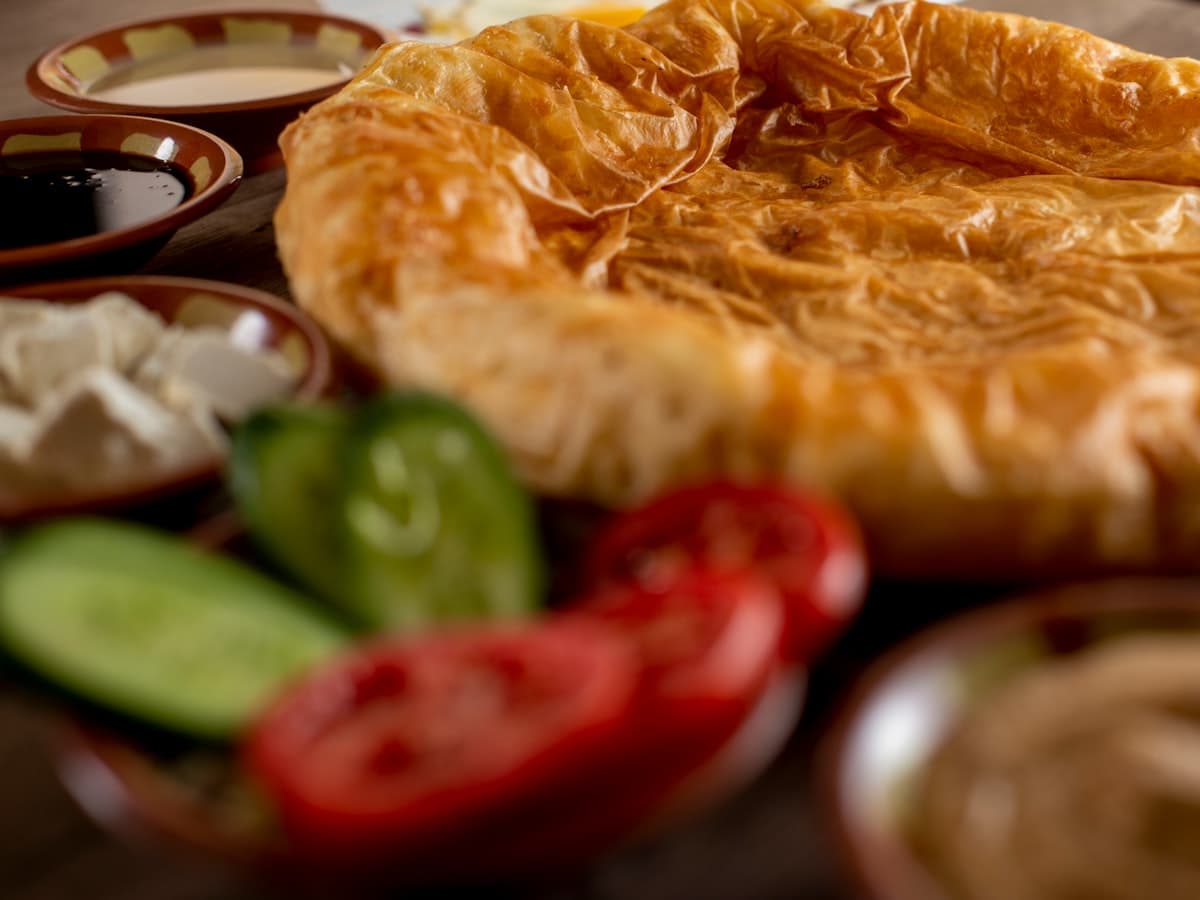
The restaurants are the most visible marker, and they are genuinely worth seeking out rather than simply acknowledging. Syrian food in Cairo is not the same as Syrian food in Damascus because it has adapted to Egyptian supply chains and Egyptian palates, which prefer less sourness and more cumin. But the kibbeh nayyeh at a handful of Mohandiseen restaurants is made with a fatness ratio and seasoning that has no Egyptian equivalent. The muhammara, a roasted red pepper and walnut paste, is a Syrian dish that has almost no Egyptian cognate and that you should order wherever you see it.
Nasr City, east of downtown, has a different Syrian demographic: more working-class, more recently arrived, denser. The Syrian sweet shops here, selling knafeh, barazek, and maamoul at prices calibrated to people living on remittances, are operating at a quality level that embarrasses the tourist-facing pastry shops in Zamalek. A tray of thirty barazek, the sesame and pistachio shortbreads that are Damascene in origin, costs around EGP 120 in Nasr City. The same quantity at a hotel patisserie in downtown would be EGP 450.
Syrian community institutions are less visible but present: cultural associations, informal Arabic language preservation schools for children born in Egypt, community radio, and a significant informal economy of freelance translators, designers, and tech workers who arrived with professional skills and rebuilt their careers inside Egyptian companies or remotely.
The Connections
The mosque of Ibn Tulun, built between 876 and 879 CE by Ahmad ibn Tulun, a Turkic governor sent from the Abbasid court in Baghdad, is the oldest mosque in Cairo to survive in its original form. Ibn Tulun was born in Baghdad but his architectural model was Samarra, the Abbasid city in what is now Iraq. The mosque's famous spiral minaret is directly borrowed from the Great Mosque of Samarra. But the workers who built Ibn Tulun were overwhelmingly Levantine: craftsmen, masons, and stucco workers from the Syrian provinces of the Abbasid caliphate.
This is the pattern Cairo repeats across fifteen centuries. The city absorbs Levantine human capital during Syrian disruption and incorporates it so thoroughly that later generations forget the seam. The stucco panels at Ibn Tulun, which UNESCO considers among the finest examples of early Islamic geometric ornament in the world, were made by craftsmen from what is now Syria and Lebanon. They are now simply Egyptian.
The Coptic community has its own thread in this connection. Coptic Christians and Syrian Christians share liturgical elements that trace back to the early church in Antioch, the Syrian city that was Christianity's first named community. The Coptic Museum at Fustat, which costs EGP 200 and requires two hours minimum, holds textiles and manuscripts that show continuous exchange between the Egyptian and Syrian church communities from the third century onward.
Common Mistakes
Treating the Syrian presence as only a refugee story. The post-2011 displacement is real and important, but arriving in Egypt with only that frame means you miss seven centuries of Syrian-Egyptian commercial and cultural entanglement. The food you eat in Khan el-Khalili and the buildings you photograph on Muizz Street both carry that history.
Eating Syrian food only in the tourist-facing restaurants in Zamalek or Garden City. These places are calibrated for expense accounts and foreign journalists. The real Syrian restaurant culture in Cairo is in Mohandiseen, specifically around the streets off Gameat el-Dowal el-Arabia. Prices are lower, portions are larger, and the clientele includes Syrians who know what the food is supposed to taste like.
Skipping the Islamic Art Museum on Port Said Street. This is one of the finest collections of Islamic material culture in the world, holding over 100,000 objects including entire reconstructed interiors from Cairo's Mamluk buildings. It costs EGP 100. The galleries on Mamluk metalwork and Syrian-Egyptian textile exchange are directly relevant to understanding the Syrian community history of Cairo and almost no one connects those dots. Most tourists walk past the building entirely.
The sound and light show at the Citadel costs EGP 250 and explains nothing about the Mamluk period that you will not understand better from simply standing in the Mosque of Sultan Hassan for thirty minutes in silence. Skip the show. The mosque is free with your Citadel ticket and the acoustic quality of the interior, an enormous echoing stone cube, tells you more about Mamluk power and ambition than any theatrical narration.
Assuming the Syrian community is concentrated only in specific districts. Syrian-owned businesses operate across Cairo, from auto repair shops in Imbaba to graphic design studios in New Cairo. The concentration in Mohandiseen and Nasr City is real but partial. The community is more diffused, and more integrated into Cairo's commercial fabric, than the refugee-neighborhood narrative suggests.
Not visiting on a weekday morning. Muizz Street on a Friday afternoon is tourist gridlock. On a Tuesday at 8am, you share it with schoolchildren and shopkeepers opening their stalls. The light is better, the noise is lower, and the shopkeepers have time to tell you things.
Practical Tips
Dress conservatively in the old city neighborhoods. This is not a security issue; it is a hospitality issue. Women in sleeveless tops in the alleyways behind Khan el-Khalili will receive a different quality of interaction than women with covered shoulders. Men in shorts are technically fine but will be read as obviously tourist, which affects prices in untagged shops.
Learn five words of Levantine Arabic before you go, not Egyptian Arabic. If you are visiting Syrian-owned spaces, the greeting ahlan wa sahlan in a Syrian accent opens more doors than a perfect Egyptian salam. Syrians in Cairo often code-switch between dialects depending on who they are talking to. Acknowledging that distinction is a small act of respect that will be noticed.
For the medieval quarter, hire an independent guide through the Egyptian Tourist Authority office at Attaba rather than through a hotel concierge. The concierge guides are on commission from shops. The ETA guides cost EGP 200 to 300 for two hours and some of them have worked the Muizz Street corridor for decades. Ask specifically for a guide who knows the Mamluk commercial history, not just the monuments.
Carry cash in small denominations. The Syrian sweet shops in Nasr City do not take cards. Neither do the copper workshops in Sikket el-Badistan. EGP 50 and EGP 100 notes are the practical currency of both neighborhoods.
If you want to understand the contemporary Syrian community in Egypt with any depth, look for the periodic cultural events organized through the Townhouse Gallery in downtown Cairo or the Darb 1718 cultural center near the Fustat ruins. Both venues have hosted Syrian artists, writers, and musicians in recent years. The programming is inconsistent but when it happens, it is a direct window into a community that is actively creating, not only surviving.
Frequently Asked Questions
The Weekly Dispatch
More on Egypt, every Friday.
Cultural depth and places most guides never mention.
No spam. Unsubscribe anytime.