Syrian Community Egypt History Guide: Cairo's Living Arab Quarter
Syrians have been reshaping Cairo since the 7th century. The neighborhood that proves it isn't a refugee camp. It's a 1,400-year-old conversation.

Quick Facts
- Best time to visit
- October through April for comfortable walking temperatures. Ramadan evenings are lively in Syrian-owned sweet shops and restaurants, making them a particularly good time for the Nasr City portion of this itinerary.
- Entrance fee
- Fatimid quarter streets: free. Wikala al-Ghouri interior: EGP 60 (approx $1.20 USD). Al-Azhar Mosque: free. Thursday evening whirling dervish performance at Wikala al-Ghouri: EGP 150 (approx $3 USD).
- Opening hours
- Wikala al-Ghouri daily 9am to 5pm. Al-Azhar Mosque to non-Muslim visitors approximately 9am to 4pm outside prayer times. Nasr City Syrian restaurants and shops noon to midnight most days, some open from 10am.
- How to get there
- Metro Line 1 to Al-Shohadaa (Ramses) for the Fatimid quarter, then 15-minute walk. Uber from Downtown Cairo EGP 50 to 80. For Nasr City, Uber from central Cairo EGP 60 to 90, or microbus from Ramses for EGP 5.
- Time needed
- Fatimid quarter historical walk: 3 to 4 hours minimum. Full Syrian Cairo day combining history, Nasr City, and dinner: 8 to 10 hours. Two days allows proper depth without rushing.
- Cost range
- Budget EGP 300 to 600 per day including food, transport, and site entries. Mid-range EGP 1,000 to 2,000 if adding a private guided walk and a longer sit-down meal at a Syrian restaurant.
There are an estimated 1.5 million Syrians in Egypt today, making it one of the largest Syrian populations outside Syria itself. Most articles about them begin in 2011. That is the wrong starting point by about 1,300 years.
The Syrian presence in Egypt is not a crisis story. It is one of the oldest continuous migration stories in the Arab world, layered into Cairo's streets, its food, its Sufi orders, its textile trade, and its mosques in ways that most Cairenes could not fully untangle even if they tried. This guide is about all of it: the medieval Levantine merchants who built warehouses in Fatimid Cairo, the Syrian scholars who shaped Al-Azhar's early theology, the waves of 19th and 20th century Syrian-Lebanese immigration that gave Cairo its publishing industry, and the more recent arrivals who have opened restaurants in Nasr City and Obour and quietly become part of the city's fabric. To understand the Syrian community in Egypt today, you need to walk the old city with a longer memory.
Quick Facts
Best Time to Visit: October through April, when Cairo temperatures are manageable and outdoor market walking is possible. Ramadan evenings are particularly alive in Syrian-owned restaurants and sweet shops.
Entrance Fees: The neighborhoods themselves are free to walk. Khan el-Khalili and the surrounding Fatimid quarter require no ticket. Specific mosques along the route: Mosque of al-Hakim bi-Amr Allah, free. Al-Azhar Mosque, free (modest dress required). Wikala al-Ghouri, EGP 60 (approx $1.20 USD).
Opening Hours: Wikala al-Ghouri daily 9am to 5pm. Al-Azhar Mosque open to non-Muslim visitors outside prayer times, roughly 9am to 4pm. The food markets and sweet shops of Nasr City operate from noon to midnight most days.
How to Get There: Cairo Metro Line 1 to Al-Shohadaa (Ramses) station, then a 15-minute walk into the Fatimid city. Taxi from Downtown Cairo approximately EGP 50 to 80. Uber from Zamalek or Garden City, EGP 80 to 120. For Nasr City's Syrian commercial strip on Abbas el-Akkad Street, take a microbus from Ramses for EGP 5 or Uber for EGP 60 to 90.
Time Needed: The Fatimid quarter historical walk, 3 to 4 hours. A full Syrian Cairo day combining history, Nasr City, and dinner, 8 to 10 hours.
Cost Range: Budget EGP 300 to 600 per day including food and transport. Mid-range EGP 1,000 to 2,000 if adding guided context and a longer meal.
Why This Place Matters
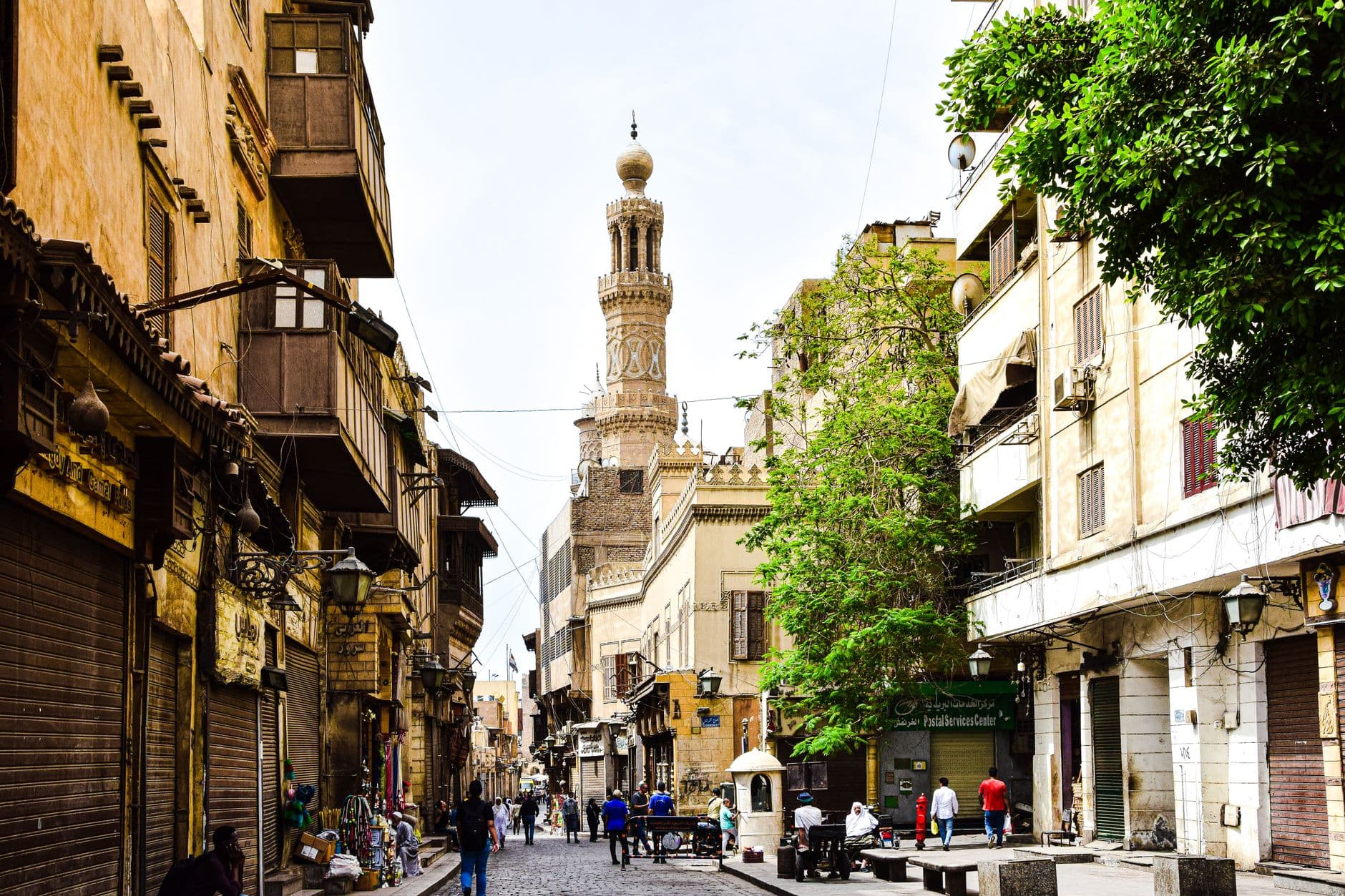
When the Fatimid general Jawhar al-Siqilli founded Cairo in 969 CE, the city he built was designed to be a Shia imperial capital, sealed off from the older, Sunni merchant city of Fustat to the south. Within a generation, the Fatimids needed to open it up, because trade required outsiders. Among the first merchant communities to establish a foothold in the new city were Levantine traders, many from what we now call Syria, who had been working the Egypt route since the Umayyad period. They brought with them spices, silk, and glass, and they built the first wakalat, the fortified caravanserais that combined warehouse, hostel, and commercial exchange under one roof.
The Wikala al-Ghouri, built in 1504 by the last significant Mamluk sultan before the Ottoman conquest, is the best-preserved example of this system in Cairo. It was used extensively by Syrian and Levantine merchants for over three centuries. The Mamluks themselves, who ruled Egypt from 1250 to 1517, had deep and complicated ties to Syria: their sultans governed both Egypt and greater Syria as a single political unit, and Damascus and Cairo were connected by a courier relay system so efficient that a message could travel between them in four days.
That integration meant that Syrian scholars, craftsmen, merchants, and mystics were not migrants in the modern sense. They were moving within a single political world. Many of the scholars who shaped Al-Azhar's curriculum in its early centuries were trained in Damascus or Aleppo. The theological arguments that split Al-Azhar in the 12th century were partly imported disputes from Syrian madrasas.
The Fatimid Quarter: What You Are Actually Walking Through
The street now called al-Muizz li-Din Allah, the main spine of the old Fatimid city, was once lined with the workshops and residences of craftsmen organized by origin and trade. Syrian glassblowers clustered near what is now the copper market. Levantine textile merchants occupied the northern section near Bab al-Futuh. These were not temporary arrangements. Some of these commercial families maintained Cairo branches for five or six generations.
At the northern gate, Bab al-Nasr, you can still see 11th-century Fatimid stonework that was reinforced by Syrian engineers brought in specifically for the project. The mason's marks on the interior walls use a system of notation that was standard in Syrian military architecture but not in Egyptian building traditions of the period. Scholars noticed the discrepancy in the 1940s. It confirmed what the administrative records already suggested: the Fatimids imported technical expertise from the Levant at a systematic scale.
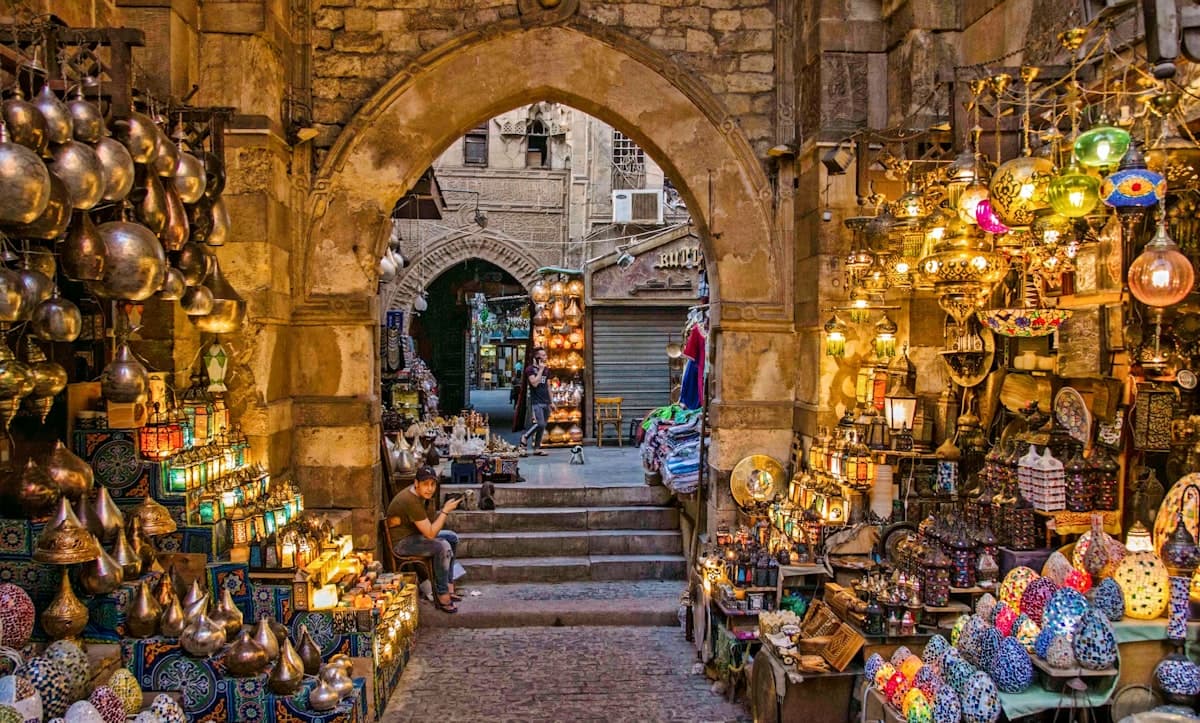
Walk south from Bab al-Nasr toward Khan el-Khalili and you pass the site of what was, in the 13th century, the main wikala for Aleppan merchants. The current building is Ottoman, reconstructed after the Mamluk original burned in 1382. Inside Khan el-Khalili itself, the layout of the market still reflects the guild organization that Syrian and Egyptian merchants negotiated together under Mamluk regulation. Perfume sellers, spice dealers, and goldsmiths occupy roughly the same zones they have occupied for 600 years. The spice trade in particular was a Levantine specialty: many of the families who controlled the Cairo end of the spice route in the 15th century had family branches in Aleppo and Homs.
What Most Visitors Walk Past
Inside the mosque-madrasa complex of Sultan al-Ghouri, there is a khanqah, a Sufi lodge, attached to the main structure. The Sufi orders that used it in the 16th and 17th centuries included the Shadhiliyya, a brotherhood that traced its founding to a Moroccan mystic but took much of its intellectual shape from Syrian scholars in Alexandria and Cairo. The relationship between Egyptian and Syrian Sufism is long and dense, and it is not fully appreciated by visitors who see the whirling dervish show at Wikala al-Ghouri on Thursday evenings without knowing that some of the tariqa traditions performed there were transmitted through Syrian chains of spiritual lineage.
The whirling dervish performance costs EGP 150 and runs roughly 90 minutes. It is genuinely worth attending if you understand what you are seeing. It is not worth attending if you expect spectacle alone.
The 19th and 20th Century Wave: Syrians Who Built Modern Cairo
The second major chapter of Syrian presence in Egypt began in the 1860s and accelerated through the early 20th century. This wave was predominantly Christian, mostly Greek Orthodox and Maronite families from Mount Lebanon and the Syrian interior, fleeing Ottoman taxation, sectarian violence after the 1860 massacres in Damascus and Lebanon, and looking for the economic opening that Khedive Ismail's modernizing Cairo represented.
They found it. Syrian-Lebanese immigrants, often listed in Egyptian records simply as "Shawam" (people of greater Syria), dominated the Cairo press by the 1890s. Jurji Zaydan, born in Beirut, founded al-Hilal magazine in Cairo in 1892. It became the most influential Arabic-language cultural publication of the 20th century and is still published today from the same city, making it one of the oldest continuously running Arabic magazines in the world. The publishing industry that Zaydan and his contemporaries built in Cairo became the intellectual infrastructure of the entire Arab Nahda, the cultural renaissance that shaped modern Arab identity.
Farouk Hosni, Egypt's longest-serving minister of culture, has spoken about how the Cairo publishing world his generation inherited was still structured around categories and editorial traditions that Syrian immigrants had established decades earlier. The Cairo Book Fair, now the largest in the Arab world, traces its institutional DNA partly to that Shawam publishing moment.
On Sherif Street in Downtown Cairo, several of the old publishing houses and literary cafes associated with this era still have facades intact, though most interiors have been converted. The building at number 42 Sherif was occupied for decades by a Damascene bookseller family whose descendants still run a smaller shop in the same district.
The Connections: Cairo's Syrian Geography Today
The current Syrian community in Egypt, which expanded sharply after 2011, has created new geography on top of the old. Nasr City, particularly the stretch of Abbas el-Akkad Street and the surrounding residential blocks of the Eighth and Tenth Districts, is now dense with Syrian restaurants, sweet shops, textile wholesalers, and professional services. The halawiyat, the Syrian pastry shops, serve knafeh, baklawa, and maamoul in styles distinct from their Egyptian equivalents. Locals will tell you the Syrian version uses more orange blossom water. Syrian bakers in Obour City supply flatbread to Egyptian households who prefer the thinner, more charred Syrian style to local baladi bread.
This is not the first time Syrian food changed Cairo. Levantine culinary influence on Egyptian urban cooking in the 19th century is documented in cookbooks from the Khedival period that describe dishes labeled "shamiyyah" (of Syria) that have since been absorbed into generic Egyptian identity. The stuffed grape leaves Cairenes consider entirely their own arrived via the same Shawam immigrant networks.
For a direct connection between the historical and contemporary Syrian presence, walk al-Muizz on a Friday morning, then take an Uber to Abbas el-Akkad for lunch. The distance is 8 kilometers. The historical continuity is 1,400 years.
Common Mistakes
Starting in 2011. Every guide to Syrians in Egypt frames the story as a refugee crisis. That framing is not wrong, but it erases the medieval and 19th-century chapters that explain why Egypt was a logical destination to begin with. Come with the longer story already in your head.
Treating Nasr City as a monolith. The Syrian community in Nasr City is not uniform. There are Aleppan families, Damascene families, communities from Deir ez-Zor and Homs and the coast. The food, the dialect, and the social networks differ. Ask the restaurant owner where they are from. The conversation will go somewhere interesting.
The sound and light show at the Citadel costs EGP 350 and tells you nothing about the Mamluk-Syrian connection that you cannot learn by reading this article or walking al-Muizz with a decent map. Skip it and spend that money on dinner at a Syrian restaurant in Nasr City instead.
Visiting Khan el-Khalili at midday in summer. The spice market is real and functional. The gold market is real and functional. But at 1pm in July, neither is navigable without significant discomfort, and the merchants are less inclined toward the longer conversations that make the visit worth having. Go at 9am or after 4pm.
Skipping the Wikala al-Ghouri interior. EGP 60 is nothing. The courtyard is one of the best-preserved examples of Levantine commercial architecture in Cairo and almost nobody goes inside. The Thursday evening performance draws crowds; the building during the day does not.
Assuming the food is the whole story. Syrian Cairo is also a story of publishing, Sufi theology, Mamluk administration, and architectural exchange. The knafeh is excellent. Eat it. But go to Wikala al-Ghouri first.
Not reading Jurji Zaydan before you come. His historical novels, set in various periods of Arab and Islamic history, were written in Cairo about a world that connects Egypt and Syria. Several are translated into English. Reading one on the plane gives you a frame that no walking tour can provide.
Practical Tips
For the Fatimid quarter walk, wear shoes you can remove easily. Several of the mosques require it, and the marble floors are cold in winter and genuinely slippery in places. Bring a scarf regardless of gender. Women should cover hair inside mosques; men in shorts will be offered a wrap.
The Arabic most useful in Nasr City's Syrian community is a Levantine dialect, not Egyptian Arabic. Egyptians will sometimes respond to your Egyptian Arabic with gentle amusement when addressing Syrian shopkeepers, who will appreciate even a word of Shami greeting.
For a guided walk of the historical Syrian commercial presence in the Fatimid city, Cairo by Foot offers a customizable Fatimid quarter tour that can be oriented toward trade history rather than monument history if you ask specifically. Cost approximately EGP 800 to 1,200 for a private two-hour walk.
If you want to understand the contemporary community more directly, the Tahrir Institute for Middle East Policy has published detailed demographic and social research on Syrians in Egypt that is freely available online. Reading it before you arrive is more useful than any walking tour for the post-2011 chapter.
Frequently Asked Questions
The Weekly Dispatch
More on Egypt, every Friday.
Cultural depth and places most guides never mention.
No spam. Unsubscribe anytime.