The Italian Community of Alexandria: A Vanished World
At its peak, Alexandria had 100,000 Italian residents. Today, fewer than 200 remain. Their palazzos still stand. Most Alexandrians walk past them without knowing.

Quick Facts
- Best time to visit
- October to April. The Mediterranean climate is mild, crowds are lower than summer, and the city's street life is at its best. March and April bring a particular clarity of light.
- Entrance fee
- Most sites free. Bibliotheca Alexandrina EGP 60 (approx $1.25 USD). Latin Cemetery by appointment, no charge. Cathedral of Saint Catherine free.
- Opening hours
- Saint Catherine's Cathedral daily 8am to 12pm and 3pm to 6pm. Bibliotheca Alexandrina Sunday to Thursday 9am to 5pm, Friday and Saturday 12pm to 4pm. Latin Cemetery Sunday mornings by advance appointment.
- How to get there
- From Cairo: Egyptian National Railways from Ramses Station to Alexandria Sidi Gaber or Misr Station, EGP 95 to 160 first class, journey 2 to 2.5 hours. Within Alexandria: all main sites within 2km of Raml Station, walkable. Tuk-tuks EGP 10 to 20 per trip.
- Time needed
- Half day for the core Italian community sites. Full day to combine with Greek and Jewish community sites for a complete cosmopolitan Alexandria picture.
- Cost range
- Budget EGP 400 to 700 per day including transport, food, and incidentals. Mid-range EGP 1,200 to 2,000 per day with private driver and sit-down meals.
At its peak in the 1920s, Alexandria held more Italian citizens than any African city outside of the colonial territories. One hundred thousand of them. They owned the pastry shops, ran the cotton exchanges, built the cathedrals, composed the local opera seasons, and died in the city's sandy soil with Italian names carved into Greek-Orthodox cemetery headstones. Today, fewer than two hundred remain. The community did not leave all at once. It unraveled across four decades of revolution, nationalization, and political pressure, ending in a quiet diaspora that scattered to Rome, Milan, and Buenos Aires. What they left behind is still here if you know how to look.
Quick Facts
Best time to visit: October to April. Alexandria's Mediterranean winters are mild and the city feels like itself again after the summer crowds. Avoid July and August when heat and humidity combine unpleasantly.
Entrance fees: Most sites connected to the Italian community are churches, cemeteries, and streetscapes, so entry is largely free. The Latin Cemetery charges no admission. The Greek Catholic Cathedral of Saint Catherine is free to enter. The Biblioteca Alexandrina, relevant for its archives on the cosmopolitan era, charges EGP 60 (approx $1.25 USD) for general admission.
Opening hours: Saint Catherine's Cathedral opens daily 8am to 12pm and 3pm to 6pm. The Latin Cemetery is accessible Sunday mornings and requires advance contact with the custodian through the Franciscan mission at +20 3 487 0425. The Bibliotheca's archive research rooms operate Sunday to Thursday 9am to 5pm.
How to get there: From Cairo, take the Egyptian National Railways train from Ramses Station to Sidi Gaber or Misr Station in Alexandria. First-class tickets cost EGP 95 to 160 depending on the train. From central Alexandria, the sites cluster around the Raml Station area and the Attarine district, all walkable within a 2km radius. Tuk-tuks will cover any gap for EGP 10 to 20.
Time needed: A focused half-day covers the main Italian-community sites. A full day allows you to add the Jewish Quarter, the Greek Club, and the corniche neighborhoods that complete the cosmopolitan picture.
Cost range: Budget EGP 400 to 700 per day including transport and food. Mid-range EGP 1,200 to 2,000 per day with a guided walk and a meal at one of the old-style Alexandrian cafes.
Why This Place Matters
Alexandria was never an Egyptian city in the narrow sense. From its founding by Alexander in 331 BC, it was designed as a meeting point between Mediterranean civilizations, a port that faced north toward Greece and Rome rather than south toward the Nile. By the late nineteenth century, that cosmopolitan logic had reasserted itself in a new form. The 1882 British occupation opened Egypt to European capital, and the Italians arrived in significant numbers, not as colonizers with a government behind them but as traders, craftsmen, lawyers, and doctors who built private lives in a private city.
The Italian community in Alexandria had a particular character that separates it from other European presences in Egypt. The French held political influence through their alliance with Egyptian elites and their control of the Suez Canal Company. The British held administrative power. The Greeks dominated the cotton trade and the cafe culture. The Italians occupied a different register: they were the builders, literally. Scan the facades on Fouad Street, the old Via Rosetta, and you will see their neoclassical imprint on nearly every block. The firm of Lasciac and Avoscani, led by the Triestine architect Antonio Lasciac, designed buildings across Alexandria and Cairo between 1882 and 1920. Lasciac eventually became chief architect of the Egyptian royal Khedival court.
The community also produced something unexpected: a hybrid literary culture. Giuseppe Ungaretti, one of the most important Italian poets of the twentieth century and a key figure in Italian modernism, was born in Alexandria in 1888 to a family from Lucca. He spent his first twenty-four years here, and critics have argued that the quality of light he describes in his sparse, imagistic poetry is specifically Alexandrian, the particular bleached gold of morning on the Mediterranean. He died in Milan in 1970, but his birth certificate is Alexandrian.
What Survives: The Buildings and the Street Grid
The most honest answer to the question of what the Italian community left behind is: architecture, cemeteries, and the street logic of the city center. Walk from Raml Station west along Fouad Street and you are moving through a city that Italians largely designed. The proportions are Roman. The window moldings are northern Italian. The ground-floor arcades, which keep the sun off the pavement and make Alexandria genuinely pleasant to walk in summer, were modeled on the Bolognese porticoes that Lasciac knew from before his emigration.
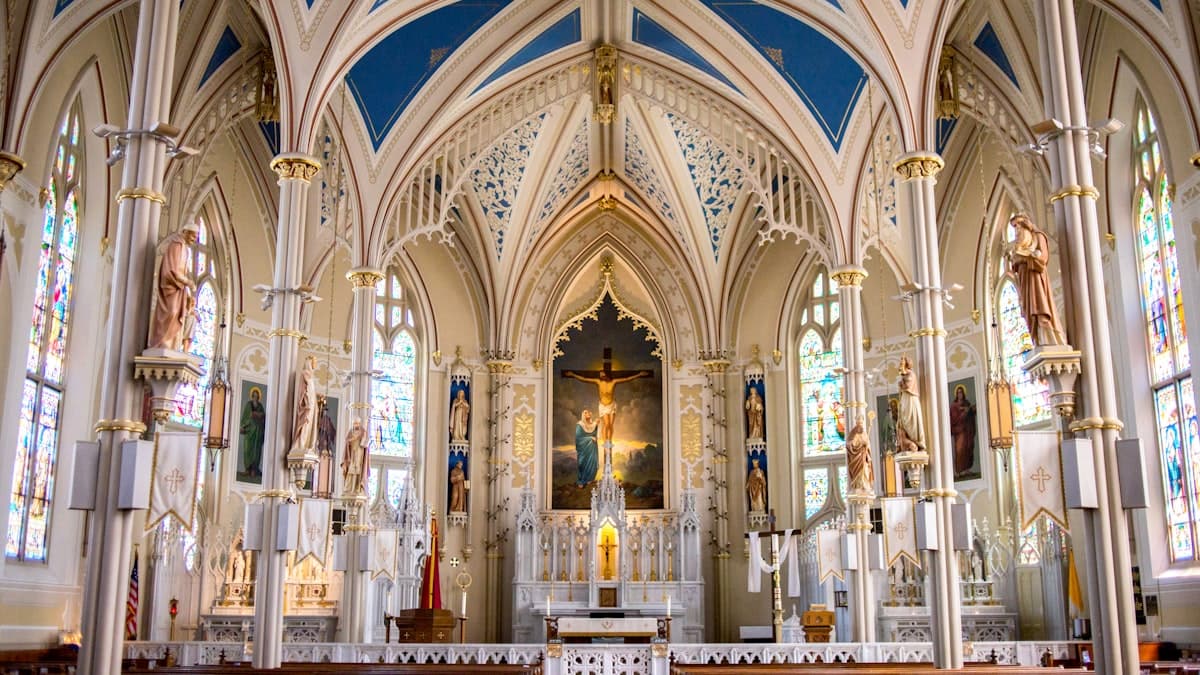
The Cathedral of Saint Catherine of Alexandria deserves more attention than it typically gets. Built in 1847 under the patronage of the Catholic community with significant Italian funding, it replaced a smaller eighteenth-century church that had served the Franciscan mission present in Alexandria since the Crusader period. The current building's interior holds a painting cycle by the Bolognese artist Luigi Mussini completed in 1862. Most visitors, if they enter at all, spend four minutes and leave. The painting of the saint's martyrdom in the apse uses a Nile background that is specific to Egyptian Catholic iconography: saints placed in recognizable local landscapes to make doctrine feel local.
The Attarine district, named for the perfume merchants who still operate there, was the center of Italian commercial life from roughly 1880 to 1940. Today it is an antique market of genuine quality. The furniture being sold out of ground-floor workshops sometimes comes directly from the villas of families who left in the 1960s, hauled into storage by Egyptian buyers and now re-emerging as vintage. If you know what Italian Liberty-style furniture looks like, pieces appear here at a fraction of European prices.
The Cemetery Evidence
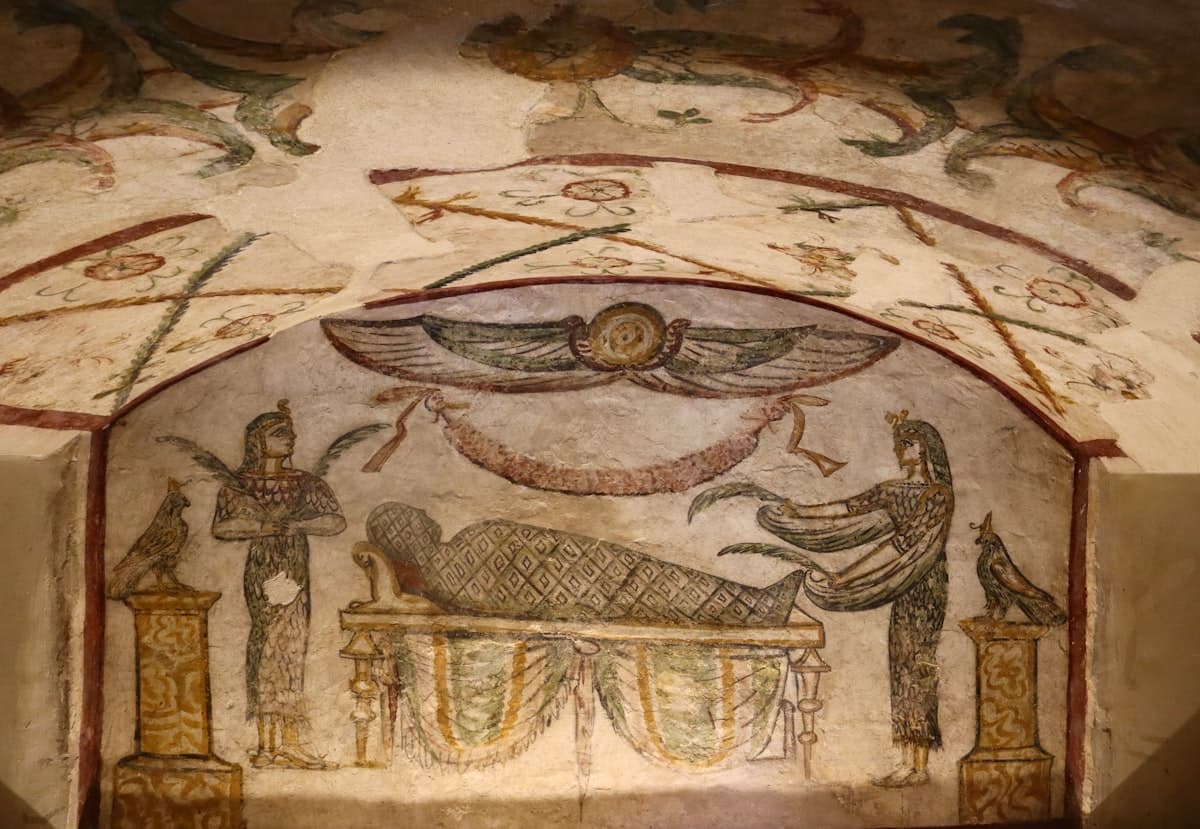
The Latin Cemetery on the edge of the Shatby district is where the Italian community history becomes visceral and undeniable. It shares a wall with the Greek Orthodox cemetery and the Jewish cemetery, that proximity being entirely deliberate: Alexandria's cosmopolitan era produced a city where communities lived together and, eventually, were buried together in adjacent ground.
The Italian section contains roughly 3,000 graves spanning 1840 to 1970. The headstones read like a ship manifest: Morpurgo, Castellani, De Martino, Ricci, Aghion (that last name Sephardic Jewish but Italian-speaking, the layered identity of Alexandria made literal in marble). The craftsmanship of the funerary sculpture is exceptional. Several tombs were carved by Alexandrian workshops trained in the Italian tradition, producing weeping angels and classical draped figures of a quality that would not embarrass a Roman churchyard. The best is the Bustros family tomb from 1909, which features a bronze door with relief panels depicting the deceased's commercial life: cotton scales, a ship's wheel, the facade of their Fouad Street building.
The cemetery is not maintained to European standards, and that is honestly part of the point. Visiting it requires some tolerance for overgrown paths and heat. But no other site in Alexandria makes the Italian community history guide feel as real, because here you have specific people with specific dates, not abstracted history but individual lives that began in Tuscany or Calabria and ended in the African sand.
The Connections
Alexandria's Italian community did not exist in isolation from Egypt's longer history, and the temptation to treat it as a purely European story inserted into Egypt misses the point entirely. The cotton economy that funded Italian prosperity in Alexandria was built on land irrigated by Muhammad Ali's canal system, constructed between 1817 and 1820 using a labor corvee that conscripted Egyptian peasants. The wealth that paid for the Italian-designed facades on Fouad Street was extracted from the Delta and moved through Alexandrian ports that the British controlled. The Italians were a middle layer in a complex system.
The connection goes backward, too. The Franciscan mission that preceded the nineteenth-century Italian community had been present in Alexandria since 1219, when Francis of Assisi himself reportedly met Sultan Al-Kamil during the Fifth Crusade. The mission maintained a church through the Mamluk and Ottoman periods, surviving through diplomatic accommodation and commercial usefulness. The same location that became the Cathedral of Saint Catherine in 1847 had been a Franciscan chapel since at least the sixteenth century. Layer underneath that: the site sits on what was, in Ptolemaic Alexandria, a residential district near the royal quarter.
The Greek connection is equally important. Many Italian families in Alexandria had been in the eastern Mediterranean for generations before arriving in Egypt, passing through Smyrna or Thessaloniki, intermarrying with Greek families, and arriving in Alexandria already partially Levantine. The sharp Italian-versus-Greek distinction that European visitors imposed on the community was blurrier on the ground.
Common Mistakes
Confusing the Corniche nostalgia with actual history. The Cecil Hotel, where everyone poses for photographs and quotes Lawrence Durrell, was not primarily an Italian institution. It was Greek-owned, later British-patronized. Durrell's Alexandria quartet romanticizes a world the Italians were part of but did not center. Treat the Cecil as atmosphere, not evidence.
Skipping the cemeteries because they seem morbid. The Latin Cemetery is the single most concentrated repository of Italian community material culture in Alexandria. The churches have been altered, the homes are divided apartments, the cafes are other businesses now. The cemetery is unchanged. Go.
Hiring a general Alexandria tour guide. Most licensed guides in Alexandria specialize in Greco-Roman and Pharaonic history because that is what the majority of tourists want. For the cosmopolitan era, contact the Alexandria Preservation Trust or reach directly to researchers at the Bibliotheca Alexandrina's Centre for Documentation of Cultural and Natural Heritage, which has assembled oral history archives from families of the cosmopolitan period.
The sound and light show at the Roman Amphitheater costs EGP 300 and is completely unrelated to the Italian community or the cosmopolitan era. It covers Pharaonic themes with a production value that does not justify the price. Skip it in favor of an evening walk along the corniche from Stanley to Sidi Bishr, which costs nothing and covers the residential neighborhoods where Italian families actually lived.
Visiting only Fouad Street. The Italian footprint extends into Moharrem Bey, the neighborhood behind the main railway station, where the working-class Italian community lived in apartment blocks that are architecturally plainer but humanly more interesting than the grand commercial facades.
Expecting the Bibliotheca Alexandrina to be a living archive of this history. The Bibliotheca is spectacular as a building and institution. Its permanent collection on Alexandria's cosmopolitan period is thin. The serious archival research happens in the Documentation Centre's back offices, accessible by appointment, not in the main exhibition halls.
Treating Lawrence Durrell as a reliable guide. His books are literature, not ethnography. He arrived in Alexandria in 1941, when the community was already contracting under wartime pressure. What he describes is an elegy, not a portrait.
Practical Tips
Wear shoes you can walk in for four or five hours. The Attarine antique district involves uneven surfaces, narrow passages, and steps that appear without warning. The Latin Cemetery path is gravel and sand.
Bring cash in Egyptian pounds. The Attarine dealers negotiate in EGP and are not equipped for card transactions. ATMs are available at Raml Station and along Fouad Street.
The best single meal near the Italian community sites is at Kadoura fish restaurant near the corniche, open daily from noon. A full meal of grilled sea bass with rice and salad costs EGP 350 to 500 per person. It has nothing specifically to do with Italian history, but it has everything to do with how Alexandria has always eaten: Mediterranean, simple, confident.
If you read Italian or French, the most useful book to carry is Jean-Jacques Luthi's "La Vie Quotidienne en Egypte au Temps des Khedives," available in the Bibliotheca's bookshop. It is dense and specific in a way that no English-language source on the cosmopolitan era quite matches.
Alexandria rewards the traveler who arrives without Cairo's urgency. The city moves differently. The history of the Italian community here is not a list of monuments. It is an atmosphere, a set of proportions, a way that a Mediterranean city organized itself and then, across forty years, forgot what it had been. You are not visiting ruins. You are walking through a city that still does not fully understand what it lost.
Frequently Asked Questions
The Weekly Dispatch
More on Egypt, every Friday.
Cultural depth and places most guides never mention.
No spam. Unsubscribe anytime.