The Italian Community of Alexandria: A Vanished World's Trail
At its peak, Alexandria had 100,000 Italians. Today fewer than 200 remain. The buildings they left behind tell a story most Egyptians have forgotten.

Quick Facts
- Best time to visit
- October to April. Mediterranean humidity and heat make July and August genuinely difficult, and summer crowds from Cairo fill the corniche hotels.
- Entrance fee
- Most Italian-era sites are free (street-level viewing, churches). Graeco-Roman Museum EGP 150 (approx $3 USD). Cavafy Museum EGP 50 (approx $1 USD). Italian Cemetery free.
- Opening hours
- Church of St. Catherine 9am to noon and 4pm to 6pm daily. Graeco-Roman Museum 9am to 4pm, closed Mondays. Latin Cemetery generally accessible daylight hours.
- How to get there
- Talgo high-speed train from Cairo Ramses Station: 2 hours, EGP 150 to 200 (approx $3 to $4 USD). Bus from Turgoman terminal: EGP 70, approx 3 hours. Tuk-tuks within Alexandria: EGP 10 to 20 per short trip.
- Time needed
- Half day for focused Italian quarter walk. Two full days to combine Italian, Greek, Jewish, and Pharaonic layers of the city properly.
- Cost range
- Budget EGP 400 to 700 per day. Mid-range EGP 1,500 to 2,500 per day including corniche-area hotel.
Quick Facts
Best time to visit: October to April, when Mediterranean humidity drops and walking the corniche districts is bearable. Summer in Alexandria is genuinely unpleasant: 90% humidity and crowds from Cairo.
Entrance fees: Most Italian-era buildings are either private property viewed from the street (free), converted to public institutions with their own fees, or churches open without charge during services. The Graeco-Roman Museum, which holds artifacts from the cosmopolitan era, charges EGP 150 (approx $3 USD). The Cavafy Museum in the former apartment of the Greek-Italian poet charges EGP 50 (approx $1 USD) and is one of the most undervisited spaces in the city.
Opening hours: Church of St. Catherine (the Italian Catholic cathedral on Tariq al-Horreya) holds services and is generally open 9am to noon and 4pm to 6pm daily. The Graeco-Roman Museum hours are 9am to 4pm, closed Mondays.
How to get there: Alexandria is 220km from Cairo. The Spanish-built high-speed rail (Talgo train) takes two hours from Ramses Station and costs EGP 150 to 200 (approx $3 to $4 USD) second class. Buses from Turgoman terminal cost EGP 70 but take three hours. Once in Alexandria, the Italian-era quarter is centered on Tariq al-Horreya (formerly Rue Fouad) and the area around Raml Station. Tuk-tuks cover short distances for EGP 10 to 20.
Time needed: A focused walk through the Italian quarter takes half a day. A full exploration combining the Jewish, Greek, and Italian layers of cosmopolitan Alexandria requires two days minimum.
Cost range: Budget EGP 400 to 700 per day. Mid-range EGP 1,500 to 2,500 per day including a hotel near the corniche.
---
Why This Place Matters
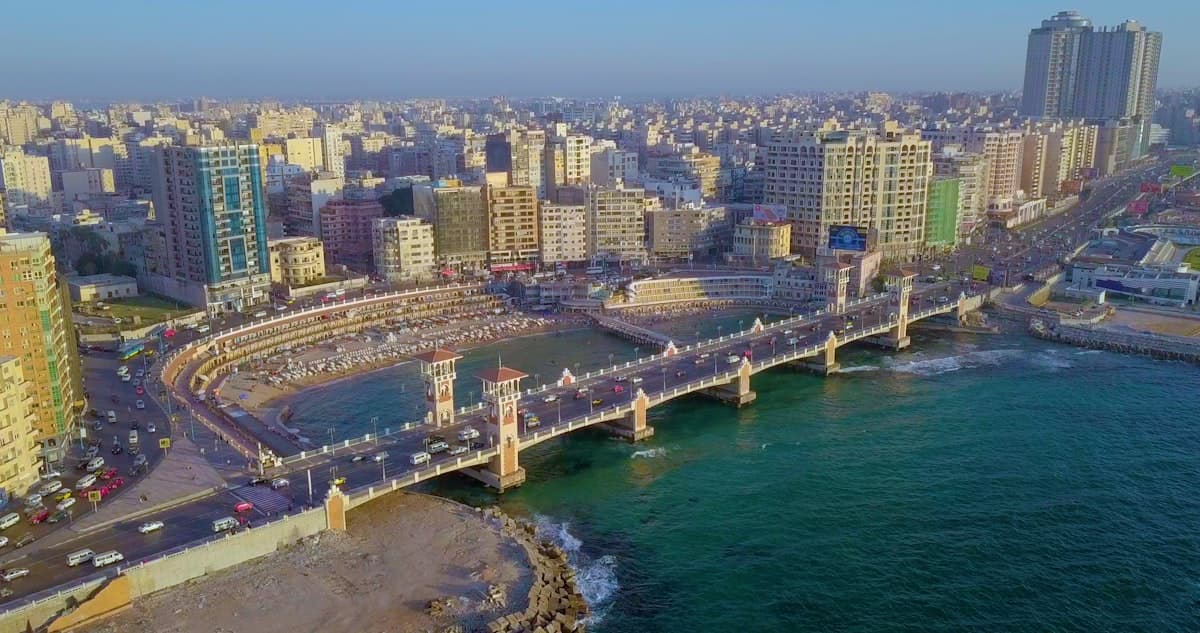
At the 1927 Egyptian census, Alexandria counted approximately 100,000 Italian residents. They were the third-largest foreign community in the city, after Greeks and British, and they had been present in significant numbers since Napoleon's 1798 campaign opened Egypt to European settlement. By the time Nasser nationalized the Suez Canal in 1956 and expelled most foreign nationals, the Italians were already leaving. The 1961 nationalization laws finished what the 1956 crisis started. Today, fewer than 200 Italians remain in Alexandria, most of them elderly, and the institutions that once anchored an entire civilization, schools, hospitals, clubs, newspapers, a chamber of commerce, have either closed, been converted, or simply vanished.
What remains is architectural. And here is the fact most visitors miss entirely: the Italian community did not build in Italian style. They built in a hybrid idiom that Egyptians came to call "Alexandrian," a fusion of Italian Liberty (Art Nouveau), Beaux-Arts, and local Islamic ornamental detail that exists nowhere else on earth. You will not find these buildings in Rome or Milan. They were designed for a specific Mediterranean climate, a specific cosmopolitan clientele, and a specific political moment. When that moment ended, the style ended with it.
Understanding the Italian community of Alexandria is not a niche exercise in immigrant history. It is the key to understanding what Alexandria actually was: not an Egyptian city with foreign guests, but a Mediterranean city that happened to be located in Egypt, governed briefly by Ottomans and then by the British, populated by Egyptians, Italians, Greeks, Jews, Armenians, Syrians, and Maltese, and held together by the cotton trade and an extraordinary collective agreement to leave one another's religions alone.
---
The Buildings They Left Behind
Walk east from Raml Station along Tariq al-Horreya and you are walking through a city most Alexandrians under forty cannot identify. The facades are still there: the wrought-iron balconies, the ceramic tile work, the curved corner buildings designed to address two streets simultaneously in the Italian manner. What has changed is everything at street level. The ground floors that once held Italian pharmacies, tailors, and cafes now sell mobile phone accessories and cheap clothing. The names above the doors are gone. The language is gone.
The Church of St. Catherine on Tariq al-Horreya is the most intact Italian institution remaining. Built in 1836 and expanded in 1929, it was the spiritual center of the Italian community for over a century. The interior holds a painting of the Madonna attributed to the school of Guercino, brought to Alexandria in the 1840s. Services are still held in Italian and Arabic. On a weekday morning, you may find four or five elderly women in the pews, the entire remnant congregation of a community that once filled this space to capacity every Sunday.
Three blocks north, on what is now called Sharia Abi Qir, stands the former Italian Hospital, built in 1904 by the Italian Benevolent Society. It operated as a fully Italian-staffed institution until 1960, when it was nationalized and converted into a state facility. The building still functions as a hospital. The plaque noting its origins is gone, but the loggia on the upper floors and the courtyard garden behind the main gate are still recognizably Italian Liberty in character.
The Villa Ambron in the Ibrahimia district deserves specific mention. This private villa, built in the 1920s for a prominent Italian-Jewish merchant family, was confiscated in 1961 and eventually became a government guesthouse. Lawrence Durrell, who wrote the Alexandria Quartet from 1957 to 1960, knew the Ambron family and drew on their world directly. The house is not open to the public but can be viewed from the street on Sharia Abdel Fattah al-Hadidi.
---
The Cosmopolitan Layer Nobody Explains
The Italian community did not exist in isolation, and this is the point that most guides on the Italian community Alexandria Egypt history fail to make clearly. The Italians were entangled with every other community in the city. The Menasce family, the most powerful Jewish banking family in Alexandria, built their fortune partly through partnerships with Italian trading houses. The Greek community and the Italian community shared the same cafes on Rue des Ptolemees (now Sharia Salah Salem) and competed fiercely for the same commercial contracts.
The Unione Italiana, the Italian community club founded in 1862, held its annual balls in the same season as the Greek Sporting Club's social calendar, and the two institutions negotiated an informal agreement not to schedule events on the same nights. This is how the city actually functioned: not through formal multiculturalism but through practical coexistence organized around commerce and social calendar.
The most unexpected Italian trace in Alexandria is in its food. The feteer, the flaky layered pastry sold at every street corner in Alexandria, has a direct ancestor in the Italian sfogliata brought by Sicilian and Neapolitan settlers in the nineteenth century. Alexandrian pizza, a thick-crusted street food sold from carts near Sidi Bishr beach, bears almost no resemblance to Neapolitan pizza but descends directly from the focaccia variations that Italian bakers adapted to Egyptian tastes and Egyptian wheat. Nobody will tell you this in a restaurant. Ask an older Alexandrian baker and they will confirm it immediately.
The Athineos Cafe at the corner of the corniche and Raml Station, opened in 1930 by a Greek family, was the meeting point between Greek and Italian Alexandria. The menu in its early decades was written in Greek, Italian, French, and Arabic. It still operates today, still serves its famous ice cream, and still has the original marble counters. The prices are now in Egyptian pounds and the menu is in Arabic only, but the room itself is unchanged. Sit at the window facing the sea and you are sitting exactly where Italian merchants sat in 1935.
---
The Connections
The site of the Italian community's main social club, the Unione Italiana, sits on ground that was, in the Ptolemaic period, part of the royal quarter of ancient Alexandria. The Ptolemaic palaces extended along the eastern harbor, and the same waterfront land that housed the greatest Greek library in the ancient world later housed an Italian gentlemen's club where men played cards and drank Campari in the Egyptian heat. This is not metaphor. It is the actual stratigraphy of the city.
Nasser's 1956 nationalization did not only expel foreigners. It destroyed the economic model of a city that had functioned as a Mediterranean port city for 2,300 years. Alexandria's port had been one of the busiest in the Mediterranean since the Ptolemies dredged and expanded it in the third century BCE. The Italian community's departure was one symptom of a broader rupture: Egypt turning inward, nationalizing its economy, and redirecting its identity away from the Mediterranean and toward the Arab world. Both things were true simultaneously. Nasser was responding to real colonial exploitation. And a civilization was being dismantled.
The Jewish community left for the same reasons at roughly the same time. The Greek community followed through the 1960s and 1970s. What survived is a city that looks, in its bones and facades, like the cosmopolitan Alexandria that existed until 1956, but functions today as an entirely Egyptian city. The tension between those two realities is the central experience of visiting Alexandria.
---
Common Mistakes
Visiting without reading Durrell or Cavafy first. The Alexandria Quartet and Cavafy's collected poems are not optional background. They are primary sources. Durrell arrived in 1941 and wrote from direct experience of the Italian-Greek-Jewish milieu. Cavafy, who was Greek-Alexandrian, spent his entire life in the city and died there in 1933. Reading them before you arrive means the city speaks to you. Arriving without them means you are looking at old buildings.
Relying on a standard city tour. Every standard Alexandria day trip from Cairo hits the Bibliotheca Alexandrina, the Citadel of Qaitbay, and the Catacombs of Kom el-Shoqafa. These are real sites worth seeing. None of them addresses the cosmopolitan twentieth-century city. You will need to build your own itinerary, or find a specialist guide from the Alexandria Preservation Trust.
Taking the horse-drawn carriage tour along the corniche. It costs EGP 150 for twenty minutes, covers no sites of historical significance, and the horses are visibly underfed. Skip it entirely.
Assuming the Italian-era buildings are protected. They are not, or not adequately. Several significant Liberty-style buildings on Tariq al-Horreya have been demolished since 2010 for commercial development. Others are in advanced states of disrepair. Photograph everything you see. Some of it will be gone on your next visit.
Spending money on the so-called "cosmopolitan Alexandria" walking tour sold at major hotels. The guides on these tours are not historians. They will point at buildings and say "this was built by the Greeks" or "the Italians lived here" without any specificity or context. The fee is typically EGP 400 to 500 per person. Use that money to hire a private guide from the Faculty of Arts at Alexandria University, where students specializing in modern Alexandria history offer genuinely informed walks for a similar fee.
Missing the Italian Cemetery. The Latin Cemetery on Sharia Moustafa Fahmy in the Chatby district holds the graves of Italian Alexandrians from the 1820s onward. The inscriptions are in Italian. The family names, Cozzika, Salvago, Aghion, tell the entire story of cosmopolitan Alexandria in miniature. It is open to visitors and free. Most guides do not mention it.
Expecting the Italian community to be commemorated. There is no museum of cosmopolitan Alexandria. There is no official monument to the Italian, Greek, or Jewish communities. The Casa d'Italia (the Italian cultural center) still operates on Sharia Abi Qir and occasionally hosts events on the history of the community, but it is not a museum and does not have permanent exhibits. If you want commemoration, you will have to construct it yourself from the buildings, the cemetery, and the surviving food culture.
---
Practical Tips
Stay in the downtown Alexandria area near Raml Station, not in the beach resort strip east of the city. The Italian-era buildings are all within walking distance of Raml. Staying in Montazah or Sidi Bishr adds forty minutes of transit each direction and serves no purpose unless you want a beach holiday, which is a different trip entirely.
The best time to explore the streets is early morning, before 9am, when the corniche is quiet and the light is horizontal and Mediterranean in a way that explains immediately why painters and writers came here. By 11am the streets fill and the heat becomes a factor from April onward.
Speak to shopkeepers in older buildings. Alexandrians who have worked in Italian-era commercial buildings sometimes have oral histories from parents or grandparents who worked for or alongside Italian families. These conversations are more valuable than any guidebook, including this one.
Bring a physical notebook. The Wi-Fi in cafes along the corniche is unreliable and the act of writing by hand in a cafe that was once Italian-owned is its own form of historical engagement.
The Graeco-Roman Museum, closed for renovation for nearly two decades, has reopened in phases. Confirm current hours and which galleries are accessible before visiting. It holds the best collection of artifacts from the Ptolemaic and early Roman periods of Alexandria, which is the deep foundation on which the Italian community later built.
Frequently Asked Questions
The Weekly Dispatch
More on Egypt, every Friday.
Cultural depth and places most guides never mention.
No spam. Unsubscribe anytime.