The Italian Community of Alexandria Egypt: A Cultural History Guide
At its peak, Alexandria had 100,000 Italians. They built the opera house, ran the stock exchange, and vanished within a generation. Here is where to find what remains.

Quick Facts
- Best time to visit
- October to April. The Mediterranean climate is mild, the light on limestone facades is directional and clear, and the summer humidity that makes July and August uncomfortable has lifted.
- Entrance fee
- Terra Santa Cemetery: free. Alexandria National Museum: EGP 100 (approx $2 USD), students EGP 50. Cathedral of St. Catherine: free. Most street architecture and facades: no fee.
- Opening hours
- Terra Santa Cemetery: Saturday to Thursday 8am to 4pm. Alexandria National Museum: Wednesday to Monday 9am to 4:30pm, closed Tuesday. Cathedral of St. Catherine: daily 8am to 12pm and 4pm to 7pm.
- How to get there
- Train from Cairo Ramses Station to Alexandria Misr Station: EGP 65 to 145 depending on class, approximately 2 hours 10 minutes. Within Alexandria: tram Line 1 from Raml Station to Chatby for EGP 3, or white taxi for EGP 30 to 50.
- Time needed
- Half-day for cemeteries and central churches. Full day to include the Attarine antique district, the Alexandria National Museum, and a walk along the European-quarter street grid.
- Cost range
- Budget EGP 300 to 600 per day covering transport, museum entry, and local lunch. Mid-range EGP 1,200 to 2,000 per day with a specialist guide and a meal at a historic dining room.
Quick Facts
Best time to visit: October to April, when the Mediterranean humidity drops and the light on limestone facades turns soft and directional. Summer in Alexandria is not brutal the way Upper Egypt is, but the salt air in July feels like wearing a damp coat.
Entrance fees: Most sites connected to the Italian community are churches, cemeteries, or street-level architecture requiring no ticket. The Latin Cemetery (Terra Santa) is free to enter during visiting hours. The Alexandria National Museum, which holds relevant artifacts and period photographs: EGP 100 (approx $2 USD), students EGP 50. The Villa of the Ptolemies site near Montaza: EGP 60 (approx $1.25 USD).
Opening hours: Terra Santa Cemetery, Chatby: Saturday to Thursday, 8am to 4pm. The Cathedral of St. Catherine (Latin Rite): open for mass and visitors daily, 8am to 12pm and 4pm to 7pm. The Alexandria National Museum: Wednesday to Monday, 9am to 4:30pm, closed Tuesday.
How to get there: From Cairo, take the Egyptian National Railways express to Misr Station, Alexandria; tickets run EGP 65 to 145 (approx $1.30 to $3 USD) depending on class. Within Alexandria, a white taxi from Misr Station to the Chatby area costs roughly EGP 30 to 50. The tram Line 1 runs along the Corniche and connects Raml Station to Chatby for EGP 3, which is both the cheapest and the most historically appropriate way to travel: Italians helped build this tram system in 1863.
Time needed: A focused half-day covers the Chatby cemetery belt and the churches of the center. A full day allows you to walk the old European quarter of Attarine and Mansheya, visit the National Museum, and end at a cafe that was once an Italian institution.
Cost range: Budget EGP 300 to 600 per day covering transport, entry fees, and lunch at a local restaurant. Mid-range EGP 1,200 to 2,000 per day if you add a guide and a meal at one of the remaining European-era dining rooms.
---
Why This Place Matters
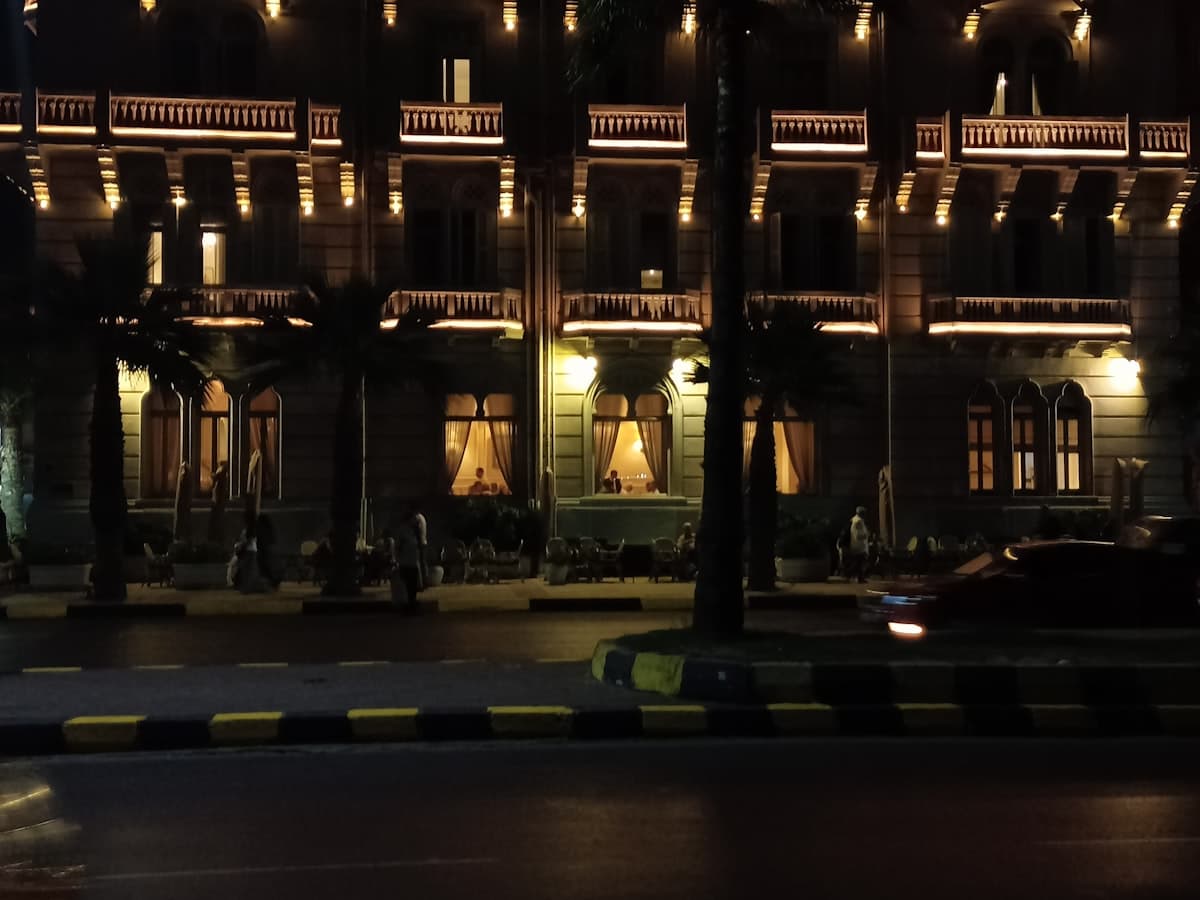
At the 1917 census, Alexandria contained approximately 100,000 Italians. They were the largest single European community in the city, outnumbering the Greeks, the British, the Levantine Jews, and the French. They ran pharmacies and built theaters. They owned foundries and operated the municipal tram system, which they had constructed in 1863, making it one of the first electric tram networks on the African continent. They sent their children to Italian-language schools funded by the Italian state. They died and were buried in limestone tombs carved by Italian stonemasons, in cemeteries arranged like small Italian hill towns, complete with streets and family chapels.
By 1970, nearly all of them were gone.
The collapse of the Italian community in Alexandria was not a single event but a sequence: the 1952 revolution, the nationalization of foreign-owned businesses under Nasser in 1956 and 1961, the sequestration of property, the erosion of the capitulation system that had given Europeans legal privileges in Egypt since the Ottoman period. Each wave of policy pushed another generation onto ships headed for Genoa or Trieste or Brindisi, most of them carrying Egyptian-born children who had never seen Italy and would spend the rest of their lives translating between two identities.
What they left behind is a city within the city: a layer of architecture, institution, and cemetery that sits beneath modern Alexandria the way a Roman floor sits beneath a Fatimid mosque. The Italian community Alexandria Egypt history is not a museum exhibit. It is written into the street grid, the church bells, and the names on tombs that no one has visited in forty years.
---
The Quarter That Built Alexandria Modern
Stand at Mansheya Square, now called Tahrir Square, in central Alexandria. The square was designed in 1834 by an Italian engineer, Francesco Mancini, working under Muhammad Ali Pasha. The column at its center honors the Albanian-born Ottoman governor who remade Egypt on a European model, and the ironwork on the surrounding buildings was mostly fabricated in Italian-owned workshops in the Attarine district two streets away.
Alexandria's modernization in the nineteenth century was substantially an Italian project, not because of political colonialism but because of proximity, poverty, and skill. Southern Italian craftsmen, many of them from Calabria and Sicily, arrived beginning in the 1820s following the promise of Muhammad Ali's modernization program, which required builders, engineers, pharmacists, and mechanics that Egypt did not yet have in sufficient numbers. They came as contract workers and stayed as residents. Within two generations, families like the Pernigottis, the Ambrons, and the Zoghebis had moved from artisan class into banking and commerce.
The Toussoun Palace, the Cicurel department store building, the original Bourse (stock exchange): all show Italian design influence in their facades, cornices, and internal ironwork. The Cicurel family itself was Jewish, but their flagship building on Fouad Street was designed in an Italian eclectic style by an Italian architect and built by Italian-trained local craftsmen. Alexandria did not import culture wholesale. It assembled it from whatever was available, which is precisely what made it extraordinary and precisely what made it fragile.
Walk Attarine Street on any weekday morning and you will find antique dealers selling exactly this fragility: Italian-language books, silver frames engraved with Italian family crests, pharmacy bottles with labels in Italian, photographs of Alexandria beach clubs where the women are wearing 1930s Italian fashion. The dealers know what they have. Prices for Italian-community objects have risen sharply since European descendants began returning to Alexandria in the 2000s to document what their grandparents left.
---
The Cemeteries of Chatby: Where the Community Still Lives
The most complete surviving record of the Italian community in Alexandria is not a building but a burial ground. The Chatby necropolis complex, located along Shari Bur Said near the sea, contains the Latin (Catholic) Cemetery administered by the Terra Santa custody, the Greek Orthodox Cemetery, the Jewish Cemetery, and the Protestant Cemetery. Together they form an accidental archive of cosmopolitan Alexandria, arranged chronologically by death date and ethnically by faith, covering roughly 150 years of a city that no longer exists.
The Latin Cemetery alone contains an estimated 15,000 to 20,000 graves, the overwhelming majority belonging to Italian families. The tomb architecture is serious: carved angels in Carrara marble shipped from Tuscany, family chapels with wrought-iron gates bearing coats of arms, mosaic floors made by craftsmen who learned their trade in the same workshops that supplied Roman Catholic churches in Naples. Some tombs are maintained by descendants who fly in once a year from Italy. Most are not.
The detail that stops most visitors: several tombs bear dual inscriptions in Italian and Arabic, evidence of inter-community marriage, of Italian men who converted to Islam to marry Egyptian women, of Egyptian Christian women who married Italian Catholics and were buried under both a cross and a crescent. The cemeteries are officially open to visitors, but bring water, wear covered shoes, and do not enter family chapels without the custodian's permission. The custodian is usually present on weekday mornings and will unlock locked chapels for a small tip, roughly EGP 50.
Beyond the Catholic cemetery, walk fifty meters to the Jewish Cemetery, where Alexandrian Jewish families with Italian names, the Aghions, the Mosseris, the De Picciotto family, rest under Hebrew inscriptions with Italian epitaphs below. The community boundaries here were permeable in life and remained so in death.
---
The Connections: From Pharaonic Canal to Italian Foundry
The site where the Chatby cemeteries now stand was, in the Ptolemaic period, the edge of the ancient city's necropolis, used continuously from approximately the third century BCE. The Ptolemaic tombs cut directly into the limestone bedrock that underlies the entire coastal strip. When nineteenth-century Italian stonemasons sank foundations for family chapel crypts in the 1870s and 1880s, they occasionally broke through into Ptolemaic burial chambers below. The Alexandria National Museum holds several objects recovered this way, objects with no documented provenance because the discovery was not reported, just quietly absorbed into the city.
This is how Alexandria works as an archaeological site. Not layer by layer, legibly, the way archaeologists prefer, but in ruptures and collisions. The Roman cisterns beneath the Attarine district supplied water to the same streets where Italian pharmacists dispensed quinine in the 1890s. The medieval Arab geographer al-Idrisi described the street pattern of central Alexandria in the twelfth century in terms that are still partially legible in the current grid, because the Fatimid administrators who rebuilt the city after its Byzantine decline used the existing Roman street lines as the cheapest available foundation.
The Italian community understood this palimpsest better than most European arrivals because many of them came from cities, Palermo, Naples, Rome, that were themselves built in layers over Roman and Greek foundations. A Calabrian builder working in 1880s Alexandria would not have been disoriented by the fact that his foundation trench kept producing Byzantine sherds. He would have simply built on top of them, as his grandfather had done in Reggio.
---
Common Mistakes
Treating this as a nostalgia tour rather than a history. The Italian community of Alexandria was real, complex, and often complicit in the colonial economic structures that made Egyptian independence necessary. The elegiac tone that most writing on this subject adopts, including memoirs by descendants, obscures the fact that the capitulation system gave European residents legal immunity from Egyptian courts. Knowing this makes the architecture more interesting, not less.
Skipping the cemeteries in favor of the street architecture. Most visitors to this subject focus on facades and overlook the fact that the cemeteries contain more information about actual lives, actual families, and actual community structures than any surviving building. Two hours in Terra Santa will teach you more than a full day of looking at cornices.
Paying for a private tour without checking the guide's actual knowledge. Several Alexandria guides market themselves as specialists in the European quarter. Ask them one specific question before booking: who was Antonio Lasciac? If they cannot answer (he was the Austro-Hungarian architect who designed the Cairo stock exchange and several key Alexandria buildings, and his work defines the late cosmopolitan period), find a different guide. The Alexandria Preservation Trust occasionally organizes specialist walking tours with documented experts; contact them directly.
The Museum of Alexandria's Graeco-Roman collections is worth less of your time than its reputation suggests. The building is poorly ventilated, the labeling is inconsistent, and much of what was here has been moved to the new Alexandria National Museum. Go to the National Museum on Al-Mathaf Al-Romani Street instead: the Italian-community period is represented in its upper floor with photographs, objects, and documents that are genuinely surprising.
Do not eat at the Cecil Hotel restaurant on the basis of its cosmopolitan-era reputation. The Cecil, once a genuinely significant hotel where Somerset Maugham and Lawrence Durrell stayed, now serves overpriced food in a room that has been renovated into blandness. The reputation is real. The current restaurant does not honor it. Walk instead to Elite Restaurant on Safia Zaghloul Street, which has operated since 1942, serves the Alexandrian fish dishes that Italian and Greek families actually ate, and costs a fraction of the Cecil's prices.
Missing the Italian Hospital, now the Alexandria University Hospital at Chatby. The building was founded as the Italian Benevolent Society Hospital in 1892 and served the Italian community's working poor. It is still functioning as a hospital, so you cannot tour the interior, but the facade on Shari Bur Said is intact and remarkable: a confident piece of late-nineteenth-century Italian institutional architecture sitting in the middle of a modern street, explaining everything about how seriously this community took its own permanence.
---
Practical Tips
The best single morning for this subject: arrive at Terra Santa Cemetery at 8am when it opens, before the heat builds and before the custodian is occupied. Spend ninety minutes in the cemetery, then walk north along Bur Said Street to the Italian Hospital facade, then cut west through Chatby toward the Attarine district. This walk covers roughly four kilometers and passes through neighborhoods where the transition from European-era to contemporary Alexandria is visible in real time, often within a single block.
For reading before you go: Robert Ilbert's "Alexandrie 1830-1930" (available in French, partially translated) is the serious scholarly foundation. Michael Haag's "Alexandria: City of Memory" is more accessible and correctly emotional about the losses without being sentimental about the inequities. Both are available from used booksellers in the Attarine market itself, occasionally in Italian editions, which feels appropriate.
Wear comfortable shoes with closed toes for the cemeteries. Bring a small flashlight if you plan to look inside chapel crypts: the interiors are often unlocked but unlit. Dress modestly for any church entry, which in practice means covered shoulders and no shorts.
Photography is permitted in the cemeteries and churches but ask before photographing private family tombs that have recent dates or fresh flowers. Someone's grandmother may have been buried last year in a tomb whose family has been in Alexandria for six generations. That story deserves more than being a social media image.
If you speak Italian, even moderately, some of the older custodians in the Latin Cemetery will switch into it and tell you things they do not tell anyone else. This is not a tip. It is simply the truth about Alexandria, which has always rewarded the person who speaks the right language at the right moment.
Frequently Asked Questions
The Weekly Dispatch
More on Egypt, every Friday.
Cultural depth and places most guides never mention.
No spam. Unsubscribe anytime.