The Italian Community of Alexandria Egypt: A Lost World Guide
At its peak, Alexandria had 100,000 Italians. Most left by 1960. What they built, buried, and left behind is still there if you know where to look.

Quick Facts
- Best time to visit
- October through April. Mediterranean summers in Alexandria are humid and hot, and the city crowds with Egyptian summer tourists in July and August. Winter offers cleaner air, comfortable walking temperatures of 15-20C, and significantly fewer visitors.
- Entrance fee
- Latin Cemetery: free. Terra Santa Church: free. Alexandria National Museum: EGP 180 (approx $6 USD). Greek Orthodox Patriarchate Museum: EGP 50 (approx $1.50 USD). Italian Cultural Institute events vary.
- Opening hours
- Latin Cemetery daily 7am-5pm (occasionally closed Fridays). Alexandria National Museum daily 9am-4:30pm, closed Tuesdays. Terra Santa Church open outside Mass hours, roughly 9am-12pm and 3pm-6pm. Italian Cultural Institute hours vary by programming.
- How to get there
- From Cairo: Egyptian National Railways express to Sidi Gaber station (EGP 120-350 depending on class, approximately 2-2.5 hours). Within Alexandria: city tram EGP 2 per ride, taxis EGP 30-60 per short trip, walking feasible between most European quarter sites.
- Time needed
- Two full days minimum. Day one: Horreya Avenue architecture walk, Pastroudis, Terra Santa, Alexandria National Museum. Day two: Chatby cemeteries, Ibrahimiya neighborhood, Italian Cultural Institute if open.
- Cost range
- Budget EGP 600-900 per day including basic accommodation near Raml Station. Mid-range EGP 2,000-3,500 per day with a corniche hotel, specialist guide, and restaurant meals.
Quick Facts
Best time to visit: October through April, when Mediterranean humidity drops and walking the corniche is a genuine pleasure rather than an endurance test.
Entrance fees: The Latin Cemetery (Chatby) is free and open to visitors during daylight hours. The Greek Orthodox Patriarchate Museum costs EGP 50 (approx $1 USD). Terra Santa Franciscan Church is free but requires modest dress. The Alexandria National Museum, which contains artifacts from the cosmopolitan era, charges EGP 180 (approx $6 USD) for foreigners.
Opening hours: Latin Cemetery open daily 7am-5pm. Alexandria National Museum open daily 9am-4:30pm. Terra Santa Church open for visits outside of Mass hours, roughly 9am-12pm and 3pm-6pm.
How to get there: From Cairo, take the Egyptian National Railways express to Sidi Gaber or Masr station (EGP 120-350 depending on class). From central Alexandria, the sites cluster across Raml Station, Chatby, and Ibrahimiya neighborhoods, all reachable by tram (EGP 2, the cheapest transport in the country), taxi (EGP 30-60 per trip), or on foot if you are staying near the corniche.
Time needed: Two full days to do this properly. One day for the eastern neighborhoods, one for the cemeteries and western Ibrahimiya.
Cost range: Budget EGP 600-900 per day including accommodation near Raml Station. Mid-range EGP 2,000-3,500 per day staying in a restored Cecil Hotel-area property.
---
At its absolute peak, in the years just before the Second World War, the Italian community of Alexandria numbered somewhere between 60,000 and 100,000 people. They ran newspapers, built baroque palazzos along the corniche, opened pasta factories, managed cotton trading houses, performed opera at the Alhambra Theatre, and buried their dead in a cemetery so ornate it drew visitors who had no relatives in it at all. By 1962, almost all of them were gone. Nasser's nationalization policies, the chaos following the 1956 Suez Crisis, and a steady erosion of the cosmopolitan legal protections that had made Alexandria livable for Europeans dismantled in six years what had taken six generations to build.
What remains is a city that does not know quite what to do with this inheritance. Italian-language inscriptions on crumbling facades. A Franciscan church serving a congregation that could now fit comfortably in a minibus. Apartment buildings in the rationalist style of 1930s Rome standing between towers of raw concrete. And a cemetery at Chatby that is, without exaggeration, one of the strangest and most affecting places in Egypt, almost entirely unvisited by tourists who spend their time in Alexandria looking at Pompey's Pillar and the new library.
---
Why This Place Matters
Alexandria was never an Egyptian city in the conventional sense, and the Italians understood this better than most. The city was founded by Alexander the Great in 331 BC as a deliberate cosmopolitan project, a capital that would be Greek in administration, Egyptian in location, and open to every Mediterranean civilization that wished to trade or think there. This model persisted, mutated, and revived so many times that by the mid-nineteenth century, when the Khedive Ismail invited European capital and expertise to modernize Egypt, the Italians were not newcomers. They were continuing a relationship with the city that predated Islam, predated Rome, predated most of the civilizations that had since influenced the world.
The modern Italian presence accelerated after 1830, when Egyptian cotton became commercially significant and Alexandria became the port through which that cotton traveled to the textile mills of Europe. Italian merchants, brokers, architects, and craftsmen arrived in numbers. They benefited from the Capitulations, a system of legal extraterritoriality that meant foreign nationals in Ottoman Egypt were tried in their own consular courts rather than Egyptian ones. This made Alexandria, legally speaking, a different country depending on who you were. An Italian businessman in 1880 lived in Egypt but was largely ungoverned by Egyptian law. The Capitulations were abolished in 1937, which was the first signal to the Italian community that their position in the city was no longer structurally guaranteed.
What the Italians built during those one hundred years of protected presence includes some of the most architecturally significant structures in the modern city. The Savoy Hotel (now derelict), multiple apartment blocks along Fouad Street in the Italianate liberty style, the Church of San Giovanni Bosco, and the Franciscan Terra Santa complex all survive in varying states of preservation. The Alhambra Theatre, where Caruso performed and where Italian opera was a social fixture of the Alexandrian winter season, does not.
---
The Chatby Cemeteries: The Real Monument
If you do one thing in Alexandria connected to the Italian community history guide, let it be this: spend two hours at the Latin Cemetery in Chatby. It is not well known. It is not on most itineraries. It is the place where the full weight of what was lost becomes legible.
The Chatby necropolis is actually a cluster of adjacent cemeteries serving the different communities that made up cosmopolitan Alexandria: Greek Orthodox, Catholic Latin, Jewish, and Protestant, each with its own wall and its own aesthetic. The Latin section, which contains the bulk of Italian graves, runs to hundreds of elaborate tomb structures, many in Carrara marble shipped from Italy specifically for the purpose. The scale of this investment is difficult to comprehend. Families that were not particularly wealthy by European standards commissioned marble mausoleums because Alexandria was home, and home deserved a permanent marker.
The inscriptions are almost entirely in Italian, occasionally in French, rarely in Arabic. Many date from the late nineteenth and early twentieth centuries. The condition ranges from immaculate, where a family or community organization still maintains a plot, to heartbreaking: collapsed iron gates, cracked marble, names becoming illegible as the stone returns to its own ambitions. There are Alexandrian Italians alive today in Rome and Milan and Turin who have never seen where their grandparents are buried because returning felt impossible and then, gradually, unnecessary.
One specific grave worth finding: that of the poet Giuseppe Ungaretti's father, who died in Alexandria in 1890 while working on the Suez Canal excavation support works. Ungaretti himself was born in Alexandria in 1888 and spent his first years in the city before his family relocated, and later wrote about the Egyptian light as the foundational experience of his visual imagination. He became one of the most important Italian poets of the twentieth century. His roots are here, in this cemetery, two blocks from the sea.
---
Fouad Street and the Architectural Residue
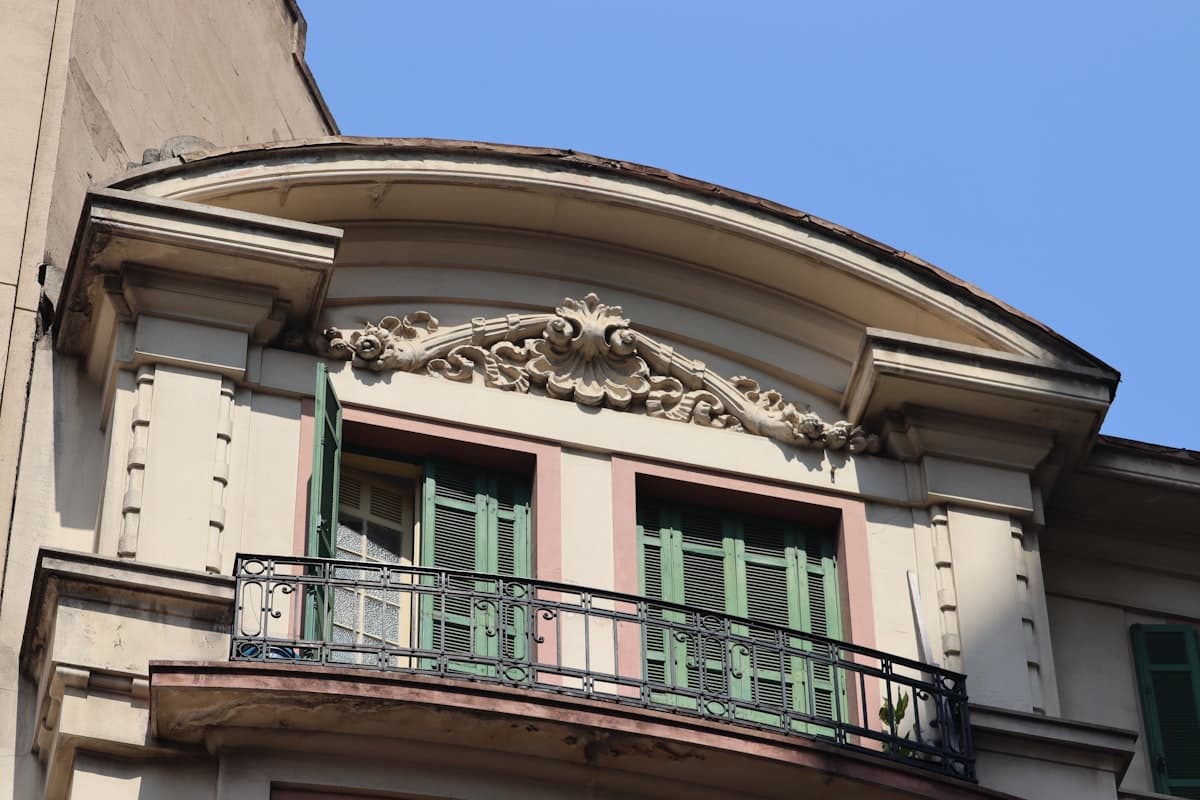
The street now officially called Horreya Avenue (Liberty Avenue) was known for generations as the Rue Fouad, and before that, informally, as the European quarter's spine. Walk it slowly from Raml Station westward and the palimpsest of the Italian community becomes visible in the upper stories of buildings whose ground floors have been entirely Egyptianized by signage, commerce, and time.
The liberty-style apartment buildings at numbers that once corresponded to Italian-owned properties retain their carved floral facades, their wrought-iron balconies, their particular proportional language of arch and window. The ground floors are now mobile phone shops and pharmacies. Look up. The second and third stories are still talking to Naples and Rome.
The Pastroudis Café, which survives at 39 El-Horreya Avenue and is one of the few genuinely old Alexandrian cafés still functioning, was for decades a place where the Italian, Greek, and Jewish communities overlapped. Lawrence Durrell drank there. Cavafy, the Greek Alexandrian poet whose apartment is preserved nearby, would have known it. It is worth sitting in for coffee not for the coffee, which is ordinary, but for the sensation of continuity. The walls have not changed in fifty years.
Terra Santa, the Franciscan complex on Nebi Daniel Street, is the most intact piece of Italian Catholic institutional life still functioning in the city. The church dates in its current form to the eighteenth century, though the Franciscan presence in Alexandria goes back to the fourteenth. Mass is still celebrated here in a mixture of Italian and Arabic. The congregation is tiny. The church itself is remarkable for being completely ignored by the tourist infrastructure despite being genuinely lovely and genuinely accessible.
---
The Connections
The Italian community did not exist in isolation from the deeper histories layered underneath Alexandria, and understanding those connections changes how you read the city.
The neighborhood of Chatby, where the Italian cemetery stands, sits directly above one of Alexandria's oldest Greek-era necropolises. When the Latin Cemetery was established in the nineteenth century, workers discovered Hellenistic tomb structures beneath the ground they were preparing. This is standard Alexandrian archaeology: you cannot dig anywhere in the old city without hitting an earlier civilization. The Italians buried their dead above Greeks who had buried their dead two thousand years earlier. The continuity is not metaphorical. It is geological.
The cotton wealth that funded so much of the Italian community's architectural ambition in Alexandria was the same wealth that funded Khedive Ismail's transformation of Cairo: the Opera House, the boulevards, the gas lighting. The two cities were financially linked. An Italian cotton broker in Alexandria in 1880 was part of the same economic system that built the Cairo Opera House where Verdi's Aida premiered in 1871, specifically commissioned for the occasion of the Suez Canal opening. The Italian community of Alexandria sent guests to that premiere. They were not separate stories.
The Suez Crisis of 1956, which triggered the mass departure of Italians and other Europeans from Egypt, was also the moment that ended British and French imperial influence in the region permanently. What felt, to the Alexandrian Italians, like a catastrophe specific to their community was in fact a civilizational reconfiguration playing out across the entire eastern Mediterranean. The Greeks of Alexandria left at the same time. The Jews of Alexandria, many of whose families had been there since the Ptolemaic period, left in even larger numbers. The city that emerged from those departures is more purely Egyptian than Alexandria had been at any point since Alexander founded it.
---
Common Mistakes
Spending your Alexandria time at Pompey's Pillar. The pillar is a single Roman column relocated in antiquity and re-erected on a platform that tells you almost nothing about the city. It is surrounded by fencing, visible from a distance, and exhausted in about twenty minutes. The pillar itself is 27 meters tall and was originally a tribute to Diocletian, not Pompey, who died nearby but had no connection to this structure. That single fact contains more interesting history than two hours at the site. Allocate your time elsewhere.
Missing the Alexandria National Museum in favor of the Bibliotheca Alexandrina antiquities display. The Bibliotheca display is impressive as a modern institution but its antiquities section is smaller and less contextualized than the National Museum, which is housed in a restored Italian-era palazzo on Tariq el-Horreya and contains material specifically from the cosmopolitan period alongside Pharaonic and Greco-Roman pieces. The building itself is part of the Italian community Alexandria history.
Going to the wrong Cecil Hotel. The historic Cecil Hotel on the corniche, where Somerset Maugham and Winston Churchill stayed and which features in Durrell's Alexandria Quartet, has changed management multiple times and in recent configurations has lost most of its atmospheric interior. It is worth a drink at the bar for the location, but do not pay to stay there expecting the original experience. The money is better spent elsewhere.
Not hiring a local guide specifically for the European quarter. Generic Alexandria tours cover the Catacombs and the Bibliotheca and skip everything discussed in this article. A specialist guide who knows the Italian community history, the cemetery, and the architectural trail costs EGP 400-700 for a half day and is the difference between a surface tour and actually understanding what you are looking at.
Visiting Chatby Cemetery without water and comfortable shoes. The site involves walking on uneven marble and gravel in direct sun. There is no café, no shade structure, and no facilities inside. Go before 10am or after 4pm.
Assuming the community is entirely gone. A small Italian consular community, some Franciscan friars, and a handful of Alexandrian families who never left still maintain real presence in the city. The Italian Cultural Institute on Mahmoud Fahmy El Nokrashy Street runs events, language courses, and occasional cultural programming that is open to visitors. Checking their calendar before you arrive may produce an unexpected opportunity.
Buying the sound and light show tickets at any Alexandria site. This applies to the Catacombs show as much as anywhere else. At EGP 300 per person, it produces a narrated light display that tells you nothing a good book on Alexandria would not cover in twenty minutes. The money is more usefully spent on a meal at a seafood restaurant in the Abu Qir neighborhood, which is the real Alexandrian cultural experience.
---
Practical Tips
Stay in the Raml Station area rather than the resort strip to Alexandria's west. This puts you within walking distance of the corniche, the European quarter architecture, Pastroudis, and the tram network.
The Alexandria tram is one of the few remaining urban tram systems in Africa and costs EGP 2 per ride regardless of distance. It is also genuinely old, slow, and atmospheric in a way that makes it worth taking even when a taxi would be faster.
Chatby Cemetery is occasionally closed without notice on Fridays and public holidays. If you arrive and find it locked, the Greek Orthodox Cemetery immediately adjacent is usually open and shares the same architectural character, with the significant difference that its inscriptions are in Greek rather than Italian.
If you read Italian, the AIDA (Association of Italians in Alexandria) has published a walking map of Italian-heritage sites that is occasionally available at the Italian Cultural Institute. It is more detailed than anything available commercially.
Alexandria's food is the best argument for staying longer than you planned. Fried calamari at Zephyrion in Abu Qir, fiteer at a Raml Station hole-in-the-wall, and the specific style of Alexandrian liver sandwich available from street carts near the central market: these are not incidental to the Italian community story. The Alexandrian food culture absorbed Mediterranean influences the same way the architecture did, and the result is a cuisine genuinely distinct from Cairo's.
Frequently Asked Questions
The Weekly Dispatch
More on Egypt, every Friday.
Cultural depth and places most guides never mention.
No spam. Unsubscribe anytime.