The Italian Community of Alexandria: Egypt's Forgotten Riviera
At its peak, Alexandria had 100,000 Italians. Most left in 1956. The cafes, churches, and cemeteries they left behind are still there, almost nobody visits them.

Audio Guide: The Italian Community of Alexandria: Egypt's Forgotten Riviera
Quick Facts
- Best time to visit
- October to April. Mediterranean winters are mild, crowds are thinner than summer, and the low-angle morning light on limestone facades is far better for understanding the architecture than harsh summer glare.
- Entrance fee
- Cathedral of Saint Catherine: free. Latin Cemetery: free (tip caretaker EGP 50 for access to locked sections). Antoniadis Garden: EGP 20 (approx $0.40). Alexandria National Museum: EGP 120 (approx $2.50).
- Opening hours
- Latin Cemetery: daily 8am to 5pm. Cathedral: open for Sunday Mass 9am, generally accessible weekday mornings. Antoniadis Garden: 8am to sunset daily.
- How to get there
- From Cairo: Spanish train from Ramses Station, EGP 100 to 160 second class, approximately 2 hours. Within Alexandria: tram lines 1 and 2 along the Corniche cost EGP 1. Taxi from Misr Station to the Latin Quarter area costs EGP 30 to 50.
- Time needed
- Half day for the core triangle: cathedral, surrounding streets, Latin Cemetery. Full day if adding Antoniadis Garden, the Alexandria National Museum, and Cafe Elite.
- Cost range
- Budget EGP 300 to 500 for a full day including transport, entry fees, lunch, and guide tip. This is among the lowest-cost cultural itineraries in Egypt.
Quick Facts
Best time to visit: October to April, when the Mediterranean humidity drops and the light on the limestone facades does something worth photographing.
Entrance fees: The Catholic Cathedral of Saint Catherine: free. The Antoniadis Garden: EGP 20 (approx $0.40). The Latin Cemetery: free, though a tip of EGP 50 to the caretaker ensures access to locked sections. The Greco-Roman Museum (currently undergoing renovation, confirm before visiting): EGP 200 (approx $4).
Opening hours: Most Italian-era churches open for Mass on Sunday mornings from 9am. The Latin Cemetery on Sharia el-Nabi Daniel is officially open daily 8am to 5pm. Antoniadis Garden opens at 8am and closes at sunset.
How to get there: From Cairo, the fastest option is the Spanish train from Ramses Station, around EGP 100 to 160 for second class, two hours. In Alexandria, the Italian-built tram (Line 1 or 2) still runs along the Corniche and through Raml Station for EGP 1. A taxi from Misr Station to the Latin Quarter streets around Sharia Fouad costs EGP 30 to 50.
Time needed: A focused half-day covers the cathedral, the Latin Cemetery, and the buildings around Saad Zaghloul Square. A full day adds the Antoniadis villa gardens, the old Italian consulate building, and a walk through the former Attarine quarter.
Cost range: This is one of the cheapest forms of cultural tourism in Egypt. Budget EGP 300 to 500 for a full day including transport, entry fees, lunch at a surviving cafe, and a guide tip.
---
Why This Place Matters
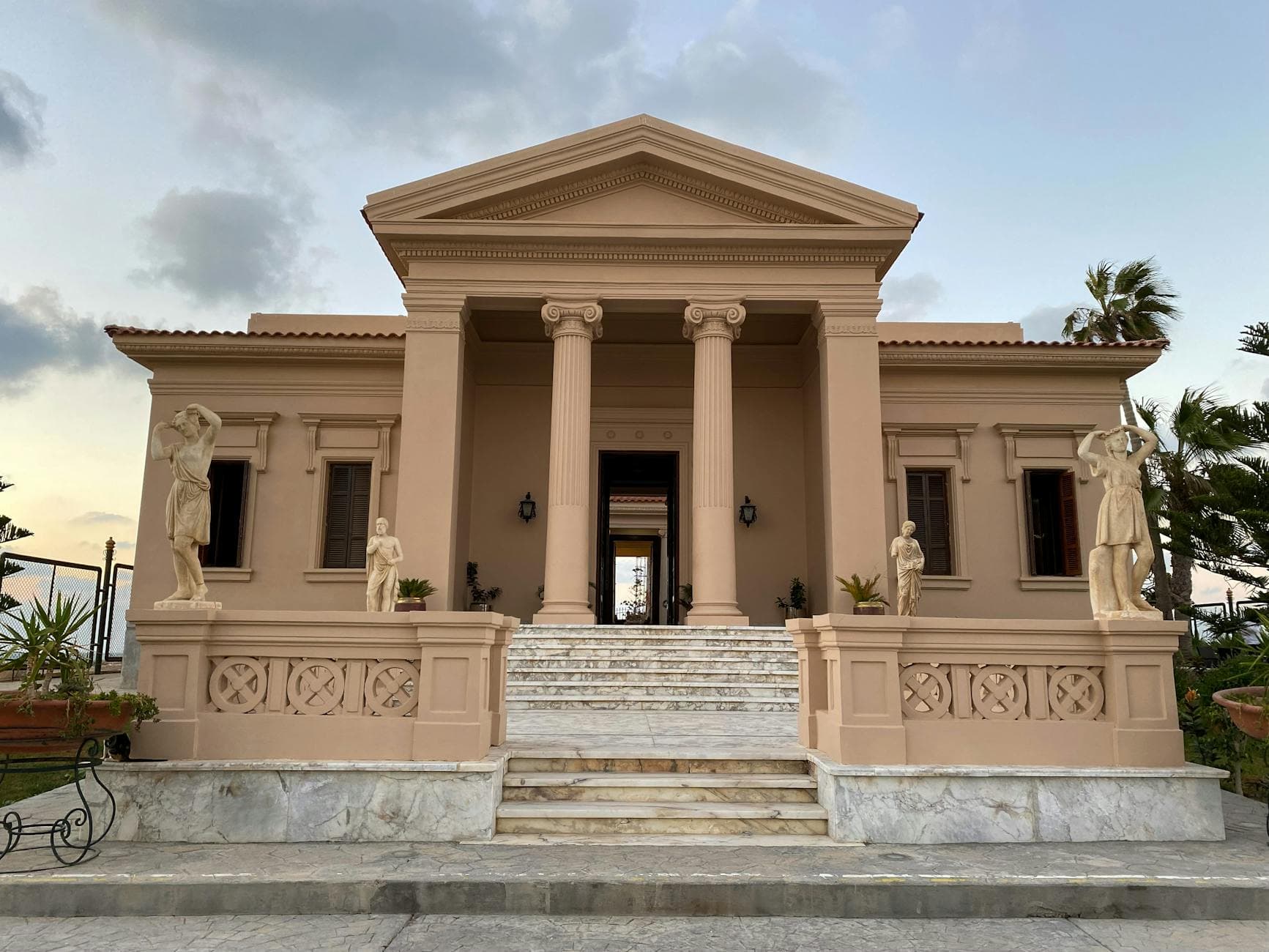
In 1927, the census counted 34,105 Italians living in Alexandria. By the mid-1950s, the broader Italian community across Egypt, concentrated overwhelmingly in Alexandria, had swelled to somewhere between 55,000 and 100,000 people, depending on whose records you trust. They were not colonial administrators. They were architects, pharmacists, cotton merchants, café owners, jewelers, and engineers. They built the tram system the city still uses. They built the Corniche-facing apartment blocks whose salt-stained balconies you pass on every taxi ride. They built hospitals, schools, and a cemetery so elaborate it was described in 1910 as one of the most beautiful in Africa.
Then Nasser nationalized the Suez Canal in 1956, and within two years the community was nearly gone. Some families left within weeks. Others held on until the early 1960s, when the nationalization of private businesses made staying economically impossible. They left behind furniture, address books, deeds to property that had been their grandparents' grandparents', and a physical city that still bears their specific handwriting.
Understanding the Italian community of Alexandria requires understanding what the city was before the twentieth century rationalized everything into nationalities. Alexandria was not Egyptian in the way Cairo was Egyptian. It was a Mediterranean port city where Greek, Jewish, Italian, Levantine, and Egyptian communities overlapped, intermarried, competed, and coexisted for over a century. The great Egyptian novelist Naguib Mahfouz almost never set his work here. He instinctively felt it was somewhere else. He was right.
---
What the Italians Actually Built
The Cathedral of Saint Catherine on Sharia Nabi Daniel is the most direct entry point into this history. Built in 1833 on land that had been a Ptolemaic neighborhood and later a Byzantine church site, it was expanded and reconfigured throughout the nineteenth century to serve a congregation that at its peak numbered in the thousands. The interior is relatively spare by Italian standards, which is itself a record of the community's character: these were not aristocrats or papal patrons. They were working and merchant-class families who pooled money for a building that was functional as much as devotional.
The real inventory of Italian building is on the streets around it. Walk north from the cathedral along Sharia Fouad (the old Rue Rosette, one of Alexandria's original Napoleonic-era arteries) and you are walking through an open-air archive. The apartment blocks with their curved balconies, their wrought-iron railings and terracotta cornice details, were almost entirely designed by Italian or Italian-trained architects between 1880 and 1940. The firm of Lasciac and Avoscani alone designed dozens of the buildings that define the city's profile. Antonio Lasciac, who served as chief architect of the Khedival household, was born in Slovenia but trained in Venice and built in a style that was simultaneously Italian, Ottoman, and Alexandrian in a way that has no precise European equivalent.
The Antoniadis Garden, technically built for a Greek cotton merchant but designed by Italian landscape architects and maintained by Italian gardeners through much of the early twentieth century, contains the villa where Lawrence Durrell and others in the wartime literary set were entertained. It is now a public park, admission EGP 20, almost entirely overlooked by tourists, and on a weekday morning in October it is one of the quietest places in any city of five million people.
---
The Latin Cemetery: The Most Honest Archive in Alexandria
If there is one site in Alexandria that condenses the entire history of the Italian community into a single walkable space, it is the Latin Cemetery on Sharia el-Nabi Daniel, about 800 meters south of the cathedral. It is not one cemetery but several overlapping ones: Catholic, Greek Orthodox, and various national sections share a walled compound that covers roughly four city blocks.
The Italian section was first consecrated in the late eighteenth century and expanded continuously until the 1950s. The monuments range from simple marble crosses for sailors who died in port to elaborate mausoleums built by merchant families who had made serious fortunes in cotton and real estate. One of these mausoleums, belonging to the Aghion family (who were technically Jewish but deeply embedded in Italian commercial networks), features a facade by the same workshop that produced decorative stone for several Khedival palaces.
What makes the cemetery historically specific is the death dates. Walk the Italian section methodically and you will notice that burials become dense from 1860 to 1950 and then stop, almost entirely, after 1958. The community did not die in Alexandria. It departed. The last generation of Alexandrian Italians who died here and were buried here were elderly people who either chose to stay or lacked the means to leave. Their headstones, often carved in a vernacular Italian mixed with Arabic transliterations of names that had been in Egypt for four or five generations, are a record of a world that ended on an administrative timetable.
The caretaker, an elderly man who has worked here for over thirty years, knows exactly where the notable graves are. He speaks limited English but fluent patience. Tip him EGP 50 and he will take you directly to the sections most visitors wander past.
---
The Connections
The Italian presence in Alexandria is inseparable from the Greek presence, the Jewish presence, and the Levantine presence, and all of them are inseparable from the specific form of Egyptian modernization pursued by Muhammad Ali and his successors from 1805 onward. Muhammad Ali, an Albanian-Ottoman officer who seized power in Egypt and then effectively built a new state, imported European expertise systematically. Italian engineers helped design the modernized irrigation canals in the Delta. Italian doctors staffed the early medical schools alongside French and Egyptian colleagues. The first professional troupe to perform opera in Cairo, in the 1869 season that inaugurated the new Cairo Opera House (built for the opening of the Suez Canal), was Italian.
The Suez Canal connection is not incidental. Ferdinand de Lesseps, who led the Canal project, was French, but a large proportion of the actual construction labor and technical management was Italian. Workers who had come for the Canal stayed for the cotton boom. By the 1880s, the phrase "Italian Alexandria" was a recognized shorthand among European diplomats for the mercantile class that had effectively colonized the city's commercial architecture and professional life without any state sponsorship whatsoever.
The buildings Italians left behind now house Egyptian families, government offices, and the occasional international NGO. The tram they built still operates, making it one of the oldest functioning urban tram systems in Africa. The fact that Alexandria's municipal transport was engineered by a community that left sixty years ago and runs on infrastructure that has barely been updated since is either a tribute to the quality of the original construction or a comment on subsequent investment, depending on your mood.
---
Common Mistakes
Treating this as a nostalgia tour rather than a history. The Italian community of Alexandria is not a story about loss and longing. It is a story about how cities are made, unmade, and reorganized by political decisions. Approaching it as a melancholy walk through a vanished world misses the more interesting question: what exactly was this place, and why did it produce the specific architecture, culture, and cosmopolitanism it did?
Skipping the Latin Cemetery in favor of the Catacombs of Kom el-Shoqafa. The Catacombs are impressive and genuinely worth seeing, but they are also on every tour itinerary and handled accordingly. The Latin Cemetery costs nothing, sees almost no foreign visitors, and tells you something about the modern city that the ancient sites cannot.
Paying for a "cosmopolitan Alexandria" walking tour without vetting the guide's actual knowledge. Several operators run tours marketed at the nostalgia market, primarily aimed at diaspora visitors. Some are excellent. Others cover surface-level facts any Wikipedia reader knows and charge EGP 800 to 1,200 for the privilege. Ask specifically whether the guide can name three Italian architects who worked in Alexandria and what buildings they designed. If they cannot, find another guide.
Assuming the buildings are all deteriorating beyond interest. Some are in poor condition. Others have been quietly restored by private owners or by the Italian Cultural Institute in Alexandria, which maintains a genuine archival interest in this history and occasionally organizes access to buildings not normally open to visitors. Check their schedule before you go.
Going to the Montaza Palace expecting Italian architecture. Montaza was a Royal summer palace built under Khedive Abbas II in 1892 and expanded under King Farouk. The architectural style is Ottoman-Florentine in a way that is interesting precisely because it is the fantasy of Italian architecture produced by a court that had absorbed Italian aesthetics without Italian builders. It is worth seeing, but for different reasons than the Latin Quarter.
The sound and light show at the Qaitbay Citadel costs EGP 250 and has no meaningful content about the Italian or cosmopolitan period. Skip it. The Citadel itself, built in 1477 by the Mamluk Sultan Qaitbay on the exact site of the ancient Lighthouse of Alexandria, is worth the EGP 80 entry on its own terms, in daylight, for the architecture and the harbor view. The evening show adds nothing.
Visiting on a Friday morning when most of the quarter is at prayer or closed. Saturday or a weekday is better for getting inside the cathedral, finding the cemetery caretaker, and walking streets without heavy vehicle traffic.
---
Practical Tips
The Italian Cultural Institute on Sharia Horreya (the old Rue de la Gare) is your best practical resource. They maintain a library, occasionally publish maps of Italian-era architectural sites, and can connect you with academic guides who know this material at depth. Email them before arriving; they respond to serious inquiries.
The light in Alexandria is different from Cairo. It comes off the Mediterranean at a low angle in winter mornings and turns the limestone facades of the Italian-era apartment blocks into a pale gold that has nothing to do with the harsh midday glare. If you are photographing buildings, be out by 8am.
Cafe Elite on Sharia Horreya, one of the last functioning cafes that dates to the cosmopolitan era (established 1923), serves Turkish coffee and fresh juice in a room whose walls are covered with photographs of old Alexandria. It is not a tourist trap because most of its clientele are elderly Alexandrian men playing backgammon. Sit, order coffee, and do not rush.
The Greco-Roman Museum, which contains the most systematic collection of artifacts from Alexandria's Mediterranean-identity period, has been under renovation for several years. Confirm its status before building an itinerary around it. The Alexandria National Museum on Tariq el-Horreya is open and contains relevant material, though its presentation is uneven. Entry is EGP 120 (approx $2.50).
If you read Italian or French, the memoir literature on cosmopolitan Alexandria is worth engaging before you arrive. Fernanda Pivano, André Aciman, and E.M. Forster (whose "Alexandria: A History and a Guide" was first published in 1922 and is still in print) all describe the city from perspectives that make the physical evidence more readable when you encounter it in person.
Frequently Asked Questions
The Weekly Dispatch
More on Egypt, every Friday.
Cultural depth and places most guides never mention.
No spam. Unsubscribe anytime.