Khan el-Khalili Bazaar Guide: Cairo's Living Market
Khan el-Khalili isn't a souvenir market. It's a 14th-century Mamluk commercial city still doing business. Here's how to read it properly.
Quick Facts
- Best time to visit
- October to February for comfortable temperatures. Tuesday and Wednesday mornings for lightest crowds. Ramadan evenings (after 8pm) for the most atmospheric experience of the year.
- Entrance fee
- Free. Khan el-Khalili is a public market with no admission charge. Nearby monuments on al-Muizz Street charge separately: approx EGP 60-150 per site.
- Opening hours
- Most shops 9am to 10pm or midnight daily. Closes midday Friday (noon to 2pm) for Jumu'ah prayer. Ramadan hours extend to 2-3am. Gold market opens closer to 11am.
- How to get there
- Metro Line 1 to al-Ataba station (EGP 10-15), then 15-minute walk east. Uber or Careem from central Cairo EGP 60-120. Negotiated taxi from Tahrir Square EGP 50-80.
- Time needed
- 2 hours minimum for a focused visit. 4 hours to explore properly including side streets and Fishawi's. Full day if combining with al-Muizz Street monuments.
- Cost range
- Budget EGP 200-500 (tea, snacks, small purchases). Mid-range EGP 800-2,500 with craft purchases. Gold and serious antiques are priced separately against market rates.
The shop selling alabaster Nefertitis on al-Muizz Street is sitting on top of a Fatimid palace. The palace was built over a Roman camp. The Roman camp was built near a Pharaonic settlement called Khere-Ohe, which the Arabs would later transliterate as al-Qahira, meaning the Victorious. Every single layer is still here. You just have to know where to look.
Quick Facts
Entrance fee: Free. The bazaar is a public market and always has been.
Opening hours: Most shops open around 9am and close between 9pm and midnight. On Fridays, everything shuts from roughly noon to 2pm for Jumu'ah prayer. Goldsmiths and antique dealers tend to open later, around 11am.
Best time to visit: October through February for weather. Tuesday and Wednesday mornings for crowds, or any weekday before 11am. Ramadan evenings are an entirely different experience: the market runs until 2 or 3am, lit with colored lanterns, and the social energy is unlike anything Egypt offers the rest of the year.
Getting there: The metro gets you close. Take Line 1 to al-Ataba station (EGP 10-15 depending on origin), then a 15-minute walk east through the Ataba market. Alternatively, a Uber or Careem from central Cairo runs EGP 60-120 depending on traffic. A taxi negotiated in advance from Tahrir Square should be EGP 50-80. Do not take a calèche from the Citadel area unless you want to spend twenty minutes discussing price.
Time needed: Two hours if you're moving quickly, four if you're serious, a full day if you add the surrounding monuments of Islamic Cairo.
Cost range: You can spend nothing or several thousand Egyptian pounds. A glass of tea at Fishawi's costs EGP 35-50. A hand-hammered copper tray runs EGP 500-2,500. Gold is sold by weight at daily market rates.
---
Why This Place Matters

Khan el-Khalili was not founded as a tourist attraction. It was founded in 1382 by Jarkas al-Khalili, the Master of Horse under the Mamluk sultan Barquq, as a caravanserai: a commercial compound where traveling merchants could store goods, stable animals, and conduct business safely. Al-Khalili chose the site deliberately. He demolished the Fatimid royal tombs that occupied the land, which scandalized the city's religious establishment but had the practical advantage of sitting directly on the main trade artery between the Red Sea and the Mediterranean.
What that means is that Khan el-Khalili has been doing exactly what it does now, which is selling things to strangers, for over six hundred years. The medieval spice trade ran through here. The Venetian merchants who needed Egyptian pepper to preserve their winter meat negotiated contracts here. Napoleon's officers, during the French Occupation, bought curiosities here to ship home. Flaubert walked through it in 1849 and wrote about the smell. The smell is the same.
The Mamluks who built it were themselves a remarkable human phenomenon. They were enslaved soldiers, mostly Circassian and Kipchak Turkic men purchased as boys from the steppes north of the Black Sea, trained as elite cavalry, and eventually powerful enough to overthrow their own masters and rule Egypt for nearly three centuries. Al-Khalili's sultan, Barquq, was the first Circassian Mamluk sultan. He came to power in 1382, the same year the khan was built, which is not a coincidence. Large construction projects were political statements. The khan announced permanence.
---
What You'll Actually Find Here
The Geography of the Market
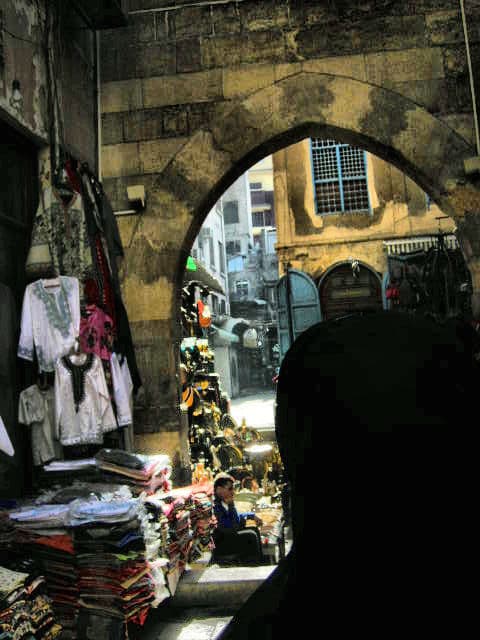
Khan el-Khalili is not one market. It is several overlapping commercial districts that foreigners (and many Cairenes) collapse into a single name. The tourist-facing section, with its papyrus shops and perfume sellers, is concentrated around the main khan square near the Sayyidna al-Hussein mosque. Walk two minutes north and the shops shift to wholesale fabric. Two minutes east and you're in the gold market, where Egyptian women with serious intent examine 21-karat pieces at prices set by the morning's gold fix. Two minutes west and you're in the spice souk, where cardamom and dried hibiscus are scooped into paper bags for local cooks.
Most visitors never leave the tourist rectangle. This is the area designed to extract money from people who don't have time, and it will do so efficiently.
Fishawi's Coffeehouse
Fishawi's, technically Qahwat al-Fishawi, claims to have been open continuously for 250 years. The claim is probably not literally true but is culturally true, which is the more interesting kind of truth in Egypt. Naguib Mahfouz, who won the Nobel Prize for Literature in 1988 and was nearly assassinated near this street in 1994, spent decades drinking tea at Fishawi's and setting fiction in these alleys. His novel "Midaq Alley" takes place one street over. The alley exists. You can walk down it. The people in it no longer resemble his characters much, but the physical architecture is essentially unchanged.
Fishawi's now functions primarily as a tourist destination and prices reflect that, but sitting there with a mint tea at 8am before the tour groups arrive is still one of Cairo's more atmospheric experiences. The mirrors are original 19th-century glass. The wooden screens are mashrabiyya, the carved latticework that allowed women in upper floors to observe public space without being seen. This was not decorative. It was a technology for navigating a specific social code.
The Goldsmiths
The gold market operates on rules most visitors don't understand. Egyptian gold is almost universally 21-karat, not 18-karat as in Europe, and sold by weight against the daily price plus a manufacturing fee. There is very little room to negotiate on the metal itself. The manufacturing fee is negotiable. If a shopkeeper quotes you a price that seems disconnected from weight, they are calculating the tourist margin. Knowing the daily gold price in Egyptian pounds before you enter is the most useful single thing you can do.
The gold souk is also where you will see gold being made, if you arrive early enough. Small workshops behind the retail fronts have craftsmen working wax-casting and hand-finishing. This is not a performance for visitors. It is production.
---
The Connections

The al-Hussein mosque that anchors the northern end of the bazaar claims to contain the head of Hussein ibn Ali, the Prophet Muhammad's grandson, killed at the Battle of Karbala in 680 CE. The head is said to have been brought from Ascalon (in present-day Israel) in 1153 by the Fatimid caliph al-Zafir, who was trying to keep it safe from Crusader forces threatening the coast. This is a central piece of Shia Islamic history housed inside what is now predominantly a Sunni Egyptian context, which tells you something about how Cairo accumulates and holds contradictions.
Five minutes' walk south of the bazaar, al-Muizz Street contains what urban historians call the highest concentration of medieval Islamic monuments anywhere in the world. The Madrasa and Mausoleum of Sultan Barquq, the man who sponsored Khan el-Khalili's founder, is right there. The Madrasa of al-Nasir Muhammad, the Mamluk sultan who rebuilt the Citadel's mosque, is right there. The Fatimid gate of Bab al-Futuh, which is 950 years old and largely intact, is at the northern end of the street.
All of these are built on top of each other's foundations, sometimes literally. The Fatimid city walls used Roman columns as structural elements. A 10th-century Islamic city was built partly from the bones of a 4th-century Roman fortress. The Roman fortress occupied high ground near a Pharaonic settlement. This city is not a series of eras. It is a vertical archive.
---
Common Mistakes
Arriving at 2pm in July. The heat in high summer is serious and the crowds in the tourist section peak between 2pm and 5pm. You will be hot, harassed, and unreceptive to anything the place is actually offering. Come at 9am or after 7pm.
Buying spices in the tourist section. The spice sellers near the main square charge five to eight times what the same product costs ten minutes further into the souk. Whole cumin, dried hibiscus for karkade, and mixed baharat are dramatically cheaper if you walk past the section where the packaging has been designed to look antique.
Engaging with every offer of a "free gift" or "just to look." Accepting anything, including a cup of tea, creates a social obligation that can be difficult to exit politely. This is not deception, it is a different commercial culture, but if you don't want to spend forty minutes in a perfume shop, the simplest response to "would you like some tea?" is a polite, firm "shukran, la" (thank you, no) while continuing to walk.
Ignoring the side streets. The main square sells mass-produced goods with handmade prices. The small workshops in the perpendicular lanes make actual things. You can watch copper being hammered, silver filigree being assembled, and glass lamps being constructed. These artisans generally welcome observers and do not necessarily expect a purchase.
Assuming the antique dealers have antiques. Most don't, or their definition of antique is creative. There are genuine dealers of old Islamic metalwork, Coptic textiles, and Ottoman coins in the area, but they are not in the tourist zone and they do not advertise in English. If you want real antiques, come with a reference or a contact. The Attarine market, a ten-minute walk south, is where the more serious material surfaces.
Converting prices to dollars and concluding things are cheap. The exchange rate makes many things seem inexpensive to foreign visitors, but aggressive bargaining drives prices below what local craftsmen need to sustain their work. A copper tray that takes a craftsman four hours to make has a floor price. Going significantly below it is not savvy; it is extractive.
Missing the interior of al-Hussein mosque because you feel uncertain about entering. Non-Muslims may not enter the mosque itself, but the courtyard and surrounding area are accessible, and the square outside during Friday midday prayer is one of the more powerful social spectacles in Cairo.
---
Practical Tips

Dress modestly regardless of the season. This is not primarily about respecting local sensibility, though you should, it is about being left alone. Women who cover their shoulders and wear loose trousers move through the market with significantly less friction than those who don't.
Bring small bills. Shopkeepers routinely claim not to have change for large notes as a negotiating strategy. Having EGP 50 and 100 notes puts you in a better position.
Learn four words of Arabic before you arrive: "shukran" (thank you), "la" (no), "bikam" (how much), and "ghaali" (expensive). Using them signals that you are not entirely disoriented, which changes the nature of interactions.
The market's wifi is unreliable and data coverage is inconsistent in the denser alleys. Download an offline map of the Gamaleya district before you arrive. Google Maps works but loses accuracy in the smaller lanes.
If you are combining the Khan el-Khalili bazaar guide experience with al-Muizz Street monuments, start at the northern Fatimid gates and walk south in the morning when the light comes from the east and hits the stonework at an angle that shows the carving detail. The same street in flat midday light is a different and lesser thing.
For lunch, al-Haty restaurant on al-Azhar Street has been serving fuul and koshary since 1948 and is where locals eat. It is not atmospheric in any Instagram sense. The food is excellent and costs EGP 40-80 per person.