Ancient Egyptian Dynasties: A Complete Cultural Guide
Thirty dynasties, 3,000 years, and the one that shaped them all lasted only 19 years. Here is what the timeline actually means on the ground.

Quick Facts
- Best time to visit
- October through February. Temperatures in Upper Egypt stay manageable and the light in Luxor at dawn is extraordinary. Summer heat in Aswan and Luxor regularly exceeds 45°C by midday.
- Entrance fee
- Karnak Temple: EGP 450 (approx $9 USD). Valley of the Kings: EGP 600 (approx $12 USD) for three tombs. Egyptian Museum Cairo: EGP 400 (approx $8 USD). Grand Egyptian Museum: EGP 1,000 (approx $20 USD). Luxor Pass covers most sites for approx $100-200 USD.
- Opening hours
- Most sites daily 6am to 5pm (winter), 6am to 4pm (summer). Egyptian Museum Tahrir closes 5pm year-round. Hours shift without consistent notice; confirm the week of your visit.
- How to get there
- Cairo to Luxor: overnight train from Ramses Station EGP 900-1,400 first class (approx $18-28 USD), or flight EGP 800-2,000. Cairo Metro to city centre EGP 10. Airport taxi to central Cairo EGP 150-250.
- Time needed
- Minimum 10 days to cover the dynastic arc meaningfully: 3 days Cairo and Giza, 4 days Luxor, 2 days Aswan, 1 day Abu Simbel. Shorter trips mean monuments without context.
- Cost range
- Budget EGP 800-1,200 per day including accommodation, food, and entry fees. Mid-range EGP 2,500-4,000 per day. A Nile cruise Luxor to Aswan adds EGP 15,000-60,000 per person for 3-4 nights depending on vessel quality.
Quick Facts
Best time to visit Egyptian historical sites: October through February, when daytime temperatures in Upper Egypt stay below 28°C. Summer in Luxor reaches 45°C by 10am, which is not dramatic, it is dangerous.
Entrance fees vary by site: Karnak Temple Complex: EGP 450 (approx $9 USD), students EGP 225 Valley of the Kings: EGP 600 (approx $12 USD) for three tombs, additional tombs sold separately at EGP 100-500 each Egyptian Museum, Cairo: EGP 400 (approx $8 USD), Royal Mummies Hall additional EGP 300 Grand Egyptian Museum: EGP 1,000 (approx $20 USD)
Opening hours: Most sites open daily 6am to 5pm in winter, 6am to 4pm in summer. The Egyptian Museum in Tahrir closes at 5pm year-round. Confirm hours before visiting, as they shift without much notice.
Getting there: Cairo to Luxor by overnight train costs EGP 900-1,400 in first class (approx $18-28 USD), departing Ramses Station. By flight, expect EGP 800-2,000 one-way depending on the carrier and timing. Aswan is four hours further by train from Luxor, another EGP 300-600 in second class.
Time needed: To engage seriously with the full arc of ancient Egyptian dynasties, plan a minimum of ten days: three in Cairo and Giza, four in Luxor, two in Aswan, with a day for Abu Simbel. Anything shorter means you are seeing monuments, not understanding a civilization.
---
Thirty dynasties ruled Egypt over roughly 3,000 years. The period from the unification of Upper and Lower Egypt under Narmer around 3100 BC to the death of Cleopatra VII in 30 BC covers more time than separates Cleopatra from us. When Julius Caesar visited Egypt, the Great Pyramid was already as ancient to him as the Roman Forum is to us. This fact rearranges everything about how you should approach the ancient Egyptian dynasties as a subject, and as a journey.
Most visitors encounter these dynasties as a flat list: Old Kingdom, Middle Kingdom, New Kingdom, and then a vague blur of Ptolemies before Rome arrives. That framing obscures the reality. Egypt was conquered multiple times, fractured into regional fiefdoms, ruled by Nubian pharaohs, by Libyans, by Persians, by Greeks. It was never a static civilization behind glass. It was three millennia of adaptation, collapse, and reinvention, conducted by people who believed, with complete sincerity, that the correct performance of ritual was the only thing preventing the sun from failing to rise.
Why the Dynastic System Matters (and Where It Came From)
The word dynasty in its Egyptian context was invented by a single person: Manetho, an Egyptian priest from Sebennytos who wrote a history of Egypt in Greek around 270 BC, commissioned by Ptolemy II. Manetho divided Egyptian history into 30 ruling families, a framework every subsequent historian has used, despite the fact that his original text survives only in fragments quoted by other ancient writers who sometimes contradict each other. We have been organizing 3,000 years of civilization around a document we do not actually possess.
What Manetho captured, even imperfectly, was the Egyptian concept of legitimacy. The pharaoh was not simply a king. He was the earthly embodiment of Horus, son of Osiris, and upon death became Osiris himself. The transition between dynasties was often not a political rupture but a theological recalibration: a new family had to demonstrate that it, too, carried divine mandate. This explains why New Kingdom pharaohs like Ramesses II spent enormous resources inscribing their names over those of predecessors. It was not vandalism. It was a claim to the same eternal legitimacy.
The Old Kingdom: When Egypt Invented the State
The Old Kingdom, spanning roughly 2686 to 2181 BC across Dynasties 3 through 6, is when Egypt built the Pyramids, and more importantly, when it invented the administrative state that made them possible. The workforce that built Giza was not enslaved, a fact established by archaeological evidence uncovered at Giza in 1990 when a wall destroyed by a tourist's horse revealed the bakeries, breweries, and medical facilities of the pyramid workers. These were organized laborers, fed on beef and fish, treated for occupational injuries, and buried with honor near the monuments they built.
The collapse of the Old Kingdom at the end of Dynasty 6 is one of history's earliest documented climate catastrophes. A prolonged drought weakened the Nile flood cycle around 2200 BC, triggering famine, the breakdown of central authority, and a period Egyptians themselves called a time of great suffering. Nomarchs, the provincial governors who had grown powerful during the 6th Dynasty under the long reign of Pepi II (who ruled for approximately 94 years, the longest documented reign of any monarch in history), simply stopped sending taxes to Memphis and began acting as independent rulers. The First Intermediate Period that followed, Dynasties 7 through 10, is poorly understood precisely because provincial record-keeping replaced the centralized royal archives.
What You Can Still See From the Old Kingdom
Giza is the obvious answer, but the more honest answer is Saqqara. The Pyramid of Djoser at Saqqara, built under Dynasty 3 by the architect Imhotep around 2650 BC, is the world's oldest monumental stone structure. Imhotep was not just an architect: he was vizier, physician, and high priest, and was eventually deified. Greeks later identified him with Asclepius, their god of medicine. You are standing inside the intellectual biography of one of history's most extraordinary minds. Most visitors drive past it on the way to somewhere else.
The recently reopened tomb complex of Saqqara, including the Tomb of Meresankh III and the recently excavated tombs of New Kingdom officials, offers a chance to see painted walls in conditions far better than most Luxor tombs, with almost no crowds. Entry to Saqqara costs EGP 200-400 depending on which tombs are open that day.
The Middle Kingdom: Egypt Learns From Its Scars
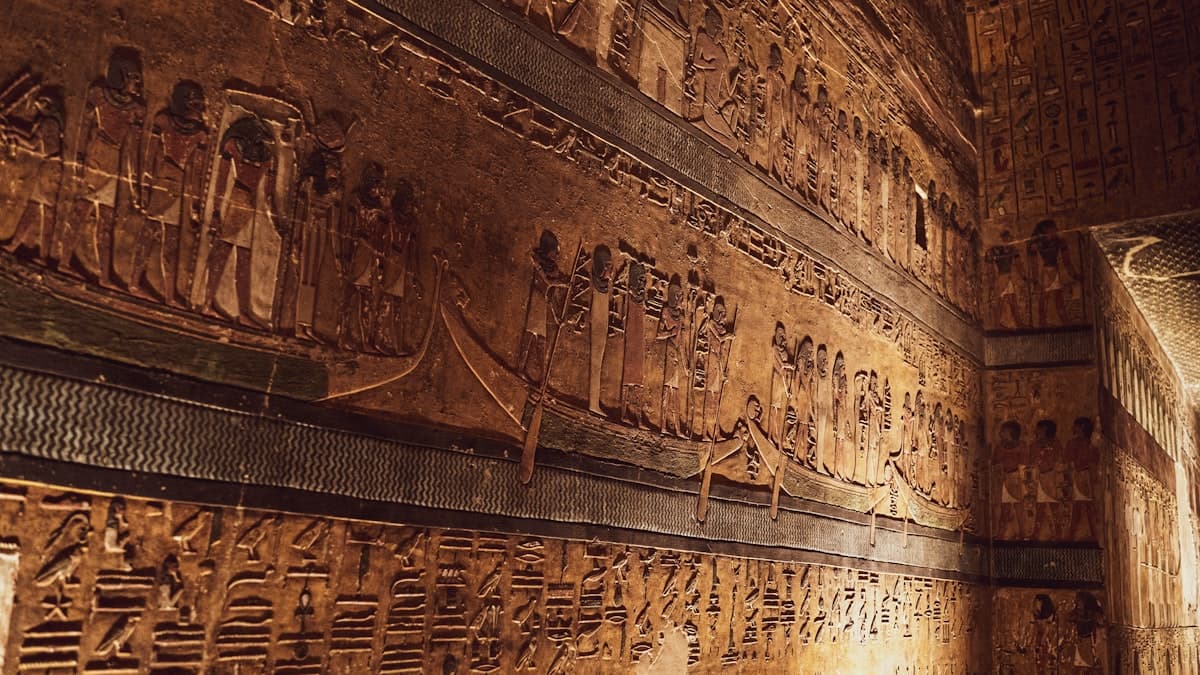
Reunification came from the south. Mentuhotep II of Thebes, the founder of Dynasty 11 and the Middle Kingdom, defeated the northern rulers around 2055 BC after decades of civil war. The Middle Kingdom, running through Dynasty 12, is considered by many Egyptologists the classical period of Egyptian culture: the literature produced then, including the Story of Sinuhe and the Eloquent Peasant, was still being copied by scribes 1,000 years later as models of perfect composition.
The Middle Kingdom pharaohs moved the capital to Itjtawy near the Faiyum, built extensive irrigation projects in the Faiyum depression, and pushed trade networks into Nubia, the Levant, and Punt. Dynasty 12 pharaohs built pyramid complexes at Dahshur and Hawara, though constructed of mudbrick with limestone casing rather than solid stone, they have mostly collapsed. The Pyramid of Amenemhat III at Hawara had a mortuary complex so labyrinthine that Herodotus called it the Labyrinth and claimed it surpassed the pyramids in complexity. It no longer exists above ground. The mudbrick interior dissolved over centuries. What remains is a low mound in an agricultural field near the Faiyum, visited by almost nobody.
The New Kingdom: The Age That Dominates the Imagination
Dynasties 18 through 20, spanning 1550 to 1070 BC, represent what most people mean when they picture ancient Egypt: Tutankhamun, Nefertiti, Ramesses II, Abu Simbel, the Valley of the Kings. This is the period that defines the complete guide to ancient Egyptian dynasties in popular culture, and it is genuinely extraordinary, but knowing why it happened matters as much as the monuments it left.
The New Kingdom began as a military response to trauma. The Hyksos, a people from the Levant who had settled in the Delta and gradually taken political control during the Second Intermediate Period, were expelled by Ahmose I around 1550 BC. The experience permanently changed Egyptian foreign policy. Where the Old and Middle Kingdoms had been essentially inward-looking, New Kingdom pharaohs pursued empire aggressively, pushing into Nubia as far south as the Fourth Cataract and into the Levant as far as modern Syria. Egypt became, for about 400 years, the dominant superpower of the ancient world.
The Valley of the Kings, used for royal burials from Thutmose I through Ramesses XI, contains 63 known tombs. Howard Carter opened Tutankhamun's tomb, KV62, in November 1922 and found it essentially intact. What that moment revealed was not just treasure: it was a complete picture of what a royal burial was supposed to contain. Tutankhamun was a minor pharaoh who died young and was buried hastily. If his tomb was this elaborate, the looted tombs of Seti I and Ramesses II were beyond imagination.
The Connections That Most Visitors Miss
The temple complex at Karnak is not simply an ancient Egyptian monument. It was added to by pharaohs across 2,000 years, from the Middle Kingdom through the Ptolemaic period, making it the largest religious structure ever built by human hands, covering approximately 100 hectares. The Copts used parts of it as a church. The Roman emperor Augustus added a sanctuary. When you walk through Karnak, you are moving through a structure where Ptolemaic columns stand against Middle Kingdom walls, and Christian crosses were carved into the faces of pharaohs. Egypt does not have layers; it has a continuous argument across time.
The Luxor Temple, connected to Karnak by a 3-kilometer avenue of sphinxes, has a mosque built directly into its structure: the Abu Haggag Mosque, dating to the 13th century, sits atop the ancient columns at the level of what was then ground level, before excavations lowered the courtyard by several meters. The mosque is still active. Friday prayers happen inside a pharaonic column hall. The building is simultaneously Islamic and Pharaonic, not metaphorically, but architecturally.
The Late Period and the End of Native Rule
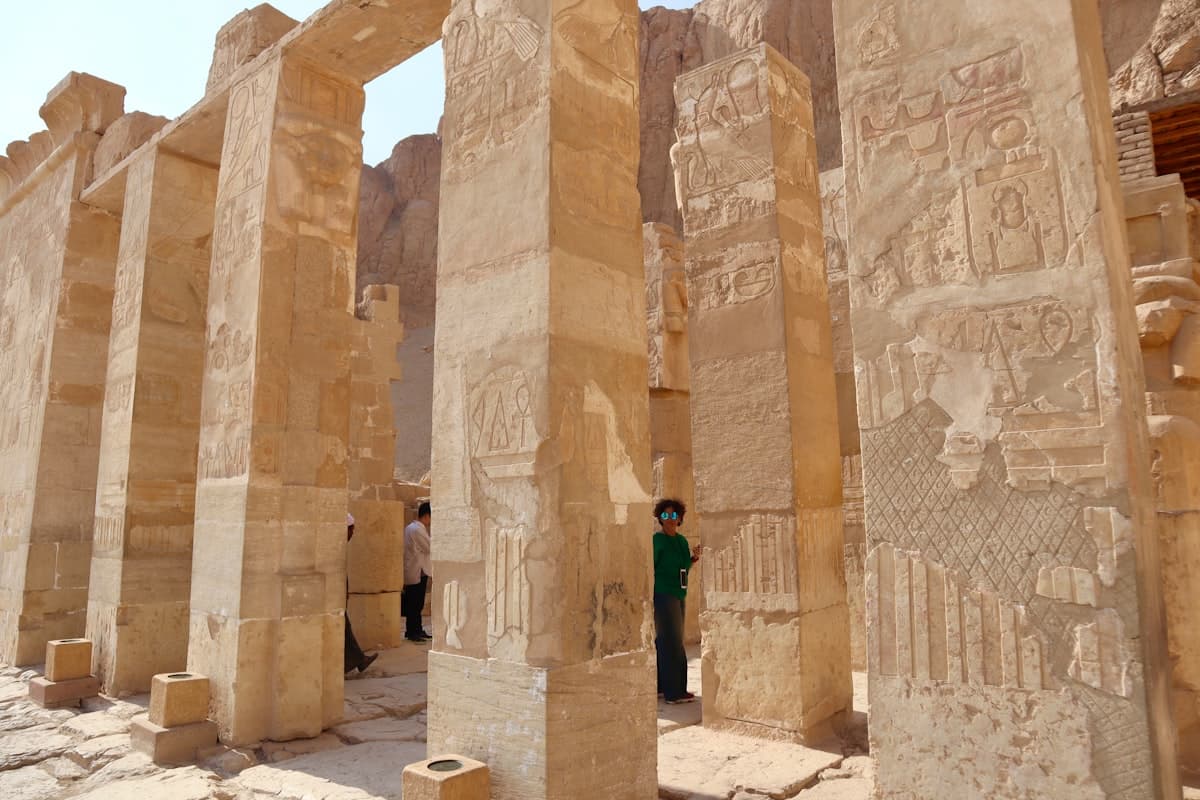
Dynasties 26 through 30 represent Egypt's last periods of native rule, interspersed with Persian occupations in 525 BC and 343 BC. The Saite pharaohs of Dynasty 26 were consciously archaizing: they deliberately copied Old Kingdom art, texts, and temple designs in an effort to invoke past legitimacy. This is why Late Period statuary is sometimes mistaken for much older work. Egypt was already looking backward at itself.
Alexander the Great took Egypt from the Persians in 332 BC without significant resistance. The Egyptians, having experienced Persian rule twice, were not sorry to see it end. Alexander visited the Oracle of Amun at Siwa Oasis, 560 kilometers west of Cairo in the Libyan Desert, where the oracle reportedly confirmed his divine parenthood. Whether Alexander believed it or found it politically useful, he took care to present himself as a pharaoh, not a conqueror. The Ptolemaic dynasty his general Ptolemy founded continued this strategy with remarkable commitment, learning Egyptian, adopting pharaonic titles, and building temples like Edfu and Dendera that are among the best-preserved in Egypt, precisely because they were built last.
Common Mistakes
Treating the dynasties as a sequence rather than a geography. Each kingdom had a different capital and a different center of gravity. The Old Kingdom is a Cairo-area story: Giza, Saqqara, Memphis. The Middle Kingdom is a Faiyum story. The New Kingdom is a Luxor story. Trying to understand all 30 dynasties from Cairo alone is like trying to understand European history exclusively from Paris.
Booking the sound and light show at Karnak. It costs EGP 450, lasts 75 minutes, tells you almost nothing you would not learn from a one-hour read, and the narration is dramatically overwritten. The money is better spent on a private Egyptologist guide for two hours at dawn, when the light is extraordinary and the crowds have not arrived.
Spending too much time at the Egyptian Museum in Tahrir instead of the Grand Egyptian Museum. The old museum is genuinely important, but its labeling is inconsistent, its lighting is poor in many galleries, and the layout has not been updated since 1902. The Grand Egyptian Museum at Giza, opened in phases since 2023, houses the complete Tutankhamun collection in conditions that finally do it justice. If you have one museum day, spend it at the GEM.
Skipping the Late Period entirely. Dynasties 26 through 30 are underrepresented in tour itineraries because there is less to see dramatically. But the Temple of Hibis at Kharga Oasis is the best-preserved temple from the Saite period, has extraordinary painted reliefs, and receives perhaps 200 visitors a year. It is 200 kilometers south of Luxor and requires a car, but nothing in Egypt compares for solitude.
Assuming Ramesses II was the greatest pharaoh. He was the most prolific self-promoter. He built more, inscribed his name more widely, and reigned longer than almost anyone else, 67 years. But Thutmose III, who preceded him by a century, won more battles, expanded Egypt further, and left military records at Karnak that historians consider the first detailed accounts of a military campaign in history. Ramesses II's reputation is partly a function of survival and partly a function of excellent publicity management.
Not hiring a licensed Egyptologist guide. The difference between visiting the Valley of the Kings alone and visiting with someone who reads Middle Egyptian is the difference between looking at a painting and reading the novel it illustrates. Prices start around EGP 1,500 for a half-day, or approximately $30 USD. This is among the best money you will spend in Egypt.
Believing the Ptolemaic temples are somehow less authentic. Edfu and Dendera are often dismissed as Roman-era tourist sites because they are so well-preserved. In fact, they were built using ancient plans and ancient religious texts, by Egyptian priests who had maintained unbroken ritual traditions for 2,000 years. The completeness of their hieroglyphic inscriptions is why Egyptologists can read ancient Egyptian at all.
Practical Tips
Buy a multi-site pass for the Luxor sites if you plan to visit more than three or four monuments. The Luxor Pass (available in two tiers, approximately $100 USD for the standard version and $200 USD for the premium version including the Royal Mummies Hall) covers entry to most West Bank and East Bank sites and saves significant money over three or more days.
Photography permits have become inconsistent across sites. At the Valley of the Kings, photography inside tombs is banned and enforced with varying seriousness depending on the inspector. At Saqqara, it is generally permitted with the standard ticket. Ask at the gate and do not assume.
The Nile cruises between Luxor and Aswan, running three to four nights, stop at Esna, Edfu, Kom Ombo, and Aswan. Prices range from EGP 15,000 to 60,000 per person depending on the vessel. The Ptolemaic temples along this route, Edfu in particular, are larger and better preserved than anything in Luxor. Do not skip them for a second day at the Valley of the Kings.
In Cairo, the Metro is the fastest way to reach central sites. A single journey costs EGP 10. Taxis from the airport to central Cairo run EGP 150-250 by meter. Car services through apps cost slightly more but have fixed prices. Do not negotiate taxi fares at the airport without establishing the destination clearly.
The ancient Egyptian dynasties complete guide you carry in your head should be a framework for curiosity, not a checklist. The point is not to see everything. The point is to understand that you are traveling through a civilization that lasted 3,000 years, which means that even a single site, a single wall of hieroglyphs, a single painted face in a tomb at Saqqara, contains more history than most countries have ever produced.
Frequently Asked Questions
The Weekly Dispatch
More on Egypt, every Friday.
Cultural depth and places most guides never mention.
No spam. Unsubscribe anytime.