Coptic Christianity in Egypt: A History and Travel Guide
Christianity reached Egypt before it reached Rome. The Coptic Church traces its founding to 42 AD, making it older than most of Europe's faith. Here is what that actually means to visit.

Quick Facts
- Best time to visit
- October to March for comfortable temperatures. January 7th (Coptic Christmas) is exceptional if you can attend a liturgy.
- Entrance fee
- Coptic Museum: EGP 200 adults (approx $4 USD), EGP 100 students. Most churches in the compound are free. Cave Church Mokattam: free.
- Opening hours
- Coptic Museum: Tuesday to Sunday, 9am to 5pm, closed Monday. Old Cairo churches: generally 9am to 4pm daily. Cave Church Mokattam: open daily, services Friday evenings.
- How to get there
- Cairo Metro Line 1 to Mari Girgis station, EGP 8 (under $0.20 USD). Taxi from downtown Cairo EGP 40 to 80. Taxi to Mokattam Cave Church EGP 60 to 100 from Old Cairo.
- Time needed
- 3 to 4 hours for Old Coptic Cairo alone. Full day to include Mokattam. Two days to include Coptic Museum properly and Wadi el-Natrun monasteries.
- Cost range
- Budget EGP 400 to 700 per day (entry, metro, street food). Mid-range EGP 1,200 to 2,000 including guide, restaurant, and taxis.
Christianity arrived in Egypt roughly four decades before Vesuvius buried Pompeii. Saint Mark the Evangelist is said to have founded the church in Alexandria in 42 AD, making the Coptic Orthodox Church one of the oldest continuously functioning Christian institutions on earth, predating the churches of Rome, Constantinople, and Canterbury by generations. Approximately 10 to 15 percent of Egypt's population, somewhere between ten and fifteen million people, are Coptic Christians. They are not a minority in the way the word implies fragility. They are a founding population of this country, and their fingerprints are on everything: the Arabic word for Egypt, "Misr", derives in part from the Coptic "Kimi", which itself comes from the ancient Egyptian word for the black land. Before you walk into a single church, understand that you are not visiting a remnant. You are visiting a living institution that has outlasted Roman emperors, Arab caliphs, Crusaders, Mamluks, Ottomans, and British colonizers.
Quick Facts
Best time to visit: October through March. Cairo summers are brutal (40°C and above), and most Coptic sites are in dense urban neighborhoods with limited shade. Coptic Christmas falls on January 7th (the Julian calendar diverges from the Gregorian by thirteen days), and attending a Christmas Eve liturgy at Saint Mark's Cathedral in Abbasiya, Cairo, or at the Hanging Church in Old Cairo is one of the genuinely rare travel experiences in this city.
Entrance fees: The Coptic Museum in Old Cairo charges EGP 200 for adults (approximately $4 USD), EGP 100 for students. Most churches in the Coptic Cairo complex are free to enter, though some, including the Hanging Church, have a small voluntary contribution box. Ben Ezra Synagogue within the same complex is free. The Cave Church (Saint Simon the Tanner) in Mokattam is free and open daily.
Opening hours: Coptic Museum: Tuesday to Sunday, 9am to 5pm, closed Monday. Churches in Old Coptic Cairo: generally 9am to 4pm daily, though hours shift during Coptic religious holidays when services run through the night. Arrive early on Sundays; the Hanging Church holds a morning mass around 8am that transforms the space entirely.
How to get there: The Cairo Metro Line 1 stops at Mari Girgis (Saint George) station, placing you directly at the entrance to Old Coptic Cairo for EGP 8 (less than $0.20 USD). From downtown Cairo, a taxi or ride-hail app costs EGP 40 to 80 depending on traffic. The Mokattam Cave Church requires a separate trip: taxi from Old Cairo takes about 25 minutes and costs EGP 60 to 100.
Time needed: Coptic Cairo alone deserves three to four hours minimum. Add Mokattam and you need a full day. If you are serious about Coptic Christianity in Egypt as a historical subject, budget two days to include the Coptic Museum properly and a visit to Deir Abu Maqar in Wadi el-Natrun (four hours from Cairo by road).
Cost range: Budget EGP 400 to 700 per day covering entry, metro, street food. Mid-range EGP 1,200 to 2,000 including a guide, restaurant lunch, and taxi transport.
Why This Place Matters
The conventional Coptic Christianity Egypt history guide begins with Saint Mark and ends with a list of churches. That is the wrong frame. Begin instead with persecution: between 284 and 305 AD, the Roman Emperor Diocletian killed so many Egyptian Christians that the Coptic Church began its own calendar, the "Anno Martyrum" or Year of the Martyrs, starting in 284 AD. Today, Coptic priests still read that date aloud during liturgy. When a Coptic priest in Cairo announces the year as AM 1741, he is counting time from the worst slaughter his ancestors survived.
This matters geographically. Old Coptic Cairo, the neighborhood known as Fustat before the Arab conquest of 641 AD, was built on and around a Roman fortress called Babylon. Not the Babylon of Mesopotamia, but a second-century Roman garrison whose walls you can still walk down into, descending several meters below street level to stand where Roman soldiers stood. The Hanging Church, Al-Muallaqah in Arabic, literally hangs over two of this fortress's towers. Its nave is suspended above two Roman towers that are themselves built on older Pharaonic foundations near a canal that once connected to the Nile. Three thousand years of civilization are stacked directly beneath your feet.
The Arab conquest of Egypt did not, as is sometimes assumed, end Coptic culture. The early Umayyad and Abbasid caliphs relied heavily on Coptic administrators because they were educated, numerate, and knew the land. The Arabic script itself was refined in part through contact with Coptic scribal traditions. Coptic gradually died as a spoken vernacular by around the 11th century AD, but it survived as a liturgical language, which is where you can hear it today, chanted in churches that were old before the mosque was invented.
What You Will Actually See in Old Coptic Cairo
The Hanging Church, consecrated somewhere around the late fourth century and rebuilt multiple times since, is the most visited. It is also genuinely worth the visit, though most people spend twenty minutes inside when it deserves ninety. The iconostasis, the screen separating the nave from the sanctuary, dates to the seventh and eighth centuries and contains forty-seven ivory inlaid panels depicting the apostles and the Virgin. The pulpit rests on thirteen columns representing Christ and the twelve apostles, and one column is deliberately darker than the others, representing Judas. No tour guide told you to look at that column. Now you will.
The Ben Ezra Synagogue sits inside the same compound and warrants ten minutes even if you are not there for Jewish history. The reason: in 1896, a Cambridge scholar named Solomon Schechter discovered nearly 300,000 medieval Jewish manuscript fragments hidden in the synagogue's geniza, a storage room for worn sacred texts. The Cairo Geniza, as it became known, turned out to be the most significant archive for medieval Mediterranean history ever found, revealing trade routes, family letters, and legal documents that rewrote historians' understanding of the 11th and 12th centuries. The room itself is plain. The implications are extraordinary.
The Church of Saints Sergius and Bacchus, Abu Serga, sits partially below street level, which means it has been sinking into Cairo for roughly fifteen centuries. A crypt inside is venerated as the site where the Holy Family rested during their flight into Egypt, a tradition that predates Islam in Egypt and that the Quran itself references. Whether or not the tradition is historically verifiable, the fact that this small cave-church crypt is mentioned in Islamic sacred geography alongside its Christian importance is exactly the kind of layered meaning that makes Egypt unlike anywhere else on earth.
The Cave Church and the City Above the City
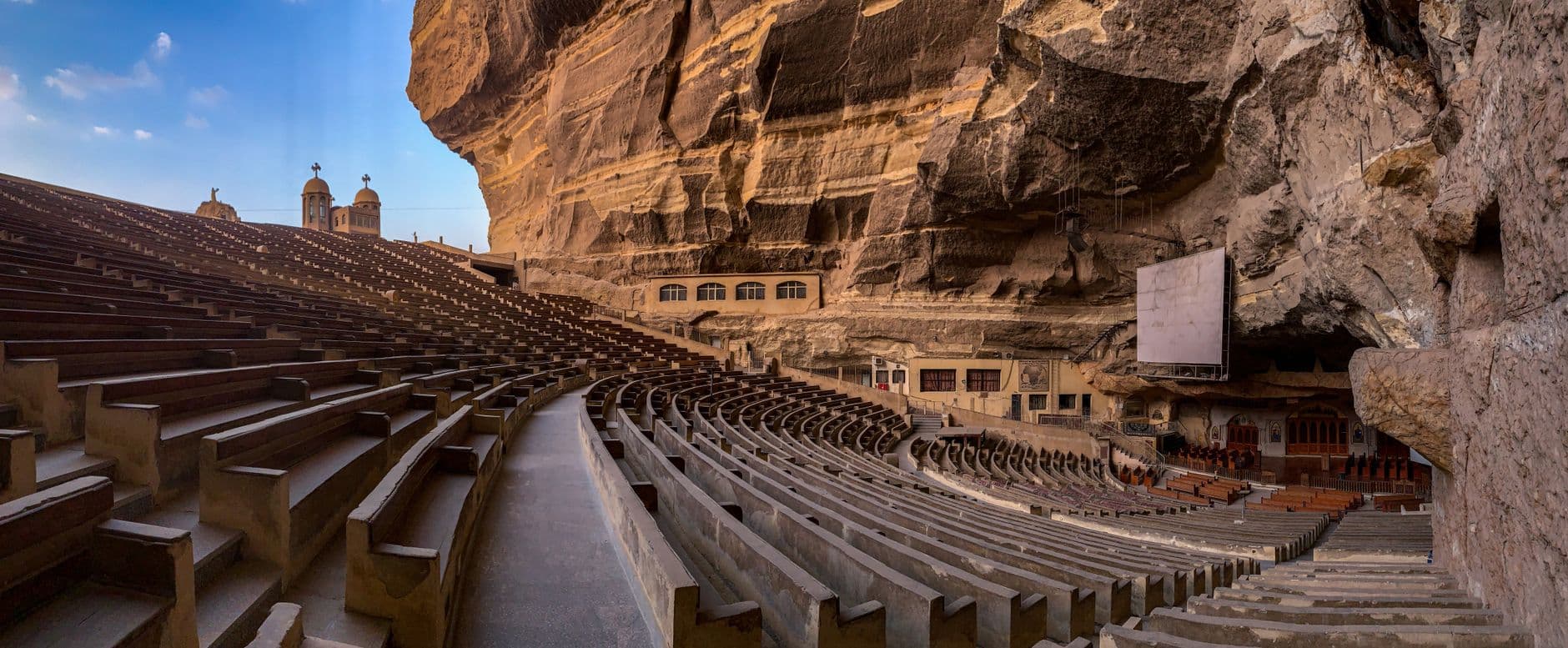
Sixty kilometers from Old Coptic Cairo but within the same city limits, the Mokattam Mountain neighborhood of Manshiyat Naser is home to the Zabbaleen, Cairo's informal garbage collectors, a community that has managed the city's waste since the 1940s and is predominantly Coptic Christian. Inside a series of caves in the cliff face above this neighborhood, Saint Simon the Tanner Church was carved and expanded from the 1970s onward into a complex that now seats 20,000 people, making it one of the largest churches in the Middle East.
The carvings on the cave walls, biblical scenes rendered into the living rock by a local Armenian-Egyptian sculptor named Mario, were completed over two decades beginning in 1976. The Sermon on the Mount occupies a full cliff face. Sitting inside during a Friday evening prayer service, with the city of Cairo spread below and the smell of incense mixing with the dust of the cliff, is one of the most genuinely affecting experiences this city offers. It is free to enter. It draws almost no international tourists. This is not a hidden gem (a phrase that means nothing). It is simply a place that has not been packaged yet.
The Connections: Copts, Pharaohs, and the Long Thread
The Coptic language is a direct descendant of ancient Egyptian. When Coptic priests chant the liturgy, they are producing sounds that are closer to the language of Ramesses II than any modern Arabic or Hebrew. This is not metaphor. Coptic uses the Greek alphabet supplemented by seven additional letters derived directly from Demotic Egyptian script. The word "Coptic" itself comes from the Greek "Aigyptos", which comes from the ancient Egyptian "Hwt-Ka-Ptah", one of the names for Memphis. The word Egypt is a Coptic word worn down by Greek pronunciation.
Monastic Christianity was essentially invented in Egypt. Saint Anthony of Egypt, born around 251 AD in Middle Egypt near Beni Suef, retreated to the eastern desert around 270 AD and established the principles of Christian monasticism that would eventually spread to Ireland, Ethiopia, and beyond. The Monastery of Saint Anthony near the Red Sea, the oldest Christian monastery in the world in continuous use, was founded by his disciples and still functions today with approximately 120 monks in residence. When medieval European monks knelt in silent cells, they were practicing a spiritual technology developed in the Egyptian desert.
The Wadi el-Natrun monasteries, four hours northwest of Cairo, connect the Coptic story to the desert fathers who shaped all of Western Christianity. Deir Abu Maqar (Saint Macarius Monastery) has operated continuously since the fourth century. Pope Shenouda III, who led the Coptic Church for 40 years until his death in 2012, spent periods of internal exile there under President Sadat, reading and writing in a desert cell. The monastery's library contains Coptic manuscripts that predate most European medieval libraries.
Common Mistakes
Treating Old Coptic Cairo as a single monument. Most visitors do the Hanging Church, glance at Abu Serga, and leave. The Coptic Museum next door holds the world's largest collection of Coptic art, including the only surviving Gnostic gospels from Nag Hammadi (Egypt, 1945), textiles from the third century, and carved stonework that shows the exact visual moment when Pharaonic iconography transformed into Christian iconography. The museum deserves two hours. Most visitors give it twenty minutes.
Visiting on a Monday. The Coptic Museum is closed. This affects many visitors who do not check.
Taking a guided tour of the churches without a specifically Coptic-trained guide. Generic Cairo guides cover the Hanging Church in twelve minutes and leave out the Judas column, the Roman towers, and the entire geniza story. Ask specifically for a Coptic Christian guide, several of whom operate independently and can be found through the Egyptian Guides Syndicate or through the Coptic Cultural Center in Shubra.
Skipping the Mokattam Cave Church. This is the honest contrarian take: if you have limited time and must choose between a second visit to the Hanging Church and a first visit to Saint Simon's Cave Church in Mokattam, go to Mokattam. The Hanging Church's exterior and interior are well-documented, photographed, and described everywhere. The Cave Church is a living religious community of 20,000 people carved into a cliff above a neighborhood that manages Cairo's garbage. It tells you more about modern Coptic Egypt than any ancient monument does.
Dressing inappropriately. Shoulders and knees must be covered in all Coptic churches, same as mosques. This is not a suggestion. Visitors who arrive uncovered are turned away or handed embarrassing plastic coverings at the door.
Visiting during Holy Week without planning ahead. Coptic Holy Week (the week before Coptic Easter, which falls on a different date from Western Easter) is extraordinary, but the churches are packed beyond capacity, and some are restricted to congregation members for certain services. Plan around it or embrace it fully, but do not wander in expecting easy access.
Practical Tips
The Mari Girgis Metro stop is the right way to arrive. Taxis drop you on the wrong side of the neighborhood and you lose fifteen minutes navigating.
Water and food are available on the street outside the Coptic Cairo complex but not inside. Eat before you go, or plan a meal afterward in Old Cairo at one of the restaurants along the Nile corniche near Fustat.
The Coptic Museum's permanent collection is strong but the labeling is inconsistent: some objects have detailed English descriptions, others have nothing. Buy the official museum catalog at the entrance desk for EGP 80. It fills the gaps.
Photography is permitted inside most churches but not during services. If a service is happening when you arrive, wait or sit quietly at the back. The Hanging Church's morning mass on Sunday is worth sitting through in full: forty minutes of Coptic chant in a seventh-century building is a more memorable experience than any photograph.
For the Wadi el-Natrun monasteries, rent a car or hire a driver for the day (EGP 1,200 to 1,800 for a round trip from Cairo with waiting time). The monasteries are accessible but require advance notice if you want to enter the inner sections. Call Deir Anba Bishoy or Deir Abu Maqar directly at least three days ahead. Visiting on a weekday is quieter. Fridays bring large numbers of Egyptian Christian pilgrims.
Frequently Asked Questions
The Weekly Dispatch
More on Egypt, every Friday.
Cultural depth and places most guides never mention.
No spam. Unsubscribe anytime.