Egypt's 1952 Revolution: A History Guide for Cairo
Nasser's officers took power in 90 minutes without firing a single shot. Cairo still carries the revolution in its bones. Most visitors never find it.

Quick Facts
- Best time to visit
- October to April. Temperatures are manageable for walking between sites and the light in late afternoon is favorable for outdoor photography. Summer months exceed 38C regularly and compress your usable day significantly.
- Entrance fee
- Egyptian Museum: EGP 450 (approx. $9 USD), mummy room extra EGP 180 ($3.60). NMEC Fustat: EGP 200 ($4). Abdin Palace: EGP 100 ($2). Cairo Tower: EGP 100 ($2).
- Opening hours
- Egyptian Museum daily 9am to 5pm (last entry 4pm). NMEC daily 9am to 5pm, closed Tuesdays. Abdin Palace daily 9am to 3pm, closed Fridays.
- How to get there
- Metro Line 1 to Sadat Station for Tahrir Square and the Egyptian Museum (EGP 10 flat fare). Metro Line 1 to Mar Girgis for NMEC and Old Cairo. Uber from Downtown to Heliopolis runs EGP 80 to 120 depending on traffic time.
- Time needed
- Two full days minimum. Day one: Egyptian Museum and Tahrir Square area. Day two: NMEC, Old Cairo layers, and Heliopolis. A third day allows Abdin Palace and neighborhood walking in Garden City and Downtown.
- Cost range
- Budget EGP 800 to 1,200 per day including metro, entry fees, and meals at local restaurants. Mid-range EGP 2,000 to 3,500 per day with Uber travel and a specialist guide.
Quick Facts
Best time to visit: October to April, when Cairo temperatures drop below 30°C and outdoor sites are walkable without damage to your concentration. July and August are punishing, and the heat shortens the amount of time you can spend at outdoor monuments.
Entrance fees: The Egyptian Museum (Tahrir Square): EGP 450 (approx. $9 USD), mummy room an additional EGP 180 ($3.60). The National Museum of Egyptian Civilization in Fustat: EGP 200 ($4). The Mohamed Ali Palace in Shubra: EGP 100 ($2), rarely visited, frequently empty.
Opening hours: Egyptian Museum daily 9am to 5pm (last entry 4pm). NMEC daily 9am to 5pm, closed Tuesdays. Mohamed Ali Palace daily 9am to 3pm, closed for Friday prayers.
How to get there: The Egyptian Museum sits on Tahrir Square, reachable by Metro Line 1 (Sadat Station, EGP 10 flat fare). The NMEC in Fustat is a EGP 50 to 80 Uber ride from Downtown, or take Line 1 to Mar Girgis and walk 15 minutes. Taxis from Tahrir to Shubra Palace run EGP 60 to 90.
Time needed: Two full days minimum if you are serious: one for the Egyptian Museum and Tahrir Square itself, one for the NMEC, Shubra, and the Republican Guard Club in Heliopolis where the coup was coordinated.
Cost range: Budget EGP 800 to 1,200 per day including transport, entry, and food from neighborhood restaurants. Mid-range EGP 2,000 to 3,500 if you add a guide.
---
Why This Place Matters
On the night of July 22 into July 23, 1952, a group of Egyptian army officers calling themselves the Free Officers Movement moved against King Farouk's regime. They occupied the army headquarters in Cairo, the telephone exchange, the radio station, and the airport. By dawn it was over. The king abdicated three days later and sailed into exile from Alexandria on the royal yacht. He was permitted to take 200 pieces of luggage.
What followed was not simply a change of government. The revolution of 1952, formally called the Egyptian Revolution, ended 2,500 years of foreign rule over Egypt in an almost unbroken sequence: Persian, Greek, Roman, Byzantine, Arab, Fatimid, Ayyubid, Mamluk, Ottoman, French, British. The officers who took power in 90 minutes were the first indigenous rulers of Egypt since the last native pharaoh, Nectanebo II, fled before Alexander the Great's army in 343 BC.
This is the frame through which modern Egypt understands itself, and Cairo is where that frame was built, broken, rebuilt, and is currently under negotiation.
Most visitors to Cairo treat the revolution as background noise: something that happened between the pharaohs and now. But the modern Egypt revolution 1952 history guide that actually does the subject justice has to put you in the city where it unfolded, because the sites are still there, some of them openly, some of them hiding behind other names.
---
Tahrir Square and the Egyptian Museum: The Revolution's Living Room
Tahrir Square is not beautiful. It is a traffic roundabout ringed by brutalist government buildings, perpetually congested, with a political weight entirely disproportionate to its physical appearance. It was called Ismailia Square under the monarchy, named for Khedive Ismail, the Ottoman viceroy who spent Egypt into bankruptcy building a European-style city in the 1860s and 1870s. The Free Officers renamed it Tahrir, meaning Liberation, after 1952. In 2011, eighteen days of occupation here brought down another president. The square earns its name repeatedly.
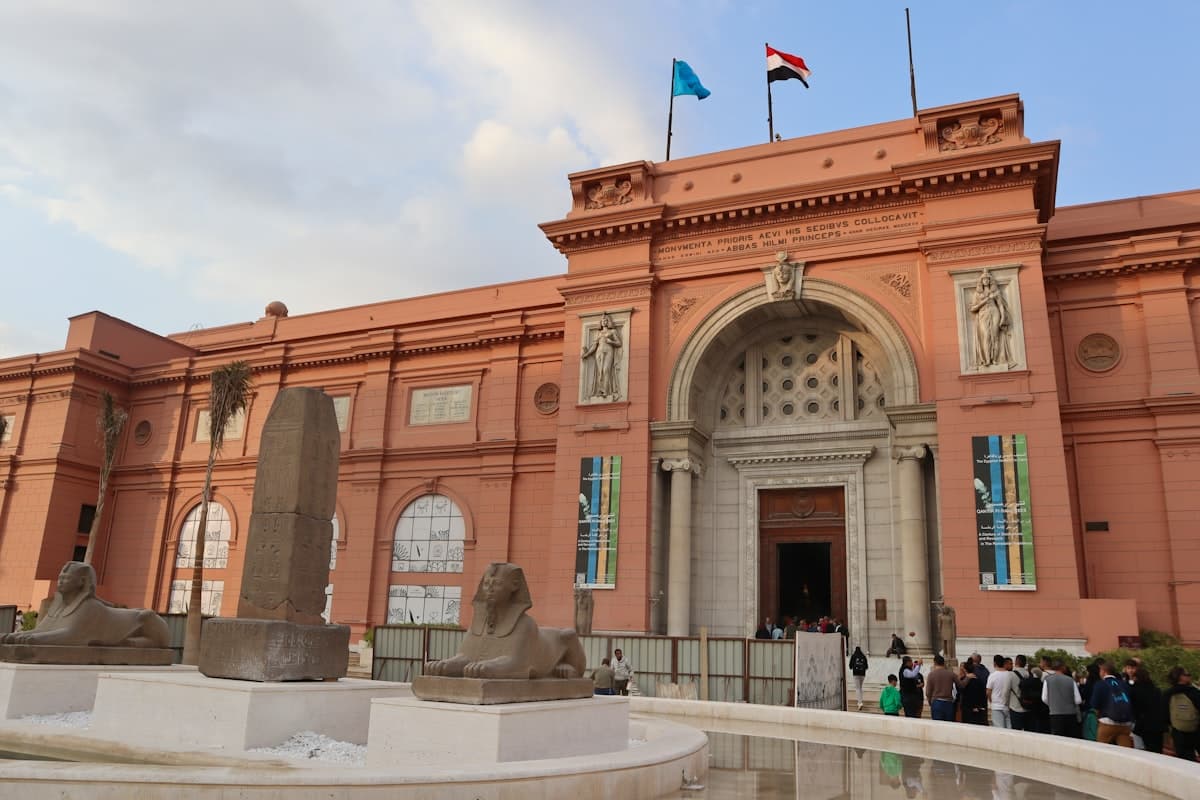
The Egyptian Museum sits on the northern edge of Tahrir, a dusty pink building completed in 1902, and it is both indispensable and genuinely difficult. The collection of 170,000 objects is displayed in roughly the order in which it was acquired over a century, which is to say it is organized with the logic of a warehouse rather than a museum. The Tutankhamun galleries on the upper floor contain 5,398 individual objects recovered from his tomb, including the two wooden statues that stood guard at the sealed doorway, painted black to represent the skin of Osiris in the afterlife. Howard Carter's excavation team spent ten years cataloguing the tomb's contents. Most visitors spend forty-five minutes in the room.
What most visitors walk past entirely is the modest display case in the central hall containing objects from the reign of Ahmose I, the pharaoh who expelled the Hyksos from Egypt around 1550 BC and reunified the country after a century of foreign rule. The curators placed it there without commentary, but its echo in the 1952 revolution is not subtle. Egypt has a very old habit of narrating itself as the story of expulsion and return.
Skip the Egyptian Museum's sound and light equivalent: the overpriced guided audio tour costs EGP 100 and repeats information printed on the placards. The placards are free.
---
The National Museum of Egyptian Civilization: Where the Story Becomes Continuous
The NMEC in Fustat is the museum the Egyptian Museum always should have been, and it opened in stages from 2017 to 2021, so most visitors who formed their mental image of Cairo before then have not yet updated their itinerary to include it. This is a mistake.
The museum traces Egyptian civilization from prehistoric times to the present in a single, coherent narrative, which means it is the only institution in Cairo that treats the 1952 revolution as part of the same story as Ramesses II, the Fatimid caliphate, and Napoleon's brief occupation of 1798 to 1801. The gallery covering the 19th and 20th centuries contains original documents from the revolution, photographs of the Free Officers, and artifacts from the Nasserist period that are not available anywhere else outside of private collections.
Fustat itself rewards attention. The district sits on the site of the first Islamic city in Egypt, founded in 641 AD by the Arab general Amr ibn al-As after his conquest of the Byzantine province. The Mosque of Amr ibn al-As still stands nearby, the oldest mosque in Africa, though almost nothing of the original 7th-century structure survives since it has been demolished and rebuilt seven times. Directly adjacent is the Coptic quarter of Old Cairo, where the Church of Saint Sergius and Bacchus was built into a Roman fortress, and where, according to Coptic tradition, the Holy Family sheltered during their flight into Egypt. Roman, Coptic, Islamic, and modern Egypt occupy roughly one square kilometer here. The NMEC is the first institution to say this out loud clearly.
Entry is EGP 200. On weekdays before noon it is quiet enough to read the wall text without someone standing on your foot.
---
The Revolution's Architecture: What Cairo Built and What It Demolished
Gamal Abdel Nasser, the revolution's dominant figure from 1954 until his death in 1970, had a specific relationship with Cairo's built environment: he demolished what reminded him of the monarchy and built what reminded Egyptians of the state.
The most visible demolition was the Royal Automobile Club in Garden City, torn down to widen the Corniche. Less visible but more significant: the Abdin Palace complex in Downtown, which had been the primary royal residence, was converted into a museum and state reception venue. It is open to visitors and rarely discussed in travel guides. The Farouk-era furnishings remain largely intact, a peculiar exhibit in which the revolution preserved the very opulence it claimed to be destroying.
What Nasser built is everywhere, though it is rarely labeled as his work. The Nile Corniche road that runs the length of Cairo was largely constructed during the 1950s and 1960s. The Tahrir Square complex of government buildings dates from the same period. The Cairo Tower on Gezira Island was completed in 1961 and designed to look, from above, like a lotus flower in Pharaonic style: Nasser was perfectly willing to invoke the ancient past when it served him, even as he replaced the royal iconography with republican symbols.
The tower was partly funded by the CIA, which gave Nasser $3 million in 1956 as a bribe intended to keep Egypt in the Western orbit during the Cold War. Nasser used the money to build the tower and reportedly told his aides he was giving the Americans a concrete finger. Whether the story is apocryphal or not, Egyptians tell it constantly, with a particular kind of satisfaction.
---
The Connections: From Pharaohs to Officers to the Arab Spring
The modern Egypt revolution 1952 history is inseparable from the physical layers of Cairo because every layer of the city reflects a version of the same argument: who belongs here, who rules legitimately, and what the past authorizes.
The Republican Guard Club in Heliopolis, where the Free Officers held their planning meetings in the months before the coup, occupies a building in a neighborhood that was itself built as a utopian European colony by Belgian baron Edouard Empain between 1905 and 1910. Empain's own palace, the Hindu-Baroque confection now known as the Baron Palace on the intersection of Al-Orouba and Ibrahim Laqany streets, still stands, partially restored after decades of abandonment. Farouk's officers planning a revolution against a monarchy used a British-era club in a Belgian-built neighborhood on land that had been desert two generations earlier. Cairo accumulates layers faster than most cities and forgets them more completely.
The Coptic connection is specific: the Coptic Christian community, roughly 10 percent of Egypt's population, was disproportionately represented in the professional and merchant class under the monarchy. The 1952 revolution's rhetoric of Egyptian identity over religious or ethnic identity was partly a Coptic calculation as well as a Muslim one. Boutros Boutros-Ghali, later UN Secretary-General, served as Egypt's Foreign Minister from 1977 to 1991, a Coptic holding one of the most sensitive posts in a Muslim-majority state: a continuity from the non-sectarian nationalism the revolution claimed to represent.
Six kilometers south of Tahrir Square, in the Old Cairo district, the synagogue of Ben Ezra is a reminder of what the revolution erased alongside what it built. Egypt's Jewish community numbered around 80,000 in 1948. By 1967, through emigration, expulsion, and statelessness, fewer than 3,000 remained. Ben Ezra is maintained as a heritage site. It holds services approximately never.
---
Common Mistakes
Treating the Egyptian Museum as the whole story. The NMEC in Fustat exists and it is better organized, less crowded, and covers the period from 1800 to now with actual intelligence. Do not visit Cairo without going to both.
Going to Tahrir Square and expecting atmosphere. It is a traffic circle. The significance is historical and political, not aesthetic. Read before you go, or hire a guide who lived through 2011, not one who describes it as a tourist attraction.
The Nile Dinner Cruise. Costs between EGP 800 and EGP 1,500 per person, delivers mediocre food and a belly dance show designed for groups from the Gulf. The view of the Nile from the Corniche is free and more honest.
Visiting Abdin Palace without knowing what it is. Most visitors who stumble in think it is a state building they have wandered into by accident and leave quickly. It is a museum of the monarchy's last decades, including Farouk's personal effects, and it is one of the stranger museums in the world. Give it an hour.
Hiring a guide who skips the 20th century. Most Cairo guides are trained in Pharaonic and Islamic history because that is what most visitors pay for. The 1952 revolution and its consequences require a guide with a different formation. Ask explicitly before booking.
Visiting the Baron Palace without checking restoration status. The building has been under intermittent restoration since 2020 and access rules change without notice. Confirm before making it a centerpiece of a day.
Skipping the neighborhoods. Heliopolis, Garden City, Zamalek, and Downtown Cairo are all legible documents of the revolution's before and after. Walking them with a decent map and some background reading teaches more than a formal site visit.
---
Practical Tips
October through March is when Cairo functions best for this kind of itinerary, which is heavily pedestrian. The Egyptian Museum and NMEC are air-conditioned but travel between sites is not.
Metro Line 1 connects most of the relevant sites and costs EGP 10 per ride flat fare. Taxis and Uber are reliable in Cairo and cheap by any international standard: a 20-minute ride rarely exceeds EGP 80 to 120.
For guides, look for historians rather than licensed tour guides. The Egyptian Center for Culture and Arts (Makan) in Downtown Cairo occasionally runs history walks led by academics. The fees are modest and the quality is significantly higher than most commercial operators.
Friday mornings, before noon, most sites are quiet. Friday afternoons are crowded with Egyptian families, which is its own kind of education about how Egyptians use their own heritage spaces, but not ideal for reading placards.
Photography inside the Egyptian Museum requires a EGP 50 camera ticket. At the NMEC, photography is permitted without a surcharge. At Abdin Palace, ask on arrival as the rules are inconsistently enforced.
Food in the Downtown area near Tahrir: Koshary Abou Tarek on Champollion Street has been serving Egypt's national dish since 1950, which puts it in operation during the revolution. A large bowl is EGP 45. This is not a coincidence to note self-consciously: it is simply a fact that makes the meal taste different.
Frequently Asked Questions
The Weekly Dispatch
More on Egypt, every Friday.
Cultural depth and places most guides never mention.
No spam. Unsubscribe anytime.