Islamic Golden Age Cairo: A Complete History Guide
Cairo's medieval Islamic quarter contains more intact medieval architecture than any city on earth. Most visitors spend 90 minutes there. Here is what that costs you.

Quick Facts
- Best time to visit
- October through March. Spring and autumn mornings are ideal. Summer temperatures in the narrow alleys of the medieval quarter regularly exceed 38C by midday.
- Entrance fee
- Al-Azhar Mosque free. Bab Zuweila towers EGP 100 (approx $2 USD). Al-Muizz Street combined monuments EGP 300 (approx $6 USD). Sultan Hassan and Al-Rifa'i mosques EGP 200 each (approx $4 USD). Cairo Citadel EGP 450 (approx $9 USD).
- Opening hours
- Most monuments 9am to 5pm daily. Al-Azhar closes to non-Muslim visitors during Friday prayer (approx 11:30am to 1:30pm). Cairo Citadel opens 8am.
- How to get there
- Cairo Metro Line 1 to Mar Girgis station (EGP 8), then taxi or Careem north to Bab Zuweila (EGP 30 to 50). Alternatively, direct taxi from central Cairo to Bab Zuweila for EGP 50 to 80 depending on traffic.
- Time needed
- Minimum four hours for Al-Muizz Street alone. Full day to include Sultan Hassan, Al-Azhar, and Khan el-Khalili. Two days recommended to add the Citadel and Coptic Cairo for context.
- Cost range
- Budget EGP 600 to 900 per day including entry fees and street food. Mid-range EGP 1,800 to 2,800 per day including a licensed guide and restaurant lunch.
Quick Facts
Best time to visit: October through March. Summer heat in the narrow alleys of Islamic Cairo turns stone into a radiator by 10am.
Entrance fees: Al-Azhar Mosque: free. Khan el-Khalili bazaar: free to enter. Bab Zuweila gate towers: EGP 100 (approx $2 USD). Al-Muizz Street monuments combined ticket: EGP 300 (approx $6 USD) for the major complexes. Cairo Citadel complex (Muhammad Ali Mosque plus towers): EGP 450 (approx $9 USD). Individual Mamluk mosque complexes such as Sultan Hassan and Al-Rifa'i: EGP 200 each (approx $4 USD).
Opening hours: Most mosques open daily from 9am to 5pm. Al-Azhar closes to non-Muslim visitors during Friday prayer (roughly 11:30am to 1:30pm). The Citadel opens at 8am.
How to get there: From Tahrir Square, take the Cairo Metro Line 1 to Mar Girgis, then a taxi or rideshare (Uber/Careem, approximately EGP 30 to 50) north to Al-Muizz Street. Alternatively, take a taxi from central Cairo directly to Bab Zuweila: expect EGP 50 to 80 depending on traffic.
Time needed: Al-Muizz Street alone deserves four hours minimum. Add Sultan Hassan Mosque and the Citadel and you have a full day. Two days is not excessive.
Cost range: Budget EGP 600 to 900 per day including entry fees and street food. Mid-range EGP 1,800 to 2,800 per day including a guided tour and a sit-down lunch in the area.
---
The city Cairo replaced, al-Fustat, was burned to the ground by its own governor in 1168. He did it deliberately, to prevent Crusader forces from capturing it and using it as a supply base. The fire burned for 54 days. What rose from those ashes, over the following four centuries, became one of the most architecturally dense capitals the medieval world ever produced. You are walking through it right now, and most of the tour buses will be gone by noon.
Why This Place Matters
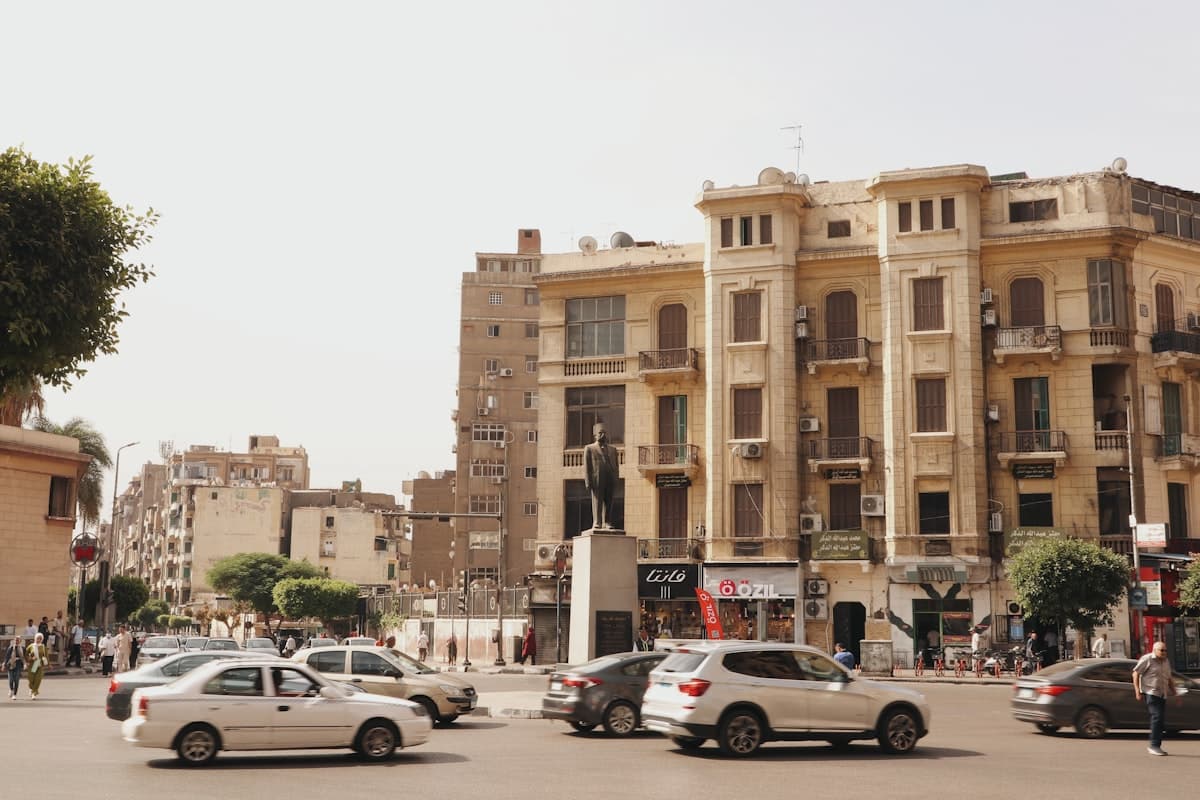
The term "Islamic Golden Age" gets applied loosely to a period stretching from roughly the 8th to the 13th century, the centuries when Islamic civilization led the world in mathematics, astronomy, medicine, and architecture. Cairo entered this story late and stayed longest. While Baghdad burned under the Mongols in 1258, Cairo's Mamluk sultans absorbed the refugees, including scholars, architects, and calligraphers, and channeled that intellectual energy into stone.
The result is Al-Muizz li-Din Allah Street, named for the Fatimid caliph who founded Cairo in 969 CE and whose army general, Jawhar al-Siqilli, a former Greek slave from Sicily, planned its original grid. UNESCO calls it an open-air museum of Islamic architecture. That phrase undersells it. It is a living street where people still buy spices in shops that occupy the ground floors of 14th-century buildings. The minarets overhead are not restoration projects. They are originals.
What makes Cairo's Islamic heritage distinct from, say, Istanbul or Isfahan is its layering. Fatimid walls enclose Ayyubid gates that were reinforced by Mamluk sultans whose mausoleums face Ottoman fountains. Nothing was cleared. Everything was built on top of, beside, or incorporating what came before. The Mosque of Amr ibn al-As in Fustat, the first mosque ever built on African soil, was constructed in 641 CE, nine years after the Prophet Muhammad's death. It stands today, expanded beyond recognition but still on the same footprint, in a neighborhood where Coptic churches are visible from its courtyard.
Al-Muizz Street: What You Are Actually Looking At
Start at Bab Zuweila, the southern gate of the Fatimid city, built in 1092 CE. For a reason that historians still debate, it became the city's execution ground under the Mamluks. The last Mamluk sultan, Tuman Bay, was hanged from its arch three times in 1517 because the rope kept breaking. The Ottoman executioners took this as a bad omen. They hanged him a fourth time, and it held.
Climb the gate towers. EGP 100 is the most underpriced entry fee in Egypt. From the top you can see the full spine of Al-Muizz Street running north, the minarets of the Mosque of al-Mu'ayyad directly attached to the gate (he built his mosque there specifically because he had once been imprisoned in the gatehouse and vowed to replace it with a place of prayer if he survived), the Citadel to the southeast, and on a clear winter morning, the very tip of the Giza pyramids to the southwest.
Walking north, you pass the Ghuriya complex, built in 1505 by the second-to-last Mamluk sultan, Qansuh al-Ghuri, who was 70 years old when he commissioned it and died at the Battle of Marj Dabiq in 1516, the battle that ended Mamluk rule. His tomb in the complex's mausoleum is empty. His body was never recovered. The caretaker will tell you this if you ask.
The Sabil-Kuttab of Abd al-Rahman Katkhuda, built in 1744, marks the street's midpoint. A sabil is a public water fountain, an institution as old as Islamic Cairo itself. A kuttab is a Quranic school for children, traditionally built above the sabil so the sound of water rose through the floor while the children memorized. The Ottoman bureaucrat who built this one was essentially buying his way into God's favor after a career of political double-dealing. The building is exquisite regardless of his motives.
Al-Azhar and the Oldest University on Earth
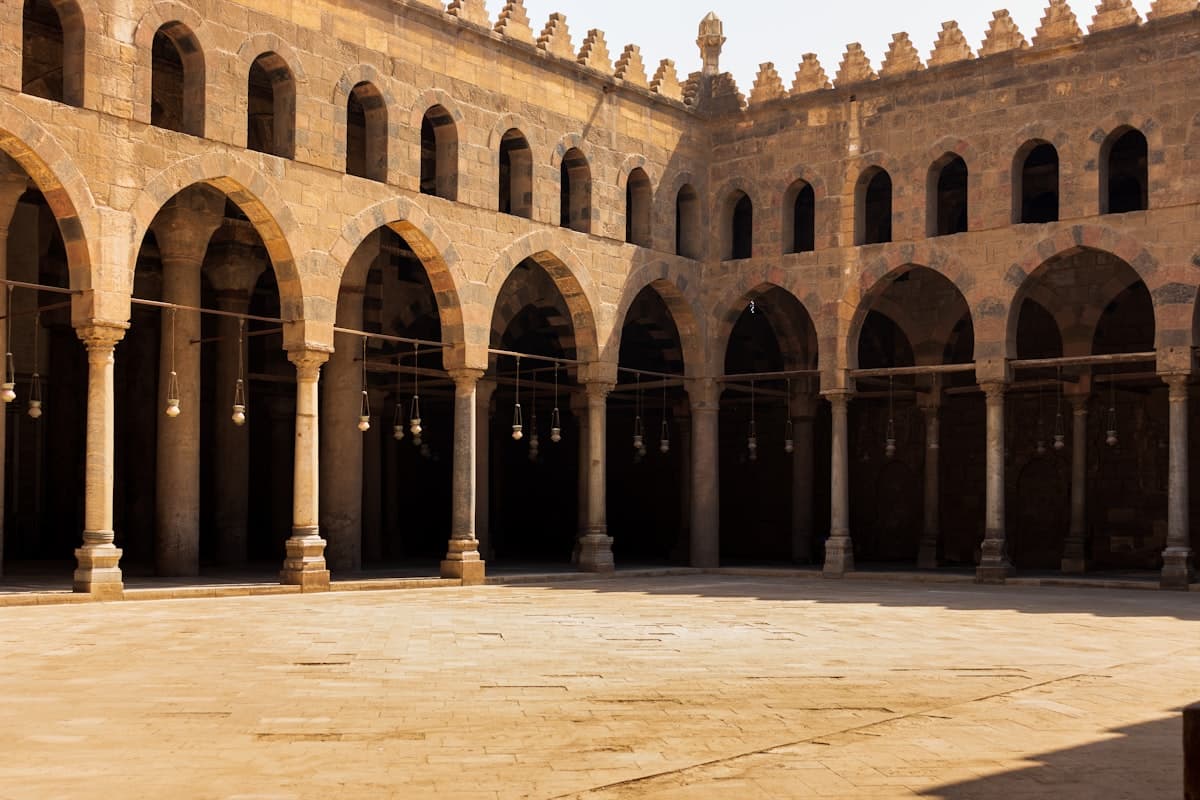
Al-Azhar Mosque was founded in 970 CE, one year after Cairo itself. Its attached university began teaching in 975 CE, making it, by most scholarly measures, the oldest continuously operating university on earth, predating Bologna (1088) and Oxford (1096 to 1167) by over a century.
The university survived the fall of the Fatimids, the Ayyubids, the Mamluks, the Ottomans, the French occupation, and British colonialism, and today has around 500,000 students enrolled globally. What you see when you enter the mosque is the original Fatimid courtyard surrounded by centuries of additions: an Ayyubid minaret, Mamluk arcades, Ottoman gates. The southern minaret was added by Qaitbay in 1469, the same sultan who built the fort at Alexandria's harbor that still bears his name.
Non-Muslim visitors are welcome in the courtyard and prayer hall outside of prayer times. Remove your shoes. Women will be offered an abaya at the entrance; bring your own if you prefer. Spend time in the courtyard rather than hurrying through. The acoustics in the late morning, when students still chant in the teaching arcades on the far side, are unlike anything you will find in a controlled tourist site.
The sound and light show at the Citadel costs EGP 350 and delivers 45 minutes of theatrical narration that confuses the Fatimid and Mamluk periods, mispronounces three sultan names, and tells you nothing you will not get from this article. Skip it. Spend that hour and a half at Al-Azhar at sunset instead.
Sultan Hassan and the Mathematics of Power
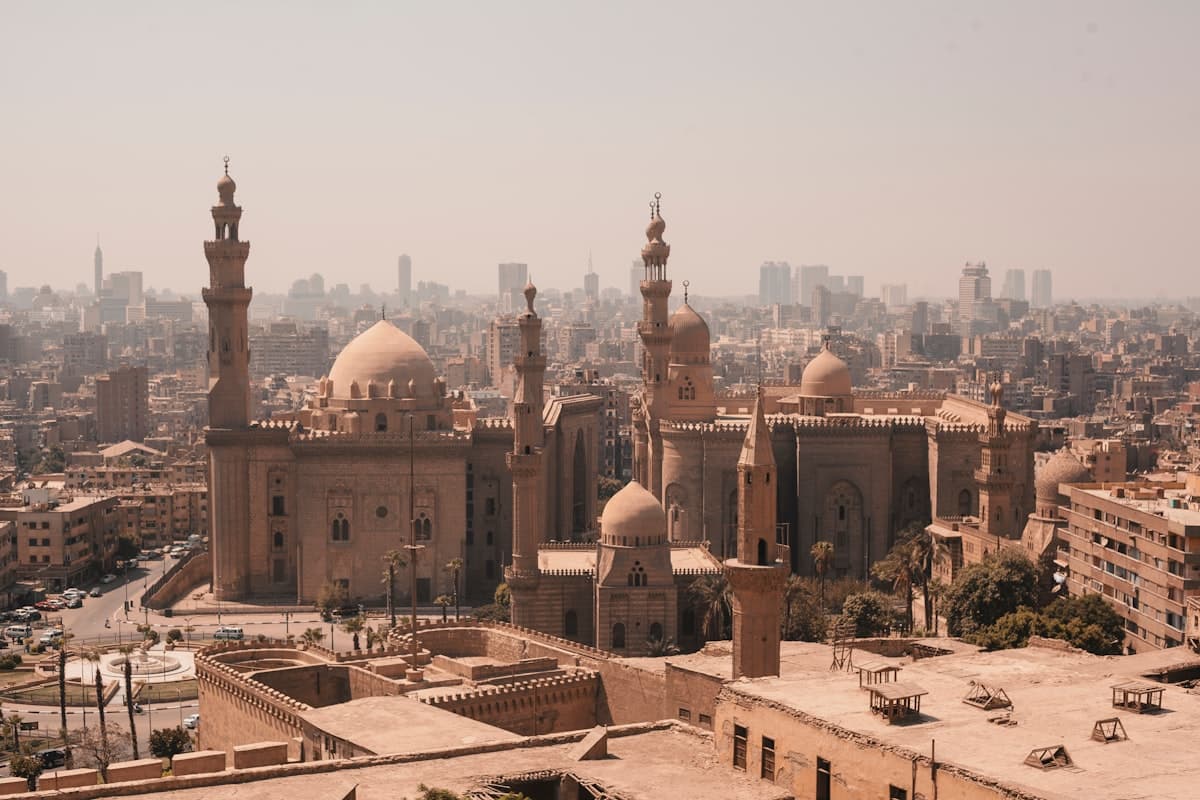
The Mosque-Madrasa of Sultan Hassan, begun in 1356, is the building that makes architects go quiet. It was built in four years by a sultan who was deposed, restored, deposed again, and eventually murdered before its completion. The building is so large, at 7,906 square meters, that when its main minaret collapsed in 1361, it killed 300 people standing below. Sultan Hassan himself had been assassinated two years earlier.
The four iwans (vaulted halls) each housed a different school of Sunni Islamic jurisprudence: Hanafi, Maliki, Shafi'i, Hanbali. Students lived in the cells stacked behind each iwan, four stories of rooms accessible by stone staircases that visitors can still climb. The genius of the plan is that the four schools shared one courtyard and one central fountain, forced into daily proximity despite their theological disagreements. Whether this was idealism or provocation is an open question.
Directly across the street, Al-Rifa'i Mosque looks like its ancient twin but was completed in 1912, built by an Egyptian princess who wanted a burial place grand enough to face Sultan Hassan across the road. The last Shah of Iran, Muhammad Reza Pahlavi, is buried inside it, exiled in death as he was in life. Both mosques for EGP 400 total, two hours minimum, and you will understand the full arc from Mamluk ambition to colonial-era nostalgia in a single street view.
The Connections

The Islamic Golden Age in Cairo cannot be understood without the layers beneath it. The Fatimids who founded Cairo built their walls on top of a Roman fortress at Babylon, which itself sat at the junction of a Pharaonic canal connecting the Nile to the Red Sea. That canal, the Canal of the Pharaohs, predates the Suez Canal by roughly 3,000 years. The Mosque of Amr ibn al-As was built over a section of it.
The Mamluk sultan Qaitbay, who ruled from 1468 to 1496 and whose buildings represent the peak of Mamluk architectural refinement, funded much of his building program with the money earned from controlling the spice trade route between India and Europe. When Vasco da Gama rounded the Cape of Good Hope in 1498 and broke that monopoly, the Mamluk economy collapsed within a generation. The Ottomans arrived 19 years later. The architecture you are looking at is literally the product of a trade route that no longer exists.
The Jewish Quarter, a short walk east of Al-Azhar, contains the Ben Ezra Synagogue, where the Cairo Geniza was discovered in 1896: a cache of roughly 300,000 manuscript fragments stored over 1,000 years that turned out to be the most complete record of medieval Mediterranean daily life ever found, letters, contracts, shopping lists, court documents, in Arabic, Hebrew, Judeo-Arabic, and Aramaic. It is direct documentary evidence of what coexistence actually looked like in Fatimid Cairo.
Common Mistakes
Arriving after 10am. Al-Muizz Street before 8am belongs to bread sellers, schoolchildren, and the occasional sheep. By 11am, tour groups from the cruise ships fill the narrow alleys. The morning light on the Mamluk stone is also categorically different from afternoon light: lower, warmer, raking across the carved stone inscriptions in a way that makes the calligraphy readable.
Doing the Citadel first. Every itinerary puts the Citadel at the start because it is visible from the highway. Put it last. Walk Al-Muizz Street first, build context for four hours, then ascend. The Muhammad Ali Mosque's Ottoman architecture will mean something specific rather than sitting in isolation.
Paying for a guide at the gate. The freelance guides who approach at Bab Zuweila charge EGP 200 to 400 for a 45-minute rush through the highlights. A licensed guide booked through a reputable agency (EGP 600 to 900 for a half-day) knows which caretakers will open the locked upper rooms of the Ghuriya complex. The difference is access, not just information.
Skipping the Coptic and Jewish Cairo connection. Mar Girgis, four kilometers south, takes 20 minutes by taxi. The Hanging Church, Ben Ezra Synagogue, and the Greek Orthodox Church of St. George sit within a walled compound on the site of the Roman Babylon fortress. Doing Islamic Cairo without this context is like reading the middle chapters of a book.
The Khan el-Khalili trap. Khan el-Khalili is worth one hour, specifically for the Fishawi's Café, which has been open continuously since 1773, and for the spice market in the alleys behind the main bazaar. The silver and papyrus shops facing the main square sell tourist goods at tourist prices and have done so since the 1920s. Walk past them.
Photographing inside mosques without asking. Photography is generally allowed in courtyards. Inside the prayer halls, particularly during or near prayer times, ask a caretaker or the imam's representative first. This is not a legal issue. It is a respect issue, and the caretakers remember who asked and who did not.
Practical Tips
Dress conservatively on Al-Muizz Street even outside the mosques. The neighborhood is a functioning residential and commercial area, not a theme park. Long pants and sleeves for all genders; women should carry a scarf.
Carry small bills. Caretakers who open side rooms and stairwells for you expect EGP 20 to 50. This is not a bribe. It is a tip for a service rendered, and the access is genuinely worth it.
Eat at El-Haty on Bab al-Wazir Street, a 15-minute walk from Sultan Hassan Mosque. It has been serving kofta and grilled meats since the 1940s. A full meal costs EGP 150 to 250. It is not photogenic. It is correct.
For the Islamic Golden Age Cairo history guide in full depth, consider two days rather than one: day one on Al-Muizz Street, Al-Azhar, and the Khan el-Khalili spice alleys; day two at Sultan Hassan, the Citadel, and the City of the Dead (the medieval necropolis where Mamluk sultans are buried and 500,000 living Cairenes also reside, a fact that surprises most visitors and clarifies a great deal about Cairo's relationship with its own history).
The metro from central Cairo to Mar Girgis station is EGP 8 and runs every five to ten minutes during the day. It is, along with the morning light on Mamluk stone and a glass of tea at Fishawi's at midnight, one of the best things in Cairo that costs almost nothing.
Frequently Asked Questions
The Weekly Dispatch
More on Egypt, every Friday.
Cultural depth and places most guides never mention.
No spam. Unsubscribe anytime.