Islamic Golden Age Cairo History Guide: Al-Qahira Unburied
Cairo's medieval city contains 600 listed Islamic monuments. Most tourists pass through in three hours. The ones who stay longer find a civilization, not a backdrop.

Quick Facts
- Best time to visit
- October to March. Temperatures in the narrow lanes of Islamic Cairo drop to 12-20 degrees Celsius, making extended walking comfortable. Ramadan brings evening energy to the streets but alters mosque access hours significantly.
- Entrance fee
- Al-Azhar Mosque: free. Ibn Tulun: EGP 80 (approx $1.60 USD). Sultan Hassan Mosque: EGP 200 (approx $4 USD). Beit al-Suhaymi: EGP 100 (approx $2 USD). Combination ticket for multiple sites: EGP 450 (approx $9 USD).
- Opening hours
- Most mosques daily 9am to 4pm, closed to visitors during Friday prayer 11:30am to 1:30pm. Ibn Tulun open 8am to 5pm. Beit al-Suhaymi open 9am to 5pm daily.
- How to get there
- Metro Line 1 to Sayeda Zeinab (EGP 10) for Ibn Tulun. Microbus from Tahrir to Al-Azhar (EGP 5-7) for Al-Muizz Street. Uber from downtown Cairo approximately EGP 40-80 depending on traffic.
- Time needed
- Half a day for the Al-Muizz corridor only. Full day combining Al-Muizz, Sultan Hassan, and the Citadel. Second day required if adding Ibn Tulun and Gayer-Anderson Museum.
- Cost range
- Budget EGP 400-700 per day including entry fees, local transport, and lunch at a neighborhood fuul shop. Mid-range EGP 1,200-2,000 per day with a specialist guide and sit-down restaurant meals.
Quick Facts
Best time to visit: October to March, when the air in the narrow lanes of Islamic Cairo carries cool dust instead of summer heat, and the light through the mashrabiyya screens falls at a lower angle that makes everything look deliberate.
Entrance fees: Al-Azhar Mosque, free. Ibn Tulun Mosque, EGP 80 (approx $1.60 USD). Beit al-Suhaymi, EGP 100 (approx $2 USD). Sultan Hassan Mosque, EGP 200 (approx $4 USD). The combination ticket covering multiple Mamluk sites runs EGP 450 (approx $9 USD) and is worth buying at the first kiosk you see, because not every site sells them.
Opening hours: Most mosques open daily from 9am to 4pm, with closures during Friday prayer (roughly 11:30am to 1:30pm). Ibn Tulun is open 8am to 5pm. Some Coptic sites nearby open from 9am to 5pm. Arrive at Ibn Tulun before 9:30am if you want it mostly to yourself.
Getting there: The metro to Sayeda Zeinab station (Line 1, EGP 10 each way) drops you within walking distance of Ibn Tulun. For the Al-Muizz corridor, take a microbus from Tahrir Square toward Al-Azhar for EGP 5-7. Uber from downtown Cairo to Islamic Cairo runs EGP 40-80 depending on traffic. Do not take a taxi without agreeing on a price first: EGP 60 is fair for central Cairo.
Time needed: Half a day covers the corridor and one major mosque. A full day lets you go deep. Two days, if you are serious.
Cost range: Budget EGP 400-700 per day including entry fees, lunch at a local fuul shop, and transport. Mid-range EGP 1,200-2,000 per day if you add a guide and sit-down meals.
---
Why This Place Matters
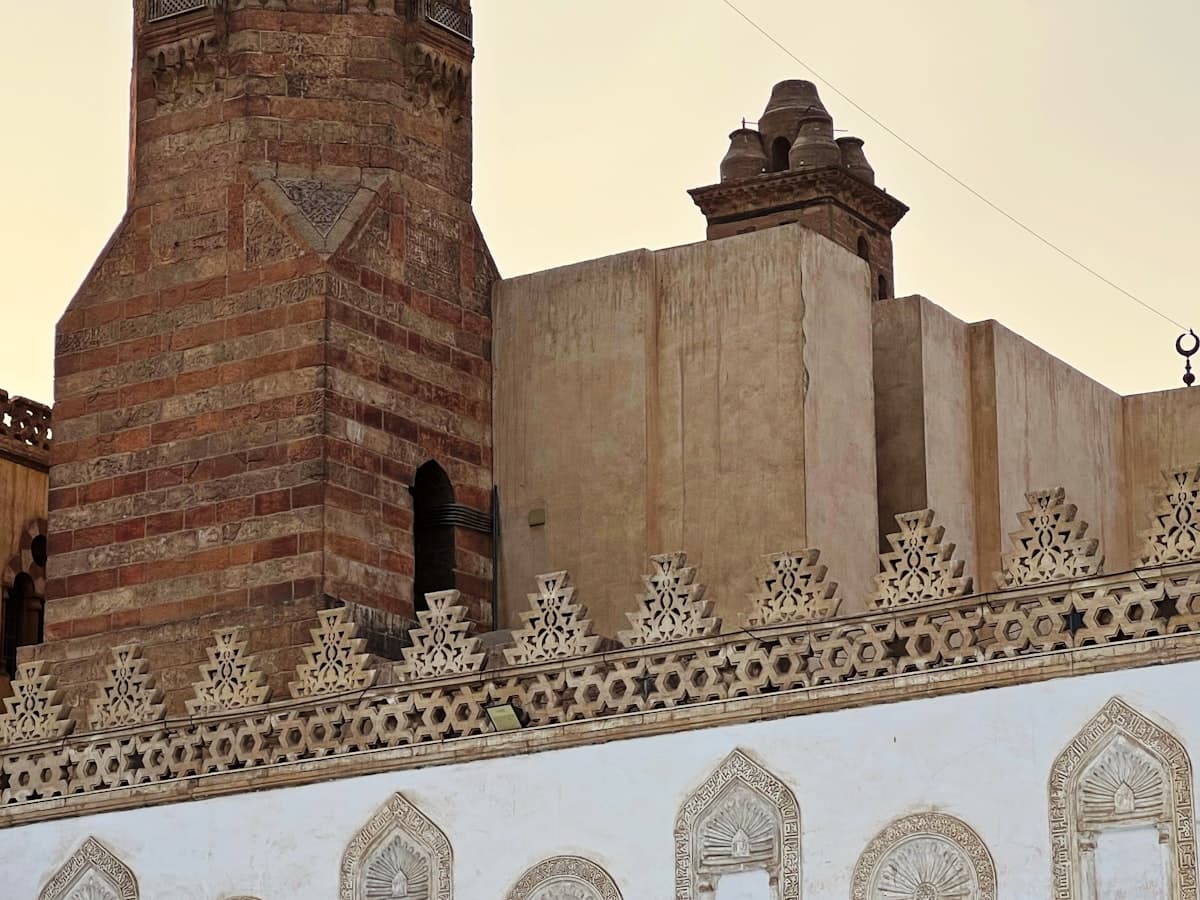
In 969 AD, a Fatimid general named Jawhar al-Siqilli conquered Egypt on behalf of the Shia Ismaili caliph al-Muizz li-Din Allah. He laid out a new royal city north of Fustat, the existing Arab capital, and named it Al-Qahira, the Victorious. The name was chosen because Mars, the planet of conquest, was rising when the city's first brick was set. That is not mythology. It is the recorded explanation from Fatimid court chronicles.
Al-Qahira became Cairo, and the medieval city it seeded is now a UNESCO World Heritage Site containing the highest concentration of Islamic monuments anywhere on earth. Six hundred are formally listed. Walking the two-kilometer spine of Al-Muizz li-Din Allah Street, the city's original Fatimid ceremonial axis, is the closest thing in the Arab world to walking through the Islamic Golden Age as a physical place rather than a chapter heading.
What makes this particular urban fabric extraordinary is its continuity. The street has been continuously inhabited and commercially active since the tenth century. The Khan el-Khalili market at its southern end was established in 1382 by Emir Jarkas el-Khalili, the master of horse under Sultan Barquq. Merchants have been selling spices and metalwork on that same ground for more than six hundred years. Beneath those stones are the ruins of the Fatimid royal palace complex, and beneath those are the remains of a Hellenistic-era settlement that pre-dates the Islamic conquest by nearly a millennium.
This is the structural truth of Cairo that most visitors never quite absorb: nothing here was built on empty ground.
---
Ibn Tulun and the Forgotten City It Replaced
The oldest intact mosque in Cairo is not in the medieval quarter everyone photographs. It is Ibn Tulun, built between 876 and 879 AD, twenty kilometers south of Al-Muizz Street, on a hill called Jabal Yashkur. Ahmad ibn Tulun was the Abbasid governor of Egypt who effectively turned the province into his own dynasty while paying nominal tribute to Baghdad. He built a mosque that could hold his entire army for Friday prayer without any soldier having to stand outside.
The mosque covers 6.5 acres and was modeled not on Mecca but on the Great Mosque of Samarra in modern-day Iraq, which had a spiral minaret. Ibn Tulun's minaret is the only surviving spiral minaret in Egypt, and its interior staircase wraps on the outside of the shaft, a design so unusual that a local legend developed to explain it: Ibn Tulun himself accidentally twisted a piece of paper while distracted, and then ordered the architect to replicate it. He did not. The design came from Samarra.
Ibn Tulun is also the first mosque in Egypt to use pointed arches throughout its structure, predating their widespread use in European Gothic architecture by about two centuries. The arches here are not ornamental. They are structural, carrying the load of the roof in a way that the earlier round-arch mosques could not. This is the kind of detail that the brief printed on the back of your ticket does not mention.
The Gayer-Anderson Museum, accessible through a door in the mosque's inner court, occupies two connected Ottoman houses from the sixteenth century and contains a collection assembled by a British civil servant and spy named John Gayer-Anderson, who lived there from 1935 to 1942. One of the rooms appears in the James Bond film The Spy Who Loved Me. This is not the most interesting thing about it, but it is the fact that makes most visitors look up from their phones.
---
The Mamluk Century: Blood, Genius, and Stone
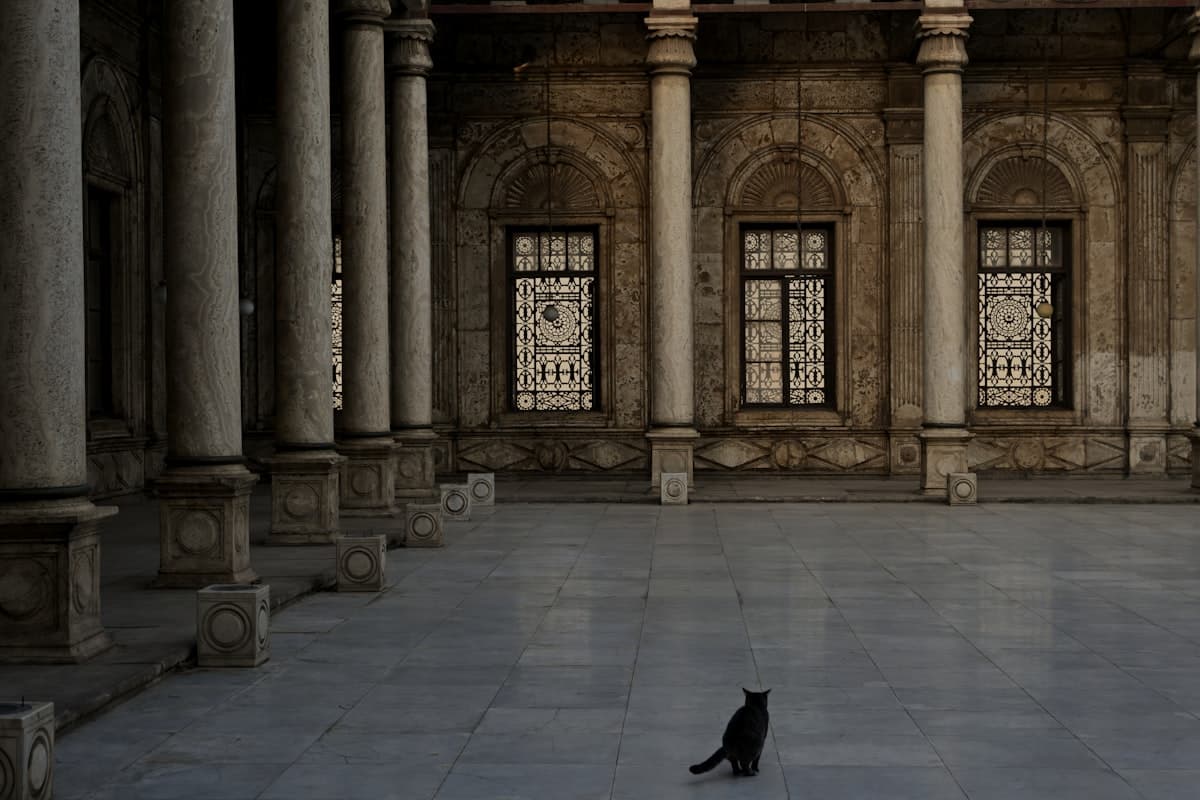
The Mamluks ruled Egypt from 1250 to 1517, and they built with a ferocity that still dominates Islamic Cairo's skyline. They were military slaves, purchased as boys from the Caucasus and Central Asia, trained as warriors, converted to Sunni Islam, and eventually powerful enough to overthrow their masters. The word mamluk means "owned." They became the most sophisticated architectural patrons in the medieval Islamic world.
Sultan Hassan Mosque, finished in 1363, contains four madrasas for the four Sunni legal schools arranged around a single central courtyard. The entrance portal is 38 meters high, the tallest in the Islamic world when it was completed. The interior is so large and so deliberately proportioned that the sound of the call to prayer inside it seems to come from somewhere above the building rather than from within it. The acoustic is not accidental. The architects were working with principles of sound distribution that modern engineers have only recently been able to fully map.
Sultan Hassan himself did not live to see the mosque completed. He was assassinated in 1361, allegedly walled up alive inside his own palace, a rumor the Mamluk court records do not confirm but do not deny. His body was never found. The tomb chamber inside the mosque is empty, which gives the space an unintended gravity.
Directly opposite Sultan Hassan stands the Mosque of Al-Rifa'i, completed in 1912 under Khedive Abbas II. It is often photographed alongside Sultan Hassan as a paired medieval composition. It is not medieval. It was built to house the tombs of Egypt's Khedival family and looks Mamluk because its architects deliberately imitated the style. The tomb of the last Shah of Iran, Mohammad Reza Pahlavi, is in a side chamber. He was buried there in 1980 because no other country would take him.
---
Al-Muizz Street: Two Kilometers, Eleven Centuries
If you walk Al-Muizz Street from the northern Bab al-Futuh gate to its southern end near Al-Azhar, you pass through the entire span of Islamic Cairo's history in about forty minutes of walking, or about three hours if you stop for everything worth stopping for.
The Fatimid gates at the northern end, Bab al-Futuh and Bab al-Nasr, were built in 1087 by Armenian architects brought specifically from the Byzantine world. The stonework uses techniques common to Byzantine military architecture rather than earlier Arab construction, which is why the gates look almost Crusader-era even though they predate the Crusades in Egypt by a century. You can walk up into the ramparts of Bab al-Futuh for free on most days. The view down into the lane below is one of the better views in Cairo that does not require a ticket.
Halfway along Al-Muizz Street is the Qalawun complex, a hospital, mausoleum, and madrasa built between 1284 and 1285, in thirteen months, which remains a construction timeline that architectural historians have not fully explained given the building's scale and detail. The Bimaristan, or hospital, that occupied the complex was one of the most advanced medical institutions in the medieval world, treating patients regardless of religion, gender, or ability to pay, and employing dedicated wards for fevers, injuries, eye diseases, and mental illness. The mental health ward included music therapy. This was 1285.
Beit al-Suhaymi, a merchant's house from the seventeenth century tucked off Al-Muizz Street, is the most complete example of Cairene domestic architecture from the Ottoman period. The courtyard, with its fountain and citrus trees, is precisely the kind of place that makes the Egyptian summer survivable. Go between 10am and noon when the light comes through the upper mashrabiyya screens.
---
The Connections
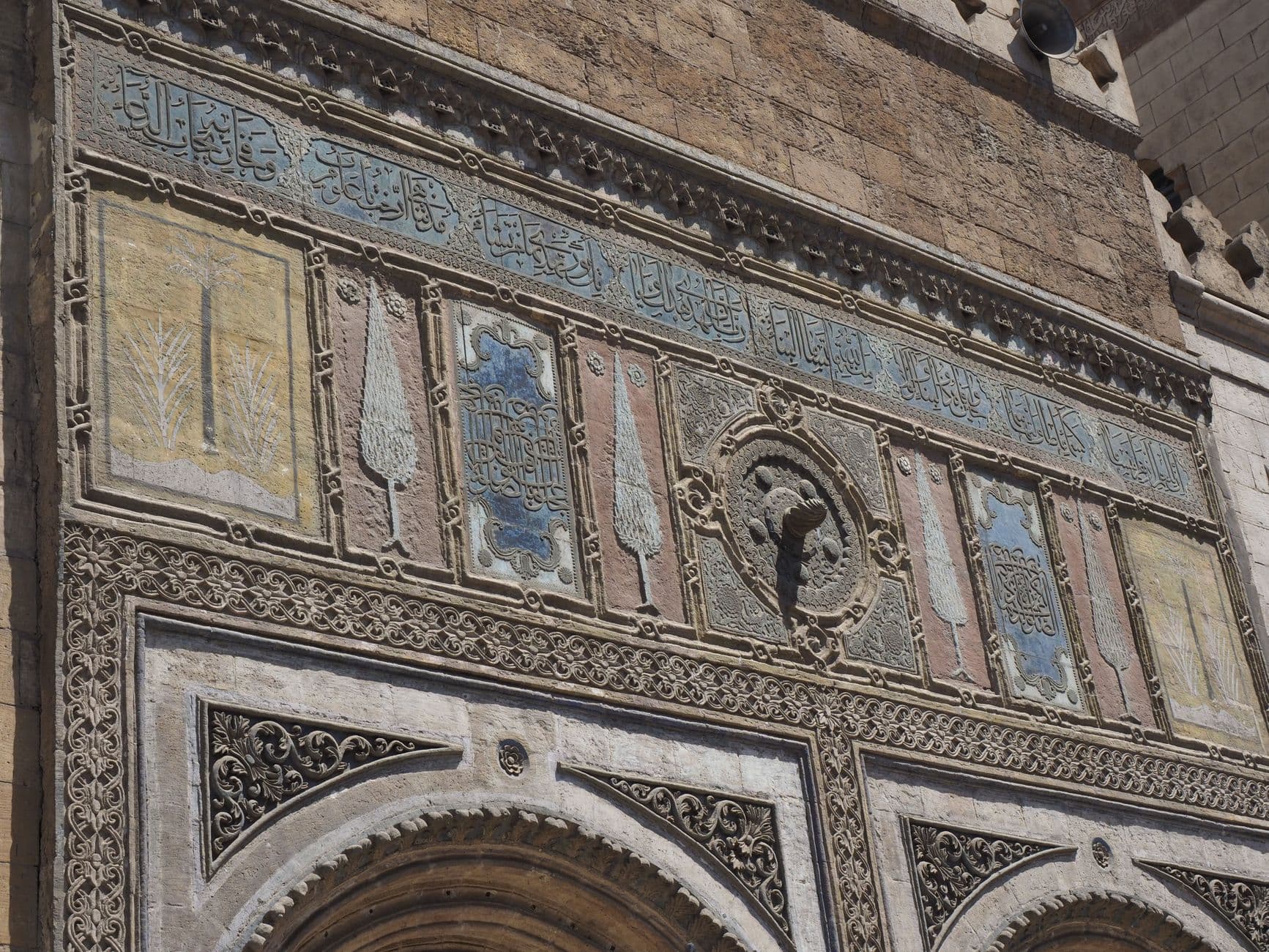
Every major site in Islamic Cairo sits on or near something older. The Mosque of Amr ibn al-As in Fustat, built in 641 AD as the first mosque in Africa, stands on ground that was previously a Byzantine military camp, which was itself built on the edge of a Pharaonic settlement. Al-Azhar University, founded by the Fatimids in 970 AD, is the oldest continuously operating university in the world, pre-dating Bologna by more than a century. It still issues degrees in theology, law, and now medicine.
The Citadel of Saladin, which dominates the skyline above the medieval city, was begun in 1176 using stones quarried from the outer casing of the smaller Giza pyramids. The smooth limestone blocks you see missing from the Pyramids' surfaces did not fall off. They were systematically removed and transported to Cairo over several centuries. The Mosque of Muhammad Ali inside the Citadel, completed in 1848, contains a clock gifted by Louis-Philippe of France in exchange for the obelisk now standing in the Place de la Concorde in Paris. The clock has never worked properly.
This is the Islamic Golden Age Cairo history guide that most tours do not give you: not a sequence of monuments but a single, continuous, argumentative city that has been revising itself for fourteen centuries.
---
Common Mistakes
Taking a guided tour that covers everything in three hours. The standard group tour of Islamic Cairo hits Ibn Tulun, Khan el-Khalili, and Al-Azhar in a sequence designed for photographs, not comprehension. You will see the same five things everyone sees and understand none of them deeply. Better to hire a specialist guide for a single neighborhood for three hours than a generalist for all of Islamic Cairo in the same time. Ask your guide specifically whether they know the Bimaristan in the Qalawun complex. If they do not, find someone else.
Skipping Ibn Tulun because it is far from everything else. It requires its own separate trip, and most itineraries drop it. This is wrong. Ibn Tulun is architecturally more significant than almost anything else in Islamic Cairo and far less crowded. Go on a Tuesday morning.
Buying anything in Khan el-Khalili without walking the side streets first. The market's main lanes are priced for tourists. The workshops and smaller shops in the alleys off Muski Street sell the same goods at a third of the price to Egyptian buyers. You will pay more than them no matter what, but you will pay less than you would on the main drag.
The sound and light show at the Citadel costs EGP 300 and delivers a ninety-minute narration that you can replace entirely by spending thirty minutes with this article and twenty minutes reading the placards inside Sultan Hassan. Skip it. The Citadel at night, from outside the walls, looking back at the illuminated Mohammed Ali Mosque, costs nothing.
Not confirming opening hours the day before. Egyptian national holidays, Ramadan scheduling, and occasional conservation closures change without much notice online. Call the site directly or ask your hotel concierge to call. The Supreme Council of Antiquities number for Cairo is publicly listed.
Wearing shoes that take more than ten seconds to remove. You will remove them at every mosque entrance. Slip-ons or sandals. This is not a tip about comfort. It is a tip about not holding up a line of fifty people behind you at the Sultan Hassan entrance on a Friday.
Expecting Khan el-Khalili to be something other than what it is. It is a tourist market that has been a tourist market since the nineteenth century. It is atmospheric, chaotic, and full of things you do not need. That is its function. Do not go looking for the "authentic" Cairo underneath it. The authenticity of Khan el-Khalili is that it has been commercially excessive for seven hundred years. That is the actual historical character of the place.
---
Practical Tips
Dress conservatively at every site. For women, loose trousers and a shirt that covers the elbows is sufficient for most mosques. Carry a scarf for your head. For men, shorts are generally not accepted inside active mosques. Sultan Hassan and Ibn Tulun are more relaxed about this than Al-Azhar, which is stricter because it is an active religious and academic institution.
Friday is the worst day to visit Al-Azhar specifically. It becomes a congregation site for tens of thousands of worshippers. For everything else, Friday afternoons after 2pm are actually less crowded than Saturday mornings, when Egyptian school and university groups visit.
Hire a local guide who specializes in Islamic architecture rather than general Egyptian history. Several Cairene historians offer private walking tours of Al-Muizz Street for EGP 500-900 for a two-to-three hour walk. This is far more valuable than any group tour at twice the price. Ask your accommodation for names, or look for guides associated with the Aga Khan Trust for Culture, which has been funding restoration work in Islamic Cairo since the 1990s.
Bring cash in small denominations. EGP 20 and EGP 50 notes. Many of the smaller sites and guardians do not have change for EGP 200 bills.
Eat lunch at one of the fuul and ta'meya shops on the side streets off Al-Muizz. A full plate of fuul with bread, salad, and tea costs EGP 60-90. Sit where you are the only non-Egyptian in the room. This is not difficult to arrange.
Frequently Asked Questions
The Weekly Dispatch
More on Egypt, every Friday.
Cultural depth and places most guides never mention.
No spam. Unsubscribe anytime.