Islamic Golden Age Cairo History Guide: Walk the Caliphate
Cairo's medieval Islamic core contains more intact Mamluk architecture than any city on earth. Most visitors spend 90 minutes there. That is a mistake with real consequences.

Quick Facts
- Best time to visit
- October to March. October offers the best combination of manageable heat, excellent light, and smaller crowds. Avoid June to August: temperatures exceed 38C in streets with minimal shade.
- Entrance fee
- Al-Muizz Street free to walk. Individual monuments: Ibn Tulun EGP 100 (approx $2 USD), Sultan Hassan EGP 200 (approx $4 USD), Bab Zuweila towers EGP 100 (approx $2 USD). Combined ticket EGP 600 (approx $12 USD). Student discount 50 percent with valid ID.
- Opening hours
- Most monuments 9am to 5pm daily. Active mosques closed to non-worshippers during Friday prayers approximately 12pm to 2pm. Al-Azhar mosque has variable hours around prayer times.
- How to get there
- Taxi from Downtown Cairo to Bab Zuweila: EGP 50 to 80. Metro Line 1 to Ataba station then 15-minute walk. Uber from central Cairo: EGP 60 to 100. Avoid driving: streets are extremely narrow.
- Time needed
- 4 hours minimum for al-Muizz Street and one major mosque. 6 to 7 hours for a full circuit including Ibn Tulun and Sultan Hassan. Do not combine with the Citadel on the same afternoon.
- Cost range
- Budget EGP 400 to 700 per day including monument tickets, street food, and transport. Mid-range EGP 1,200 to 2,000 including a licensed guide and a sit-down lunch.
At its peak in the 14th century, Cairo was the largest city in the world outside China. Ibn Battuta called it "the mother of all cities." Its markets moved more spice than Venice and more textiles than Bruges. The caliphs and sultans who built it were often former slaves, many of them Circassian or Kipchak Turks purchased as boys and trained into the most effective military and administrative class the medieval Islamic world produced. They built in stone as a form of argument: we are legitimate, we are permanent, we are here to stay. Walk al-Muizz Street on a quiet morning before the tour groups arrive and you will understand, viscerally, what they meant.
Quick Facts
Best time to visit: October to March. Summer heat in Islamic Cairo, where streets are narrow and shade is scarce, is genuinely punishing. October is ideal: the light is extraordinary and crowds are manageable.
Entrance fees: Al-Muizz Street itself is free to walk. Individual monuments vary. The Mosque of Ibn Tulun costs EGP 100 (approx $2 USD). The Mosque-Madrasa of Sultan Hassan costs EGP 200 (approx $4 USD). The Bab Zuweila gate towers cost EGP 100 (approx $2 USD). A combined ticket covering multiple Islamic Cairo sites is available through the Ministry of Antiquities for EGP 600 (approx $12 USD) and covers most major monuments. Student discount is 50 percent with valid ID.
Opening hours: Most mosques and monuments open 9am to 5pm daily. Active mosques close to non-worshippers during Friday prayers (approximately 12pm to 2pm). Arrive early.
Getting there: From Downtown Cairo, a taxi to Bab Zuweila costs EGP 50 to 80 (approx $1 to 1.60 USD). The Metro Line 1 stops at Ataba, a 15-minute walk to al-Muizz Street. Uber from central Cairo runs EGP 60 to 100. Avoid driving yourself; the lanes of Islamic Cairo are narrow enough that a donkey cart can block traffic for 20 minutes.
Time needed: A serious half-day is 4 hours. A full circuit of Ibn Tulun, Sultan Hassan, al-Muizz, and Bab Zuweila requires 6 to 7 hours minimum. Do not try to combine this with the Citadel on the same afternoon unless you enjoy seeing nothing properly.
Cost range: Budget EGP 400 to 700 per day including tickets, local lunch, and transport. Mid-range EGP 1,200 to 2,000 if you add a guide and a restaurant meal.
Why This Place Matters
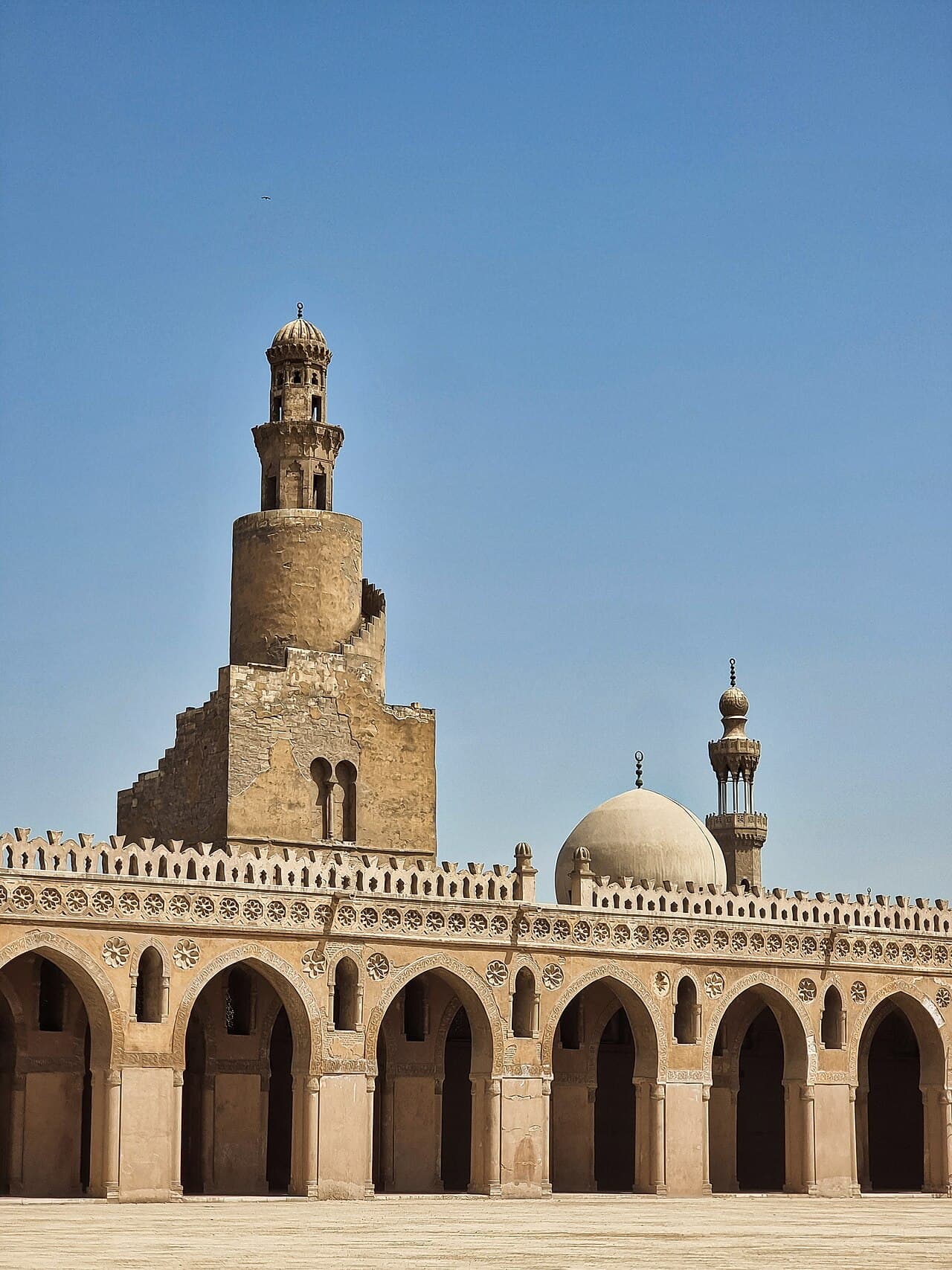
The Islamic Golden Age did not happen in one place. It was a network: Baghdad under the Abbasids, Cordoba under the Umayyads, and Cairo under the Fatimids, Ayyubids, and Mamluks in sequence. What makes Cairo singular in an Islamic Golden Age Cairo history guide is the survival rate. Baghdad was razed by the Mongols in 1258. Cordoba's great mosque was swallowed by a Catholic cathedral. Cairo was spared the Mongols, absorbed the Ottomans relatively gently, and retained enough of its medieval fabric to make a coherent walk through eight centuries of Islamic civilization still possible.
The Fatimids founded al-Qahira ("The Victorious") as a royal enclosure in 969 CE. They brought with them the Shia branch of Islam, an extraordinary library of 1.6 million manuscripts (later burned or sold by the Ayyubids who replaced them), and a tradition of architectural sophistication that set the standard for everything that followed. The Ayyubids, founded by Saladin, introduced the Sunni madrasa system, essentially a university model attached to a mosque, as a way to reassert orthodox theology. The Mamluks, who displaced the Ayyubids in 1250, turned those institutions into something extraordinary: 75 percent of Cairo's surviving medieval monuments were built under Mamluk rule between 1250 and 1517.
What tends to get missed in popular history is that the Mamluks stopped the Mongols. At the Battle of Ain Jalut in 1260, a Mamluk army defeated the forces of Hulagu Khan, marking the first major Mongol defeat and almost certainly saving Islamic civilization in the Levant and Egypt from the fate that consumed Persia and Iraq. The buildings you are walking past are, in part, monuments built by men who understood they had caught history at a hinge point.
Al-Muizz Street: The Spine of a Medieval Capital
Al-Muizz Street is approximately one kilometer long and contains the highest concentration of medieval Islamic monuments of any street on earth. This is not promotional language; it is the UNESCO assessment that led to its inscription. Walk it south to north, starting at Bab Zuweila, the massive southern gate completed in 1092 under the Fatimid caliph al-Mustansir. The gate's twin minarets were added in the 15th century by the Mamluk sultan al-Muayyad, who built his mosque directly against the gate's walls, using them as his own minarets. This is typical of how Islamic Cairo was built: opportunistically, palimpsestically, each generation incorporating and overwriting what came before.
At the northern end of the street, the Mosque of al-Hakim bi-Amr Allah deserves more than the brief pause most visitors give it. Al-Hakim, who ruled from 996 to 1021, was one of the most theologically radical and personally volatile rulers in Islamic history. He banned chess, ordered all dogs in Cairo killed because their barking disturbed his meditations, and eventually declared himself a divine manifestation, which led directly to the founding of the Druze religion. His mosque was used as a Crusader prison, a Napoleonic stable, and an earthquake rubble dump before being restored in the 1980s by the Dawoodi Bohra, a Shia sect from India who consider al-Hakim spiritually significant. They paid for the entire restoration. The mosque now glows with white marble that feels jarring and new but the minarets, partially embedded in the Fatimid city walls, are original.
The Khan el-Khalili bazaar, which most tourists treat as the endpoint of al-Muizz, was established in 1382 by Emir Djaharks el-Khalili on the site of the Fatimid royal cemetery. He literally built his caravanserai over the tombs of the caliphs. It has been a commercial site for more than 640 years without interruption, which is worth holding in your mind as you navigate it.
Ibn Tulun and Sultan Hassan: Two Buildings That Explain Everything
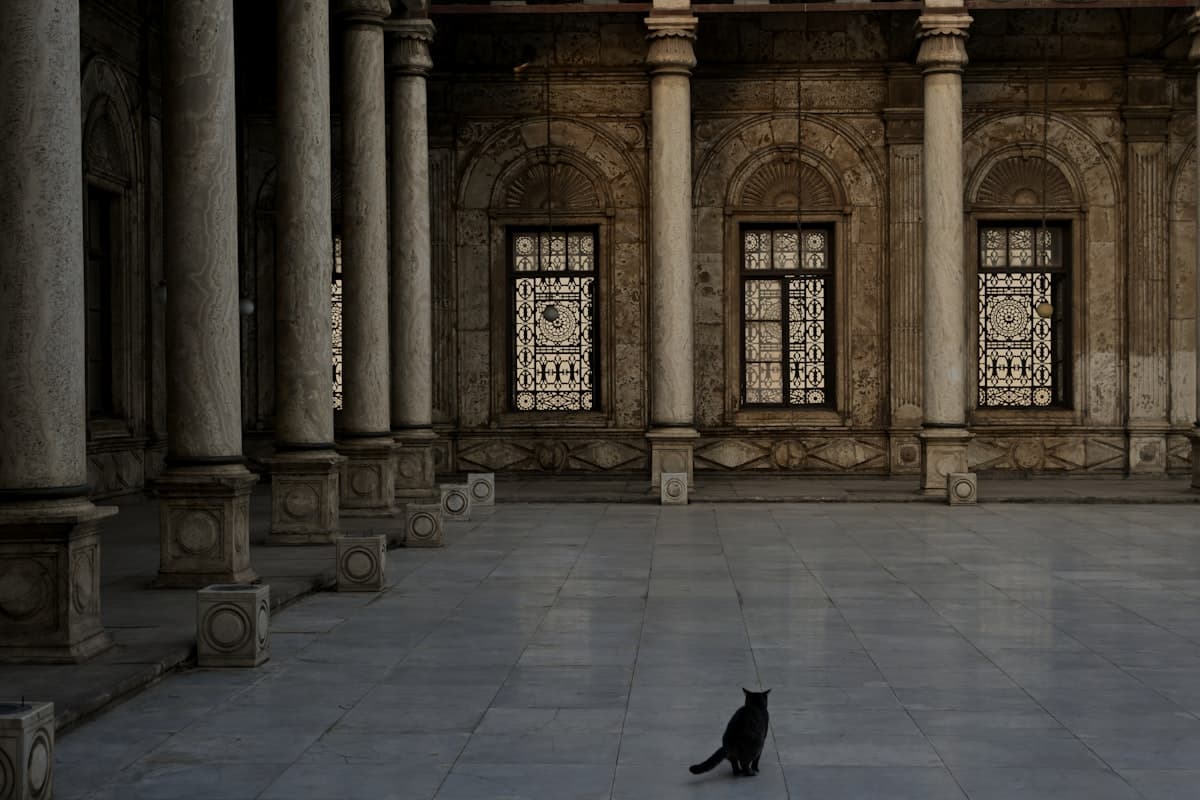
If you only visit two monuments in all of Islamic Cairo, they should be the Mosque of Ibn Tulun and the Mosque-Madrasa of Sultan Hassan. They are a 20-minute walk apart and together span roughly 600 years of Islamic architectural ambition.
Ibn Tulun was completed in 879 CE, making it Cairo's oldest intact mosque and one of the oldest in the world still in its original form. Ahmad ibn Tulun was an Abbasid governor who effectively made himself autonomous, and he built on a scale that announced his ambitions. The mosque covers 2.6 hectares and was designed by a Christian architect named Sayrfoun according to some historical sources, reflecting the pragmatic pluralism that characterized the early Islamic Golden Age. The famous spiral minaret, which bears a striking resemblance to the minaret at the Great Mosque of Samarra in Iraq (Ibn Tulun's hometown), was either inspired by Samarra or, according to a persistent legend, sketched by Ibn Tulun himself on a piece of parchment he had been absent-mindedly rolling into a spiral during a meeting. The legend is probably apocryphal. The resemblance to Samarra is not.
Sultan Hassan's mosque-madrasa, built between 1356 and 1363, is a different kind of statement. Hassan was a Mamluk sultan who came to power at age 13 and was deposed twice before being restored. He commissioned a building so large that the Ottoman sultan Selim I, after conquering Cairo in 1517, allegedly tried to dismantle it and ship it back to Istanbul, finding the feat logistically impossible. The building contains four separate madrasas (one for each of the Sunni legal schools), a mausoleum, and a mosque, all stacked around a central courtyard with a fountain. The main portal is 38 meters high and deliberately designed to dwarf the human figure entering it. Sultan Hassan never saw it completed. He was assassinated in 1361, two years before the building was finished, probably by enemies who resented the enormous financial resources the project consumed.
The Connections: Nothing Exists in Isolation
The Citadel, visible from almost every minaret in Islamic Cairo, was begun by Saladin in 1176 on a limestone spur of the Muqattam Hills. He chose the site partly because a slaughterhouse had operated there and the continuous wind kept it free of the plague miasma that periodically devastated the city below. Saladin used prisoners captured during the Crusades as construction labor. The wells he dug to supply the Citadel with water, known as Joseph's Well (Bir Yusuf, using his Arabic name), descend 87 meters through solid rock and were almost certainly engineered by workers with knowledge of earlier Pharaonic well-cutting techniques.
The Mamluk sultans who later expanded the Citadel, built Sultan Hassan below it, and filled al-Muizz Street with monuments were operating within a city whose street grid followed a Roman plan, whose neighborhoods retained Coptic Christian and Jewish quarters that predated the Islamic conquest by six centuries, and whose Nile-side infrastructure was built over Pharaonic irrigation channels. The al-Fustat settlement, the original Arab capital before al-Qahira was built, sits directly south of Islamic Cairo and beneath it archaeologists have found Roman-era pottery, Coptic textiles, and Pharaonic foundation stones reused as building material. Every era in Cairo is a layer. Nothing was built on empty land.
Common Mistakes
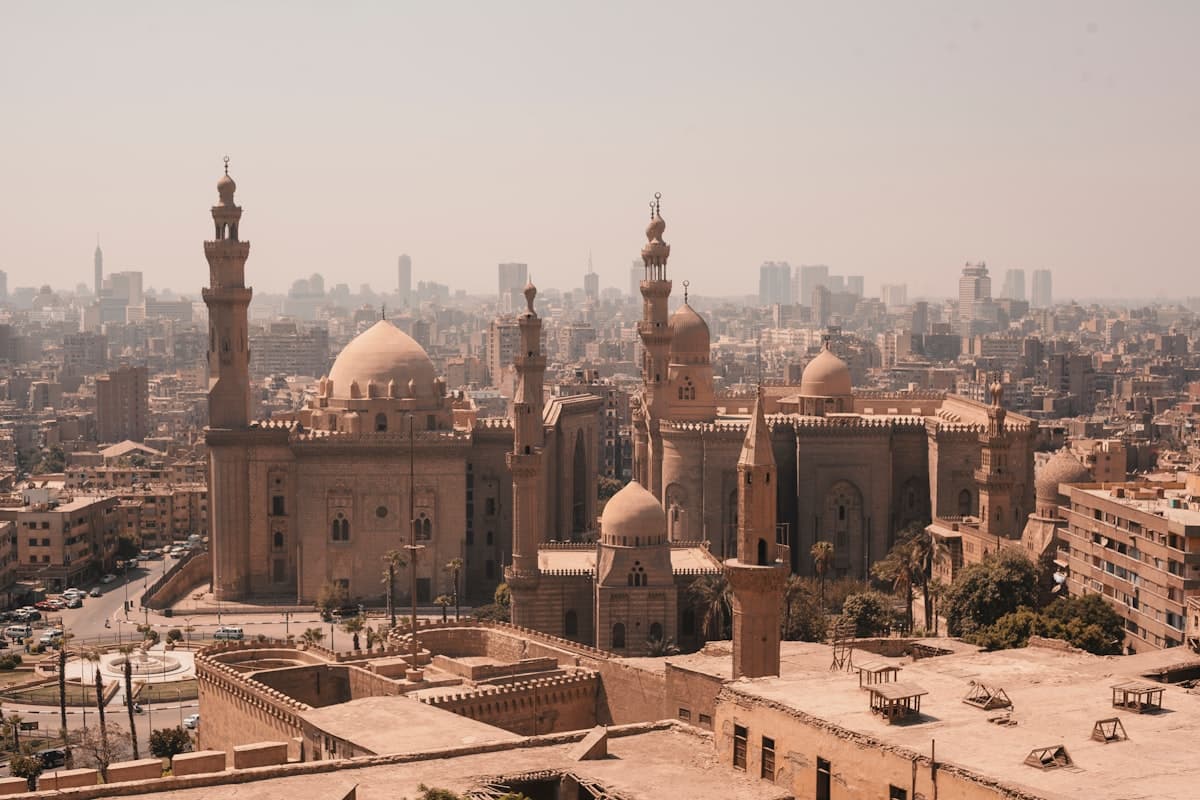
Doing the Citadel and Islamic Cairo in one afternoon. The Citadel is a three-hour site on its own. Tacking it onto an Islamic Cairo walk means you rush both and understand neither. Give each a separate half-day.
Skipping Ibn Tulun because it seems out of the way. It is a 20-minute walk from Sultan Hassan. The people who skip it are the ones whose itinerary was written by someone who never went. It is a more powerful building than almost anything on al-Muizz Street and usually has almost no visitors.
The Sound and Light Show at the Citadel. It costs EGP 400 and tells you nothing that reading this article will not tell you better. The theatrical narration is patronizing and the lighting makes the Mohamed Ali Mosque look like a casino. Skip it without guilt.
Entering Khan el-Khalili with shopping expectations. The market has been substantially tourist-oriented since at least the 1970s. For actual Cairene commerce, walk 200 meters west to al-Khayamiya Street (the tentmakers' market) where craftsmen still sew the applique panels used in Ramadan tents and funeral processions. Prices are lower and the craft is genuine.
Visiting at midday in summer. The streets of Islamic Cairo have minimal shade and the stones radiate heat absorbed since dawn. Temperatures between June and August regularly exceed 38 degrees Celsius. The light is also flat and uninteresting photographically. This is not a minor inconvenience. It is a physical health consideration.
Assuming a single visit covers it. Al-Muizz Street alone has more than 600 listed monuments. A serious exploration of Islamic Golden Age Cairo history requires multiple days and multiple visits. Plan accordingly or accept that you are getting the surface reading.
Tipping guides before the tour ends. A common tourist instinct but a negotiating disadvantage. Agree on a price before you start, pay at the end.
Practical Tips
Dress conservatively. Loose trousers or a long skirt and covered shoulders are required to enter working mosques and strongly advisable everywhere in Islamic Cairo. Carry a scarf regardless of gender. You will need to remove shoes at most mosque entrances; slip-ons save significant time over the course of a day.
Hire a licensed guide for the first visit. The visual vocabulary of Islamic Cairo, muqarnas ceilings, ablaq stonework, keel-arch windows, requires context to read. A good guide charges EGP 400 to 600 for a half-day. The Egyptian Tourist Authority website lists licensed guides. An unlicensed tout will give you confident misinformation.
Eat at Naguib Mahfouz Café in Khan el-Khalili only if you want to pay a significant premium for the name. The ful and ta'ameya sandwich shops on the side streets parallel to al-Muizz cost EGP 20 to 40 and are significantly better food.
Carry cash. Most monument ticket offices do not accept cards. The nearest ATMs to al-Muizz are on al-Azhar Street.
The best light for photography is between 7am and 9am, when the low sun angles into the narrow streets and the tourists have not yet arrived. If you can be at Bab Zuweila at 7:30am, do it. The gate turns copper in that light and the street is often completely empty.
Frequently Asked Questions
The Weekly Dispatch
More on Egypt, every Friday.
Cultural depth and places most guides never mention.
No spam. Unsubscribe anytime.