Khedival Cairo Belle Epoque Architecture: The Complete Guide
Khedive Ismail built a European city on top of a medieval one in under a decade. Most of it still stands. Almost nobody walks it deliberately.

Quick Facts
- Best time to visit
- October to March. Winter light is lateral and reveals facade relief work clearly. Summer heat above 38C makes prolonged street walking genuinely unpleasant.
- Entrance fee
- Streets are free. Baron Empain Palace EGP 100 (approx $2 USD). Abdeen Palace Museum EGP 100 (approx $2 USD). Manial Palace EGP 200 (approx $4 USD). Most significant facades are viewable from the pavement at no cost.
- Opening hours
- Baron Empain Palace: daily 9am to 5pm. Abdeen Palace Museum: Tuesday to Sunday 9am to 3pm. Manial Palace: daily 9am to 4pm. Downtown streets: walkable at any hour, best before 10am or after 4pm.
- How to get there
- Metro Line 1 or 2 to Attaba station (EGP 10, approx $0.20 USD) for Downtown. For Heliopolis and Baron Empain Palace: Metro Line 3 to Alf Maskan then microbus to Baron area (EGP 5 total, approx $0.10 USD). Taxi from Downtown to Heliopolis EGP 80 to 120 (approx $1.60 to $2.50 USD).
- Time needed
- Half day for focused Khedival Downtown walk. Full day to add Heliopolis and one palace interior. Two days for a thorough exploration including Manial Palace on Rhoda Island.
- Cost range
- Street walking costs nothing. Budget day including Metro, two interior tickets, coffee, and lunch: EGP 400 to 600 (approx $8 to $12 USD). Mid-range with private guide and sit-down restaurant: EGP 1,500 to 2,200.
Quick Facts
Best time to visit: October through March. The facades read better in low winter light, and you will not be dripping sweat while craning your neck at cornices.
Entrance fees: The streets are free. The interiors that matter most, including the Baron Empain Palace (EGP 100, approx $2 USD) and the Manial Palace (EGP 200, approx $4 USD), charge separately. The Abdeen Palace Museum costs EGP 100 (approx $2 USD). Most of the interesting facades are viewed from the pavement.
Opening hours: Street walking, any time. Abdeen Palace Museum: Tuesday through Sunday, 9am to 3pm. Manial Palace: daily 9am to 4pm. Baron Empain Palace: daily 9am to 5pm.
How to get there: The Metro is the correct answer. Attaba station (Line 1 and Line 2 interchange) deposits you at the edge of Khedival Cairo for EGP 10 (approx $0.20 USD). A taxi from Downtown to Heliopolis for the Baron Empain Palace runs EGP 80 to 120 (approx $1.60 to $2.50 USD) depending on traffic, which in Cairo is always worse than you expect.
Time needed: Half a day for a focused walk through Khedival Downtown. A full day if you add Heliopolis and the Manial Palace.
Cost range: Walking the district costs nothing beyond coffee. Budget EGP 300 to 500 for transit, one or two interior tickets, and lunch at one of the old-city cafes. Mid-range EGP 1,000 to 1,800 if you add a guide and a sit-down meal.
---
Why This Place Matters
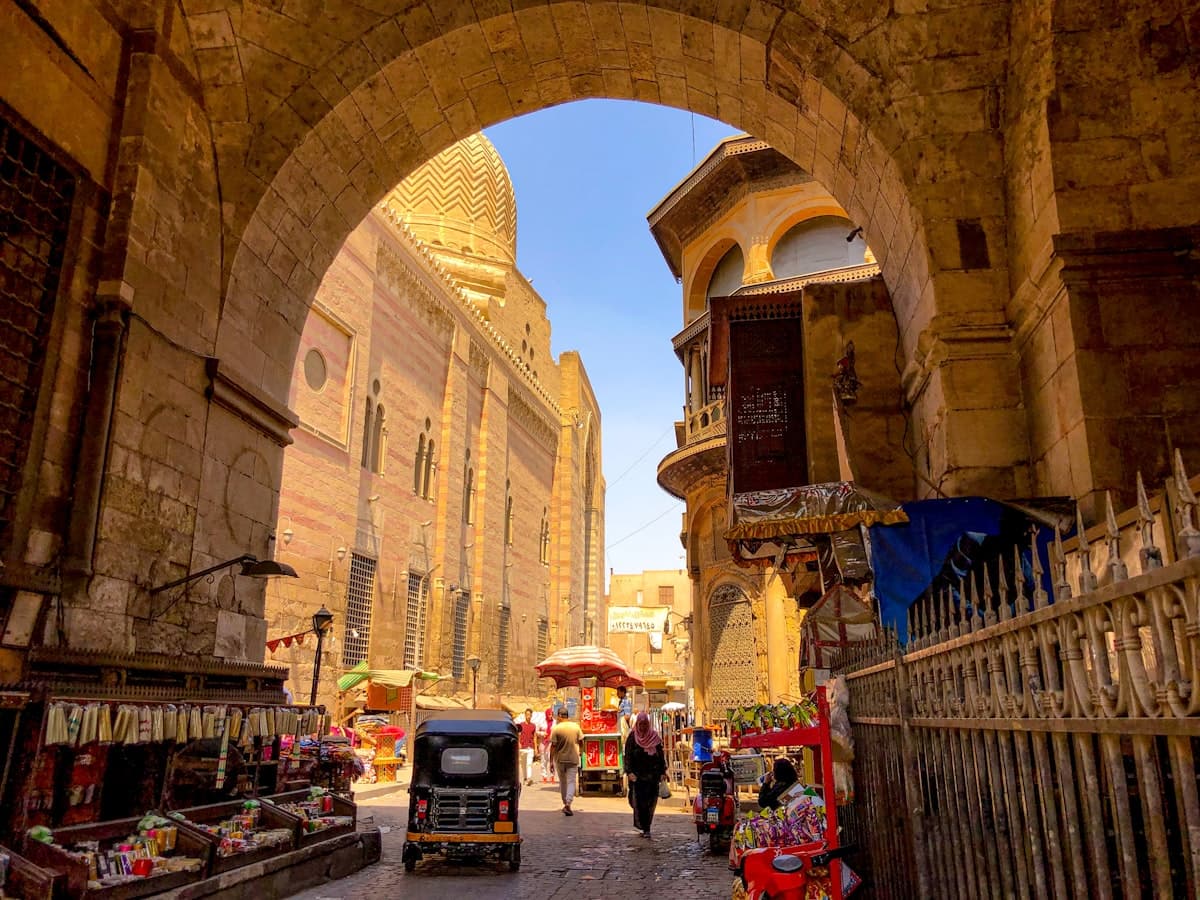
In 1867, Khedive Ismail visited the Paris Exposition Universelle and came home with a plan. He wanted Cairo to be the Paris of the East. Not metaphorically. He hired Pierre Grand, a student of Haussmann himself, to lay out a grid of wide boulevards west of the medieval Fatimid city. He gave property developers a deadline: build a European-style facade or lose the land. Within eight years, a functioning 19th-century European capital had been constructed, almost from nothing, on the floodplain between the old city and the Nile.
Ismail opened the Suez Canal in 1869 and threw a party that reportedly cost the equivalent of the entire annual budget of Egypt. Verdi was commissioned to write an opera for the new Cairo Opera House. He delivered Aida, two years late, after the inauguration had already passed.
The Khedival Cairo belle epoque architecture guide most tourists encounter is either nonexistent or buried inside a hotel brochure. That is a structural problem. These buildings are not in a museum. They are a functioning city, layered over Roman roads, Fatimid walls, and Ottoman grain stores. The iron balconies are still occupied. The pharmacies in the ground-floor arcades still sell aspirin. Understanding what you are looking at requires knowing that Ismail did not simply want beautiful buildings. He wanted sovereignty expressed in stone, and he bankrupted Egypt doing it.
By 1879, the national debt had reached 100 million Egyptian pounds. Britain and France forced the creation of the Caisse de la Dette Publique to manage repayments. Three years later, the British occupied Cairo. The city Ismail built to announce Egyptian modernity became the administrative capital of a British protectorate. The irony is physical: the same Italianate ministries he raised to signal independence were immediately occupied by colonial administrators.
---
What You Are Actually Looking At
Start at Midan Talaat Harb, the circular square with the statue of economist Talaat Harb at its center. Harb founded Bank Misr in 1920 specifically to break British financial control of the Egyptian economy, and the building behind his statue still houses a bank branch. Look up at the curved facades wrapping the square: Venetian Gothic, French Second Empire, and Italianate Renaissance in a forty-meter radius, all built within a decade of each other by Greek, Italian, and Syrian architects working under Egyptian patronage.
The dominant architectural firm was that of Antoine Lasciac, an Austrian-Italian who served as chief architect to the Khedival household for over two decades. Lasciac designed or influenced more buildings in this district than any other single person, yet he has no monument, no named square, and almost no presence in Cairo's official historical narrative. His work is everywhere: the arcaded ground floors of Qasr el-Nil Street, the corner towers of the old Sednaoui department store on Clot Bey Street, the Ministry of Irrigation on the Corniche.
The arcades themselves are worth your full attention. Ismail mandated them specifically so that pedestrians could walk the entire downtown district in shade, a civic gesture lifted straight from the rue de Rivoli in Paris. They survive today in varying states of repair. On Qasr el-Nil Street the arcade is intact and still functional. On Sherif Street, half the columns have been filled in with brick to create extra retail space. This is not vandalism so much as a city continuing to live inside its own skin.
One building most visitors walk past without stopping: the former Credit Lyonnais building at the corner of Qasr el-Nil and Adly Streets, now a commercial bank. Its facade is 1920s beaux-arts, but the basement contains vaulted ceilings from a Mamluk-era structure that was incorporated rather than demolished. The current bank staff are generally happy to let you look, if you ask politely and do not carry a large camera.
---
Heliopolis: The Second City Ismail Never Planned
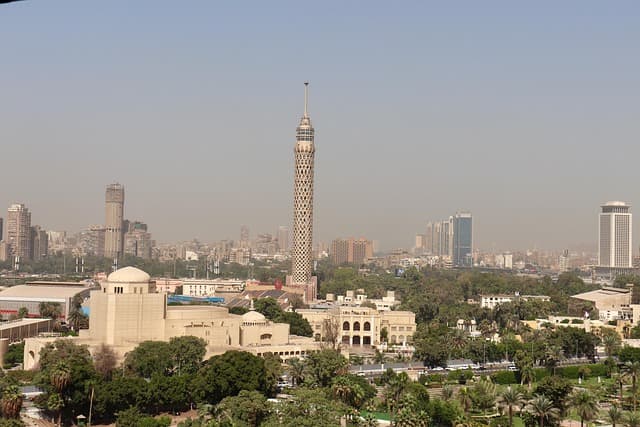
Twenty kilometers northeast of Downtown, Baron Édouard Empain built an entire suburb from desert in 1905. Empain was a Belgian industrialist who had already built the Brussels metro and the Paris Metro's eastern lines. He bought 6,000 acres of desert outside Cairo, laid a tramline, and constructed a city of Moorish Revival and Indo-Saracenic buildings around it. Heliopolis was not Egyptian, not French, not British. It was a Belgian fantasy of what an Oriental garden city should look like.
The Baron's own palace, completed in 1911, is Hindu temple architecture filtered through a Belgian architect's imagination, with rotating upper floors designed so Empain could always have his bedroom face the sun. The rotation mechanism broke decades ago and the building sat derelict from the 1950s until a full restoration was completed in 2020. It is now open to the public and remains the most architecturally strange building in a city not short on architectural strangeness.
The Heliopolis Basilica next to the Baron Palace is a direct copy of the Hagia Sophia in Istanbul, scaled down and built in 1913 as a Catholic church for the suburb's European residents. This detail stops most visitors cold. A Byzantine-form church built by a Belgian baron in the Cairo desert, modeled on a Byzantine structure that had been a mosque for 450 years at the time of construction. Egypt has always operated at this level of layered reference.
The residential streets of old Heliopolis, particularly Beirut Street and Ibrahim Laqqani Street, have the best-preserved belle epoque streetscapes in Cairo precisely because they never became commercial enough to gut and rebuild. Walk them slowly. The loggias, the tiled entrance halls visible through open front doors, the cast-iron name plaques still reading the names of families long departed: this is what Khedival-era Cairo looked like before the cars arrived.
---
The Connections
The grid Ismail laid over western Cairo in the 1860s was not drawn on empty land. The street now called Ramses Street follows the eastern bank of a Ptolemaic canal that ran from the Delta into the city. The canal was functional until the early Islamic period, when it silted beyond use. The Fatimid caliphs built their administrative city, al-Qahira, on its eastern bank, which is why the old city sits elevated above the modern Downtown: it is literally on higher ground, the ancient levee.
Abdeen Palace, which Ismail built as his official residence in 1872 after moving out of the Citadel, sits on the site of a Mamluk amir's compound. The Mamluks had chosen the location because it was adjacent to the Birkat al-Fil, the Elephant Pond, a large depression that seasonally filled with Nile flood water and served as both a recreation ground and a water reserve for the city. The pond was drained and built over in the 1830s under Muhammad Ali, who also demolished the Mamluk-era compound to build a barracks. Ismail demolished the barracks to build his palace. Every Cairo building is the third or fourth thing to occupy that footprint.
The Sednaoui department store, opened in 1913 by a Syrian Christian family from the Levant, was the Middle East's first department store with an elevator. The Sednaoui family's success was part of a broader pattern: Greek, Italian, Syrian, Jewish, and Armenian merchant families built much of what feels European about Khedival Cairo. The architecture was imported, but the commercial energy was local and Levantine. When Nasser nationalized foreign businesses in 1961, most of these families left, and the buildings they built became state property overnight.
---
Common Mistakes
Skipping the walk in favor of the taxi. Khedival Cairo is a walking city. The details that matter, the tilework in the entrance halls, the Arabic calligraphy worked into the plasterwork of buildings ostensibly in the French style, the evidence of the older city visible in the irregular lot lines, are all invisible at taxi speed. If you are short on time, do fewer streets more slowly.
Visiting Abdeen Palace Museum expecting grandeur. The palace exterior is genuinely imposing. The museum inside is a collection of royal weapons, gifts of state, and furniture in rooms that feel more depressing than impressive. The gardens are better than the interiors. Spend thirty minutes, not two hours.
Paying for a guided tour of the Downtown facades. Several operators offer walking tours of Khedival Cairo at EGP 400 to 600 per person. The better ones exist, but the average tour moves too fast, covers only the marquee buildings, and tells you nothing about the urban planning logic connecting them. The contrarian advice: buy Mohamed Elshahed's book "Cairo Since 1900" (available at Diwan bookshop on Zamalek for around EGP 350) and walk it yourself. Elshahed is an architectural historian who actually lives in this argument. His notes are better than most guides' scripts.
Ignoring the interiors. Cairo building owners, particularly in the older commercial blocks, are generally not hostile to someone asking to see the entrance hall or the staircase. The worst answer is no. The best answer is being shown a 1910 mosaic floor that no tourist website has photographed.
Conflating "restored" with "better." Several belle epoque buildings have been recently restored with smooth white plaster and uniform paint that erases every surface detail that made them interesting. The Four Seasons on the Nile sits in a building whose bones are Khedival-era but whose skin has been sandpapered into generic luxury. Walk past it.
Visiting Heliopolis without accounting for traffic. Getting from Downtown to the Baron Empain Palace by car at midday can take forty-five minutes for a twenty-kilometer drive. The Cairo Metro does not currently reach Heliopolis directly. Take the Metro to Heliopolis station (Line 3 reaches Alf Maskan, then a microbus runs to the Baron area for EGP 5) or go early morning before the roads saturate.
Expecting the buildings to be labeled. There are almost no heritage plaques on Khedival Cairo architecture. The city does not perform its history for visitors. This is not a failure; it is a feature. These buildings are not exhibits. They are offices, apartments, and pharmacies with very good bones.
---
Practical Tips
October through March is the correct window. The light in these months is lateral and golden in the early morning, which means the relief work on facades casts proper shadows and the buildings actually read as three-dimensional. At noon in July, the glare flattens everything and you will be too miserable to look up anyway.
Wear shoes you can walk four to six kilometers in. The Downtown pavement is uneven, the Heliopolis sidewalks are occasionally blocked by parked cars, and the interesting things are always on the second and third floors, which means you are stopping and looking up repeatedly.
The best coffee in the Downtown district is at Cafe Riche on Talaat Harb Street, which has been open since 1908 and where Naguib Mahfouz wrote parts of the Cairo Trilogy. It is not the best coffee in Cairo in a technical sense. It is the most appropriate coffee for a walk through a city built to impress.
For Heliopolis specifically: the residential streets are best on a Friday morning when traffic is low and families are at prayer. The Baron Palace's restoration is well done but the interpretive material inside is thin. Give it forty-five minutes, not two hours.
If you want a guide, the Egyptian Center for Housing Rights maintains a list of accredited architectural historians who do private walking tours. Fees run EGP 800 to 1,500 for a half-day. Worth it if you read the book first and come with specific questions.
Frequently Asked Questions
The Weekly Dispatch
More on Egypt, every Friday.
Cultural depth and places most guides never mention.
No spam. Unsubscribe anytime.