Mohamed Ali Pasha and the Modernizing of Egypt: Cairo's Living Record
He executed 470 Mamluk beys at a single dinner and used the proceeds to build a European-style army. Cairo still carries the evidence of both acts.

Quick Facts
- Best time to visit
- October to March. The Citadel hill is exposed and the walk from the gate to the mosque is unshaded. Winter light on the alabaster mosque is also markedly better for photographs than summer haze.
- Entrance fee
- EGP 450 (approx $9 USD), students EGP 225. The Sultan Hassan and Al-Rifa'i mosques at the base of the hill cost an additional EGP 120 combined. The Military Museum inside the Citadel complex is EGP 35 extra.
- Opening hours
- Daily 8am to 5pm (winter), 8am to 6pm (summer). The Mohamed Ali Mosque closes briefly during Friday midday prayers. Arrive before 9am on weekends to avoid group tours.
- How to get there
- Uber or Careem from downtown Cairo: EGP 50 to 80. CTA Bus 951 from Tahrir Square: EGP 5. Street taxi: EGP 60 to 90, agree on price before entering. No direct Metro connection; Sayeda Zeinab station is a 20-minute walk.
- Time needed
- 2 hours minimum for mosque and main Citadel. 3 to 4 hours for full complex including Suleiman Pasha Mosque and northern terrace. Half-day if combining with Sultan Hassan and Al-Rifa'i mosques below.
- Cost range
- Budget day EGP 600 to 900 including Citadel entry, transport, and lunch near Khan al-Khalili. Mid-range EGP 1,500 to 2,500 if adding a licensed guide and the surrounding Islamic Cairo walking route.
Quick Facts
Best time to visit: October to March, when the Citadel is not a furnace and the light on the alabaster mosque turns the color of old bone.
Entrance fee: Citadel complex EGP 450 (approx $9 USD), students EGP 225. The Mohamed Ali Mosque is included. The Military Museum inside the complex costs an additional EGP 35.
Opening hours: Daily 8am to 5pm (winter), 8am to 6pm (summer). The mosque closes briefly during Friday prayers.
How to get there: CTA Bus 951 from Tahrir Square runs directly to the Citadel gate for EGP 5. A metered taxi from downtown Cairo costs EGP 60 to 90. Ride-hailing apps (Uber, Careem) run EGP 50 to 80 depending on surge. The Salah Salem Road approach by car deposits you at the gate called Bab al-Azab, which is where the massacre happened.
Time needed: Two hours for the mosque and Citadel walls alone. Three to four hours if you walk the full complex, visit the Police Museum (underrated, empty, free), and spend time on the northern rampart terrace watching Cairo resolve itself into a horizontal city.
Cost range: Budget EGP 600 to 900 per day including transport and lunch in the surrounding area. Mid-range EGP 1,500 to 2,500 if you add a guide and a longer excursion into the surrounding medieval city.
---
Forty-seven percent of Cairo's arable land was owned by the state when Mohamed Ali Pasha came to power in 1805. By the time he was done, the state and Mohamed Ali Pasha were, for practical purposes, the same thing. He had seized nearly all of it. He had also built Egypt's first modern army, its first secular schools, its first cotton export economy, and a mosque on the highest point of Cairo that was designed to be seen from every neighborhood in the city at once. He wanted you to know he was there.
The Mohamed Ali Pasha story is the story of how a functionally illiterate Albanian soldier who arrived in Egypt as part of an Ottoman force in 1801 became the founder of a dynasty that would rule until 1952. It is the story of how one man's obsessive project of modernizing Egypt was inseparable from one man's obsessive project of enriching and entrenching himself. Cairo holds both truths simultaneously, in stone and in memory, and the city rewards visitors who are willing to hold them too.
Why This Place Matters
The Citadel of Saladin, which is where Mohamed Ali chose to base his government, had been the seat of Egyptian power since 1183 CE. Saladin built it to defend Cairo against Crusader raids. The Mamluks expanded it over the next six centuries, housing a succession of sultans who were themselves former slaves, mostly of Central Asian or Circassian origin, purchased as boys and trained as elite cavalry. By the time Mohamed Ali arrived, the Mamluk beys controlled Egypt's military and collected its taxes, while the Ottoman governor sat in nominal authority in the same Citadel that Saladin had built.
Mohamed Ali solved the Mamluk problem on March 1, 1811. He invited approximately 470 Mamluk leaders to a celebration at the Citadel for the appointment of his son Tusun to lead the campaign against the Wahhabis in Arabia. They ate. They drank. They began the procession down the narrow road called Bab al-Azab toward the gate. At a signal, the Citadel doors closed behind them and soldiers opened fire from the walls above. The chronicle of al-Jabarti, the Egyptian historian who witnessed this era, records the aftermath with controlled horror: the bodies were stripped, the heads were sent to the Ottoman Sultan in Istanbul as proof, and within weeks Mohamed Ali's forces had killed Mamluks in every province of Egypt. It was efficient. It was also the moment that made everything else possible.
The land the Mamluks had held reverted to the state. The state was Mohamed Ali. He used that land to finance a military conscription system built on Egyptian peasants, trained by French officers, equipped with European weapons. He sent students to Paris. He established a school of medicine in 1827 at Qasr al-Aini, staffed initially by the French physician Antoine Barthélemy Clot, who vaccinated over 100,000 Egyptians against smallpox in the following decade. He established a school of translation that introduced Arabic editions of European scientific and philosophical texts. He built the first Egyptian-language newspaper, al-Waqa'i al-Masriyya, in 1828. He built cotton-processing mills in the Delta that turned Egypt into the primary cotton supplier for British and French textile industries. He did all of this with coerced labor, brutal taxation, and a contempt for Egyptian peasant welfare that his own chroniclers do not entirely conceal.
The Mohamed Ali Pasha history of modernizing Egypt is both the founding myth of modern Egyptian statehood and a case study in how modernization can function as extraction dressed in Enlightenment vocabulary.
What You Will Actually See at the Citadel
The Mosque: A Statement in Alabaster
The Mohamed Ali Mosque was begun in 1830 and not completed until 1848, the year of his death. Its architect was Yusuf Bushnak, a Greek who was given the specific brief of building something that would make Cairo's skyline look like Istanbul's. It worked. The two minarets are 82 meters tall. The central dome is 52 meters high. The courtyard is paved in alabaster quarried from the same eastern desert deposits that supplied material to pharaonic builders three thousand years earlier. The alabaster is why the mosque catches the late afternoon light differently from anything else in the city: it does not reflect so much as it seems to hold the light inside the stone for a moment before releasing it.
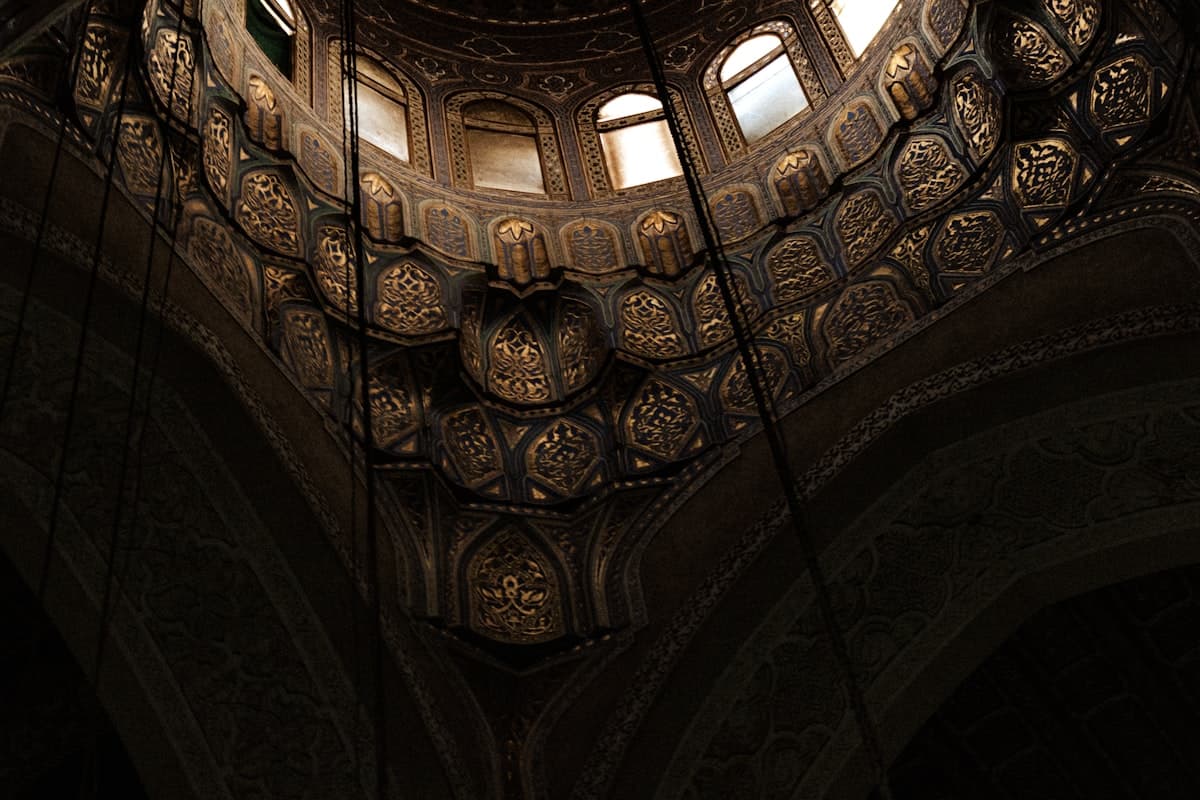
Inside, the proportions are Ottoman imperial: a central dome supported by four semi-domes, the whole interior hung with hundreds of lamps that were originally oil-burning and are now electric, arranged in low circular rings that fill the space between your eye level and the dome above. Mohamed Ali's tomb is in the mosque, enclosed behind white marble screens on the right as you enter. It is easy to walk past without noticing it. Most visitors do.
What most visitors also miss: the clock tower in the mosque's courtyard was a gift from King Louis-Philippe of France in 1845, given in exchange for the obelisk that now stands in the Place de la Concorde in Paris. The obelisk was originally one of a pair at Luxor Temple. France took one and left the other. The clock Mohamed Ali received in exchange has never worked properly. Egyptians find this funnier than French visitors do.
The Citadel Walls and the View
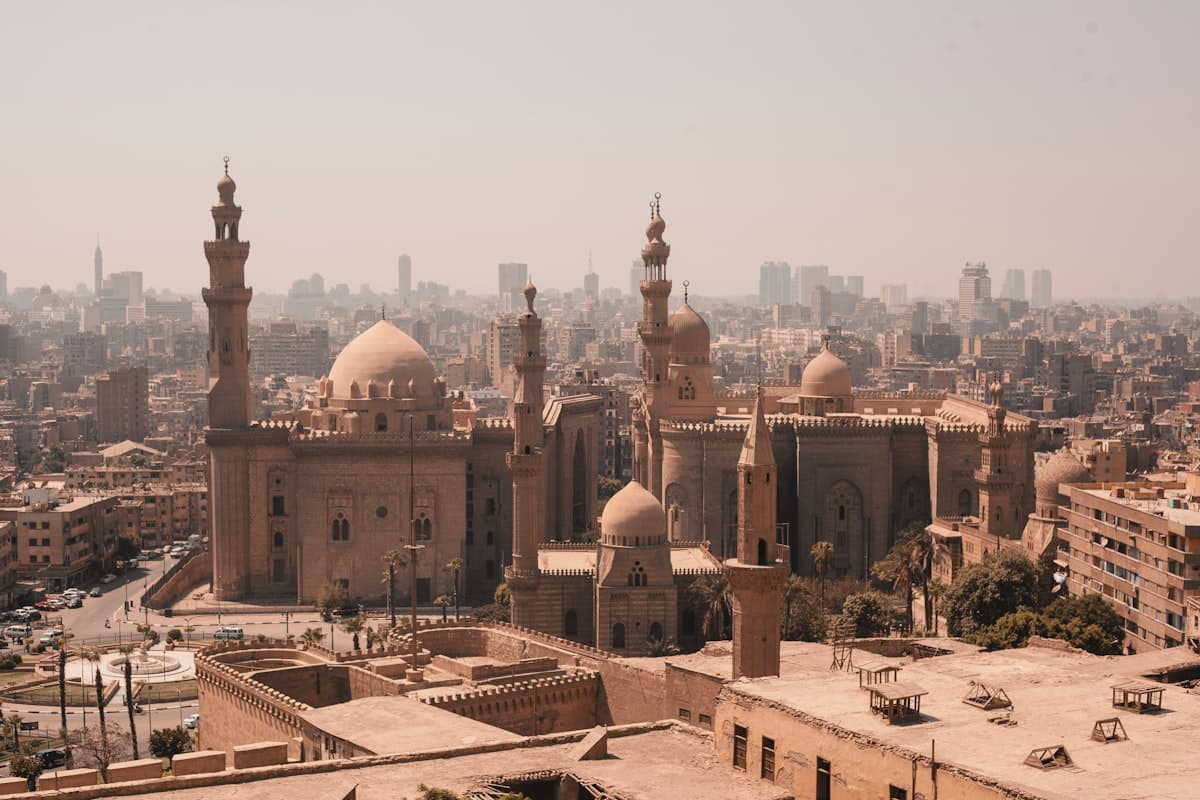
The northern terrace of the Citadel gives you the clearest possible picture of how Cairo was organized by Mohamed Ali's era, and by what came before him. Directly below are the medieval districts of Islamic Cairo, the minarets of the Sultan Hassan Mosque and the Al-Rifa'i Mosque crowded against each other, the former Mamluk, the latter Khedival, both of them enormous and both of them built partly to announce dynastic legitimacy to the population that would look up at them from below. In the middle distance, on a clear day, you can see the Pyramids at Giza. On a polluted day, which is most days, you cannot.
The Citadel walls themselves contain structural material from at least three earlier periods. Saladin's builders used stone quarried from the outer casing of smaller Giza pyramids. Look at the base of the south wall and you will occasionally see carved limestone blocks that do not match their medieval surroundings. They are older by three millennia.
The Human Cost That the Monument Doesn't Show
Mohamed Ali conscripted Egyptian peasant men, the fellahin, into his new army beginning in 1822. Before his rule, Egyptians had not served as soldiers since the Pharaonic period. The Ottoman system had kept military service as the exclusive domain of imported slave-soldiers precisely to prevent Egyptian subjects from acquiring military power. Mohamed Ali reversed this not out of concern for Egyptian dignity but because he needed bodies for his campaigns in Sudan, Arabia, Greece, and eventually against the Ottoman Sultan himself.
The recruitment was violent. Village leaders were given quotas. Men mutilated themselves to avoid service. The historian Khaled Fahmy, in his study of Mohamed Ali's army and society, documents that some men put out their own eyes or cut off fingers to be declared unfit. The army that built Mohamed Ali's reputation in Europe was built on the bodies of fellahin who had no choice about joining it.
Mohamed Ali's modernizing Egypt history looks different depending on which floor of the building you are standing on. From the terrace of his mosque, it looks like a civilization being invented. From the perspective of the Delta villages that supplied his cotton labor and his soldier quotas, it looks like a more efficient system of extraction than the Mamluks had managed.
The Connections
Mohamed Ali died in 1849 in Alexandria, mentally deteriorated, his ambitions for an independent Egyptian empire blocked by the European powers and the Ottoman Sultan. His successors continued the project he started, each adding a layer to the city. His grandson Ismail Pasha, who ruled from 1863 to 1879, built the Cairo Opera House and the European-designed downtown grid that now contains Tahrir Square. Ismail also ran Egypt into debt so severe that Britain and France imposed financial oversight, which led to the British occupation of 1882.
The building that now houses the Egyptian Museum on Tahrir Square was built in 1902 precisely because Mohamed Ali's dynasty had created enough institutional infrastructure to commission a national museum. The Antiquities Service that collected the objects in that museum was established in 1858 by Said Pasha, another of Mohamed Ali's sons, initially under French direction.
The Al-Rifa'i Mosque that faces the Sultan Hassan Mosque at the base of the Citadel hill contains the tombs of most of Mohamed Ali's dynasty, including King Farouk, the last Egyptian king, who died in exile in Rome in 1965 and was brought back to be buried there. It also contains the tomb of Mohammad Reza Shah Pahlavi of Iran, who was given refuge in Egypt by Anwar Sadat in 1980. The dynasty that Mohamed Ali founded, and the alliances his descendants made, left residue across the region for 150 years after his death.
Common Mistakes
Arriving at midday in summer. The Citadel is on a hill with no shade on the approach paths and minimal shade in the outer courtyard. Between 11am and 3pm from May through September, it is genuinely unpleasant, and the alabaster in the mosque courtyard becomes hot enough to feel through shoe soles. Come at 8am when the gates open, or after 4pm when the light on the stone is better anyway.
Hiring a guide from outside the gate. The Citadel entrance is surrounded by men offering unofficial tours at what sound like reasonable rates (EGP 150 to 200). Several of them are good. Several will route you through a papyrus shop or a perfume store before the tour ends. Book through your hotel or use a licensed guide whose credentials you can verify in advance.
Spending all your time in the mosque and none on the walls. The Mohamed Ali Mosque is the main attraction and it deserves time. But the Citadel complex is large, and the northern terrace, the Suleiman Pasha Mosque (the oldest Ottoman mosque in Cairo, built 1528, almost never visited), and the walkable section of the eastern wall collectively tell a more complete story than the mosque alone.
The Sound and Light Show at the Citadel costs EGP 300 and adds nothing you would not learn from reading for an hour beforehand. The narration is the same patriotic summary you will find in any Egyptian history textbook from the 1970s. Mohamed Ali appears as a hero without complication. Skip it, and spend the EGP 300 on dinner in the Khan al-Khalili area instead.
Skipping the surrounding neighborhood entirely. The area between the Citadel and the Sultan Hassan Mosque is one of the densest concentrations of Mamluk architecture remaining anywhere on earth. The street called Shari'a al-Mu'izz is a twenty-minute walk north and contains continuous Islamic-period architecture from the 10th through the 19th centuries. Most Citadel visitors do not walk it.
Confusing Mohamed Ali Pasha with Mohamed Ali the boxer. This sounds obvious, but search engine results for "Mohamed Ali history" conflate both. The Pasha has a less interesting Wikipedia article but a more interesting building.
Expecting the military museum inside the complex to be well-labeled in English. It is not. The artifacts are significant, the captions are sparse. Go with curiosity about the objects rather than expectation of contextual explanation.
Practical Tips
Dress for a mosque: shoulders and knees covered. The mosque provides robes at the entrance for EGP 5 if you need one. Remove shoes before entering. The stone floor inside is cool, which is relief in summer.
Bring water. There are vendors outside the gate selling cold water for EGP 10. Inside the complex, prices rise.
The Citadel is busiest on Friday mornings and on Egyptian national holidays. On a Tuesday or Wednesday between October and February, you can have the mosque courtyard nearly to yourself at 8am.
Combine the Citadel with the Sultan Hassan Mosque and the Al-Rifa'i Mosque at its base (combined ticket approximately EGP 120) for a half-day that takes you from the Mamluk 14th century through the dynastic 19th century in a single walk. Then walk north into the Mu'izz Street district for the centuries in between.
If you want to understand Mohamed Ali Pasha modernizing Egypt history with more depth than a site visit allows, Khaled Fahmy's "All the Pasha's Men" is the definitive academic account in English, and Juan Cole's "Napoleon's Egypt" provides essential context for the world Mohamed Ali walked into when he arrived in 1801.
Frequently Asked Questions
The Weekly Dispatch
More on Egypt, every Friday.
Cultural depth and places most guides never mention.
No spam. Unsubscribe anytime.