Mohamed Ali Pasha Modernizing Egypt: History in Stone and Steel
He executed 470 Mamluk lords at a single dinner party and used the chaos to rebuild Egypt from scratch. The mosque he left behind is not what you think it is.

Quick Facts
- Best time to visit
- October to March for clear air and cool temperatures. July and August bring haze and heat that flatten the views from the Citadel walls and make the open courtyard uncomfortable by midmorning.
- Entrance fee
- EGP 450 (approx $9 USD), students EGP 225 with valid ID. Audio guide EGP 50 extra at the ticket window.
- Opening hours
- Daily 8am to 5pm (winter, October to April), 8am to 6pm (summer, May to September). Mosque closes briefly Friday midday for prayer.
- How to get there
- Metro to Sadat station, then ride-share to Citadel gate: EGP 30 to 50 total. Bus 951 from Ramses Square runs direct. Taxi from central Cairo EGP 60 to 100 depending on traffic and negotiation.
- Time needed
- 3 hours minimum for mosque and main Citadel sites. Half-day (4 to 5 hours) if combining with Military Museum and wall walk. Full day if descending to Sultan Hassan and Al-Rifa'i mosques at the base.
- Cost range
- Budget day including entry, transport, and street food: EGP 600 to 900. Mid-range with guided tour and sit-down lunch: EGP 1,800 to 2,500.
Quick Facts
Best time to visit: October through March, when the Citadel sits in clear winter light rather than summer haze
Entrance fee: EGP 450 (approximately $9 USD) covers the Citadel complex including the Mosque of Mohamed Ali, the Military Museum, and the Police Museum. Students with valid ID pay EGP 225.
Opening hours: Daily 8am to 5pm (winter), 8am to 6pm (summer). The mosque closes briefly on Friday for midday prayer.
How to get there: From Tahrir Square, take the metro to Sadat station, then a microbus or taxi to the Citadel gate (Bab al-Azab) for around EGP 30 to 50 by ride-share. Bus 951 from Ramses runs directly but takes longer. A Cairo Card day pass (EGP 85) covers metro and some bus routes.
Time needed: 3 hours minimum for the mosque and main courtyard. Add 2 more hours if you plan to walk the full Citadel walls and visit the Carriage Museum.
Cost range: Budget day including transport and lunch nearby: EGP 600 to 900. Mid-range with a guided tour: EGP 1,800 to 2,500.
---
In March 1811, Mohamed Ali Pasha invited every Mamluk leader in Egypt to a celebration at the Citadel. He fed them, honored them, led them through the narrow corridor of Bab al-Azab, and then had his soldiers shoot them from the walls above. Between 470 and 500 Mamluk lords died in that passage in a matter of minutes. One survivor reportedly jumped his horse off the walls and escaped. Mohamed Ali spent the following decades quietly eliminating the rest.
This is the man whose mosque dominates the Cairo skyline. The man Egyptian schoolchildren are taught to call "the Father of Modern Egypt." Both things are true at once, which is the first thing you need to understand before you climb the Citadel hill.
Why This Place Matters
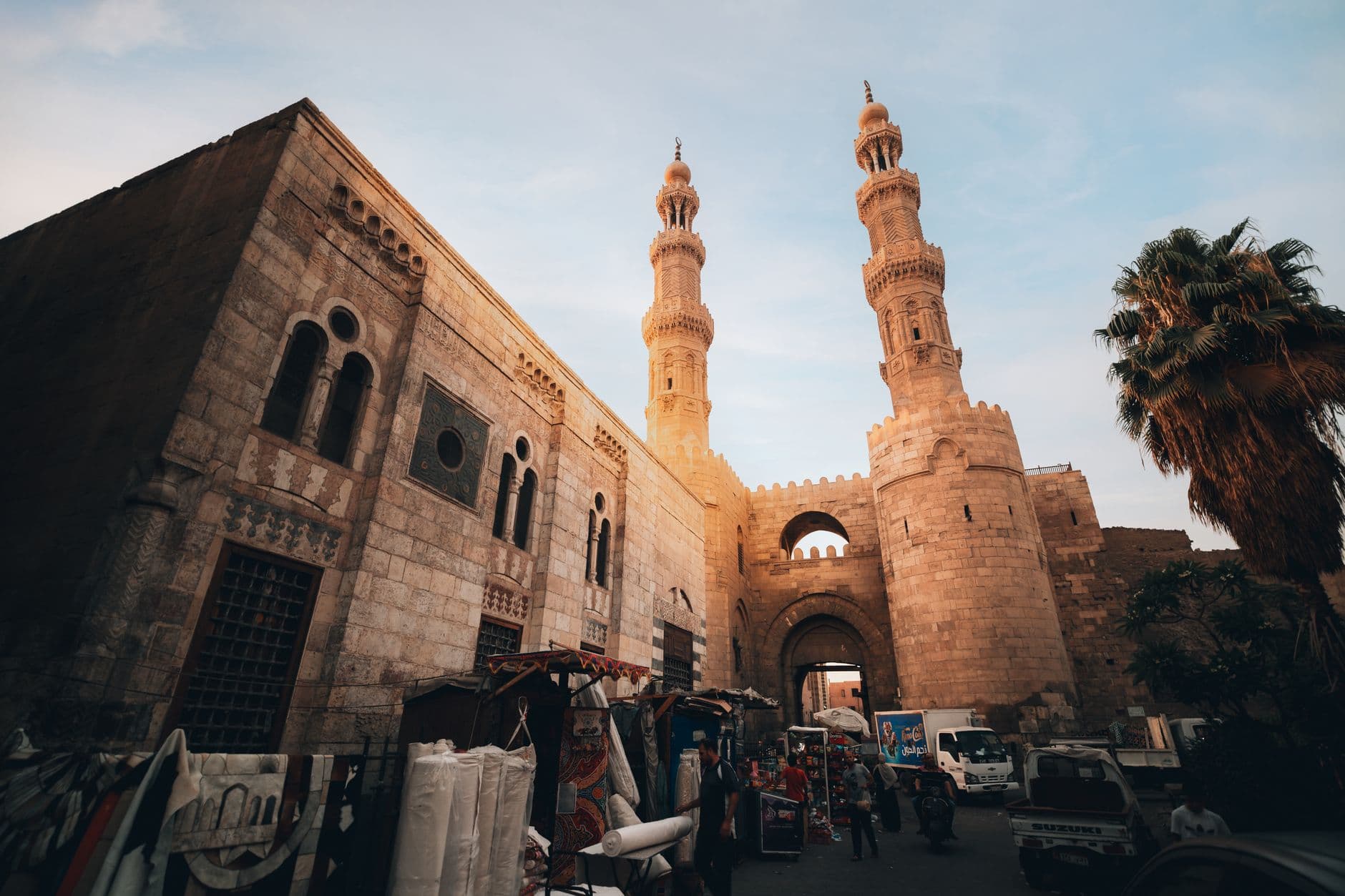
The Citadel of Cairo, which Saladin began constructing in 1176 CE on a spur of the Muqattam Hills, has been the seat of Egyptian political power for nearly 700 years across completely different civilizations. Ayyubids, Mamluks, and Ottomans all ruled Egypt from this hill. Mohamed Ali Pasha did not inherit a functioning state when he came to power in 1805. He inherited a country exhausted by Napoleon's invasion, Ottoman neglect, and Mamluk infighting. He inherited a population that had not been meaningfully governed in a generation.
What he built in response was genuinely new for Egypt: a modern army trained by French officers, a navy, a network of state schools, cotton-based industrial agriculture, and a bureaucracy modeled on European administration. He sent Egyptian students to Paris on state scholarships, at least 44 in the first cohort of 1826, with instructions to learn medicine, engineering, and military science. One of those students, Rifaa al-Tahtawi, came back and translated French Enlightenment texts into Arabic. The political ideas that would eventually produce Egyptian nationalism in the late 19th century trace a direct line to that scholarship program.
The mosque he built between 1830 and 1848, which was still unfinished when he died in 1849, is architecturally a deliberate statement. It does not look like a Mamluk mosque. It does not look Egyptian at all. It is modeled almost exactly on the Blue Mosque in Istanbul, and that was entirely intentional. Mohamed Ali was performing his legitimacy in stone: he was telling the Ottoman Empire, which still nominally controlled Egypt, that he was their equal, not their provincial governor.
The clock tower in the mosque's courtyard tells the same story from a different angle. It was a gift from King Louis-Philippe of France, sent in 1845 in exchange for the obelisk from Luxor Temple that now stands in the Place de la Concorde in Paris. The French clock has never worked correctly. The Luxor obelisk is still in Paris.
What You Will Actually See
The approach matters. Come through Bab al-Azab if you can, the lower gate on the northern side of the Citadel hill. This is the passage where the Mamluk massacre happened in 1811, and walking it gives you a sense of the trap it was: narrow, walled, with high ramparts on both sides. The gate is sometimes closed to general traffic, in which case the main entrance brings you up through Salah Salem Road and into the southern compound. Either route deposits you eventually into the wide upper courtyard facing the mosque's twin minarets.
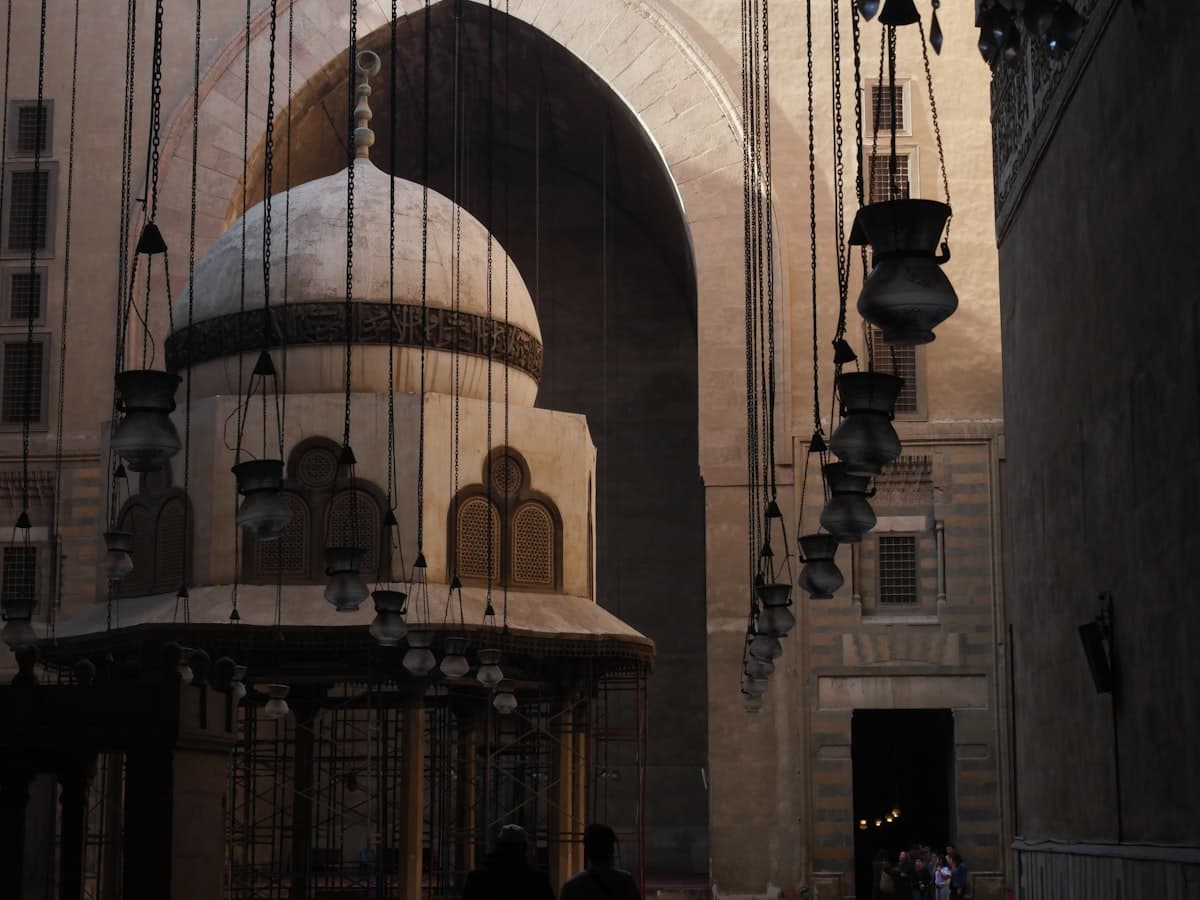
The minarets are 82 meters tall and visible from much of Cairo. They are the formal Ottoman style, pencil-thin and elegant, and they were specifically chosen to signal the mosque's political allegiance. Inside, the effect shifts completely. The central dome rises 52 meters, ringed by four smaller domes and illuminated by hundreds of hanging brass lamps. The alabaster cladding on the lower walls is real: Mohamed Ali imported the stone from quarries near Beni Suef in Upper Egypt, which is why the mosque acquired its common name, the Alabaster Mosque. The floor is carpeted in red, and on busy mornings the light through the western windows cuts across it in long diagonal stripes.
Mohamed Ali's tomb is in the mosque, inside a marble enclosure in the right transept. It is quiet and relatively ignored by most tourists who have already moved to take photographs of the dome. Spend a moment there. The man who industrialized Egypt's cotton economy, abolished the Mamluk ruling class, and tried to build a regional empire stretching from Sudan to the Levant is buried in a building that still gets the clock-tower story wrong on most tour scripts.
The Military Museum and What It Tells You
Directly opposite the mosque in the Citadel's northern compound sits the Military Museum, installed in what was Mohamed Ali's Harem Palace in 1827. This building matters for the modernization story specifically. Mohamed Ali built it as his administrative residence when he moved the seat of government from the older Mamluk structures to a purpose-built European-style palace. The architecture is Franco-Egyptian: French neoclassical facade, Egyptian proportions, rooms designed to accommodate both Ottoman court ceremony and French-style reception.
The museum inside is uneven. There are genuine artifacts from Mohamed Ali's military campaigns, including weapons from the Sudan campaigns and maps of the Levantine wars his son Ibrahim Pasha fought against the Ottoman Empire in the 1830s. Ibrahim came close enough to threatening Istanbul that the major European powers intervened diplomatically to stop him. Egypt, at that moment, had a stronger military than the empire it nominally served. That context is mostly absent from the museum's labeling, which tends toward general military history rather than the specific extraordinary fact of a 19th-century Egyptian army that nearly brought down the Ottoman Empire.
Admission is included in your Citadel ticket. Give it 45 minutes.
The Connections
Mohamed Ali Pasha modernizing Egypt history cannot be understood without the longer chain it sits inside. The Citadel hill itself had been fortified since the Fatimid period in the 10th century. Saladin chose it for his citadel specifically because it commanded the canal routes between the Nile and the city, and those canal routes traced paths that Pharaonic engineers had used for drainage and agriculture for two thousand years before Saladin arrived.
The Mamluk sultans who ruled Egypt from the Citadel between 1250 and 1517 built the great mosque complexes you see in Historic Cairo below: the Sultan Hassan Mosque, the Al-Rifa'i Mosque, the Ibn Tulun complex. They funded those buildings with the income from the spice and silk trade passing through Egypt between Asia and Europe. When the Portuguese found the sea route around Africa in 1498, they broke Egypt's monopoly on that trade and began the long economic decline that made the Mamluks vulnerable to the Ottomans in 1517 and eventually vulnerable to Napoleon in 1798.
Mohamed Ali understood this chain. His industrial cotton program was a deliberate attempt to find a new export commodity that could replace what the spice trade had once provided. He succeeded in making Egypt the primary long-staple cotton supplier for British textile mills, which made Egypt genuinely important to the British Empire, which is exactly why Britain eventually occupied Egypt in 1882. The modernization project he designed for Egyptian autonomy created the conditions for Egyptian colonization. That particular irony runs through every level of the Citadel site.
One more connection that almost no tour scripts mention: the French architect Pascal Coste designed several of Mohamed Ali's industrial buildings in the 1820s, including facilities in Bulaq that no longer exist. Coste also produced the most detailed architectural drawings of Islamic Cairo's medieval monuments ever made in the 19th century, documenting Mamluk buildings that were already deteriorating. His drawings became the primary reference for later European architects who "restored" those same monuments in ways that changed them. The French influence on Mohamed Ali's Egypt thus shaped the documentation and reconstruction of everything that came before him.
Common Mistakes
Arriving without cash. The ticket window at the Citadel sometimes accepts cards and sometimes does not. Bring EGP in small bills. The ticket includes the main complex but some internal museums charge separately at the door.
Going on Friday midday. The mosque closes for Jumu'a prayer from roughly 12:30pm to 2pm. The Citadel remains open but the mosque interior, which is the main draw, goes with it. Plan accordingly.
Taking the sound and light show. It runs on Thursday and Saturday evenings for EGP 300 to 400 per person. It adds nothing to what you will learn from thirty minutes of reading and reduces the Citadel to a backdrop for a narration that treats Mohamed Ali as an unambiguous hero without engaging the massacre, the conscription of Egyptian peasants into his armies, or the forced-labor cotton agriculture. Skip it.
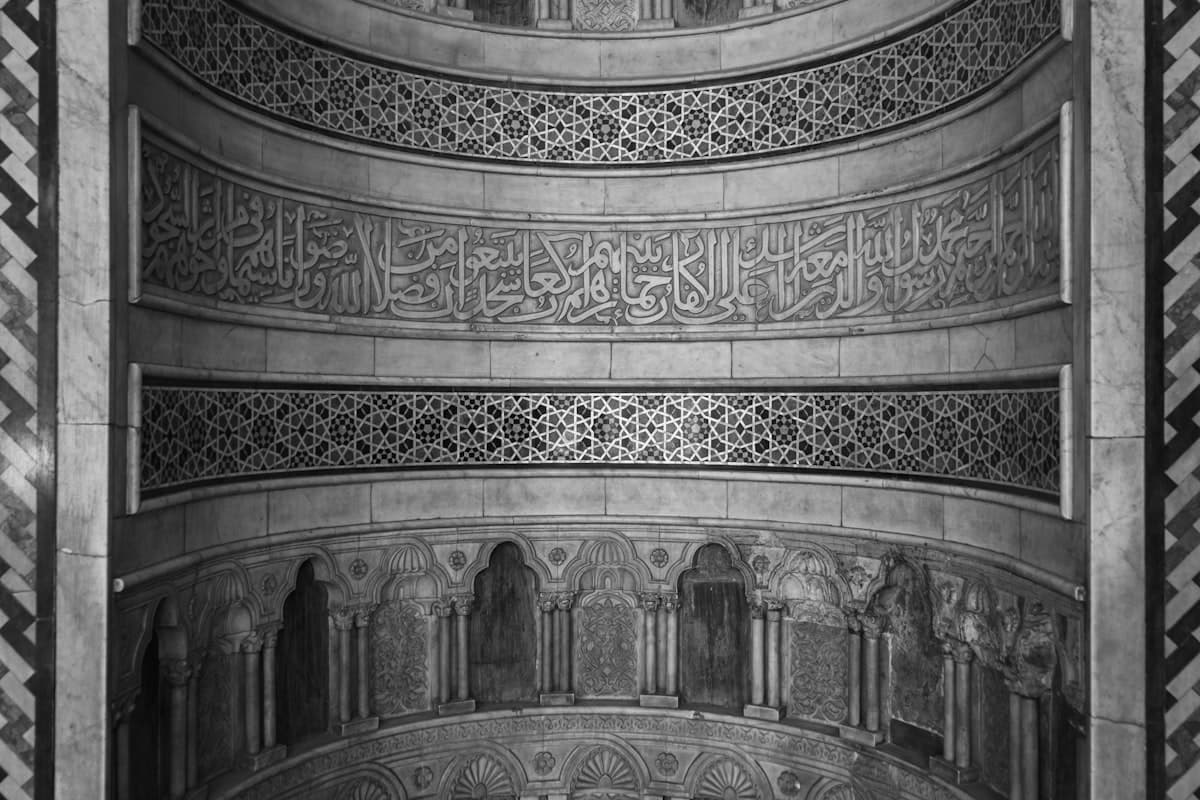
Confusing the two mosques. The Al-Nasir Mohamed Mosque in the Citadel's northern enclosure is a Mamluk structure from the 14th century and is architecturally extraordinary. Its carved stucco and ceramic tilework survive in remarkable condition. Most visitors walk past it to reach Mohamed Ali's mosque and never go back. Go to Al-Nasir first.
Skipping the Citadel walls. The walkable sections of the Ayyubid and Mamluk walls give you the clearest possible view of how Cairo's urban geography has changed since the 12th century. From the eastern wall you can see the Muqattam Hills and trace where the medieval city ended and the desert began. This takes 20 minutes and costs nothing extra.
Hiring an unofficial guide at the gate. They will offer prices that sound reasonable and deliver a tour scripted around tips. The official audio guide, available in English, Arabic, French, and German at the ticket window for EGP 50, is more accurate and lets you move at your own pace.
Treating this as a standalone site. The Citadel connects directly to the Mohamed Ali district below and to the historic mosque complexes of Old Cairo. If you visit the Citadel without walking down to Sultan Hassan and Al-Rifa'i mosques, which sit literally at the Citadel's base, you are leaving the most important architectural conversation in medieval Islamic Cairo half-read.
Practical Tips
Wear shoes you can remove easily. You will take them off to enter the mosque and sometimes the floor is cold in winter mornings. Socks are a practical kindness to yourself.
Dress modestly. The mosque provides robes at the entrance for women who need them, but they are usually rough and sometimes damp. Bring your own long skirt or scarf if you prefer.
The best light for photography inside the mosque is between 9am and 11am on a clear day, when the western windows are still in direct sun. After noon the interior goes flat.
The courtyard cafe near the northern entrance sells tea and soft drinks. The food stalls just outside the Citadel gate on Salah Salem Road serve koshary and ful for EGP 30 to 50 a plate. There is no reason to eat inside the complex.
Crowds peak between 10am and 1pm, particularly on weekends when Cairo families visit. Arrive at 8am when the site opens if you want the mosque to yourself for the first 45 minutes. It is a different experience in near-silence.
Frequently Asked Questions
The Weekly Dispatch
More on Egypt, every Friday.
Cultural depth and places most guides never mention.
No spam. Unsubscribe anytime.