Naguib Mahfouz Cairo Literary History Guide: The Real Khan el-Khalili
Mahfouz wrote Cairo Trilogy in a city that no longer exists. The coffeehouse where he held court for 40 years still serves tea. The alley that inspired it all is a 10-minute walk from where tourists stop.

Quick Facts
- Best time to visit
- October through March. The alleys of Gamaliya trap heat severely in summer. Winter mornings offer the best light on al-Muizz Street and the most comfortable walking conditions.
- Entrance fee
- El-Fishawi coffeehouse: no cover, tea EGP 20-40 (approx $0.40-0.80 USD). Al-Muizz Street and Gamaliya: free to walk. Al-Azhar Park for orientation views: EGP 35 (approx $0.70 USD).
- Opening hours
- El-Fishawi: 24 hours daily, quietest before 10am. Al-Muizz Street: open access at all hours, best light 7-9am and 4-6pm. Qalawun complex: generally 9am-5pm, Friday hours vary.
- How to get there
- Metro Line 2 to El-Ataba station (EGP 10, approx $0.20 USD), then 15-minute walk northeast. Taxi from downtown Cairo: EGP 50-80. Tuk-tuk within the old city area: EGP 15-25.
- Time needed
- Half day for the core literary walk (Bab el-Futuh to Fishawi). Full day to include Qalawun complex, al-Hussein Mosque, and a proper sit at El-Fishawi. Two days if you are reading the novels alongside.
- Cost range
- Budget EGP 300-500 per day including metro, tea, and street food. Mid-range EGP 1,200-2,000 if adding a restaurant meal and guided context.
Quick Facts
Best time to visit: October through March, when the air in Islamic Cairo is cool enough to walk slowly and the light on medieval stone turns copper by late afternoon.
Entrance fees: Naguib Mahfouz Museum (Gamaliya): Free, though donations are welcomed. Check current status before visiting as opening hours shift seasonally. Al-Azhar Park (useful orientation point): EGP 35 (approx $0.70 USD) Khan el-Khalili bazaar area: Free to walk El-Fishawi Coffeehouse: No cover. A tea costs EGP 20-40 (approx $0.40-0.80 USD)
Opening hours: El-Fishawi is technically open 24 hours and has been, with one brief closure, since 1773. Morning visits before 10am are quiet enough to think.
How to get there: Take the Cairo Metro Line 2 to El-Ataba station (EGP 10, approx $0.20 USD), then walk 15 minutes northeast into Gamaliya. A taxi from downtown runs EGP 50-80. A tuk-tuk from the edge of the old city to Bab el-Futuh costs EGP 15.
Time needed: Half a day for the literary walk alone. A full day if you combine it with the Al-Hussein Mosque, the Qalawun complex, and a proper sit at Fishawi. Two days if you take Mahfouz seriously as a guide to this neighborhood.
Cost range: Budget EGP 300-500 per day including transport, tea, and street food. Mid-range EGP 1,200-2,000 if you add a meal at the Naguib Mahfouz Restaurant in Khan el-Khalili.
---
Why This Place Matters
Naguib Mahfouz won the Nobel Prize for Literature in 1988. He was the first Arab writer to do so. The Swedish Academy described his work as forming "an Arabian narrative art that applies to all mankind." He accepted the prize from Stockholm because he was afraid to fly, and because by then a death threat from a religious extremist had already been circulating for years. In 1994, a man stabbed him in the neck outside his apartment in Agouza. He was 82. He survived, but the nerve damage left his writing hand partially paralyzed. He dictated his final stories.
This is the man whose novels you are walking into when you enter Gamaliya.
Mahfouz was born in 1911 in the Gamaliya district of Islamic Cairo, in a narrow apartment on Darb Qirmiz alley, a street so old it appears in Ottoman land records from the 16th century. He left the neighborhood as a young man but never stopped writing it. The Cairo Trilogy, his masterwork, follows three generations of the al-Jawad family through a merchant's house in Bayn al-Qasrayn, a street name that translates to "between the two palaces," a reference to two Fatimid royal complexes that no longer stand but that defined the axis of medieval Cairo for three centuries.
The books are set between 1917 and 1944. The neighborhood they describe has been continuously inhabited since the 10th century. When the Fatimid caliph al-Muizz li-Din Allah entered Cairo in 972 CE, he rode down a street that is now called al-Muizz Street, and it is still there, and you can walk it today, and the stones beneath your feet are not the original ones but the grid is the same grid and the scale is the same human scale that Mahfouz used as the skeleton of his fiction.
This is what makes the Naguib Mahfouz Cairo literary history guide unusual among literary tourism itineraries: the city he wrote about is, unusually, still present. It is worn, compressed, and loud. But it is there.
---
The Neighborhood That Became Literature
Start at Bab el-Futuh, the northern gate of the Fatimid city, built in 1087 by the Armenian general Badr al-Jamali who served as vizier to the Fatimid caliph. The gate's stones were taken from earlier Pharaonic and Roman structures: you can still see repurposed column drums and older carvings embedded in the lower courses of the gate walls. This is not unusual in Cairo. It is the operating principle of Cairo. Nothing is ever entirely demolished. Everything is reused.
Walk south down al-Muizz Street. You will pass the Qalawun complex, built between 1284 and 1285 by the Mamluk sultan Qalawun, who had himself been purchased as a slave from a Mongol merchant for one thousand dinars and who went on to defeat the Crusaders at the Siege of Tripoli. His mausoleum, hospital, and madrasa together form one of the most concentrated pieces of medieval architecture in the world, and most people walk past them reading their phones.
At the intersection known as Bayn al-Qasrayn, stop. This is the literal setting of the first volume of the Cairo Trilogy. The name refers to the two Fatimid palaces that faced each other across a grand ceremonial boulevard here from the 10th to the 12th century. The palaces were dismantled by Saladin after he took Cairo in 1171, and their stones were used in other projects. But the street name survived the palaces by nine centuries, and Mahfouz used it as his title, trusting that a name carries weight even when what it named is gone.
The merchant's house where the patriarch al-Sayyid Ahmad Abd al-Jawad runs his household is fictional, but it is based on a specific typology of Cairene domestic architecture called a wikala. There are real examples within 200 meters of this intersection. The architecture determines the psychology of the characters: the separated male and female quarters, the street-facing mashrabiya screens that let women observe the street without being seen, the internal courtyard where sound echoes. You cannot fully understand why the women of the al-Jawad household are imprisoned by their situation without understanding the physical logic of the house.
---
El-Fishawi and the Coffeehouse Tradition
El-Fishawi coffeehouse sits in a narrow passage off Khan el-Khalili, and it has been there, with one brief interruption during a plague, since 1773. The mirrors that line its walls are original. The low wooden tables are not designed for Western bodies. The tea arrives in glasses, not cups.
Mahfouz held court here for roughly 40 years. Every Thursday, through much of the second half of the 20th century, he would sit with a rotating circle of writers, journalists, and intellectuals. The meetings were not formal but they were consistent, and they produced some of the most important conversations in 20th-century Egyptian cultural life. Writers including Yusuf Idris, who many critics believe deserved the Nobel Prize before Mahfouz, and the poet Salah Abd al-Sabour were regulars.
The coffeehouse in Egyptian literary culture is not background. It is infrastructure. The ahwa functions as an extension of the apartment, the office, and the parliament. Mahfouz understood this and wrote it repeatedly: coffeehouses in his fiction are where men negotiate, confess, philosophize, and collapse. They are also where they waste time in exactly the right way.
Sit here for at least 45 minutes. Order tea. Do not order coffee if you want to think; Egyptian coffee is short and thick and will make your heart move faster than the neighborhood requires. Watch the passage between the bazaar lanes. In the early morning, before the vendors arrive, you can see the street the way Mahfouz's characters would have known it: narrow, the upper floors of the buildings nearly touching above you, the light coming in at an angle that never reaches the ground directly.
One detail most visitors miss: the mirrors in Fishawi are not decorative. In a coffeehouse used by men who sometimes needed to conduct business without appearing to watch the door, mirrors allowed peripheral surveillance. The design is practical and the same logic appears in descriptions of coffeehouse interiors in Mahfouz's fiction.
---
The Connections: From Pharaonic Canal to Nobel Prize
The area between Gamaliya and the Nile was, before the Fatimid city was built, threaded with branches of the khalij, the ancient canal that connected the Nile to the Red Sea. The canal's earliest known construction dates to the reign of Senusret III in the Middle Kingdom, roughly 1870 BCE. It was rebuilt by the Persians, then by the Ptolemies, and then by the Roman emperor Trajan. The early Islamic caliphs used it to ship grain. By Mahfouz's childhood, it had been filled in and built over, but the street that runs along its former course, Sharia Port Said, still traces the canal's route.
This is the thing about Islamic Cairo that rewards attention: the urban geography is layered in a way that the archaeology hasn't fully caught up to. The street pattern of Gamaliya follows the logic of medieval Islamic urbanism, which itself responded to a Pharaonic hydraulic system. Mahfouz wrote novels about human nature and Egyptian society, but the container he put them in was a neighborhood that was itself a compressed record of 3,000 years of habitation.
The Nobel Prize citation mentioned his work gave "the whole world a share in a rich and living culture." The culture in question is not Pharaonic Egypt. It is the Islamic Cairo of the 20th century: the call to prayer five times a day, the feast days, the political upheaval of nationalism and post-colonialism, the persistence of traditional merchant-class social structures even as Egypt modernized around them. Mahfouz was not a romantic about the old city. He was a realist who knew that the old city was the only honest lens he had.
---
Common Mistakes
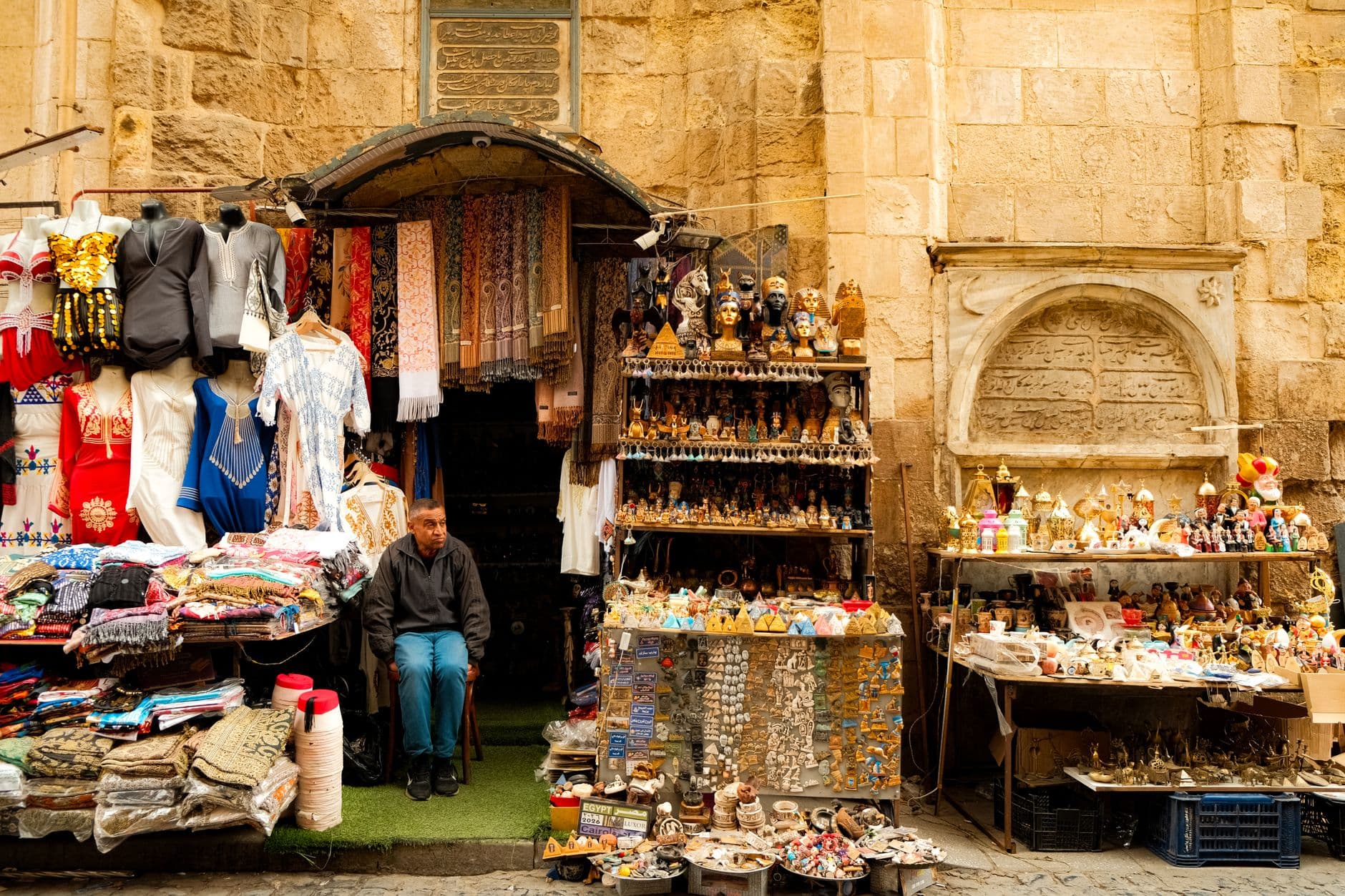
Treating Khan el-Khalili as the destination. The bazaar is where most tourists stop because the tour buses stop there. The actual literary geography of Mahfouz's Cairo begins north of the bazaar, in Gamaliya proper, and extends south along al-Muizz Street. Khan el-Khalili itself is a 14th-century Mamluk caravanserai complex that has been converted into a tourist market. Some of it is good. Much of it is not the place Mahfouz wrote about.
Eating at the Naguib Mahfouz Restaurant. It trades on the name and the address. The food is expensive by neighborhood standards, the clientele is primarily tour groups, and you will learn nothing about Mahfouz there that you could not learn from reading the back cover of Palace Walk. Eat at one of the smaller fuul and falafel spots along al-Muizz instead.
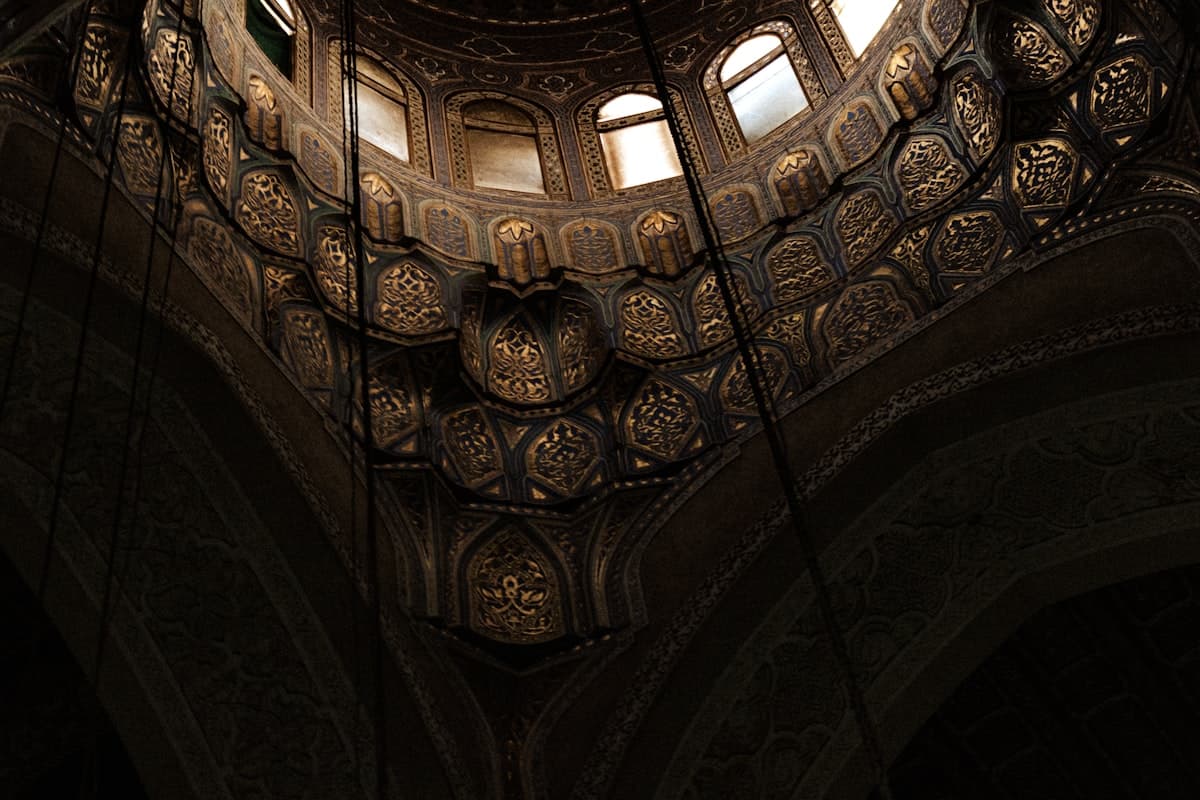
Skipping the Qalawun complex because you've read it's "in need of restoration." It is always being restored, partially. Go anyway. The interior of the mausoleum contains a ceiling that is among the finest examples of Mamluk geometric woodwork surviving in Cairo. The restoration scaffolding does not cover it.
Buying a novel at the tourist shops near Fishawi. The translations available there are inconsistent in quality. The Anchor Books translations of the Cairo Trilogy by William Hutchins are the standard English versions. Order before you arrive and read at least the first 50 pages before you walk the neighborhood. The geography of the opening chapters is a map.
Going at midday in July or August. The alleys of Islamic Cairo trap heat in a way that is specific and total. The stone absorbs it through the morning and radiates it back through the afternoon. October to March, or early morning in any season, is when the neighborhood is habitable for serious walking.
Expecting Mahfouz's Cairo to be melancholic. His prose has that reputation among readers who know his later, more experimental work. The Trilogy is not melancholic. It is detailed and sometimes very funny, and the neighborhood rewards the same attention he paid it: persistent, curious, unbothered by the surface chaos.
---
Practical Tips
Dress conservatively in Gamaliya. This is not optional etiquette. The neighborhood is a living residential and religious community, and the density of mosques means you will pass people at prayer multiple times. Shoulders and knees covered for both men and women.
Bring cash in small denominations. EGP 20 and 50 notes. The coffeehouse and street food vendors do not take cards and are occasionally suspicious of large bills.
The best single purchase in the area is a copy of "Ziqaq al-Midaq" (Midaq Alley) in Arabic if you read Arabic, or in one of the English translations if you don't. The alley it describes, Midaq Alley, is real and accessible from Khan el-Khalili. It takes about four minutes to walk its full length. But after you have read the novel, those four minutes contain fifty years of fictional lives.
For orientation before you arrive: the Egyptian government's Bibliotheca Alexandrina has digitized several of Mahfouz's manuscripts and the images are accessible online. Seeing his handwriting, the small cramped script he used before the stabbing, and then the looser dictated pages after, is a preparation that no guidebook provides.
If you visit on a Friday, the neighborhood shifts completely after noon prayer. The streets around al-Hussein Mosque will be crowded with worshippers, street food vendors, and families. This is not a problem. It is exactly the kind of scene Mahfouz described. Stay through it.
Frequently Asked Questions
The Weekly Dispatch
More on Egypt, every Friday.
Cultural depth and places most guides never mention.
No spam. Unsubscribe anytime.