Naguib Mahfouz Cairo Literary History Guide: Walking His World
Mahfouz wrote about Khan el-Khalili for decades without a desk. He worked in cafes, in ministry offices, on scraps of paper. The neighborhood shaped a Nobel Prize.

Quick Facts
- Best time to visit
- October through March for comfortable walking temperatures. Early morning visits (8 to 10am) in any season for light and quiet.
- Entrance fee
- Naguib Mahfouz Museum: EGP 50 (approx $1 USD). Khan el-Khalili streets: free. Egyptian Museum for Pharaonist context: EGP 450 (approx $15 USD).
- Opening hours
- Museum: Saturday to Thursday 10am to 5pm. Fishawi Cafe: daily, roughly 9am to midnight. Khan el-Khalili market: daily 9am to midnight, quieter on Friday mornings.
- How to get there
- Metro to Attaba (Line 1 or 2, EGP 7), then 15-minute walk northeast into Gamaliya. Taxi from Downtown Cairo EGP 40 to 80. Walking from Al-Azhar Mosque takes 5 minutes.
- Time needed
- 3 to 4 hours for the literary walk alone. Full day of 6 to 7 hours if combining with Al-Azhar, Darb al-Ahmar, and the Wikala of al-Ghuri.
- Cost range
- Budget EGP 300 to 500 including museum entry, tea at Fishawi, and local lunch. Mid-range EGP 800 to 1,500 adding the Egyptian Museum or a proper restaurant dinner.
Quick Facts
Best time to visit: October through March, when Khan el-Khalili and Islamic Cairo are cool enough to walk for hours without stopping.
Entrance fees: The Naguib Mahfouz Museum (Gamaliya district) charges approximately EGP 50 (approx $1 USD) for entry. Most cafes and streets are free to walk. The Egyptian Museum, relevant for context on the Pharaonist movement Mahfouz absorbed, charges EGP 450 (approx $15 USD).
Opening hours: The Naguib Mahfouz Museum is open Saturday through Thursday, 10am to 5pm. Khan el-Khalili operates daily from roughly 9am to midnight, though the literary cafes are best visited between 11am and 3pm or after 8pm.
How to get there: From Tahrir Square, take the Metro to Attaba station (Line 1 or 2, EGP 7 per trip) and walk northeast for 15 minutes into Gamaliya. Taxis from Downtown Cairo cost EGP 40 to 80 depending on traffic. The walk from Al-Azhar Mosque takes five minutes.
Time needed: Half a day for the literary route alone. A full day if you combine it with Al-Azhar, the Wikala of al-Ghuri, and a sit-down meal at a historic cafe.
Cost range: Budget EGP 300 to 500 for the literary route including entry, tea, and lunch at a local fuul restaurant. Mid-range EGP 800 to 1,500 if you add the Egyptian Museum or a proper dinner at Naguib Mahfouz Cafe.
---
Why This Place Matters
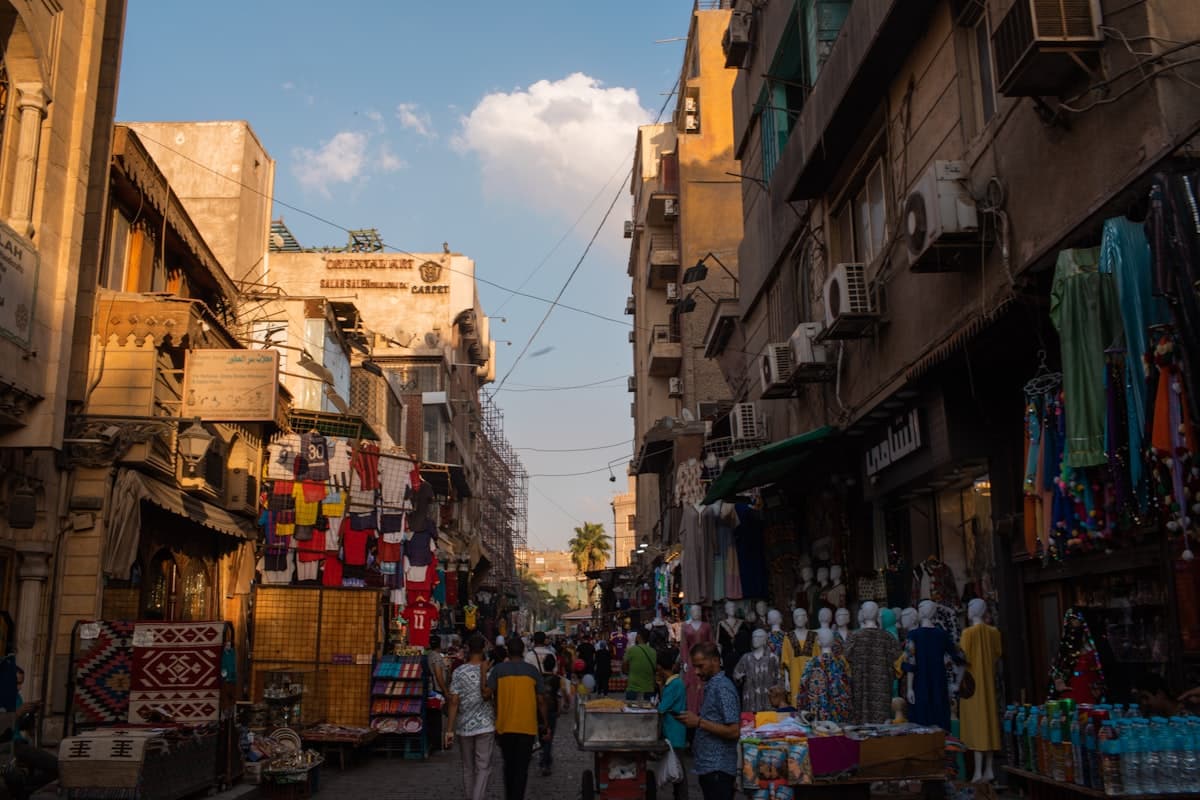
Naguib Mahfouz won the Nobel Prize for Literature in 1988, the only Arab writer ever to do so. The Swedish Academy cited his work for its portrayal of "an Arab narrative art that applies to all mankind." What they were really describing was three square kilometers of Islamic Cairo, specifically the alleys of Gamaliya and Khan el-Khalili, which appear in his fiction so precisely that you can still walk into scenes he wrote in the 1940s and find the geometry unchanged.
Mahfouz was born in 1911 in the Gamaliya neighborhood, in a house on Bein al-Qasreen, a street whose name translates literally as "between the two palaces." The two palaces in question were Fatimid royal structures from the tenth century, long demolished by the time Mahfouz was born, but embedded in the district's collective memory. He turned that street into the title of the first volume of his Cairo Trilogy, the sequence of three novels published between 1956 and 1957 that traced one Cairo family across three generations and effectively documented the end of a world.
The Trilogy is set between 1917 and 1944. Mahfouz wrote it between 1945 and 1952, working as a civil servant in the Ministry of Waqfs (Islamic religious endowments) by day and writing by hand in the evenings and early mornings. He had no study. He wrote at the Fishawi Cafe in Khan el-Khalili, at a table he occupied so regularly that locals assumed it was reserved for him, though it was not.
To understand why the Naguib Mahfouz Cairo literary history guide matters, you need to understand what Islamic Cairo was in 1945. It was not a tourist district. It was one of the most densely populated urban areas on earth, a working-class neighborhood built on the ruins of the Fatimid city of al-Qahira, which was itself built on the ruins of Roman Babylon, which sat on a Pharaonic settlement beside the Nile. Mahfouz did not romanticize this layering. He lived inside it.
---
The World Mahfouz Built and the Streets That Built Him
Start at the Al-Hussein Mosque, not because Mahfouz was particularly devout (he was not, and his late novella "Children of Gebelawi" nearly got him killed for its allegorical treatment of the Abrahamic faiths), but because the square in front of it is the geographic and emotional center of his fiction. Al-Sayyida Zeinab appears in his novels. Al-Hussein appears. The sound of the Friday sermon drifting over the rooftops while his characters negotiate love, money, and colonial humiliation appears on nearly every other page.
From the mosque, walk west into the covered market of Khan el-Khalili. The market was established in 1382 by the Mamluk emir Jaharkas al-Khalili, who demolished a Fatimid royal cemetery to build it. He was executed shortly after for reasons unrelated to the demolition. The market survived him by six centuries. What you are walking through is a commercial structure that has been continuously operating longer than the Ottoman Empire existed.
Fishawi Cafe, buried inside the market's northwest section, has been open continuously since 1773. That is not a marketing claim. It is documented. The cafe served as a gathering point for Egyptian intellectuals throughout the twentieth century and Mahfouz sat here regularly from the 1960s through the 1990s. His table is near the back, marked now with a small photograph. The tea costs EGP 25. Order it. Sit for twenty minutes. The mirrors on the walls are original. The noise is the same noise that appears in his descriptions of the coffeehouse in "Midaq Alley."
"Midaq Alley" (Zuqaq al-Midaq, 1947) is set in a specific alley that still exists, running south off the main Khan el-Khalili corridor. The novel follows a handful of residents through the 1940s, as Cairo lurches through World War II and the British occupation with a mixture of indifference and opportunism that Mahfouz renders without judgment. The alley today sells tourist goods. It is still worth finding because the physical proportions, the way the upper floors nearly meet overhead, the smell of old stone and recent cooking, match Mahfouz's descriptions closely enough to function as a kind of verification.
---
The Museum, the Stabbing, and the Late Work
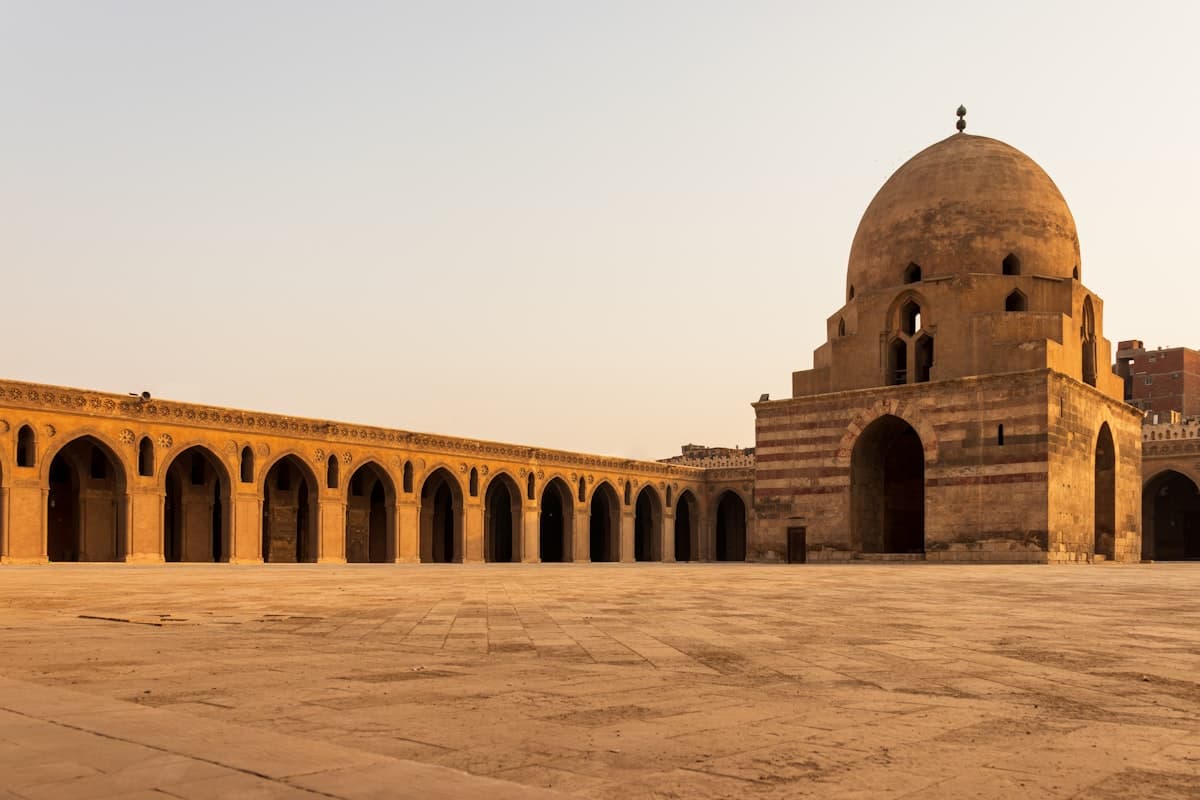
The Naguib Mahfouz Museum in Gamaliya opened in 2021, built into a restored merchant house on the edge of his birth neighborhood. It is small, three rooms and a courtyard, and it focuses on manuscripts, photographs, and his working materials. The most important thing in it is not any single object but the cumulative evidence of his method: the handwritten drafts show a writer who revised almost nothing. His sentences arrived whole.
In October 1994, Mahfouz was attacked outside his home in Agouza by two men who stabbed him in the neck with a knife. He was 82 years old. The attack was carried out by individuals connected to an extremist network that had condemned him for "Children of Gebelawi," published in 1959 and banned in Egypt almost immediately. He survived but the nerves in his right hand were damaged and he could no longer write by hand for any extended period. He dictated his remaining work, producing several more novels and hundreds of short pieces before his death in 2006 at the age of 94.
The stabbing happened because of a book that portrays God, the prophets, and Satan as characters in a Cairo allegorical story. Mahfouz never apologized for it. He also never left Egypt. He had chances. After the Nobel, European and American publishers offered arrangements that would have made his final years considerably more comfortable than they were. He declined all of them. He told an interviewer in 1989 that he could not write outside Cairo because Cairo was not a setting for him. It was the substance.
His apartment in Agouza, on the west bank of the Nile, is not open to the public. His daughter Umm Kulthum Mahfouz, named after the legendary singer, has declined requests to memorialize it. Respect this. Walk past the building if you find it, but the district itself, middle-class, slightly faded, full of the professional families who appear in his later urban novels, tells you more than a plaque would.
---
The Connections: Mahfouz Inside Egyptian Time
Mahfouz's first published works were not set in Islamic Cairo. They were Pharaonic historical novels, written in the 1930s under the influence of the Pharaonist intellectual movement, which argued that Egypt's true identity was pre-Islamic, rooted in the civilization of the Nile Valley rather than in Arab conquest. He wrote four novels in this mode before abandoning it entirely and turning to the alleys of Gamaliya. He later said the Pharaonic novels were an exercise in learning structure. The Cairo Trilogy was the first time he wrote what he actually knew.
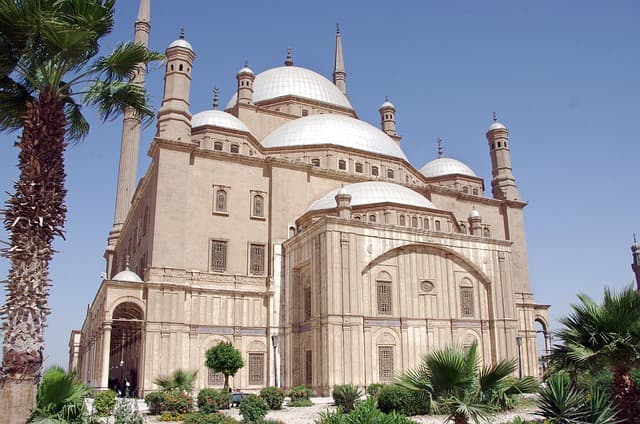
The building that housed the Ministry of Waqfs where Mahfouz worked for years stands in the Darb al-Ahmar district, a few hundred meters south of Khan el-Khalili. Darb al-Ahmar was the address of the Mamluk aristocracy in the fourteenth and fifteenth centuries. The street runs past the Mosque of Aqsunqur, built in 1347, and past the Blue Mosque, reworked in the seventeenth century by an Ottoman Ibrahim Agha who added Iznik tiles from a demolished Anatolian mosque. Mahfouz walked this street five days a week for years. The Ottoman tiles, the Mamluk stonework, the Fatimid street grid underneath everything: this was his commute.
Al-Azhar University, two minutes' walk from Fishawi, was founded in 970 CE by the Fatimid general Jawhar al-Siqilli, who was born in Sicily, possibly to Greek parents, and conquered Egypt on behalf of a North African Shia dynasty. Al-Azhar is now the preeminent Sunni Islamic institution in the world. This transformation took about two centuries and involved considerable violence. Mahfouz's character Sheikh Mutawalli Abd al-Samad in the Cairo Trilogy haunts the streets around Al-Azhar as a kind of living remnant of an older religious order, the neighborhood's spiritual conscience and its most unreliable narrator.
---
Common Mistakes
Eating at the Naguib Mahfouz Cafe in Khan el-Khalili. The restaurant bearing his name at the entrance to the market is a good-looking, properly managed place that serves competent Egyptian food at prices calibrated for European tourists. It will cost you four times what the fuul and ta'meya restaurant two alleys deeper into the market charges, for food that is not meaningfully better. Mahfouz himself never ate there. It was named after him posthumously as a commercial decision. Skip it and eat where the locals eat.
Going to Khan el-Khalili on a Friday morning. The market itself is quiet, which sounds appealing until you realize that the entire district surrounding it is also quiet, which means you miss the neighborhood as a living thing rather than a preserved artifact.
Skipping the museum because it sounds small. The Naguib Mahfouz Museum is small. It is also the only place in Cairo where you can see his actual manuscripts, his correspondence, and photographs of him at Fishawi in the 1970s when he was still largely unknown outside Egypt. It takes 45 minutes. It is worth 45 minutes.
Reading the Cairo Trilogy after you visit rather than before. The novels are long, roughly 1,500 pages combined, but even reading "Midaq Alley," which is 250 pages, before you arrive will transform the walk through Khan el-Khalili from a pleasant market visit into something that operates on two time periods simultaneously. The preparation is not optional.
Taking an organized literary tour. Every organized literary tour of Mahfouz's Cairo follows the same route, stops at the same locations, and concludes with the same photograph opportunity at Fishawi. You will hear facts you could read in five minutes. The neighborhood rewards wandering far more than it rewards following a guide with a laminated map.
Expecting the streets to be quiet. Khan el-Khalili is genuinely, actively loud. The calls to prayer from Al-Hussein overlap with calls from Al-Azhar, which overlap with the sound of metalworkers in the Coppersmiths' Bazaar two alleys east. This is not a problem to manage. This is the sensory environment Mahfouz spent his life describing. Arrive without headphones.
---
Practical Tips
Wear flat, closed shoes. The stones in Fatimid Cairo are uneven in ways that sandals and heels do not forgive. The streets narrow in places to less than two meters and motorcycles use them regardless.
Carry cash. The small cafes and food stalls inside the market do not take cards. ATMs exist on Al-Azhar Street, which runs along the southern edge of the district. Withdraw before you go in.
The best light in Khan el-Khalili arrives between 8am and 10am, when the sun is low enough to enter the covered alleys at an angle. Mahfouz described this light specifically in "Palace Walk." If you arrive at 11am, the light is gone and the tourist traffic is starting. If you arrive at 8am, you have the place largely to yourself.
Bring a copy of "Midaq Alley" or the first volume of the Cairo Trilogy. Reading a paragraph on the street where it is set is a specific kind of attention that no tour guide can replicate.
The neighborhood is safe by any reasonable standard. Petty hassle from vendors in the tourist sections of the market is real but manageable: walk with purpose and say "la shukran" (no thank you) once without stopping. The residential streets east of the market, where Mahfouz's actual childhood was located, see almost no tourists and the residents are indifferent to your presence in a way that feels respectful rather than cold.
Frequently Asked Questions
The Weekly Dispatch
More on Egypt, every Friday.
Cultural depth and places most guides never mention.
No spam. Unsubscribe anytime.