Pharaonic Egypt History Guide for Travelers
Pharaonic civilization lasted 3,000 years. Rome lasted 500. Here is how to actually read Egypt instead of just standing in front of it.

Quick Facts
- Best time to visit
- October to February. Winter brings cooler temperatures, better light for photography, and manageable crowds compared to summer. March and April see Khamaseen sandstorms in some years.
- Entrance fee
- Giza Plateau EGP 360 (approx $7 USD), Great Pyramid interior EGP 600 ($12 USD) extra. Karnak EGP 450 ($9 USD). Valley of the Kings EGP 400 ($8 USD) for three tombs. Egyptian Museum EGP 400 ($8 USD). Abu Simbel EGP 600 ($12 USD).
- Opening hours
- Most sites open 6am, close between 5pm and 6pm. Valley of the Kings closes at 5pm winter, 4pm summer. Arrive at opening to avoid crowds and heat.
- How to get there
- Cairo is the international entry point. Overnight sleeper train Cairo to Luxor approximately EGP 1,400 to 2,200 per person. Budget flights Cairo to Luxor EGP 800 to 2,000. Local train Luxor to Aswan EGP 90 to 150 in second class. Taxis between Luxor sites EGP 200 to 500 per half day.
- Time needed
- Ten days minimum for a complete pharaonic Egypt circuit. Cairo three days, Luxor four days, Aswan two days, Dendara and Abydos one day.
- Cost range
- Budget EGP 1,200 to 2,000 per day ($24 to $40 USD). Mid-range EGP 3,500 to 6,000 per day ($70 to $120 USD). Guide fees EGP 800 to 1,500 per half day extra.
The workers who built the Great Pyramid were not slaves. We know this because their graffiti survives. One crew called themselves "Friends of Khufu." Another called themselves "Drunkards of Menkaure." They received beer rations, medical care, and honorable burial near the pyramids if they died on site. Herodotus got it wrong in the fifth century BC, and the slave-labor myth has persisted for 2,500 years. This is what a pharaonic Egypt history guide for travelers actually needs to do: replace the myths with the people.
Egypt is not a museum. It is a 5,000-year argument about power, death, water, and what gods want from humans. The sites are the physical evidence of that argument. When you know what you are looking at, standing inside a hypostyle hall or on the floor of a royal tomb stops feeling like tourism and starts feeling like reading.
Quick Facts
Best time to visit: October through February. Summer temperatures in Upper Egypt regularly exceed 45°C (113°F), and the major sites have little shade. Winter light in Luxor at dawn is also better for photography than the flat midday glare of summer.
Key entrance fees (approximate, subject to change): Giza Plateau: EGP 360 (approx $7 USD) for the site; Great Pyramid interior EGP 600 (approx $12 USD) extra; Khafre pyramid interior EGP 400 (approx $8 USD) extra Karnak Temple Complex, Luxor: EGP 450 (approx $9 USD) Valley of the Kings, Luxor: EGP 400 (approx $8 USD) for three tombs; Tutankhamun's tomb EGP 600 (approx $12 USD) extra Egyptian Museum, Cairo: EGP 400 (approx $8 USD); Royal Mummies Hall EGP 600 (approx $12 USD) extra Abu Simbel: EGP 600 (approx $12 USD)
Opening hours: Most sites open at 6am and close between 5pm and 6pm depending on season. The Valley of the Kings closes at 5pm in winter, 4pm in summer. Arrive at opening.
Getting between Cairo and Luxor: The overnight sleeper train from Cairo Ramses Station to Luxor costs approximately EGP 1,400 to 2,200 (approx $28 to $44 USD) per person for a cabin. It departs around 7:30pm and arrives around 8am. It is comfortable enough, genuinely useful, and saves a hotel night. Budget airlines (Air Cairo, EgyptAir) fly Cairo to Luxor for EGP 800 to 2,000 ($16 to $40 USD) if booked ahead. Luxor to Aswan by local train takes roughly three hours and costs EGP 90 to 150 ($2 to $3 USD) in second class.
Time needed: Do not try to do Pharaonic Egypt in a week. A serious pass requires ten days minimum: three days in Cairo for Giza and the Egyptian Museum, four days in Luxor for the East and West Banks, one day in Dendara, and two days in Aswan with Abu Simbel.
Cost range: Budget EGP 1,200 to 2,000 per day ($24 to $40 USD) covering accommodation, transport, and site entry. Mid-range EGP 3,500 to 6,000 per day ($70 to $120 USD).
Why Pharaonic Civilization Is Harder to Understand Than It Looks
Pharaonic Egypt ran continuously from approximately 3100 BC, when King Narmer unified Upper and Lower Egypt, to 30 BC, when Cleopatra VII died and Rome absorbed the country. That is 3,070 years. For context, Christianity is about 2,000 years old. The distance in time between Cleopatra and us is shorter than the distance between Cleopatra and the builders of the Step Pyramid.
This scale matters for travelers because it means the sites are not a single civilization. Old Kingdom Egypt (roughly 2686 to 2181 BC), which built the pyramids at Giza, would have looked at New Kingdom Egypt (1550 to 1070 BC), which built Karnak and the Valley of the Kings, the way a medieval European would look at us. Same gods, broadly. Completely different theology, architecture, politics, and economy.
The organizing principle that does carry through all 3,000 years: the Nile. Every significant Pharaonic site sits within a few kilometers of the river, because Egypt outside the flood plain is desert. The ancient Egyptians called the fertile black soil "Kemet" (the Black Land) and the desert "Deshret" (the Red Land). The line between them is not gradual. You can stand in Egypt with one foot in irrigated cultivation and one foot in absolute desert. That geography produced the theology: the sun died each night in the west (the Red Land side), traveled through the underworld, and was reborn each morning in the east. Burial sites were always on the west bank. Temples for the living gods were on the east bank. This division is not symbolic at Luxor. It is still physically true.
The Sites That Actually Deserve Your Time
Karnak: The Longest Construction Project in Human History
Karnak Temple was under continuous construction for approximately 1,500 years, from the Middle Kingdom through the Ptolemaic period. Thirty pharaohs added to it. The result is not a single coherent building but a layered argument in stone about who had the right to claim divine power.
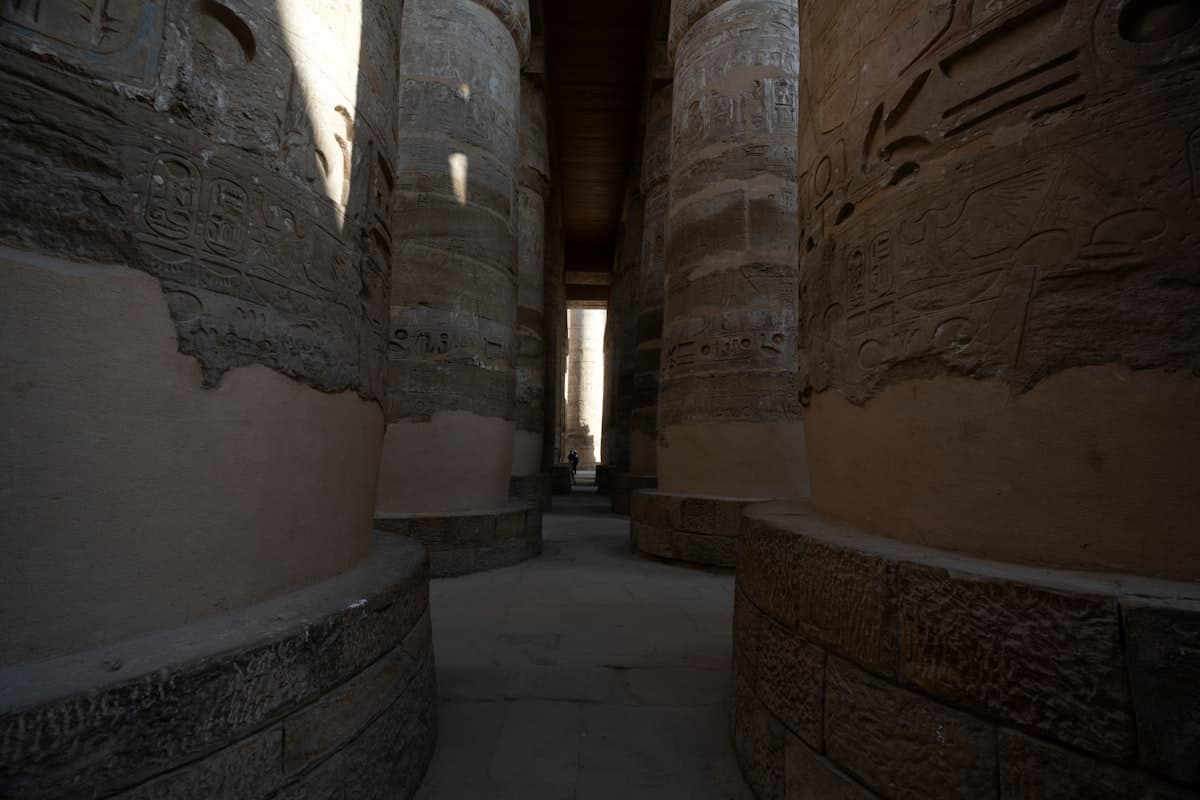
The hypostyle hall, built under Seti I and Ramesses II in the 13th century BC, contains 134 columns. The twelve central columns are 21 meters tall (69 feet) with capitals large enough to hold 100 people standing on top. This is not an exaggeration deployed for tourist brochures. It is a structural fact that you will feel as a physical disorientation when you walk in at 6am before the groups arrive.
Most visitors walk through the main axis and leave. Do not do this. The sacred lake in the southeast corner of the complex is where priests performed purification rituals before entering the temple. The granite scarab beetle on its northwest corner, placed by Amenhotep III, has accumulated a modern ritual around it: tourists walk around it seven times to summon luck. Amenhotep III would have found this baffling, but the impulse to use Karnak's objects as conduits to something larger is not new.
The Karnak Sound and Light Show costs EGP 350 ($7 USD) and runs nightly in multiple languages. Skip it. It tells you nothing you will not learn from reading this guide, the light is unflattering, and the narrative is the 1960s colonial-era version of Egyptian history. Spend that evening at a riverside restaurant in Luxor town instead.
Valley of the Kings: What the Tombs Are Actually For
Sixty-three tombs have been found in the Valley of the Kings. The standard tourist visit includes two or three. This is not a time problem. It is a tour operator problem: groups default to the most famous tombs, which are also the most damaged by the humidity of 3 million annual breaths.
Your entry ticket covers three tombs of your choosing. Tutankhamun's tomb is a separate ticket and is, frankly, the worst tomb in the valley for its price. The treasures are all in the Egyptian Museum in Cairo. What remains in situ is a small, undecorated burial chamber with the mummy and the outermost coffin. The reason it is famous is that it was found intact in 1922 by Howard Carter, making it an archaeological event rather than an artistic one.
The tombs worth your ticket: KV 17 (Seti I), which has the most detailed and best-preserved decoration in the valley and an unfinished lower chamber that shows the work in progress; KV 9 (Ramesses VI), which has the complete astronomical ceiling called the Book of the Earth; and KV 11 (Ramesses III), which has the famous side chambers depicting blind harpists and foreign peoples. Tomb KV 62 (Tutankhamun) costs extra and delivers less than any of these three.
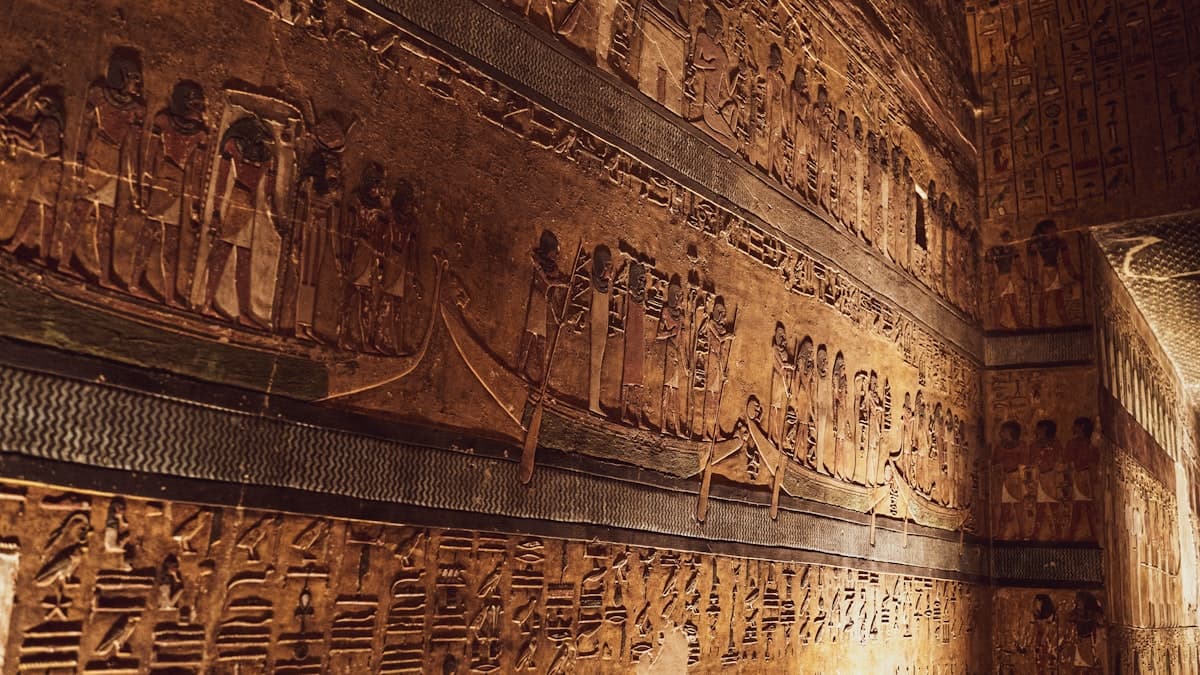
The paintings inside these tombs are not decoration. They are operational. They are the instructions the deceased pharaoh needed to navigate the underworld, identify the correct gates, speak the correct spells, and achieve resurrection. The "Book of the Dead" is a loose term for dozens of different funerary texts. The version on the walls of Seti I's tomb is the Amduat, which maps the twelve hours of the night the sun-god Ra spends traveling through the underworld. The pharaoh was identified with Ra. His successful passage guaranteed the sun would rise again. The theology is not metaphor. It was engineering.
The Egyptian Museum in Cairo: The Problem of Abundance
The Egyptian Museum on Tahrir Square contains approximately 120,000 objects. A first-time visitor wandering without a plan will remember almost none of them. The museum's organization is approximately chronological by gallery but practically incoherent in the details, labels are inconsistent in quality, and the lighting in some rooms was designed in 1902 and has not been significantly updated.
This is both a flaw and, oddly, a pleasure. The objects are not behind glass. In the jewelry rooms, you can lean close enough to see the individual granulation work on Middle Kingdom gold necklaces, a technique that involves fusing spheres of gold less than a millimeter in diameter to a surface without using solder. It was not replicated by European goldsmiths until the 19th century AD.
The Royal Mummies Hall requires a separate ticket of EGP 600 ($12 USD) and contains seventeen mummies of New Kingdom pharaohs including Ramesses II, who died around 1213 BC at roughly 90 years old, ruled for 66 years, and fathered at least 96 children. His mummy was issued an Egyptian passport in 1974 so it could be flown to Paris for conservation treatment. The passport listed his occupation as "King (deceased)."
The Grand Egyptian Museum near Giza, which has been partially open since 2023 and is still completing its full inauguration, holds the complete Tutankhamun collection including objects never previously displayed. It is worth the visit for the Tutankhamun galleries alone.
The Connections: Pharaonic Egypt Did Not End
The impulse to treat Pharaonic Egypt as hermetically sealed, ending cleanly in 30 BC when Rome arrived, misreads the actual history. The transition was slower and stranger.
The Coptic Orthodox Church of Egypt claims foundation by Saint Mark the Evangelist in Alexandria around 42 AD. The early Coptic Christians in Upper Egypt built their monasteries on Pharaonic foundations, literally: the Monastery of St. Simeon near Aswan sits adjacent to an ancient quarrying site, and Coptic monks reused Pharaonic blocks. The Coptic language, still used liturgically, is a direct descendant of ancient Egyptian, written in a modified Greek alphabet. When a Coptic priest chants in a church in Luxor, the vowel sounds are the closest living approximation to how the ancient Egyptians actually spoke.
The Arab conquest of 641 AD introduced Islam but did not erase what came before. The great mosque of Ibn Tulun in Cairo, built in 879 AD, used columns stripped from Pharaonic and Coptic sites. The Mamluk Sultan Qaitbay in the 15th century built his funerary complex using stone from Pharaonic quarries at Tura, the same quarries that supplied casing stone for the Giza pyramids. When the Ottoman general Selim I defeated the Mamluks at the Battle of Ridaniyya in 1517, he camped his army at a site in eastern Cairo near the ancient canal of the Pharaonic city of Heliopolis, where Thutmose III had erected obelisks nearly 3,000 years earlier.
Egypt does not have layers of history. It has a single ongoing conversation between the living and the dead about who owns the Nile valley.
Common Mistakes
1. Doing Giza at midday. The plateau is completely exposed. By 10am in winter and 8am in summer, the light is flat, the heat is punishing, and every tour bus in Cairo has arrived. The site opens at 6am. Arrive then. You will have the Sphinx in near-solitude for about forty minutes.
2. Hiring a guide at the gate. Unlicensed guides who approach you at site entrances are not the problem. The problem is that their information is frequently wrong in ways you cannot detect in the moment. Book a licensed Egyptologist guide through your hotel or through a reputable agency in advance. Expect to pay EGP 800 to 1,500 for a half-day. It is worth it at every major site.
3. Spending a full day at the Egyptian Museum without a plan. Three to four hours with a focused itinerary covers the essential collection. Pick four things you want to see in depth before you arrive: the Narmer Palette (Room 43, ground floor), the Tutankhamun mask, the Amarna royal family statues from Akhenaten's short-lived monotheistic revolution, and the Predynastic and Early Dynastic galleries on the ground floor that most visitors skip entirely.
4. Taking the Abu Simbel day trip from Aswan by convoy. The standard tourist convoy departs Aswan at 3am to arrive at Abu Simbel by 8am, gives you two hours, and returns by early afternoon. This is enough to see the temples but not enough to understand them. The temples were relocated between 1964 and 1968 in one of the largest archaeological engineering projects in history, moving 20,000 tons of sandstone block by block to a site 65 meters higher to avoid flooding by Lake Nasser. The visitor center explains this relocation. The convoy schedule gives you no time to engage with it. Fly instead: EgyptAir runs a morning flight from Aswan for approximately EGP 2,500 to 3,500 ($50 to $70 USD) return, with more time on site.
5. Skipping Dendara and Abydos. These two temples, roughly an hour north of Luxor, are among the best-preserved in Egypt and receive a fraction of the visitors. Dendara's Temple of Hathor has intact painted ceilings in the outer hypostyle hall and a zodiac relief (the original is in the Louvre; a plaster cast marks the spot) that represents the earliest complete depiction of the Western zodiac on any Egyptian monument. A private taxi from Luxor to both sites and back costs approximately EGP 800 to 1,000 ($16 to $20 USD).
6. Buying "papyrus" from the shops outside major sites. Ninety percent of what is sold as papyrus at tourist shops is banana leaf paper, which yellows and cracks within years. Real papyrus made from the Cyperus papyrus plant is sold at Dr. Ragab's Papyrus Institute in Cairo and at a small number of shops in Luxor that will let you see the manufacturing process. It costs more and is worth the difference.
7. Not reading anything before you arrive. Egypt without context is a sequence of large old things. Egypt with context is one of the most intellectually dense places on earth. Read "The Oxford History of Ancient Egypt" edited by Ian Shaw, or at minimum "The Complete Gods and Goddesses of Ancient Egypt" by Richard Wilkinson, before you go. The sites will double in meaning.
Practical Tips
Wear closed shoes at every site. The Giza plateau is rough limestone rubble in places, and the Valley of the Kings has uneven steps. Sandals are a structural error.
Carry cash in EGP at all times. ATMs are available in Cairo and Luxor city centers but not always at or near sites. Entrance fees, tips, and transport are cash transactions.
Tipping is not optional in Egypt. It is part of the economy. A guard who opens a restricted side chamber for you, a driver who waits patiently, a site employee who shows you something you would have missed: EGP 50 to 100 ($1 to $2 USD) is appropriate for small favors. It is not extortion. It is a livelihood.
The call to prayer at Islamic sites adjacent to Pharaonic ones, which is most of Cairo, creates brief pauses in the day that are worth paying attention to. At the Mosque of Muhammad Ali in the Citadel, which sits above medieval Cairo and above the Roman fortress of Babylon and above the Pharaonic suburb of Memphis, the adhan carries across a city that has been continuously inhabited for longer than almost any other on earth. Listen to it. That is also the pharaonic Egypt history for travelers that no entry ticket covers: the sound of a civilization still arguing with itself across five thousand years.
Frequently Asked Questions
The Weekly Dispatch
More on Egypt, every Friday.
Cultural depth and places most guides never mention.
No spam. Unsubscribe anytime.