Ptolemaic Egypt: A Traveler's Guide to Alexandria's Lost World
The Ptolemies ruled Egypt for 275 years and spoke Greek for most of them. Cleopatra was the first of her dynasty to learn Egyptian. Alexandria still holds the evidence.

Quick Facts
- Best time to visit
- October to April. Mediterranean winters are mild and clear, ideal for walking between sites. Summer heat and coastal humidity flatten the light and make outdoor sites unpleasant by midday.
- Entrance fee
- Greco-Roman Museum EGP 200 (approx $4 USD), Pompey's Pillar and Serapeum EGP 150 (approx $3 USD), Catacombs of Kom el-Shoqafa EGP 180 (approx $3.50 USD), Bibliotheca Antiquities Museum EGP 100 (approx $2 USD). Student discounts of 50 percent apply with valid ID.
- Opening hours
- Most sites daily 9am to 5pm. Catacombs close at 4:30pm. Greco-Roman Museum hours vary due to ongoing renovation; confirm before visiting.
- How to get there
- From Cairo: Talgo train from Ramses Station, EGP 250 to 400 one-way, approximately 2 hours 15 minutes. From Alexandria Misr Station, taxi to Pompey's Pillar approximately EGP 40 to 60. Uber operates reliably in Alexandria. Microbuses connect sites for EGP 5 to 10 per leg.
- Time needed
- 2 full days for the complete Ptolemaic circuit including museum time. 1 full day minimum if choosing only the Catacombs, Serapeum site, and Greco-Roman Museum.
- Cost range
- Budget EGP 600 to 900 per day including all entry fees and local transport. Mid-range EGP 1,800 to 2,800 per day including overnight accommodation and a proper Corniche seafood lunch.
Quick Facts
Best time to visit: October through April. Alexandria's Mediterranean climate means summers are humid and hazy, which flattens the light and makes outdoor sites uncomfortable by midday. Winter mornings are cool and clear.
Entrance fees: Greco-Roman Museum: EGP 200 (approx $4 USD), students EGP 100 Pompey's Pillar and Serapeum site: EGP 150 (approx $3 USD) Catacombs of Kom el-Shoqafa: EGP 180 (approx $3.50 USD) Royal Jewelry Museum (Ptolemaic artifacts section): EGP 150 (approx $3 USD) Bibliotheca Alexandrina Antiquities Museum: EGP 100 (approx $2 USD)
Opening hours: Most sites open daily from 9am to 5pm. The Catacombs close at 4:30pm. The Greco-Roman Museum has been under renovation for years and currently operates on reduced galleries; confirm opening before visiting.
How to get there: From Cairo, the fastest option is the Spanish train (the Talgo), which runs twice daily and costs EGP 250 to 400 one-way depending on class, arriving at Misr Station in central Alexandria. From Misr Station, a taxi to Pompey's Pillar costs roughly EGP 40 to 60. Microbuses connect most of the city for EGP 5 to 10 per leg. Uber operates in Alexandria and is reliable.
Time needed: Two full days to do this seriously. One day if you are ruthlessly selective. The Greco-Roman Museum alone deserves three hours.
Cost range: Budget EGP 600 to 900 per day including transport and entry fees. Mid-range EGP 1,800 to 2,800 per day with a decent seafood lunch on the Corniche.
---
The last Ptolemaic ruler of Egypt was not Egyptian. She was Macedonian Greek by blood, fluent in nine languages including Aramaic, Ethiopian, Hebrew, and Parthian, and she was the first person in her entire 275-year dynasty to bother learning the language of the people she ruled. Cleopatra VII, whose face appears on temple walls at Dendera dressed as a pharaoh making offerings to Hathor, is the exception that proves the rule about Ptolemaic Egypt: it was a civilization that spent nearly three centuries performing Egyptianness for its subjects while remaining, in private, defiantly Greek.
This tension, between performance and identity, between the colonizer who becomes the culture, is the animating fact of Ptolemaic Egypt history. It is also what makes Alexandria one of the most intellectually interesting cities on earth for the traveler willing to read beneath the surface. Very little of Ptolemaic Alexandria survives above ground. The royal quarter is under the Eastern Harbor. The Library is gone. The Lighthouse is gone. But the catacombs are there, and the Serapeum site, and the Greco-Roman Museum, and the city's street grid, which Ptolemy I's architect Dinocrates laid out in 331 BC and which Alexandria's downtown still roughly follows today.
Why This Place Matters
At its height under Ptolemy II Philadelphus, who reigned from 283 to 246 BC, Alexandria was the largest city on earth, with a population estimated at 500,000 to 1 million people. The Museum, the word's actual origin, was not a building full of objects but an institute for scholars: a research campus where Euclid wrote the Elements, Eratosthenes calculated the circumference of the earth to within 1 percent accuracy using two wells and the angle of the sun, and Herophilus performed the first recorded systematic human dissections. The Library held an estimated 500,000 scrolls, many acquired by a simple method: every ship that docked in Alexandria's harbor had its books confiscated, copied, and returned, while the originals stayed in the collection.
This was not a coincidence of genius. Ptolemy I Soter deliberately built an intellectual infrastructure to make Alexandria the cultural capital of the Hellenistic world, understanding that knowledge production was a form of imperial power. The decision had consequences that reached far beyond Egypt: when Julius Caesar accidentally burned part of the harbor and likely damaged the Library in 48 BC, he was destroying an archive that had been accumulating for two and a half centuries.
What most visitors to Alexandria do not know is that the Ptolemaic project was also a theological one. The Ptolemies invented a god. Serapis, the presiding deity of Ptolemaic Alexandria, was a synthetic creation, combining the Egyptian Osiris-Apis bull cult with the Greek gods Zeus, Hades, and Asclepius. The Serapeum, the great temple that stood on Alexandria's highest point and held a branch of the Library, became one of the most visited sacred sites in the Mediterranean. When the Christian emperor Theodosius ordered it destroyed in 391 AD, it was not simply an act of religious politics. It was the erasure of a theological experiment that had lasted three centuries.
What You Will Actually See
Pompey's Pillar and the Serapeum Site
The pillar has nothing to do with Pompey. This is one of the more brazen mislabelings in archaeological tourism. The 27-meter red Aswan granite column was erected in 297 AD by the prefect Publius, in honor of the emperor Diocletian, who had just suppressed a revolt in Alexandria and distributed free grain to prevent further unrest. Medieval crusaders, arriving centuries later and seeing a lone enormous column in a field of ruins, decided it must commemorate the Roman general whose head was delivered to Julius Caesar in a sack after his assassination nearby. They were wrong, and the name stuck.
The site around the pillar is genuinely significant. You are standing on what was the Serapeum precinct, and underground, accessible by a separate ticket that is occasionally included with the main entry, are rock-cut galleries where the sacred Apis bulls were buried in massive granite sarcophagi. Two sphinx alleyways remain, battered but readable. The scale of what was destroyed here in 391 AD becomes legible when you look at the column and the scattered architectural fragments around it and try to reconstruct a temple complex that once rivaled the Parthenon.
Catacombs of Kom el-Shoqafa
These are the most important Ptolemaic-era site you can actually enter in Alexandria, and they are consistently undervisited because they require descending a spiral staircase around a central shaft that drops about 35 meters into the earth. Discovered in 1900 when a donkey fell through the roof of the main chamber, the catacombs date from the 2nd century AD, which places them at the end of the Ptolemaic cultural tradition, already absorbed into Roman Egypt.
The reason to visit is what happened to Egyptian religious art under the combined pressure of three cultures meeting in a single tomb. The main burial chamber, the Triclinium, shows Anubis dressed as a Roman legionary, wearing a cuirass and carrying a caduceus. It shows figures in the formal frontality of Egyptian art, painted in the naturalistic style of Greek portraiture, framed by Roman architectural motifs. This is not artistic confusion. It is the visual record of a civilization that had been code-switching for so long it had produced something genuinely new.
The Ptolemaic Egypt history traveler who spends time here looking carefully will notice one detail that most guides do not mention: the snake imagery. The agathodaemon, a divine serpent, appears repeatedly throughout the catacombs. It was a Ptolemaic religious symbol adapted from both Egyptian and Greek traditions, another invention of that hybrid world.
The Greco-Roman Museum
This is the best single collection of Ptolemaic artifacts in existence, and it has spent much of the past decade being renovated. At time of writing, parts of the collection are accessible; confirm the current situation before planning your visit. When fully operational, the museum holds more than 40,000 objects including tanagra figurines, Serapis busts, crocodile mummies, and the extraordinary faience vessels produced in Ptolemaic workshops.
The objects that pass the fact test most decisively are the portrait mummies from the Fayoum, which belong to the Roman period but descend directly from Ptolemaic artistic practice: encaustic wax portraits of extraordinary psychological realism, painted to cover the faces of mummified bodies. They are the first portraits in Western art that feel like they are looking at you rather than performing for a divine audience. The technique, mixing pigment into molten beeswax, was not rediscovered until the 18th century.
The Connections
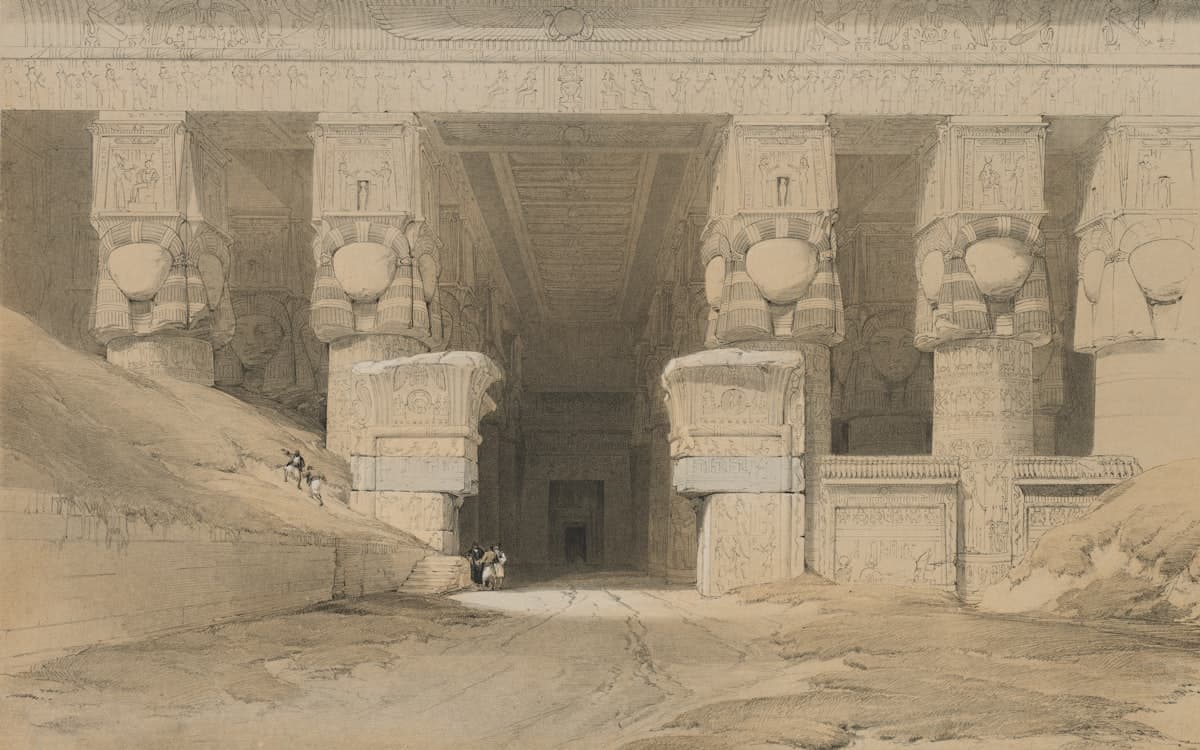
Ptolemaic Alexandria did not exist in a vacuum, and the connections it left behind are still visible across Egypt. The temple at Dendera, 60 kilometers north of Luxor, is almost entirely a Ptolemaic construction, built between 54 BC and 20 BC. Its famous zodiac ceiling, now in the Louvre after Napoleon's expedition extracted it in 1820, is the first Egyptian representation of the Babylonian zodiac, imported into Egypt through the Ptolemaic court's contact with Mesopotamian astronomical traditions. The ceiling you see in Dendera today is a cast.
The temple at Edfu, dedicated to Horus and built between 237 and 57 BC, is the best-preserved ancient Egyptian temple on earth precisely because it is Ptolemaic. Its walls carry the fullest surviving texts of Egyptian religious ritual, including the Myth of Horus and Seth. The Ptolemies were obsessive temple builders because they understood that constructing and restoring temples was the primary visible act of legitimate pharaonic rule. Ptolemy III Euergetes added to Karnak. Ptolemy VIII restored parts of Luxor Temple. The Ptolemaic fingerprints on Upper Egypt are everywhere.
In Alexandria itself, the connection that most travelers miss is the Arabic layer over the Greek one. The medieval city that Ibn Battuta visited in 1326, which he described as one of the greatest cities in the world, was built substantially on the Ptolemaic street grid. The Arab Conquest of 641 AD did not erase Alexandria; it inherited it. The Ptolemies had built on a scale that made their infrastructure essentially permanent.
Common Mistakes
Skipping the catacombs because of the descent. The spiral staircase is manageable for most people and takes about three minutes. What is underground is worth considerably more than what is above ground at most Alexandria sites. Do not let the logistics put you off.
Spending your Alexandria day at Qaitbay Citadel instead of Ptolemaic sites. The Citadel is a 15th-century Mamluk fort built with stones from the collapsed Lighthouse of Alexandria. It is photogenic and the harbor view is good. It is also a medieval site with almost no Ptolemaic content beyond the recycled building material. If your reason for coming to Alexandria is Ptolemaic Egypt history, this is not where to spend your morning.
Believing the Bibliotheca Alexandrina is connected to the ancient Library. It is not, except as a gesture. The modern library, opened in 2002 and designed by a Norwegian architectural firm, is a fine building with a good antiquities museum in its basement. But the ancient Library of Alexandria was destroyed centuries before the modern building's site was selected. The Bibliotheca is an aspiration, not a continuation. The antiquities museum inside is genuinely worth an hour.
Not confirming the Greco-Roman Museum's current status. It has opened, closed, partially opened, and rescheduled its full reopening multiple times over the past decade. Go to their official website or call before building your day around it.
Taking a guided tour that covers all of Alexandria in one day. The standard Alexandria day trip from Cairo covers Pompey's Pillar, the Catacombs, Qaitbay, the Corniche, and perhaps the Montazah Gardens. It covers them in about forty minutes each. You will see everything and understand nothing. Two days minimum, or stay overnight.
Buying papyrus at the tourist shops near the sites. They are almost universally banana leaf, not papyrus. The price point and the fact that they fold without cracking should tell you this. If you want actual papyrus, the Bibliotheca gift shop is a more reliable source.
Eating at any restaurant within 200 meters of Pompey's Pillar. Walk ten minutes toward the Corniche or the Attarine neighborhood and the food quality doubles while the price halves.
Practical Tips
Stay overnight. Alexandria without Cairo's crowds has a different quality of light and a different pace. The Corniche at 6am, walking toward the Eastern Harbor with the Mediterranean flat and green, is the closest you will get to the city that Strabo visited in 25 BC and described as the greatest trading city in the world.
Hire a local guide specifically for the Ptolemaic circuit. The difference between standing in front of the catacombs with a map and standing there with someone who can read the architectural grammar of the Hellenistic-Egyptian synthesis is not small. Ask your accommodation to recommend a licensed Egyptologist guide rather than a generalist.
Bring a torch to the Catacombs. The electric lighting is uneven and some of the side galleries are dim. A phone torch is adequate.
The Attarine neighborhood, Alexandria's antique market district, occasionally surfaces Ptolemaic-era objects through legal dealers. Buying antiquities is illegal, but looking is free, and the neighborhood itself, full of Greco-Roman architectural salvage worked into medieval and Ottoman buildings, is a lesson in stratigraphic Alexandria that no museum can replicate.
If you are combining this trip with Upper Egypt, the Ptolemaic temples at Edfu and Dendera are two of the best-preserved ancient structures in Egypt. Plan the Ptolemaic Egypt history itinerary to include them. The context they provide for what you have seen in Alexandria is worth the journey.
Frequently Asked Questions
The Weekly Dispatch
More on Egypt, every Friday.
Cultural depth and places most guides never mention.
No spam. Unsubscribe anytime.