7 Day Egypt Itinerary: Cairo, Luxor, and Aswan Done Right
Most 7-day Egypt itineraries waste two days on logistics. Rearrange three things and you gain a full extra site. Here is the sequence that actually works.

Quick Facts
- Best time to visit
- October to February. Temperatures are manageable across all three cities. March through May is acceptable but warming fast. June through September is genuinely dangerous heat in Luxor and Aswan, with temperatures regularly exceeding 42°C.
- Entrance fee
- Giza complex EGP 450 (approx $9 USD); Great Pyramid interior EGP 800 ($16 USD) extra. Karnak EGP 450 ($9 USD). Valley of the Kings EGP 480 ($10 USD) for 3 tombs. Abu Simbel EGP 950 ($19 USD). Philae EGP 450 ($9 USD). Egyptian Museum EGP 450 ($9 USD); Royal Mummies Hall EGP 600 ($12 USD) extra.
- Opening hours
- Most sites daily 6am to 5pm (winter), 6am to 6pm (summer). Egyptian Museum opens 9am. Abu Simbel best visited before 11am to beat tour bus arrivals from Aswan.
- How to get there
- International flights land at Cairo International Airport. Watania Sleeper train Cairo to Luxor approx EGP 2,800 to EGP 4,200 per person. Regular train Luxor to Aswan EGP 130 to EGP 250. Abu Simbel flight from Aswan approx EGP 4,500 to EGP 7,000 return, or 4-hour road trip leaving at 4am.
- Time needed
- 7 days minimum for Cairo, Luxor, and Aswan with meaningful depth. Add 2 days for the White Desert or Alexandria. Add 3 days for Sinai.
- Cost range
- Budget EGP 900 to EGP 1,400 per day excluding accommodation. Mid-range EGP 3,500 to EGP 6,000 per day including decent hotels, private guides for key sites, real meals, and local transport.
The Problem With Most Egypt Itineraries
Most people who visit Egypt in seven days spend roughly eighteen hours of that week in transit, waiting in lines they could have skipped, or eating mediocre hotel buffets because nobody told them about the kushari place on the corner. The country gets sold as a checklist: Pyramids, Sphinx, Luxor Temple, Valley of the Kings, done. What gets lost is the fact that Egypt is not a museum circuit. It is a continuous, living argument between civilizations, and the best version of a 7 day Egypt itinerary treats it that way.
Here is the sequence that works, why it works, and what to do instead of the things most itineraries tell you to do.
---
Quick Facts
Best time to visit: October through February. Cairo is bearable, Luxor is warm rather than punishing, and Aswan reaches a maximum of around 28°C rather than the 45°C it hits in July. Avoid the two weeks around Eid al-Adha if possible: domestic tourism peaks sharply and prices follow.
Key entrance fees: Giza Pyramid complex: EGP 450 (approx $9 USD) general admission; interior of the Great Pyramid is an additional EGP 800 (approx $16 USD) Egyptian Museum Cairo: EGP 450 (approx $9 USD); Royal Mummies Hall an additional EGP 600 (approx $12 USD) Karnak Temple: EGP 450 (approx $9 USD) Valley of the Kings: EGP 480 (approx $10 USD) for three tombs; Tutankhamun's tomb an additional EGP 600 (approx $12 USD) Abu Simbel: EGP 950 (approx $19 USD) Philae Temple: EGP 450 (approx $9 USD)
Opening hours: Most sites open 6am to 5pm in winter, 6am to 6pm in summer. The Egyptian Museum opens at 9am. Abu Simbel is best visited before 11am, when tour buses from Aswan arrive en masse.
Getting between cities: Cairo to Luxor by sleeper train (Watania Sleeper) costs roughly EGP 2,800 to EGP 4,200 per person (approx $55 to $84 USD) in a private cabin. This is vastly preferable to a budget airline for reasons explained below. Luxor to Aswan costs EGP 130 to EGP 250 (approx $3 to $5 USD) by regular train, two hours, and is one of the best train journeys in Africa.
Daily budget: Budget travelers spending carefully can manage on EGP 900 to EGP 1,400 per day (approx $18 to $28 USD) excluding accommodation. Mid-range, meaning decent hotels, private guides for major sites, and real food, runs EGP 3,500 to EGP 6,000 per day (approx $70 to $120 USD).
Time needed: Seven days is tight but coherent if you follow the logic below. Eight would be better. Six is a highlight reel with no depth.
---
Why This Route Matters: Three Cities, Four Thousand Years
Cairo, Luxor, and Aswan are not just three stops on a tourist map. They represent three entirely different relationships between human ambition and the Nile. Cairo is Islamic Egypt layered over Coptic Egypt layered over a Roman fortress layered over a Pharaonic city called Heliopolis, most of which is now under a suburb. Luxor is New Kingdom Egypt, the period from roughly 1550 to 1070 BC when Egypt was the wealthiest empire on earth and Thebes, as Luxor was then called, was its capital. Aswan is frontier Egypt: the first cataract of the Nile, the border between Egypt and Nubia, contested and traded for millennia.
What connects them is not just the Nile but the specific fact that each city reused what the previous civilization left behind. The Mosque of Amr ibn al-As in Old Cairo, the first mosque built on African soil in 641 AD, was partially constructed using columns taken from a Roman structure that was itself built on the site of a Pharaonic settlement. This is not an exception in Egypt. It is the pattern.
---
Days 1 and 2: Cairo, Selectively
Land in Cairo and resist the instinct to do everything. Two days in Cairo is enough if you are disciplined about what you skip.
Day 1: Giza and the Egyptian Museum
Go to Giza first, before the city wakes up. The complex opens at 6am, and the forty-five minutes between 6am and 6:45am are the closest you will get to understanding the scale of the place without fighting through a crowd. The Great Pyramid of Khufu is 146 meters tall and remained the tallest human-built structure on earth for 3,800 years, a record broken only when Lincoln Cathedral added its central spire in 1311. No other single building has held that record for a fraction of that time.
Pay for the interior of the Great Pyramid only if claustrophobia is not an issue and you understand that there is essentially nothing to see inside: no paintings, no inscriptions, no treasures. What you get is the experience of moving through a passage engineered to exact tolerances by a society that predated the wheel in Egypt, and that alone is worth the EGP 800 to some people and not to others.
The Sphinx is free to view from the complex. The sound and light show that runs at night costs EGP 350 and will tell you nothing you have not already learned. Skip it without guilt.
Spend the afternoon at the Egyptian Museum in Tahrir Square rather than the new Grand Egyptian Museum unless you have a specific reason. The GEM is extraordinary but requires a half-day minimum to do properly. The old museum's chaos is part of its character, and the Royal Mummies Hall contains Ramesses II, Seti I, and eighteen other pharaohs in a room so quiet and so strange that most visitors walk out without speaking.
Day 2: Islamic Cairo, Not All of It
Islamic Cairo is a district of roughly 600 listed monuments in an area you can walk across in forty minutes. Do not try to see it comprehensively. Go to the Citadel of Saladin for the view and for the Mosque of Muhammad Ali, completed in 1848 and modeled on Ottoman mosques in Istanbul, which should tell you something about where Egypt's political ambitions were pointing at that moment. Then walk down through the Khan el-Khalili bazaar, which has operated continuously since 1382, and eat lunch at Naguib Mahfouz Café or, better, at one of the smaller fuul and ta'ameya places in the side streets where the tourist markup disappears.
The one thing most guides will not tell you to do: take a taxi to the Mosque and Madrasa of Sultan Hassan, completed in 1363, and stand in the courtyard alone if timing allows. It is arguably the finest piece of medieval architecture in Africa, built by a Mamluk sultan using stone quarried, according to some historians, directly from the outer casing of the Giza pyramids. The connection between the oldest monuments in Cairo and one of the most recent Pharaonic building materials is sitting right there in the walls.
---
Days 3 and 4: Luxor, West Bank First
Take the Watania Sleeper overnight from Cairo to Luxor. The train leaves Cairo Ramses Station around 7:30pm and arrives in Luxor around 7am, which means you wake up to sugar cane fields and lose no daylight. Budget airlines exist between Cairo and Luxor and are not worth it: they leave from a different terminal, require an earlier arrival, and you gain perhaps forty minutes while losing the single best overland introduction to the Egyptian countryside.
Day 3: The West Bank
Luxor light at 6am is a specific quality of gold that travel photographers have been trying to describe accurately for two centuries without quite succeeding. Go to the West Bank first, before the East Bank temples, because the tombs deteriorate in direct proportion to the number of breaths exhaled inside them and early arrival actually matters for preservation reasons as much as crowd reasons.
The Valley of the Kings currently has sixty-three known tombs. Most tour groups visit Ramesses IV, Ramesses IX, and Merenptah because those are the tombs that appear on the standard ticket and require the least walking. The tomb of Seti I, who died around 1279 BC, contains some of the most complete painted astronomical ceilings in Egypt and is available on a separate ticket for EGP 1,200 (approx $24 USD). It is worth every pound. The tomb of Thutmose III, reached by a steep staircase cut into a crack in the cliff face, has walls painted in a deliberate imitation of papyrus scrolls: the entire Book of Amduat written in red and black outline on cream-colored stone. Almost no one visits it.
After the Valley of the Kings, cross to Deir el-Medina: the village where the workers who built the royal tombs actually lived. Their own tombs are small, brilliantly painted, and almost always empty of other visitors. These were skilled tradespeople who went on strike in 1170 BC because the pharaoh Ramesses III had failed to deliver their wages of grain. The first recorded labor strike in human history happened here, and a papyrus documenting it survives in the Turin Egyptian Museum.
Day 4: Karnak and Luxor Temple
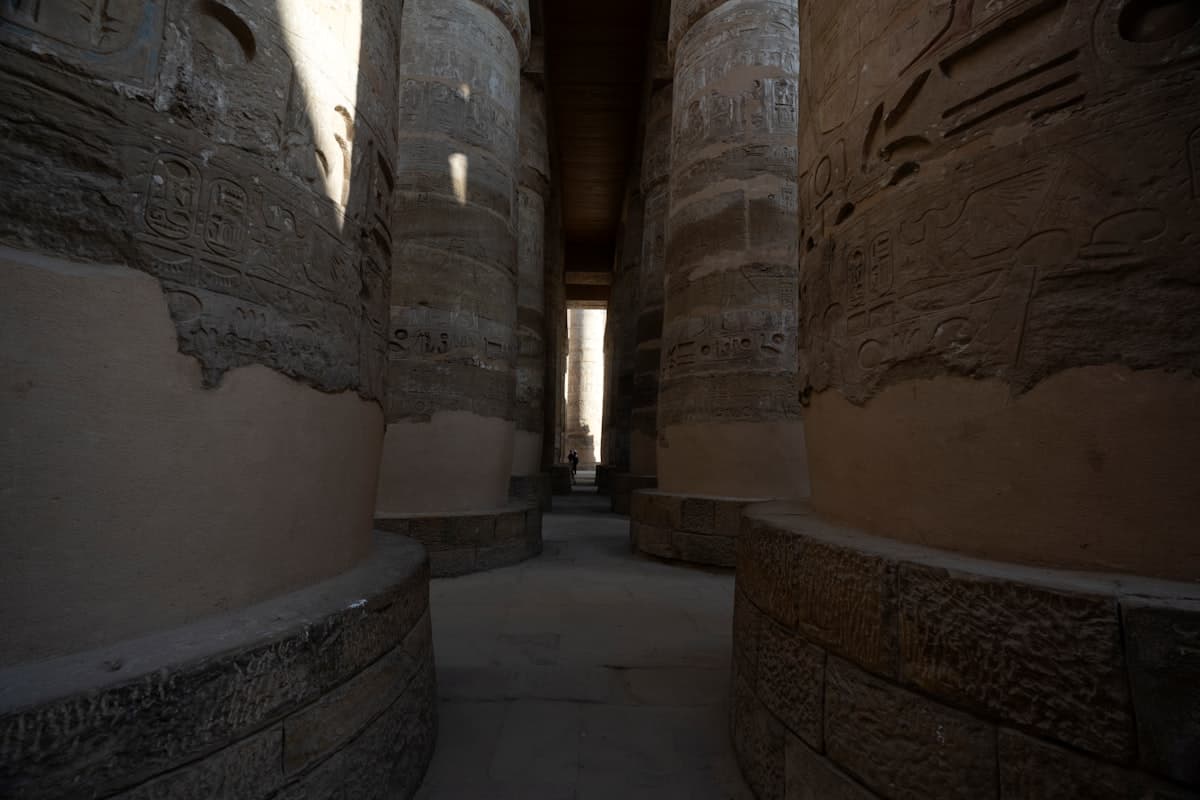
Karnak was built, expanded, demolished, rebuilt, and expanded again over a period of approximately 2,000 years by thirty different pharaohs. The Hypostyle Hall alone contains 134 columns, the tallest of which are 21 meters high, and covers an area large enough to contain Notre-Dame Cathedral. Go early. The light enters from the east and rakes across the column surfaces in a way that makes the hieroglyphs read as three-dimensional, which they are, for exactly that reason.
Luxor Temple is best at night, when it is lit and almost everyone has gone to dinner. It is also the only major Pharaonic site in Egypt with an intact mosque built directly on top of it: the Mosque of Abu Haggag, Luxor's patron saint, whose minaret rises above the ancient court at a level that tells you exactly how deep the sand was when the town was built around and over the temple in the medieval period.
---
Days 5, 6, and 7: Aswan and What It Contains
The two-hour train from Luxor to Aswan passes through some of the most concentrated agricultural land on earth: the strip of cultivation on either side of the Nile is in places less than two kilometers wide, and beyond it the desert begins immediately. You can see this boundary from the train window with complete clarity.
Aswan is a smaller, slower, more Nubian city than Luxor. The light is different: harder, whiter, reflecting off granite rather than limestone. The city smells of hibiscus tea, which Nubians call karkadeh and sell everywhere.
Day 5: Philae and the Old Aswan Dam
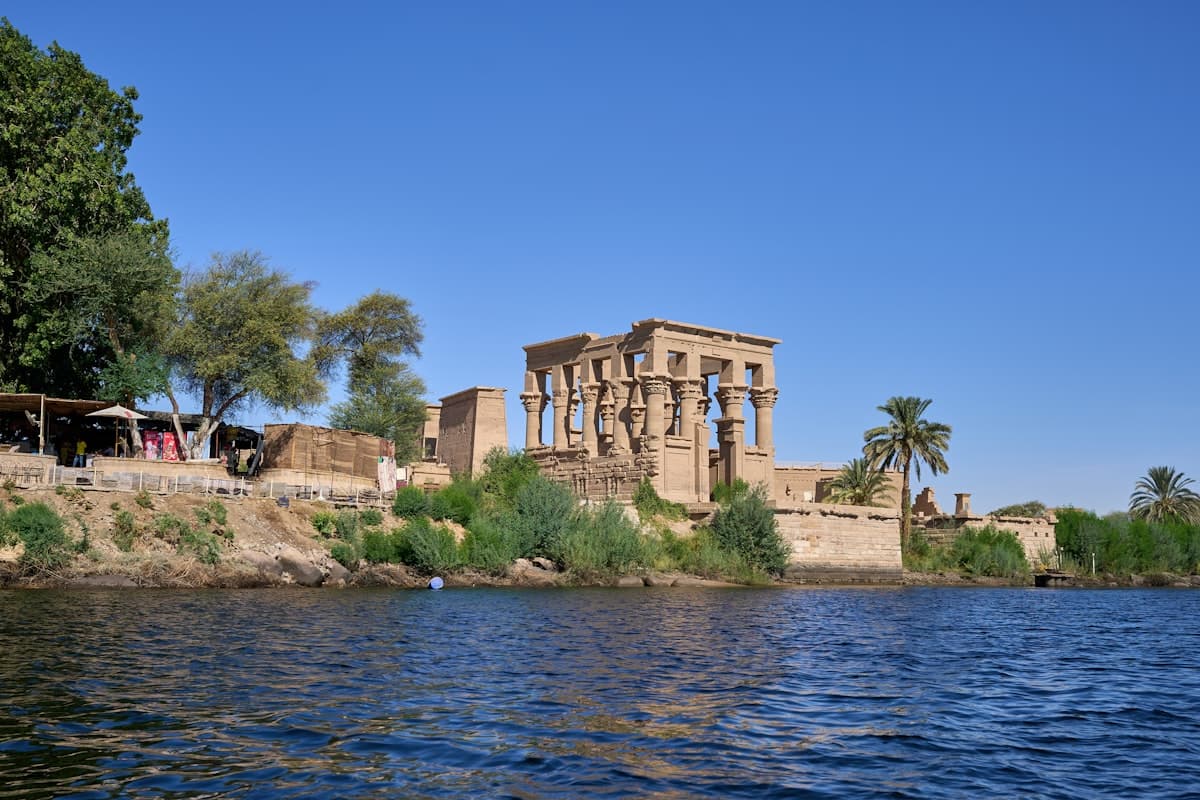
The Temple of Isis at Philae was dismantled block by block between 1972 and 1980 and reconstructed on a higher island after the Aswan High Dam threatened to submerge it permanently. This UNESCO salvage operation, which also moved Abu Simbel, is one of the largest archaeological rescue efforts in history and involved twenty-three countries contributing funding. What you visit now is the original temple, every block original, but on an island that did not exist before 1980. The boat ride to reach it costs approximately EGP 250 (approx $5 USD) per person shared, or EGP 800 (approx $16 USD) to hire privately.
Day 6: Abu Simbel, the Honest Assessment
Abu Simbel is 280 kilometers south of Aswan and requires either a four-hour round trip by road (leaving at 4am with the convoy, which is no longer mandatory but most operators still follow the schedule) or a flight. The flight costs approximately EGP 4,500 to EGP 7,000 (approx $90 to $140 USD) return and takes thirty minutes. For a seven-day itinerary, the flight is the correct choice.
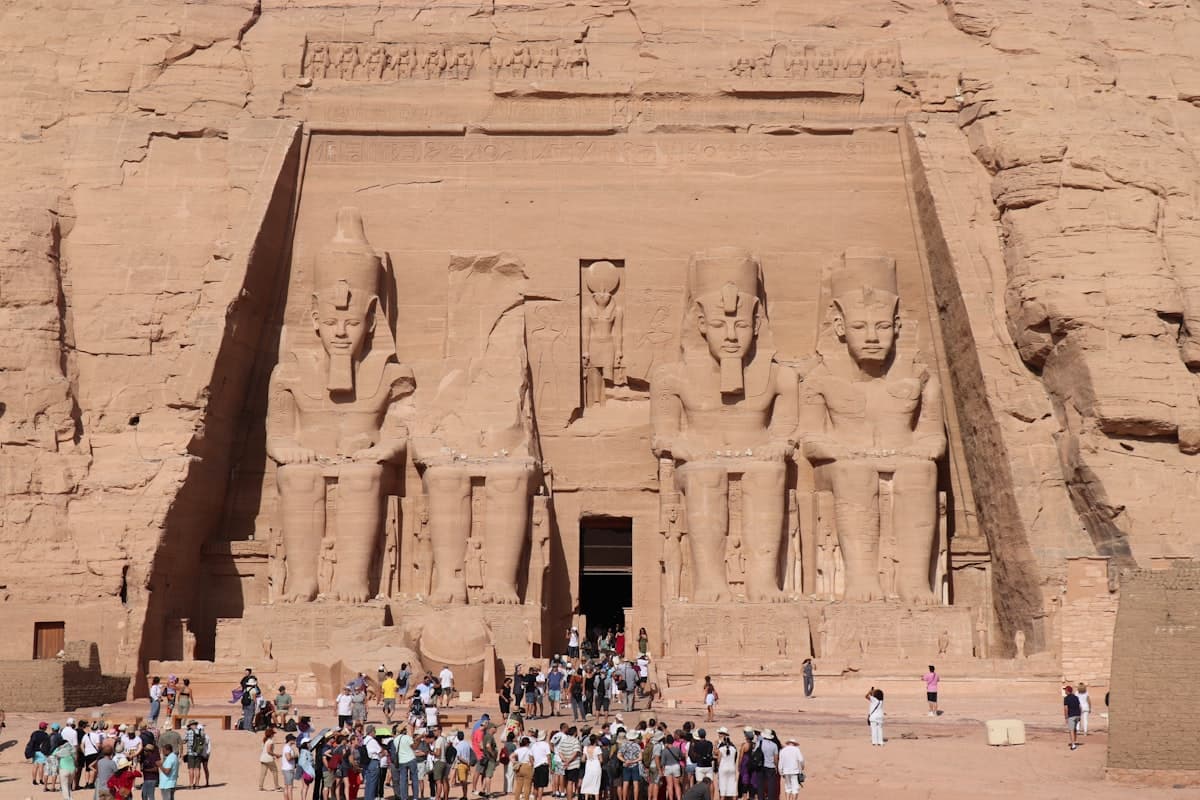
The temples are extraordinary. Ramesses II cut them directly into a sandstone cliff around 1264 BC and oriented the inner sanctuary so that twice a year, on February 22 and October 22, sunlight travels 60 meters into the mountain and illuminates the seated statues of Ramesses and the god Ra. When the temple was moved to save it from the rising reservoir, Egyptian engineers rotated the entire structure on its axis to preserve this alignment precisely. The fact that they succeeded is the kind of thing that makes you sit down.
Day 7: The Nubian Village and Departure
Do not spend your final morning in another temple. Take a felucca from the Aswan corniche to the Nubian village on Elephantine Island, which has been continuously inhabited since at least 3000 BC and where the houses are painted indigo, yellow, and turquoise in a color palette that belongs to no other architecture in Egypt. Have tea. Buy nothing you do not genuinely want. Watch the Nile from a level of 6 inches above the surface, which is the correct elevation from which to understand what this country actually is.
---
Common Mistakes
1. Flying between Cairo and Luxor. Budget airlines on this route depart from Cairo Terminal 1, which is forty-five minutes from Terminal 2 where most international arrivals land. Factor in the transfer, the early arrival, and the taxi from Luxor airport (EGP 200 to EGP 300) and you have saved perhaps twenty minutes over the overnight train while missing the Nile Delta at dawn.
2. Booking a Nile cruise for seven days. This advice will appear everywhere and should be evaluated carefully. A cruise between Luxor and Aswan takes three to four nights and sounds efficient. In practice, the ships dock at the same sites at the same times in convoy, the guiding is group-oriented and shallow, and you see the Nile from a large floating hotel rather than from a felucca at water level. If you have fourteen days, a cruise is wonderful. In seven days, it eats your Cairo time.
3. Tipping too little or too much. Egypt's service economy runs on baksheesh and visitors who ignore this create genuine hardship for people earning very low wages. A standard tip for a site guard who opens a locked tomb for you is EGP 50 to EGP 100. Tipping EGP 500 at the first site because you feel generous creates a precedent that follows you through the site in a way that becomes uncomfortable. Carry small bills.
4. Visiting the Grand Egyptian Museum without a full half-day. The GEM contains over 100,000 artifacts across a footprint larger than any museum building in the world. People who give it two hours come out frustrated. Either commit four hours minimum or skip it on this itinerary and return for it on a future trip.
5. Skipping Deir el-Medina. Every guide covers it in theory. Almost every tour bus skips it in practice because it requires an additional walk and the tombs are small. They are also among the most intimate and beautifully painted spaces in Egypt. The workers who painted them were painting their own afterlives, not their employer's.
6. Relying on hotel-arranged everything. Hotel drivers and guides are frequently excellent. Hotel-arranged everything costs thirty to fifty percent more than arranging the same services yourself at the site or through a local operator. The exception is Abu Simbel: the convoy logistics are genuinely better handled by someone who runs that route regularly.
7. Trying to visit Saqqara on Day 1 alongside Giza. Saqqara, which contains the world's oldest complete stone building complex (the Step Pyramid of Djoser, circa 2650 BC), is not a quick add-on to Giza. It is thirty-five kilometers away, requires a separate ticket, and deserves three hours alone. Combining it with Giza means doing both badly. If your itinerary cannot accommodate a separate Saqqara morning, accept that and go back.
---
Practical Tips
Book Valley of the Kings tickets online before arrival if the Egypt Tourism Authority's online portal is functioning, which it sometimes is not. In that case, buy at the gate before 7:30am.
Wear a scarf you can put on your head in Coptic churches and mosques alike. Not because you will be turned away without one, but because it is a courtesy that costs nothing and is noticed.
The Egyptian pound fluctuates significantly. All prices here are accurate at time of writing but will have shifted. Always convert at the current rate rather than using mental shortcuts from a previous visit or a previous article.
Aswan's heat in summer is not a climate inconvenience. Temperatures above 42°C are common from May through September and outdoor sites become genuinely dangerous between 10am and 4pm. Schedule accordingly or change your travel months.
SIM cards with data are available from Vodafone Egypt and Orange Egypt at Cairo airport arrivals for approximately EGP 150 to EGP 250 (approx $3 to $5 USD) for a monthly package with 20GB of data. Buy one. The maps and translation tools alone are worth it many times over.
The best kushari in Cairo is a debate Cairenes will have with more passion than they apply to most political questions. The correct answer for a first visit is Koshary Abou Tarek near Ramses Street, which has been operating since 1950 and serves approximately 5,000 bowls a day.
Frequently Asked Questions
The Weekly Dispatch
More on Egypt, every Friday.
Cultural depth and places most guides never mention.
No spam. Unsubscribe anytime.