Nile Cruise from Luxor to Aswan: The Real Guide
Most Nile cruises stop at four sites. There are forty-three temples between Luxor and Aswan. Here is what the boats skip and why it matters.

Quick Facts
- Best time to visit
- October to February. Temperatures are 22 to 28 degrees Celsius, crowds are manageable before December, and the light on the west bank is exceptional in November and early December.
- Entrance fee
- Varies by site: Edfu EGP 360 (approx $7.40 USD), Kom Ombo EGP 180 (approx $3.70 USD), Esna EGP 180 (approx $3.70 USD), Unfinished Obelisk Aswan EGP 100 (approx $2 USD). Philae Temple EGP 450 (approx $9.25 USD) plus EGP 150 boat transfer.
- Opening hours
- Most sites open 6am to 5pm in winter, 6am to 4pm in summer. Philae Temple has evening sound and light shows (skip them). Confirm current hours with your guide as they shift seasonally.
- How to get there
- Fly Cairo to Luxor with EgyptAir, EGP 1,200 to EGP 2,500. Sleeper train from Cairo Ramses to Luxor, EGP 800 to EGP 1,400 for a two-berth cabin, departs around 8pm arrives 6am. Cruise ends in Aswan with flights back to Cairo from EGP 900.
- Time needed
- 4 nights minimum on the cruise itself. Add one day in Luxor before boarding to see Karnak and the West Bank properly. Add one day in Aswan after disembarking for Philae and the Unfinished Obelisk.
- Cost range
- Budget cruise EGP 18,000 to EGP 25,000 per person all-inclusive. Mid-range EGP 28,000 to EGP 45,000. Premium and dahabiya EGP 60,000 to EGP 120,000. Excludes flights and individual entrance fees on budget boats.
The Nile between Luxor and Aswan is 215 kilometers long. Most four-night cruise itineraries fill that distance with four temples, two felucca rides, and a sunset you could have watched from your cabin. The temples they skip include Elkab, where the oldest known swallow migration records in human history were painted on a tomb wall around 1550 BC, and Tod, where a hoard of Minoan silver buried inside an Egyptian temple in the Twelfth Dynasty proved that the Mediterranean world was trading long-distance three and a half thousand years ago. This guide is not about convincing you to take a Nile cruise. You have already decided that. It is about making sure you take the right one, stop at the right places, and understand what you are actually looking at when the boat docks.
Quick Facts
Journey distance: 215 km, Luxor to Aswan Cruise duration: Three nights minimum, five nights recommended Standard cruise cost: EGP 18,000 to EGP 55,000 per person all-inclusive, depending on boat category (approx $370 to $1,130 USD at current rates) Dahabiya (traditional sailing vessel) cost: EGP 60,000 to EGP 120,000 per person for five nights (approx $1,230 to $2,460 USD), typically includes private guide Best time: October through February. Temperatures run 22 to 28 degrees Celsius on deck. March brings Khamsin winds that turn the sky brown. July and August are survivable only if you treat the boat as an air-conditioned hotel and the sights as a necessary interruption. Getting to Luxor: EgyptAir flies direct from Cairo to Luxor, roughly EGP 1,200 to EGP 2,500 one way. Sleeper train from Cairo Ramses Station costs EGP 800 to EGP 1,400 for a two-berth cabin, departs around 8pm, arrives 6am. The train is the better experience by some distance. Disembarkation: Aswan. You can fly back to Cairo from Aswan International (EGP 900 to EGP 2,000) or continue by road or rail to Abu Simbel, which is not on the river and not reachable by boat.
Why This Stretch of River Matters
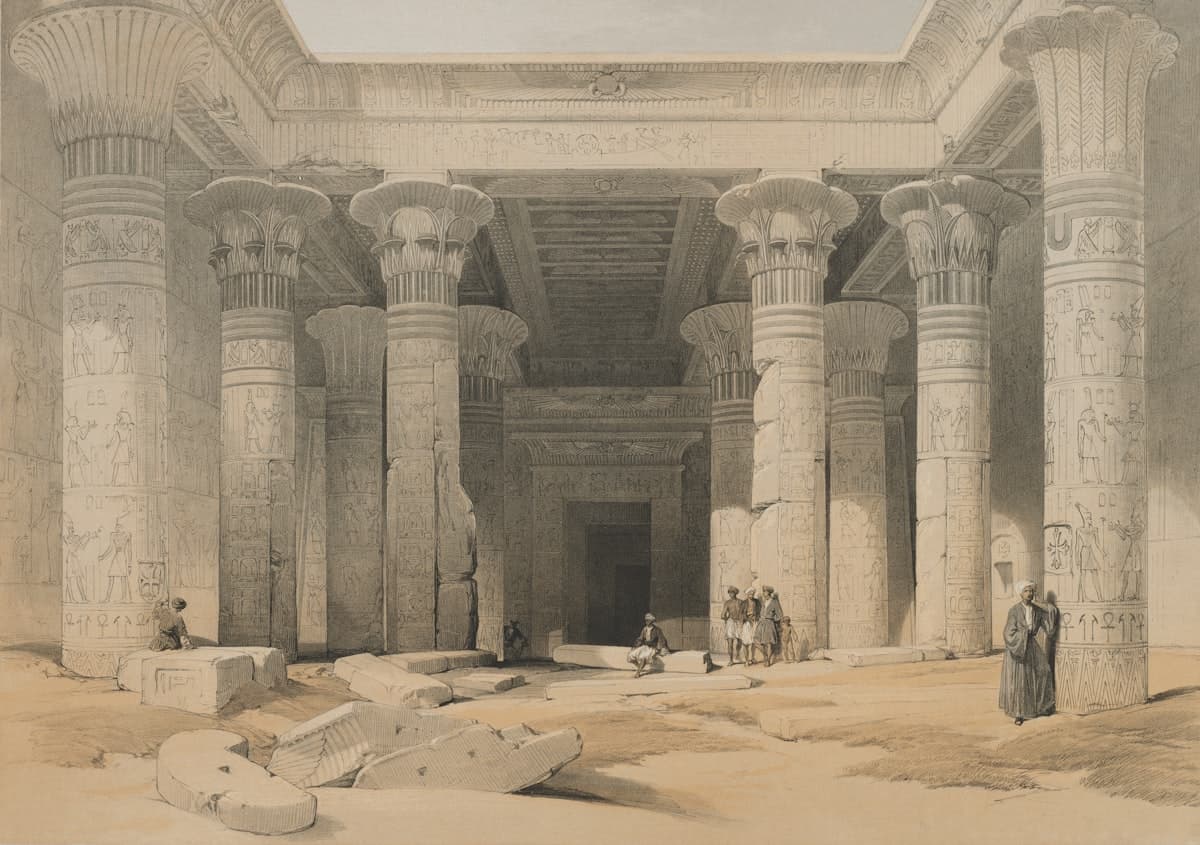
The Nile between Luxor and Aswan is not the whole Nile. It is the Nile of Upper Egypt, the ancient land called Ta-Shemau, meaning the land of the sedge plant. For three thousand years of Pharaonic history, this was where power began. Luxor was Thebes, the capital of the New Kingdom empire that stretched south into Nubia and north into the Levant. Aswan was the frontier, the granite quarry, and the border with Africa.
Every obelisk in every European capital came from the quarries at Aswan. The unfinished obelisk still lying in the granite bedrock there, abandoned after a fissure cracked the stone, is 42 meters long and would have been the largest single piece of stone ever shaped by human hands. It was abandoned around 1480 BC, which means it has been lying in that quarry, slightly longer than the Washington Monument, for roughly 3,500 years.
The temples along this route were not built in isolation. They accumulated. Karnak in Luxor was under construction for 2,000 years, touched by pharaohs from the Middle Kingdom to the Roman period. Kom Ombo, halfway between Luxor and Aswan, was built by the Ptolemies, the Greek dynasty that ruled Egypt after Alexander, and expanded by Rome. The carvings on its outer wall include what are widely considered the earliest known depictions of surgical instruments: scalpels, bone saws, and what appears to be a gynecological speculum, carved in stone around 150 BC. As a medical school graduate who never practiced, I find it impossible to walk past that wall without stopping.
What You Will Actually See: The Main Stops
Edfu: The Best-Preserved Temple in Egypt
Most people arrive at Edfu by horse-drawn carriage from the dock, which takes twelve minutes and costs around EGP 100 per person. The carriages are genuinely difficult to avoid, the drivers are aggressive, and the horses are in varying states of health. The alternative is a ten-minute walk along the corniche, which most cruise staff will tell you is impossible. It is not.
The Temple of Horus at Edfu is the best-preserved complete temple in Egypt, not because it was maintained but because it was buried. Sand filled it to the ceiling over a period of centuries after the cult was abandoned, and when Auguste Mariette excavated it between 1860 and 1880, he found interior walls that had barely been touched by light since the Ptolemaic period. The color in some inner chambers still carries traces of the original ochre and blue.
The temple was built between 237 and 57 BC, making it one of the later temples in Egypt, constructed during Ptolemaic rule, but deliberately designed to look ancient. The Ptolemies were politically savvy: they built in classical Egyptian style to legitimize their rule in the eyes of the priesthood. The inscriptions inside include the Edfu Texts, a corpus of architectural and ritual literature that is the longest surviving religious text from ancient Egypt. Most visitors spend forty-five minutes here. Three hours is closer to appropriate.
Kom Ombo: Two Gods, One Temple, One Crocodile
Kom Ombo is unusual even by Egyptian standards: a temple simultaneously dedicated to Sobek, the crocodile god, and Horus the Elder, the falcon. Every axis of the building is doubled: two sanctuaries, two hypostyle halls, two sets of ritual rooms. The reason is still debated, but one theory holds that the temple served two different priestly communities who shared a site but maintained separate cults.
What most cruise passengers miss entirely is the small Crocodile Museum attached to the temple complex, which houses 22 mummified crocodiles found in a nearby cache. Admission is included in the temple ticket. The largest specimen is over three meters long. The mummification is detailed enough to see individual scales. It is more interesting than it sounds, and it takes fifteen minutes.
The Nilometer at Kom Ombo, a calibrated stone shaft used to measure flood levels and calculate agricultural tax, dates to the Ptolemaic period and was still in use under the Ottoman governors who ruled Egypt before the Muhammad Ali dynasty. The connection between Pharaonic hydraulic engineering and 18th-century tax collection is exactly the kind of thread that makes this river worth traveling slowly.
Aswan: The City at the End
Aswan is where the Nile stops being navigable without assistance. The first cataract, a stretch of granite boulders and churning water that begins just south of the city, was the ancient world's natural barrier against invasion from the south. Aswan (ancient Syene) sits at latitude 24 degrees north, close enough to the Tropic of Cancer that Eratosthenes, the Greek mathematician in Alexandria, used it in 240 BC to calculate the circumference of the earth. He measured the angle of the sun at noon on the summer solstice, compared it to Alexandria, and got an answer within 2% of the correct figure using nothing but a stick and the distance between two Egyptian cities.
The Nubian villages on the west bank of the Aswan reach are accessible by felucca for around EGP 150 to EGP 200 per hour, and they are the most honest argument for slowing down. The houses are painted in indigo and turquoise and burnt orange. The families have been here since before the Aswan High Dam, completed in 1970, displaced over 90,000 Nubians from villages that now lie under Lake Nasser. That loss is living memory for people in their sixties and seventies. If someone invites you to sit and drink tea, sit and drink tea.
The Connections: What the River Ties Together
The Nile cruise from Luxor to Aswan is not a journey through ancient Egypt. It is a journey through every Egypt at once. The Coptic monasteries on the desert cliffs above the river, some founded in the 4th century AD, were built in part using stone from abandoned Pharaonic temples whose cults had been outlawed by Roman decree. The medieval Arab geographer al-Idrisi described this stretch of river in his 1154 world geography, noting the granite quarries and the market at Aswan where gold from Sudan arrived via camel caravan. When Napoleon's surveyors came through in 1798, they mapped all of it: the temples, the monasteries, the caravan routes, the Nilometers. The Description de l'Egypte, the 23-volume record they produced, is the founding document of modern Egyptology and was itself built on the back of a military invasion.
The Philae Temple, now on an island in the reservoir south of Aswan, was the last place in the ancient world where hieroglyphics were used as a living script. The final known hieroglyphic inscription was carved there in 394 AD, more than 600 years after Egypt became a Greek-speaking kingdom under the Ptolemies. When UNESCO moved the temple to higher ground between 1972 and 1980 to save it from Lake Nasser, they accomplished something the ancient world's most devoted engineers had never managed: they relocated an entire temple, stone by stone, to a different island.
Common Mistakes
Booking the cheapest cruise and assuming the stops are the same. They are not. Budget boats frequently skip Elkab and Esna, add a shopping stop at a factory outside Luxor that sells alabaster at three times the medina price, and spend more time moored than moving. Read the exact itinerary before booking. If it does not list specific temples by name, ask.
Skipping Esna because it sounds minor. The Temple of Khnum at Esna was only fully excavated in the 1860s, and its ceiling contains the latest known hieroglyphic astronomical inscriptions, dated to the reign of the Roman Emperor Decius in 250 AD. The hypostyle hall, the only standing section, is remarkable precisely because it sits below street level in the middle of a market town, surrounded by fabric stalls and coffee sellers. Admission is EGP 180 (approx $3.70 USD). It takes forty-five minutes and almost every cruise includes it. Do not be the person who stays on the boat.
Taking the sound and light show at Karnak before departure. The Karnak sound and light show costs EGP 450 and narrates Egyptian history in a tone that combines National Geographic circa 1987 with a particularly slow airport announcement. It tells you nothing you will not learn from a competent guide the following morning. Skip it. Spend that evening in the Luxor souk instead.
Tipping guides once at the end. In Egypt, guides, drivers, and boat staff are paid partially in tips, not as an optional courtesy but as a structural part of their income. Tip the guide after each excursion (EGP 100 to EGP 200 per person per day is appropriate for a good guide), the cabin steward at mid-cruise, and the captain on the final night. Front-loading respect produces better service and is accurate to how the economy works.
Trusting that a five-star boat means a five-star guide. Boat category and guide quality are entirely separate systems. Ask specifically about your guide's qualifications before booking. Egyptian Ministry of Tourism-licensed guides must pass a degree program and examination. Unlicensed guides are common on budget boats and cannot legally enter certain sites.
Missing the Aswan granite quarries in favor of a fourth felucca ride. The Unfinished Obelisk, EGP 100 admission (approx $2 USD), is the single most clarifying object in Egypt for understanding how any of this was built. Standing next to 1,200 tonnes of granite that was being shaped by hand when it cracked and was simply left, you understand scale in a way that no finished monument quite delivers.
Practical Tips
Book the Nile cruise from Luxor to Aswan directly through a licensed Egyptian tour operator rather than through an international aggregator. The price difference can be significant, 20 to 35% less, and the operator has more flexibility on guide assignment and itinerary customization. Reputable operators include Spring Tours, Memphis Tours, and Djed Egypt Travel, all Cairo-based with English-language booking systems.
For the dahabiya option, which moves more slowly and carries 8 to 16 passengers rather than 150, book at least four months in advance for the October to February season. Dahabiyas are the traditional wooden sailing vessels that carried European travelers and scholars up this river in the 19th century. They cannot navigate locks under their own sail and must be towed at Esna, which takes about an hour and is itself worth watching.
Bring a torch for tombs. The lighting in many secondary sites is genuinely insufficient. A lightweight LED headlamp is more useful here than on almost any other trip. Bring more cash than you think you need in Egyptian pounds: many riverside sites have no ATM within practical distance, and cards are not accepted at smaller attraction entrances.
Mornings on the river before 8am are the practical argument for traveling this way. The light on the west bank cliffs at 6am is a particular quality of pale gold that does not repeat at any other hour. Set an alarm. Stand on deck. The coffee from the boat kitchen will be fine.
Frequently Asked Questions
The Weekly Dispatch
More on Egypt, every Friday.
Cultural depth and places most guides never mention.
No spam. Unsubscribe anytime.