Alexandria's Italian Community: A Vanished World's Surviving Traces
At its peak, Alexandria had 60,000 Italian residents who built the city's Art Nouveau facades, ran its opera house, and called it home. Almost none remain.

Quick Facts
- Best time to visit
- October through April. The Mediterranean humidity drops, the light is clearer, and the summer crowds from Egyptian domestic tourism are absent.
- Entrance fee
- Cavafy Museum: EGP 80 (approx $1.60 USD). Royal Jewelry Museum: EGP 200 (approx $4 USD), students EGP 100. Latin Cemetery: free. Most church exteriors and streetscape: free.
- Opening hours
- Cavafy Museum: Tuesday to Sunday 10am to 3pm. Royal Jewelry Museum: Daily 9am to 5pm. Latin Cemetery: Approximately 9am to noon. Italian Cultural Institute: check current schedule at their website.
- How to get there
- Tram from Raml Station: EGP 3 per ride. Tuk-tuk from central Alexandria to Moharrem Bey: EGP 20 to 30. Uber or Careem within the city: EGP 40 to 70. From Cairo: Spanish Talgo train from Ramses Station, EGP 120 to 200, approximately 2 hours.
- Time needed
- Half a day for core sites (Fouad Street walk, Royal Jewelry Museum, Cavafy Museum). Full day if adding the Latin Cemetery, Moharrem Bey villa exteriors, and the Anfushi waterfront.
- Cost range
- Budget EGP 300 to 500 per day including tram, entry fees, and lunch. Mid-range EGP 1,200 to 2,000 per day with a private guide and sit-down restaurant meals.
Quick Facts
Best time to visit: October through April, when the Mediterranean humidity drops and the light turns the color of old photographs.
Entrance fees: Cavafy Museum: EGP 80 (approx $1.60 USD). Villa of Ambron (exterior only, no interior access without appointment): free. Greek Orthodox Patriarchate courtyard: free. Royal Jewelry Museum (formerly Villa Fatma el-Zahraa, designed by Italian architect Ernesto Verrucci): EGP 200 (approx $4 USD), students EGP 100.
Opening hours: Cavafy Museum: Tuesday through Sunday, 10am to 3pm. Royal Jewelry Museum: Daily 9am to 5pm. Most churches: mornings only, typically 9am to noon.
How to get there: From Ramla Tram Station, take Tram Line 1 or 2 west toward Sidi Gaber. A tuk-tuk from downtown Raml Station to Moharrem Bey (where many villas survive) costs EGP 20 to 30. Ride-hailing apps (Uber, Careem) from central Alexandria cost EGP 40 to 70 depending on destination.
Time needed: Half a day for the core sites, a full day if you include the Cavafy Museum, the Latin Cemetery, and a walk along the Corniche past the palazzo facades.
Cost range: Budget EGP 300 to 500 per day including tram, entry fees, and lunch in a local restaurant. Mid-range EGP 1,200 to 2,000 per day if adding a private guide.
---
Why This Place Matters
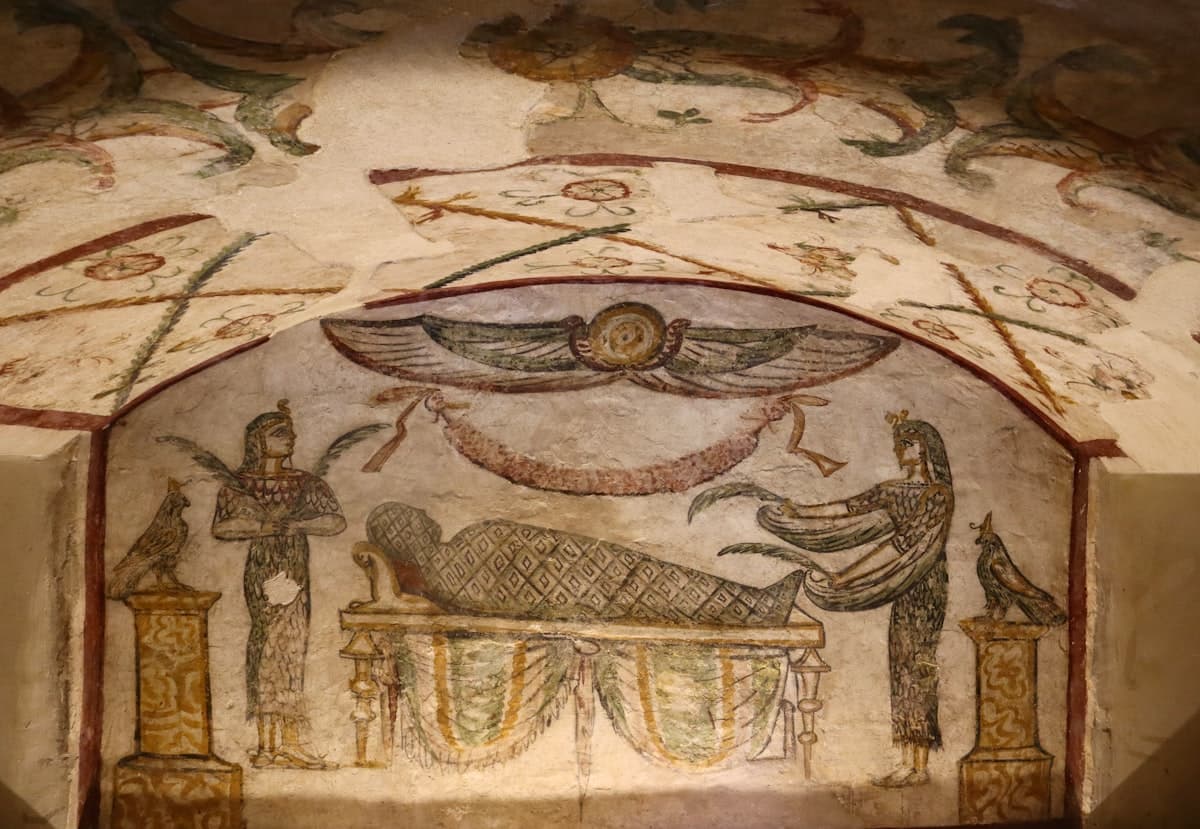
In 1927, Italians were the largest foreign community in Alexandria, numbering over 60,000 people. They were not diplomats or administrators. They were barbers and bankers, architects and anarchists, fishermen from Sicily and textile merchants from Turin. They had a hospital, a school system, a newspaper called Il Messagero Egiziano, two football clubs, and a social club on the Corniche that served espresso better than anything in Rome. By 1965, the community had collapsed to a few hundred families. By the end of the century, barely a handful remained.
What they left behind is one of the most quietly extraordinary architectural and cultural palimpsests in the Mediterranean world. The Italian community in Alexandria did not simply pass through Egypt. They built the physical city that travelers walk through today, often without knowing it. The Art Nouveau and Liberty-style facades on Fouad Street, the marble staircases in buildings now subdivided into government offices, the sea-facing villas in Gleem and Sidi Bishr: these are Italian buildings occupied by Egyptian lives, which is its own kind of continuation.
Understanding this story also means understanding that Alexandria has always been this way. The city founded by Alexander the Great in 331 BC was never mono-cultural for a single generation of its entire history. Greeks, Jews, Romans, Arabs, Ottomans, and eventually a constellation of Mediterranean communities all layered themselves into the same limestone and salt air. The Italians were not anomalous. They were the latest expression of a city that has always been assembled from elsewhere.
---
The Architecture They Left Behind
The single best way to encounter the Italian community Alexandria Egypt history guide in physical form is to walk Fouad Street (formerly Rue Fuad Premier, formerly the ancient Canopic Way, the main east-west artery of Ptolemaic Alexandria) in the early morning before the traffic overwhelms it. Every third or fourth building bears the signature of an Italian or Italian-trained architect. Look for the ironwork balconies, the terracotta detailing, the ceramic-tiled entryways stamped with Milanese manufacturing marks still legible under decades of Cairo dust blown in from the desert.
The firm of Antonio Lasciac, a Slovenian-born architect who worked in the Egyptian eclectic style, designed dozens of the city's public and private buildings between 1882 and 1924. His work sits at the intersection of Italian Liberty style and Ottoman decorative tradition, which is architecturally honest, because his clients were often Ottoman subjects who had been educated in Florence. The mixed parentage is in the stone.
The Villa of Ambron in Moharrem Bey is the most intact private survival. Built for a wealthy Italian-Egyptian family in the early twentieth century, it is now used by the Egyptian government and is not open to the public, but its exterior, visible from the street, gives you the full grammar of how the Italian community understood itself: grand without being ostentatious, Mediterranean in its arcaded loggia, but planted firmly in African soil. The garden has bougainvillea that was almost certainly there when the family still lived in it.
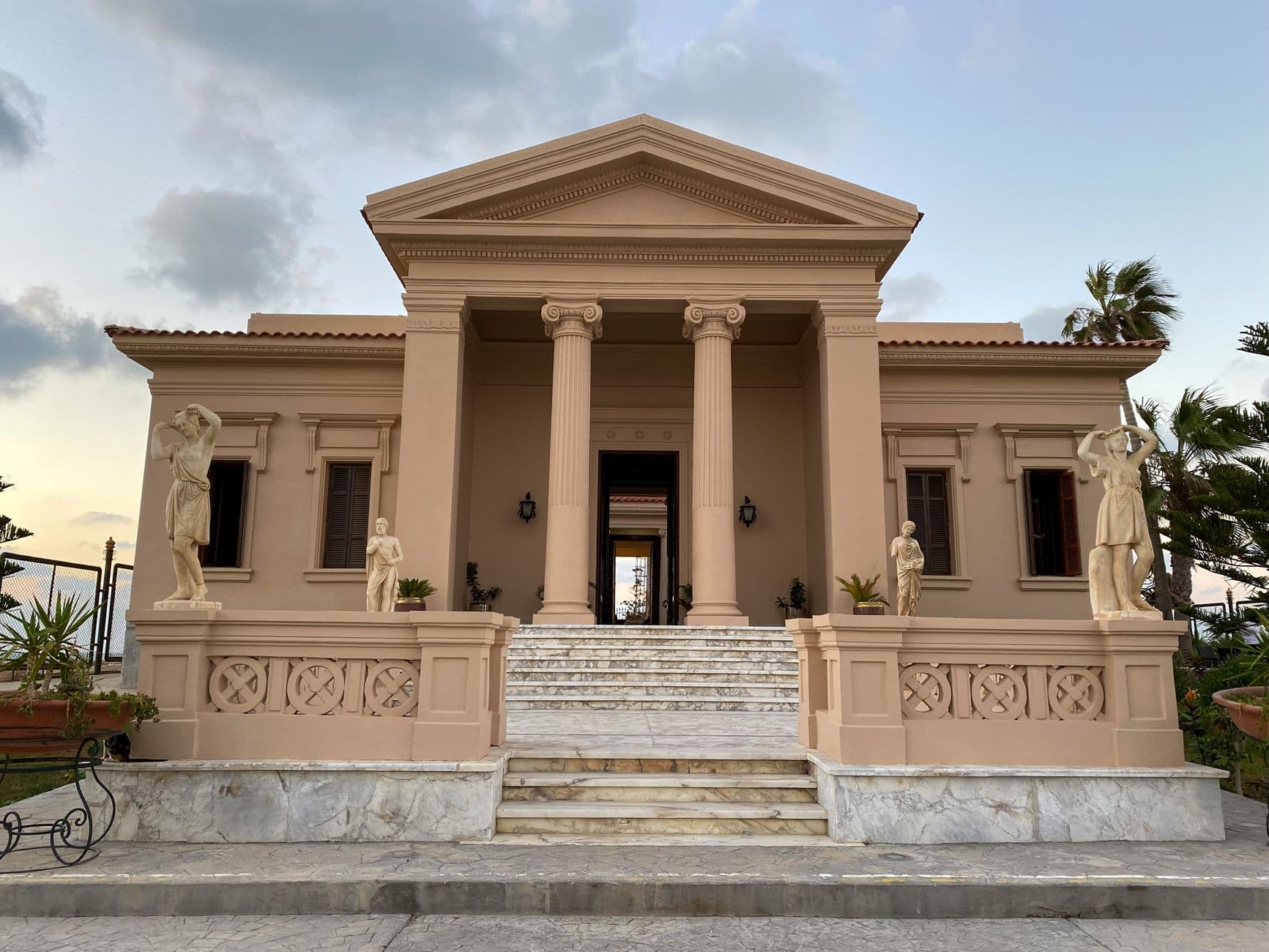
For the interiors, the Royal Jewelry Museum on Ahmed Zewail Street is your best access point. The building was designed by Ernesto Verrucci, an Italian architect who served as court architect to King Fuad I and King Farouk, and the rooms themselves, now displaying the royal collection, retain the original ceiling frescoes and marble floors. Verrucci also designed the Abdeen Palace extensions in Cairo, which tells you how thoroughly Italian aesthetics had penetrated Egyptian royal patronage by the 1920s.
---
The Human Story: Who They Were and How They Left
The departure of the Italian community from Alexandria was not a single event. It was a slow hemorrhage across three political ruptures.
The first was the Italian invasion of Libya in 1911, which created a public relations problem for Italians living under British-administered Egypt and soured their relationships with Egyptian nationalists who saw Italian colonialism as a preview of European intentions everywhere.
The second was the Second World War, specifically the Italian declaration of war against Britain in June 1940. Overnight, Italian residents of Alexandria found themselves classified as enemy aliens. Many were interned at camps in the Egyptian desert. Others were expelled. Families who had lived in Alexandria for three generations were given forty-eight hours to pack.
The third and decisive rupture was Nasser's nationalization decrees of 1956 and after, which sequestered foreign-owned businesses and property. Italian families who had rebuilt after the war now lost their commercial bases. The logic of staying evaporated. Between 1956 and 1965, the community fell from perhaps 15,000 to under 2,000.
What makes this story genuinely complicated is that many of these families had Egyptian nationality, or dual nationality, or no clear nationality at all because they had been in Alexandria for so long that their legal status had never been formally resolved. Some had converted to Islam and intermarried with Egyptian families generations earlier. The categories we use, Italian, Egyptian, foreign, local, collapse almost immediately when you look at the actual lives.
The best place to sit with this complexity is the Latin Cemetery on Sharia Abdel Salam Arif, one of the most affecting places in Alexandria that almost no traveler visits. The Italian section contains headstones dating from the 1840s through the 1960s, spanning the entire arc of the community's presence. The inscriptions are in Italian, sometimes in French, occasionally in Arabic. Some of the later stones carry Egyptian names for people buried under Italian epitaphs. The cemetery is open in the mornings and is free to enter. Bring water and plan an hour.
---
The Connections
The Italian presence in Alexandria sits within a longer story of Mediterranean mobility that most visitors to Egypt never fully register.
Alexandria's Greek community, which overlapped and intertwined constantly with the Italian one, produced the poet Constantine Cavafy, born in 1863, who spent almost his entire life in a city he described in Greek verse while living among Arabs, Turks, Italians, and Jews. The Cavafy Museum, in the apartment where he lived for the last twenty-five years of his life, is worth two hours of anyone's attention. His poem "The City" (1910) is essentially a meditation on what it means to be formed by a place you cannot leave and cannot entirely claim. Every Italian family that left Alexandria left in the state Cavafy described.
The physical sites also connect backward to earlier layers. The street the Italians built their social club on was built over a Ptolemaic boulevard. The Latin Cemetery sits adjacent to a Jewish cemetery that dates to the same nineteenth-century expansion. The church of Saint Catherine, the main Catholic church in downtown Alexandria completed in 1847, was built on a site where a Franciscan chapel had stood since the fourteenth century, when Italian merchant-monks first established a permanent presence in the city. The Franciscans came because Alexandria was still a major spice and textile transit point. They stayed because the city kept being worth staying in.
In Cairo, this same Italian thread runs through the downtown Khedivial district, where the urban planning of the 1860s and 1870s was carried out by Ali Mubarak and Baron Haussmann-influenced Italian engineers working for Khedive Ismail. The architectural DNA of downtown Cairo and cosmopolitan Alexandria is related, and both trace partly to the same movement of Italian professionals through the Ottoman Mediterranean world.
---
Common Mistakes
Treating this as a nostalgia tour. The tendency when visiting sites of vanished communities is to romanticize the loss. The Italian community in Alexandria lived inside a colonial economic structure. Their prosperity depended in part on legal privileges that Egyptian workers did not have. The story is genuinely interesting precisely because it does not resolve into simple grief or simple critique.
Skipping the Latin Cemetery in favor of better-publicized sites. Every guide mentions the Catacombs of Kom el-Shoqafa. Fewer mention that the Latin Cemetery, fifteen minutes away by tram, contains a more layered and more recent record of Alexandria's cosmopolitan life. The Catacombs are impressive. The cemetery is moving.
Expecting building interiors to be accessible. Many of the most significant Italian-built villas are now Egyptian government offices, private residences, or in states of uncertain ownership. Exterior exploration is the rule. Do not try to enter buildings that are not clearly museums or churches.
Taking a guided tour that treats the cosmopolitan era as a golden age. Several operators sell "Alexandria's Belle Epoque" tours that are essentially exercises in colonial nostalgia, presenting the pre-1952 era as an exotic lost paradise without engaging with why it ended or what its terms were. These tours are architecturally informative and politically illiterate. Use them for building identification, not for history.
Overlooking the living continuity. A small Italian Cultural Institute still operates in Alexandria on Fouad Street and occasionally hosts events, exhibitions, and language programs that connect to this history. The Instituto Italiano di Cultura is not a museum. It is a continuing presence. Check their program calendar before you visit.
Assuming the Cavafy Museum is only for literature readers. The apartment itself, the furnishings, the view from the window, the neighborhood around it, constitute one of the most precise surviving interiors from cosmopolitan Alexandria. You do not need to have read a word of Cavafy to find it one of the most specific and honest small museums in Egypt.
Spending money on the Montaza Palace tour. The palace grounds (EGP 35 entry) are pleasant for a coastal walk, but the palace itself is not accessible to the public and the site tells you almost nothing about the Italian architects and communities this article covers. Save the time for Moharrem Bey.
---
Practical Tips
The best base for exploring Italian community Alexandria Egypt history is the downtown area near Raml Station, where you are within tram distance of almost every relevant site. The Steigenberger Cecil Hotel on the Corniche is the most historically resonant accommodation option: the building dates from 1929 and Somerset Maugham and Noel Coward both stayed here during the cosmopolitan era. Rooms start around EGP 3,500 per night. Budget travelers will find clean, perfectly adequate hotels on Sharia Salah Salem for EGP 400 to 700 per night.
The tram system is genuinely the right way to navigate Alexandria for this kind of itinerary. It is slow, which is an advantage. A tram fare costs EGP 3. You will see the facades of Italian-era buildings at walking pace from the window.
For food, the Italian culinary inheritance in Alexandria is real but subtle. The city's seafood restaurants, particularly those around the fish market in Anfushi, serve dishes whose seasoning and preparation owe something to Italian Mediterranean cooking absorbed over generations. Elite Restaurant on Sharia Safiya Zaghloul has been operating since 1953 and serves a hybrid menu that is itself a document of the era. Lunch for two costs EGP 400 to 700.
If you want structured access to archives and private collections, contact the Alexandria and Mediterranean Research Center (Alex Med) at the Bibliotheca Alexandrina in advance of your visit. They hold photograph collections, municipal records, and community association documents from the cosmopolitan period that are not available in any guidebook and are genuinely extraordinary.
Finally: go in the morning. Alexandria's Mediterranean light between 7am and 10am is a specific quality of silver and salt that the city does not offer at any other hour. The facades look different. The streets are quieter. The call to prayer from the Mohammed Ibrahim Mosque on Fouad Street echoes off buildings that Italian architects raised a century ago, which is not a metaphor for anything. It is simply what Alexandria sounds like, and it is worth hearing.
Frequently Asked Questions
The Weekly Dispatch
More on Egypt, every Friday.
Cultural depth and places most guides never mention.
No spam. Unsubscribe anytime.