Armenian Community Egypt History Guide: Cairo's Living Diaspora
At its peak, Egypt's Armenian community numbered 100,000. Today it is under 6,000. What they left behind in Cairo is extraordinary, and almost nobody visits it.

Quick Facts
- Best time to visit
- October to April for manageable temperatures. January 6 (Armenian Christmas) for the main liturgical gathering at Saint Gregory's Cathedral.
- Entrance fee
- Free at all sites. Small donation expected at churches (EGP 20 to 50 is appropriate).
- Opening hours
- Saint Gregory's Cathedral: Saturday to Sunday 9am to 1pm. Weekday visits by appointment only. Armenian Evangelical Church: Sunday mornings. Cemetery: daylight hours, request at gate.
- How to get there
- Metro Line 3 to Nozha station (EGP 9, approx $0.18) then taxi to Heliopolis cathedral (EGP 30 to 50). Metro Line 1 to Mar Girgis for Old Cairo cemetery (EGP 9). Ramses metro station for the downtown Evangelical church (EGP 9).
- Time needed
- Half day for Heliopolis cathedral and surroundings. Full day to include downtown church and Old Cairo cemetery.
- Cost range
- Extremely low cost. Budget EGP 150 to 350 total for transport and donations across a full day itinerary.
Quick Facts
Best time to visit: October through April, when Cairo's heat is manageable and the churches hold their main liturgical calendar events. The Armenian Christmas on January 6 is worth timing a visit around.
Entrance fees: The Armenian Cathedral of Saint Gregory the Illuminator in Heliopolis: free, though a small donation box sits near the door. The Armenian Evangelical Church in downtown Cairo: free. The Armenian cemetery in Old Cairo: free, accessible during daylight hours with a polite request at the gate.
Opening hours: Saint Gregory's Cathedral is generally open Saturday and Sunday mornings from 9am to 1pm, and by appointment on weekdays. Call ahead: 02 2290 1234. Hours shift around liturgical seasons.
How to get there: From central Cairo, take the metro Line 3 to Nozha station (EGP 9, approx $0.18), then a tuk-tuk or taxi to the cathedral in Heliopolis (EGP 30 to 50, approx $0.60 to $1.00). The Armenian Evangelical Church on Shari'a Ramses is walkable from Ramses metro station. For the Old Cairo cemetery, take the metro to Mar Girgis station, Line 1.
Time needed: A focused half-day covers the cathedral, the community club, and the Heliopolis quarter where most Armenians lived. A full day adds the evangelical church downtown and the Old Cairo cemetery.
Cost range: This is an extremely low-cost itinerary. Budget EGP 200 to 400 for transport, food, and any donations across a full day. The real investment is time and the willingness to knock on doors.
---
Why This Place Matters
At its demographic peak in the 1940s and 1950s, Egypt's Armenian community numbered close to 100,000 people. They operated their own schools, newspapers, clubs, churches, pharmacies, and football teams. Cairo had an Armenian quarter. Alexandria had Armenian merchants who helped finance the cotton trade that made the city one of the wealthiest ports in the Mediterranean. Then came 1956, then 1961, then 1967. Nasser's nationalizations, the expulsions of foreign nationals, the slow pressure on minorities to leave. By the early 1970s, most were gone. Today the community holds somewhere between 5,000 and 7,000 people, depending on who is counting.
This is the context you need for the Armenian community Egypt history guide to make sense: what you are looking at is not ancient ruins. It is a living diaspora experiencing its twilight. The churches still hold services. The community club still opens its doors. But the congregation for a Sunday mass at Saint Gregory's Cathedral might be thirty people in a building designed for three hundred.
The Armenians arrived in Egypt in several waves. The first significant wave came in the 15th and 16th centuries, when Armenian merchants established trading networks between Cairo and Aleppo. The second wave, and by far the largest, came in 1915 and the years immediately after: survivors of the Ottoman genocide who arrived with nothing and rebuilt their lives in a country that, under both British administration and the monarchy of Fuad I, was still relatively open to minorities. Egypt was a polyglot, multi-confessional place in that era. Greeks, Jews, Italians, Syrians, and Armenians all occupied specific economic and cultural niches within a society that was itself only beginning to define what Egyptian identity meant.
The Armenians who arrived after 1915 were mostly from Anatolia, from cities like Erzurum, Diyarbakir, and Marash. They carried their dialect, their food, their liturgy, and their trauma. Within two generations, they had built schools that were considered among the best in Cairo, and the Nubarian family, whose patriarch Boghos Nubar Pasha had served as Egypt's first prime minister under the Khedive, represented how thoroughly some Armenians had integrated into the Egyptian establishment.
Boghos Nubar Pasha is worth pausing on. His father, Nubar Pasha, served as prime minister of Egypt three times between 1878 and 1895, and was arguably the most powerful non-royal figure in Egyptian political life during the late 19th century. He was Armenian. This is not a footnote. It is a central fact of Egyptian political history that most visitors to Cairo never encounter.
---
The Cathedral of Saint Gregory the Illuminator, Heliopolis
Heliopolis itself is an early 20th century planned city, built by the Belgian entrepreneur Baron Edouard Empain beginning in 1905 on what was desert northeast of Cairo. Empain recruited workers and professionals from across the Mediterranean, and Armenians settled here in significant numbers during the interwar period. The neighborhood still carries the architectural bones of that era: the Moorish-meets-Art Deco streetscapes, the wide avenues planted with trees, the villas that have been subdivided but not yet demolished.
The Cathedral of Saint Gregory the Illuminator sits on Shari'a Ibrahim Laqani. Gregory the Illuminator is the patron saint of Armenia, the man who converted the Armenian king Tiridates III to Christianity in 301 AD, making Armenia the first nation to adopt Christianity as a state religion. Twelve years before Constantine made it legal across the Roman Empire. That sequence matters: Armenia was not following Rome. It was ahead of it.
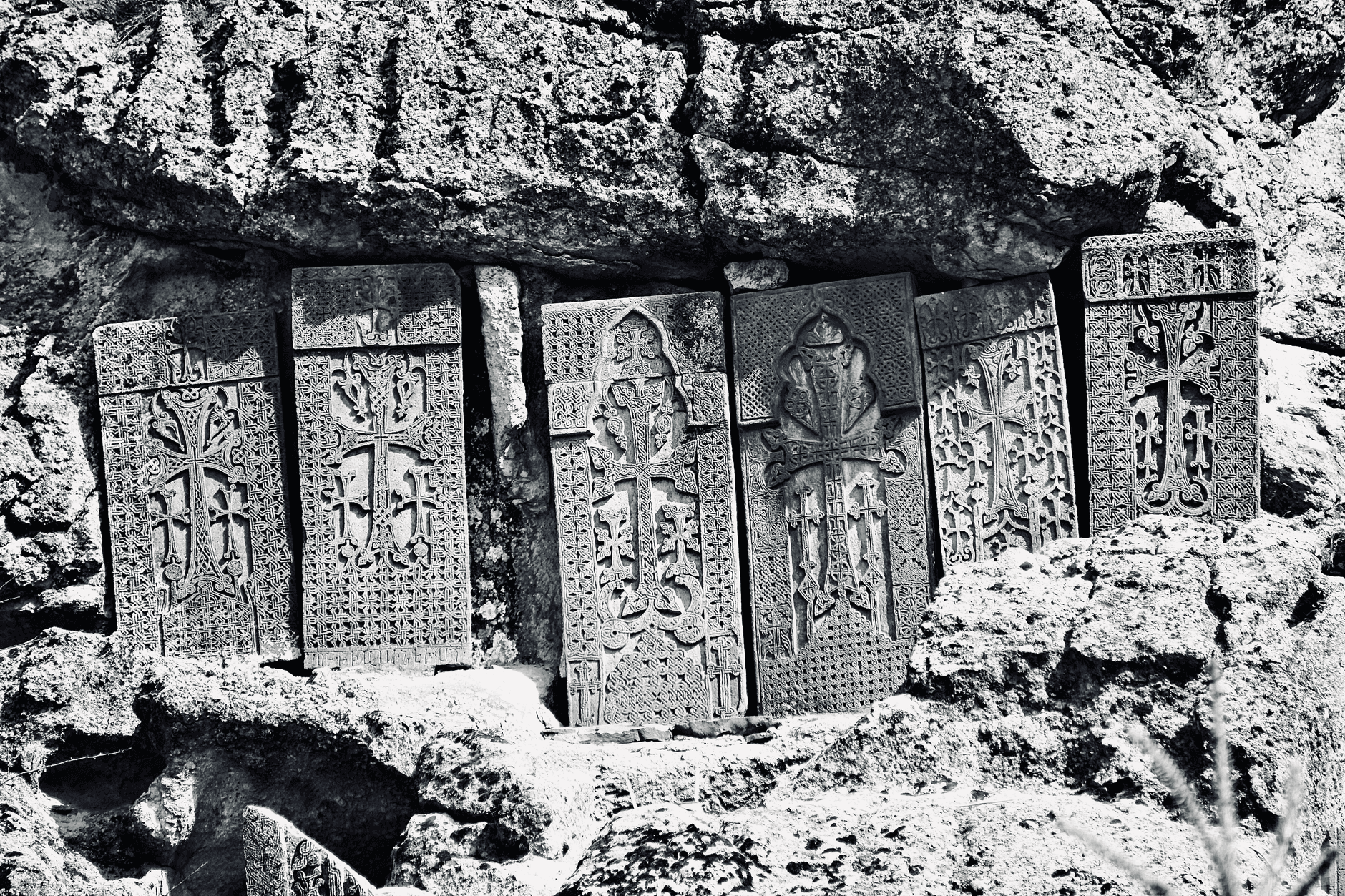
The cathedral was built in 1952, and its construction tells you something about Armenian timing: the community was investing in permanent infrastructure in Cairo just as the political conditions that would force them out were beginning to form. Inside, the liturgical art follows the Armenian Apostolic tradition, which visually separates itself from both Eastern Orthodox and Roman Catholic iconography in specific ways. The khachkar, the Armenian cross-stone, appears throughout, a form of sacred art that UNESCO inscribed on its Intangible Cultural Heritage list in 2010. The ones in this cathedral were carved by craftsmen whose families had fled Anatolia a generation earlier.
If you arrive on a Sunday morning, you will hear the Divine Liturgy chanted in Classical Armenian, called Grabar, a language that has not been a spoken vernacular for over a thousand years but survives entirely in liturgical use. It is the Latin of the Armenian church: ancient, precise, and kept alive by communities that understand its loss would be irreversible.
Ask at the cathedral office about the community archives. They are not publicly catalogued, but the priests and administrators know where things are. There are photographs, records of the first arrivals after 1915, registers of births and marriages going back to the 1920s. This is primary source material for one of the 20th century's defining catastrophes, sitting in a modest office in Heliopolis.
---
The Armenian Evangelical Church and the Downtown Layer
The Armenian community was never monolithic. The Apostolic church represented the ancient tradition, but a significant Protestant minority had emerged during the 19th century missionary period, when American Protestant missions converted a portion of the Armenian population in Anatolia. When those Armenians fled to Egypt, they brought their Evangelical faith with them.
The Armenian Evangelical Church on Shari'a Ramses in downtown Cairo is architecturally modest compared to the Heliopolis cathedral, but its history is dense. The congregation was formally established in Cairo in 1925, within ten years of the genocide, by survivors who were simultaneously grieving their dead, rebuilding their lives, and maintaining their theological identity against the pull of the larger Apostolic community.
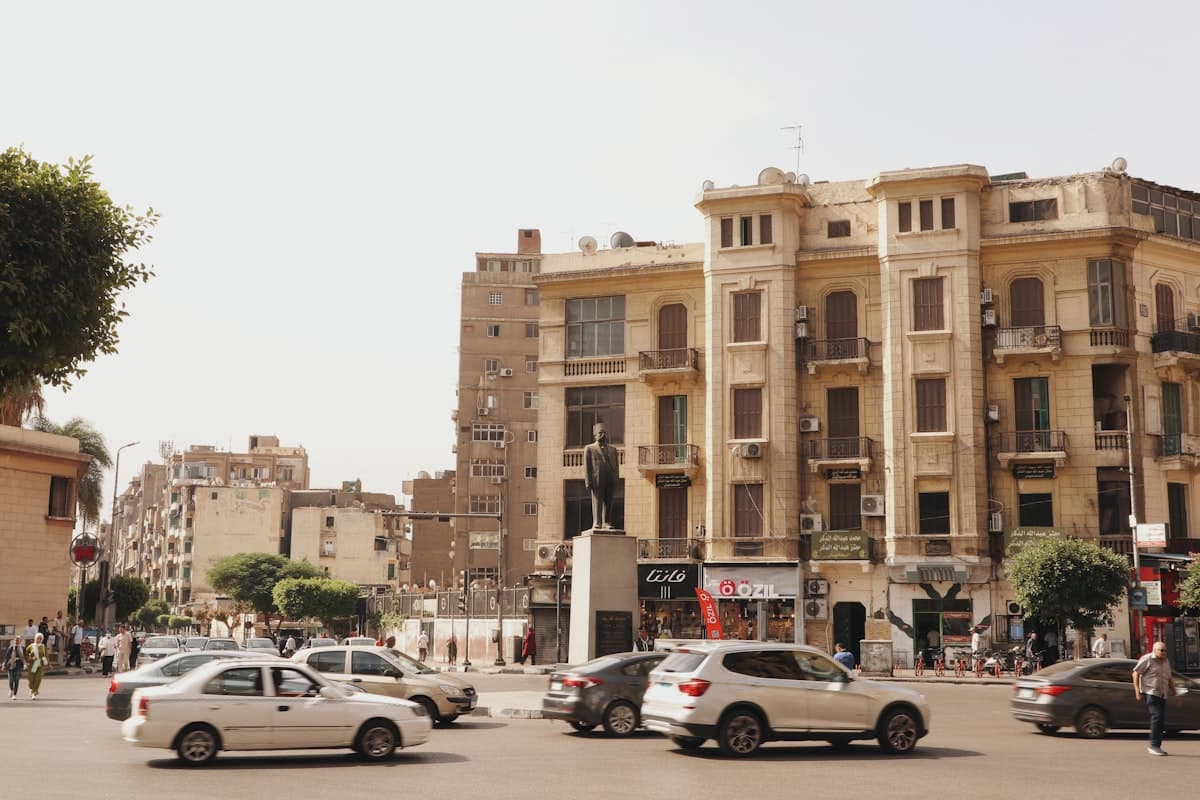
The street outside, Ramses Street, is now one of Cairo's major arteries, twelve lanes of controlled chaos anchored by the Ramses railway station at one end. Standing in front of this small church and watching the city move around it is one of the more instructive experiences Cairo offers. The urban Egypt of 2024 has simply grown over and around the Armenian Egypt of 1925, without erasing it entirely.
Inside, services are conducted in a mix of Armenian and Arabic, which tells you everything about how the community has navigated survival. The grandchildren of genocide survivors speak Arabic as their primary language. The liturgy code-switches to meet them.
---
The Connections
The Armenian presence in Egypt cannot be understood in isolation from the broader pattern of Cairo as a city that has always been built in layers. The neighborhood of Old Cairo, where the Armenian cemetery sits among the Coptic churches and a surviving Roman fortress wall, is the most compressed version of this layering. The Roman fortress of Babylon was built here in the 1st century AD. The Coptic churches rose within its walls after the Arab conquest of 641 AD, when the Christian community withdrew from the new Islamic city being built to the north. The Armenian cemetery occupies ground that has been used for Christian burial since at least the medieval period.
The Mamluk sultans who built the great mosques of Cairo in the 13th through 15th centuries also employed Armenian craftsmen and soldiers. The Mamluks were themselves a slave-soldier class drawn from Turkic and Circassian populations, and the cosmopolitanism of medieval Cairo meant that Armenian merchants, clergymen, and craftsmen moved through the city with relative freedom. One of the more obscure facts of this period: the Mamluk sultan Al-Ashraf Khalil, who captured Acre in 1291 and ended the Crusader presence in the Levant, had an Armenian mother.
The 19th century connection runs through the cotton economy. The same global demand for Egyptian long-staple cotton that enriched Alexandria's Greek and Jewish merchant communities also created space for Armenian traders who had established networks between Cairo, Aleppo, and Istanbul over centuries. When the genocide destroyed those Anatolian networks in 1915, Egypt became not just a refuge but the new commercial headquarters for families whose business relationships with Egyptian merchants predated the catastrophe.
---
Common Mistakes
Assuming this is a museum experience. Nothing here is labelled for tourists. There are no audio guides, no entrance queues, no gift shops. You are visiting active religious and community institutions. Treat them accordingly: dress modestly, ask before photographing, and understand that your presence is a courtesy granted, not a right.
Visiting without contacting ahead. The cathedral has irregular opening hours outside of Sunday services. If you show up on a Wednesday afternoon hoping for a tour, you will find a locked door. Email or call the Armenian Patriarchate of Egypt before you go. They are accustomed to researchers and interested visitors and will usually arrange access.
Doing only the Heliopolis cathedral. The downtown evangelical church and the Old Cairo cemetery together take two hours and provide a completely different dimension of the community's history. The cemetery in particular, with its carved khachkars and inscriptions in Armenian, Arabic, and sometimes French, is one of the most honest documents of diaspora identity in Cairo.
Taking the guided tour of Heliopolis without an Armenian-specific context. General Heliopolis tours mention Empain and the architectural history but typically skip the Armenian layer entirely. The Armenians were not incidental to Heliopolis. They were among its most established communities for three decades. Do your reading before you go.
The sound and light show at the Gayer-Anderson Museum, sometimes packaged alongside Old Cairo visits, costs EGP 300 and adds nothing to understanding this community or this neighborhood. Skip it. Use the time to walk the streets of Coptic Cairo after 4pm, when the tour groups have left, and find the Armenian inscriptions on cemetery walls that nobody has catalogued for general visitors.
Expecting the community to perform its history for you. The Armenians of Cairo are not a living exhibit. They are people managing the complicated reality of being a very small minority in a country that has changed enormously around them. Curiosity is welcome. Entitlement is not.
Missing the Nubar Pasha connection. If you are near the Egyptian Museum, the portrait of Nubar Pasha in the 19th century galleries is one of the few places the Egyptian-Armenian political history is physically represented in a major institution. Most guides walk past it without comment.
---
Practical Tips
The best single point of contact for any visit is the Armenian General Benevolent Union (AGBU) Cairo chapter, which maintains the community club in Heliopolis and can connect you with community members willing to speak about the history. Their contact information is available through the AGBU international website.
January 6 is Armenian Christmas, celebrated according to the Julian calendar. The liturgy at Saint Gregory's Cathedral on that morning is the most attended service of the year and the one moment when you can see the community assembled in something close to its full contemporary size. It is also one of the few dates when the cathedral's interior is fully lit and the choir performs the full choral tradition. If you can arrange your Cairo visit around this date, do it.
For food, the Armenian community does not operate public restaurants in Cairo anymore. The community club occasionally hosts dinners, particularly around holidays. Otherwise, the Armenian culinary influence survives in the basturma, the cured spiced beef that appears in Egyptian breakfast culture and in sandwiches across the city. Cairo's basturma largely came through Armenian producers in the early 20th century. The connection is rarely acknowledged.
Bring a notebook, not just a camera. The details that matter here, the names on tombstones, the dates on foundation stones, the community members' recollections, are not captured well in photographs. This is a place you understand through listening and writing.
Frequently Asked Questions
The Weekly Dispatch
More on Egypt, every Friday.
Cultural depth and places most guides never mention.
No spam. Unsubscribe anytime.