British Colonial Egypt: A Guide to the Sites That Still Speak
Britain occupied Egypt for 72 years without ever formally annexing it. The paper trail, the architecture, and the consequences are still everywhere. Here is where to find them.

Audio Guide: British Colonial Egypt: A Guide to the Sites That Still Speak
Quick Facts
- Best time to visit
- October to March. Archive buildings in Alexandria are humid in summer, and walking colonial-era neighbourhoods in 40-degree Cairo heat defeats the purpose.
- Entrance fee
- Egyptian Museum EGP 450 (approx $9 USD). Baron Empain Palace EGP 100 (approx $2 USD). Abdeen Palace Museum EGP 150 (approx $3 USD). Cavafy Museum Alexandria EGP 80 (approx $1.50 USD). Garden City and Heliopolis streets are free.
- Opening hours
- Egyptian Museum: daily 9am to 5pm. Baron Empain Palace: Saturday to Thursday 9am to 5pm. Abdeen Palace: Saturday to Thursday 9am to 3pm. Cavafy Museum Alexandria: Tuesday to Sunday 10am to 3pm.
- How to get there
- Cairo downtown: Metro Line 1 or 2 to Sadat Station, EGP 7. Heliopolis: Metro Line 3 to Heliopolis Station, EGP 10, or microbus from Abbasiya for EGP 5. Alexandria: Spanish Car train from Ramses Station, EGP 110 to 130, two hours.
- Time needed
- Three days for Cairo and Alexandria combined. One day Khedival Cairo and Garden City, one day Heliopolis, one full day Alexandria.
- Cost range
- Budget EGP 500 to 800 per day in Cairo, EGP 700 to 1,000 in Alexandria including accommodation and sites. Guide fees EGP 600 to 1,200 for a half day.
Britain occupied Egypt for 72 years and never once called it a colony. That legal fiction, maintained from 1882 to 1954 through three wars, two world wars, a revolution, and a king's exile, left a physical and institutional residue that Cairo and Alexandria are still negotiating. The British Egypt colonial history sites guide you were probably searching for tends to list Qasr El Nil barracks or the Mohamed Ali Club and move on. This is not that guide. This is about understanding what the occupation actually built, who it served, who it displaced, and how those structures, literal and otherwise, look today.
Quick Facts
Best Time to Visit: October through March. Cairo and Alexandria sites are manageable in the heat, but most colonial-era buildings have no climate control, and the humidity in Alexandria's archive buildings in July is punishing.
Entrance Fees: Most colonial-era sites in Cairo are free to enter or bundled with existing museum tickets. The Egyptian Museum (which houses the British-era antiquities collection and documentation) costs EGP 450 (approx $9 USD). The Gezira Palace, now the Cairo Marriott, is technically a hotel lobby and free to walk through. The Baron Empain Palace in Heliopolis costs EGP 100 (approx $2 USD) and is open Saturday through Thursday, 9am to 5pm. Alexandria's Villa of Greek and Roman Antiquities, built during the colonial period, costs EGP 100 (approx $2 USD).
Key Sites Hours: Egyptian Museum: daily 9am to 5pm. Abdeen Palace Museum: Saturday to Thursday 9am to 3pm, EGP 150 (approx $3 USD). Heliopolis neighbourhood: free and always accessible. Alexandria Corniche and Cecil Hotel: walk-in, free.
Getting There: Cairo's colonial sites cluster in three zones. Downtown Cairo (Khedival Cairo) is a ten-minute metro ride from Tahrir on Line 1 or Line 2. Heliopolis is accessible by Metro Line 3 to Heliopolis station or microbus from Abbasiya for EGP 5. Alexandria is two hours from Cairo by train from Ramses Station, EGP 45 to EGP 120 depending on class, or two and a half hours by bus from Turgoman terminal for EGP 90.
Time Needed: Three days minimum to do this properly across Cairo and Alexandria. One focused day in Khedival Cairo, one day in Heliopolis, one day in Alexandria.
Cost Range: Budget EGP 400 to 700 per day in Cairo, EGP 600 to 900 in Alexandria. Colonial-era site fees are low; budget more for the cafés and hotels that are themselves part of the story.
Why This Period Still Matters
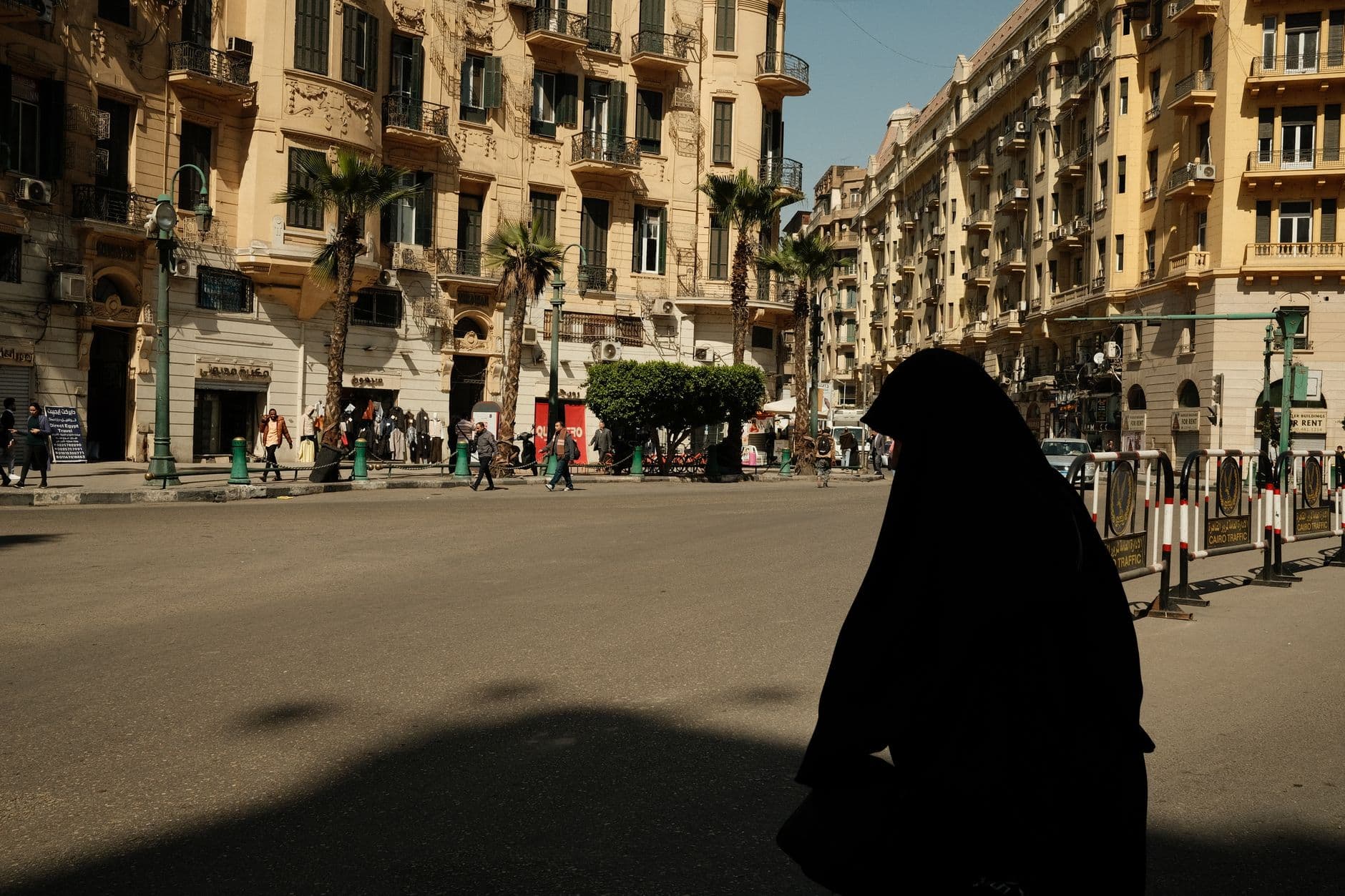
The British did not find Egypt empty. They found a country that had spent sixty years under Muhammad Ali and his successors becoming one of the most aggressively modernizing states in the Ottoman world. Egypt had already built the Suez Canal, opened the first opera house in Africa (Verdi's Aida premiered there in 1871), and accumulated a debt that European creditors were using as leverage. The British military intervention in 1882, justified as restoring order after Urabi Pasha's nationalist uprising, was in practice a debt-collection exercise dressed in imperial language.
The occupation lasted until 1954, with formal independence declared in stages: nominally in 1922, constitutionally in 1936, and finally in practice after Nasser's revolution and the evacuation of British troops from the Canal Zone. During those 72 years, Egypt was simultaneously a sovereign state with its own khedives, then kings, and a country whose foreign policy, military, and finances were controlled from London. The physical evidence of that contradiction is what makes the British Egypt colonial history sites worth tracing.
One fact most visitors do not know: the British Residency in Garden City, the administrative nerve center of the occupation, was not built by the British at all. It occupied and expanded a palace built by the Egyptian royal family. The appropriation was not subtle. It was the point.
Khedival Cairo: The City Built for European Eyes
The district Cairenes call Wust El Balad, Downtown, was designed in the 1860s and 1870s by Khedive Ismail as an Egyptian answer to Haussmann's Paris. The British did not build it. They moved into it and made it their administrative capital. That distinction matters enormously when you walk it.
Start at Tahrir Square, which is not a colonial invention but a khedival one, originally called Midan Ismailia. The Egyptian Museum on its northern edge opened in 1902, designed by the French architect Marcel Dourgnon, and the British were already fully in control of the country when it opened. The antiquities inside, including many objects excavated under the Antiquities Service that the British used French director Gaston Maspero to run as a kind of cultural firewall, represent a period when Egyptian heritage was documented and removed simultaneously. The Rosetta Stone, found by Napoleon's troops in 1799, was surrendered to Britain under the Treaty of Alexandria in 1801 and has been in the British Museum ever since. Its absence from the Egyptian Museum is not accidental. It is a specific consequence of a specific treaty.
Walk south from Tahrir along Qasr El Aini Street into Garden City, the residential quarter carved out for British officials and wealthy foreigners. The street grid here is deliberately curved, breaking from the Haussmanian grid of central downtown, because curved streets were thought to discourage the kind of crowd formation that straight boulevards permitted. The British Residency, now the British Embassy, sits on the Nile at the end of this quarter. You cannot enter it, but standing outside the perimeter wall and understanding that Lord Cromer ran Egypt for 24 years from inside those gates, without ever being elected to anything or answerable to any Egyptian, is its own education.
The Qasr El Nil barracks, which stood where the Nile Hilton now stands, were demolished in 1959 as a deliberate act of post-revolutionary erasure. The Nile Hilton itself, opened in 1959 on those foundations, became the scene of a different history: it is where journalists gathered during the 1967 war, where Anwar Sadat's assassination was processed by foreign correspondents in 1981, and where the lobby filled with protesters during the 2011 revolution. The colonial era does not end cleanly. It bleeds.
Heliopolis: The City a Belgian Baron Built
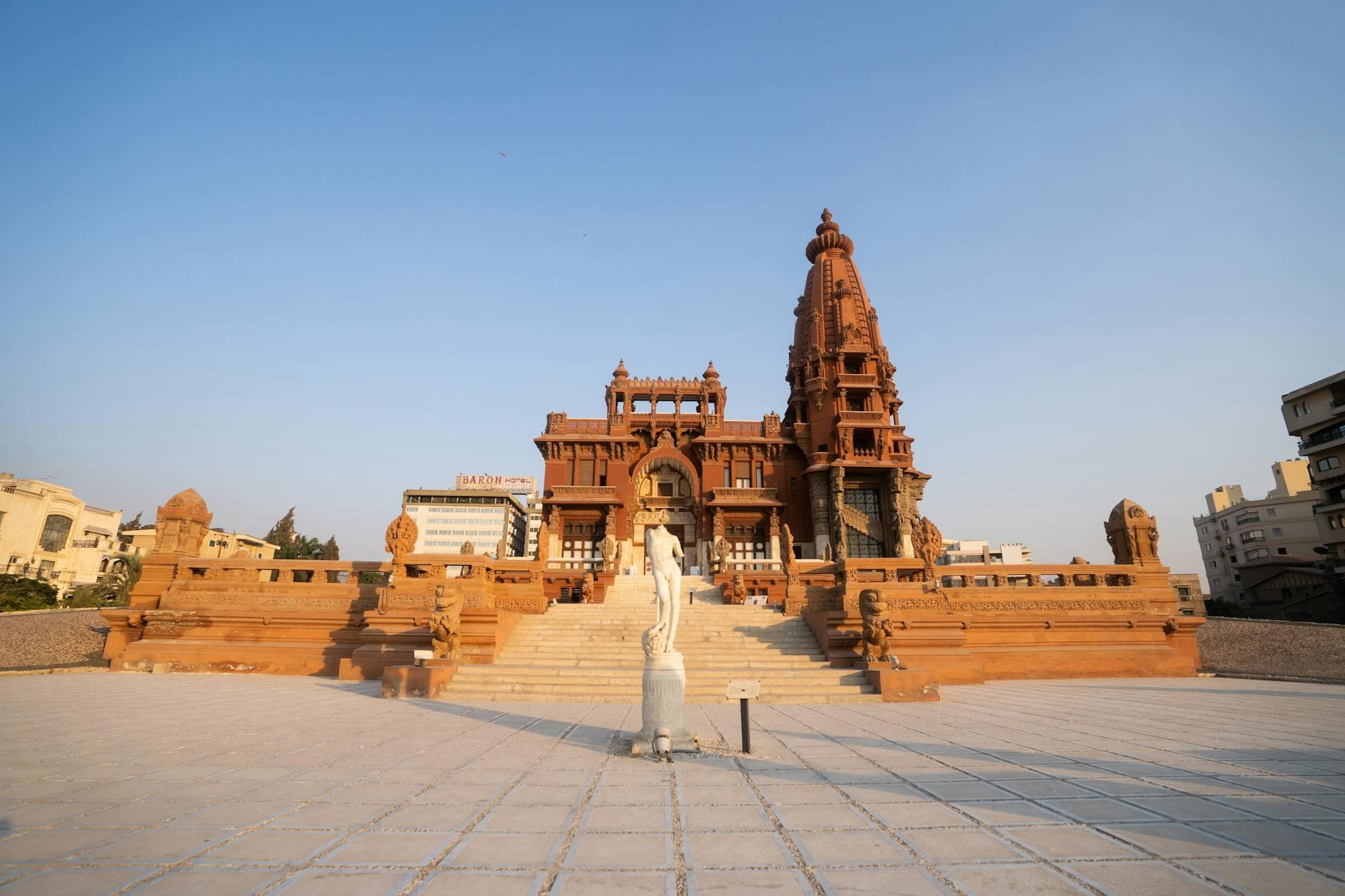
Eight kilometres northeast of Downtown Cairo, Heliopolis feels like a European city that arrived by accident and decided to stay. It was not an accident. In 1905, Baron Édouard Empain, a Belgian industrialist who had already built metro systems in Paris and Brussels, purchased 25 square kilometres of desert from the Egyptian government for almost nothing and built a company town. He called it Heliopolis. The existing ancient city of Heliopolis, birthplace of the sun cult that informed both Pharaonic theology and the later Aten worship of Akhenaten, was already there beneath the sand. Empain built on top of it.
The suburb Empain designed has arcade-shaded streets, a racecourse, a luna park, and a palace for himself that still stands. The Baron Empain Palace, also called the Hindu Palace for its extraordinary Indo-Saracenic architecture, was completed in 1911 and is one of the most genuinely strange buildings in Egypt. It was designed by the French architect Alexandre Marcel, who based it on the Cambodian temple of Angkor Wat with additions from Hindu temple architecture in India. Empain, who had financial interests across three continents, wanted his home to announce that he was not bound by European architectural convention. It announces exactly that. It also rotates. The palace was built on a mechanism that allowed the entire structure to turn to follow the sun, though the mechanism has not functioned for decades.
Heliopolis became fashionable among upper-class Egyptians and the foreign community during the British period precisely because it was not British. It was Belgian, cosmopolitan, and sufficiently European to be acceptable to the colonial social world while being sufficiently independent to attract Egyptians who wanted distance from the Residency's orbit. Gamal Abdel Nasser was born in Alexandria but lived in Heliopolis before the revolution. His house there is now a museum, and the irony of the Arab nationalist leader growing up in a Belgian-built suburb is one of those Egyptian layerings that resists any simple narrative.
Alexandria: The Colonial City That Was Already a Colonial City
Alexandria was founded by a Macedonian general in 331 BC and has been a city of foreign ambition ever since. When the British arrived in 1882, bombarding the city's forts on July 11 after Egyptian military officers refused to stop their fortification works, they were doing what Greeks, Romans, Arabs, Fatimids, Ottomans, and French had done before them. They were claiming the most Mediterranean city in Africa.
The Cecil Hotel on the Corniche opened in 1929 and immediately became the center of Alexandrian colonial social life. During World War Two, it served as a base for British intelligence operations. The Special Operations Executive ran agents through its rooms. Somerset Maugham visited. Lawrence Durrell used it in his Alexandria Quartet, which is a romanticization of colonial Alexandria so thorough that it has permanently distorted how many foreign visitors understand the city. The Cecil is still a hotel, now operating as a Steigenberger property. The rooms are expensive and not particularly special. The lobby bar is worth one drink for the atmosphere, and then you should go to one of the Greek-owned fish restaurants on the eastern harbor instead.
The Alexandria that the British occupied was already layered with Greek, Jewish, Italian, and Levantine communities that had been there for generations. The community that the 1956 Suez Crisis effectively ended, when Nasser nationalized the canal and the British and French invasion that followed accelerated the expulsion of foreign nationals, was not a British creation. It was an Ottoman creation that the British had simply moved into and exploited. The community cemeteries along Shari Imam Ahmad, the old Latin Cemetery and the Greek Orthodox Cemetery next to it, hold the graves of families who had been in Alexandria since the eighteenth century and were gone within a decade of 1956. Walking them is the most honest account of what the occupation's end actually cost, at the human level, that Alexandria offers.
The Connections: Nothing Exists in Isolation
The Egyptian Museum's colonial-era wing documents a period when the Antiquities Service required all excavators to split finds fifty-fifty with Egypt, a rule that sounds equitable until you understand that the Egyptian state kept the duplicates and the originals went abroad. The rule was set by the same administration that controlled Egypt's finances and had no political incentive to enforce it strictly.
The Abdeen Palace, built by Khedive Ismail and completed in 1874, became the official residence of the Egyptian royal family during the British period and is now a museum containing one of the most extraordinary collections of royal documents in the Middle East, including the 1919 revolution correspondence and letters between King Farouk and Winston Churchill. Farouk's reign ended in 1952 when Nasser's Free Officers gave him 24 hours to leave. The British, who had stationed tanks outside Abdin Palace in 1942 to force Farouk to appoint a pro-British prime minister, found themselves unable to protect the king they had humiliated a decade earlier.
The Suez Canal Zone, two hours east of Cairo, is where the formal occupation ended. The last British troops left the Canal Zone in June 1956. Four months later, after Nasser nationalized the canal, they came back. The British and French invasion of November 1956 lasted ten days before American financial pressure and Soviet threats forced a withdrawal. The Canal Zone today is a functional industrial zone, not a tourist destination, but the War Museum in Ismailia documents the whole sequence with unusual candor about the 1956 episode.
Common Mistakes
Treating Khedival Cairo as British Cairo. The downtown grid, the opera house site, the broad boulevards were Egyptian ambition, not British imposition. The British occupied a city that was already trying to become something. Misreading the architecture as colonial rather than khedival misses the entire story of what the occupation actually did to Egyptian self-determination.
Paying EGP 350 for the Cairo sound and light show at the Pyramids. It is not relevant to colonial history and it tells you nothing a half-hour of reading will not. Skip it entirely.
Reading Durrell's Alexandria Quartet before visiting Alexandria. Read it after, or not at all if you want to see the city as Egyptians see it. Durrell's Alexandria is an elegy for a foreign community written from inside that community's self-regard. It is beautiful and it is partial. Naguib Mahfouz's work, or Khaled Al Khamissi's Taxi, will orient you more honestly.
Missing the Heliopolis streetcar route. The original Heliopolis tram network, built by Empain's company, is now Line 2 of the Cairo Metro in large part. Riding it from Heliopolis to downtown is literally following the colonial infrastructure.
Expecting the British Embassy site in Garden City to be accessible. It is not. Security is tight. Do not attempt to photograph the building from the perimeter. Walk the street outside, note the scale of the compound relative to the neighborhood, and move on.
Assuming the Cecil Hotel in Alexandria is the place to stay. It trades on its history and underdelivers on every practical measure. Stay at the Steigenberger Cecil if you must, but San Giovanni on the eastern harbor is quieter, cheaper, and has better food.
Skipping the foreign community cemeteries in Alexandria. Every other colonial-history site shows you what the British and European presence built. The cemeteries show you what it lost and what it left behind. The Greek Orthodox Cemetery on Shari Imam Ahmad contains graves of families with roots in Alexandria going back to 1810. Walking it takes forty minutes and costs nothing.
Practical Tips
Hire a local guide specifically for the colonial period rather than a general Cairo guide. The knowledge base is specific and matters. Ask the Egyptian Tourist Authority office in Tahrir for accredited guides who specialize in modern history: rates run EGP 600 to 1,200 for a half day.
For Heliopolis, block half a day minimum. The neighbourhood rewards walking: the arcaded streets off Shari Ibrahim El Lakkani, the old Heliopolis Palace Hotel (now a presidential guesthouse and not accessible), and the area around Korba give you the full picture of what Empain intended. The Baron Palace is the set piece, but the street scale is what makes Heliopolis legible.
Alexandria is best approached by train. The Spanish Car train from Ramses Station is EGP 110 to 130 and takes two hours. Arrive at Misr Station and walk or taxi to the Corniche. Allocate a full day: the cemeteries, the Cecil bar for one drink, the eastern harbor fish restaurants, the Cavafy Museum (the Greek poet who documented colonial Alexandria's cosmopolitan world lived and died in the apartment that is now the museum, at 4 Sharm El Sheikh Street off the Corniche), and the Corniche walk at dusk.
Dress conservatively in the cemeteries. They are active religious sites maintained by their respective communities, not monuments. Ask permission before photographing graves.
Carry cash. Colonial-era sites and small museums rarely accept cards.
Frequently Asked Questions
The Weekly Dispatch
More on Egypt, every Friday.
Cultural depth and places most guides never mention.
No spam. Unsubscribe anytime.